
Discover how the 183-day rule in Spain impacts your visa renewal process and learn essential tips to maintain your residency smoothly.
The 183-Day Rule in Spain: What It Means for Your Visa Renewal

BLUF: the 183-day presence rule is not a fixed legal threshold for the Digital Nomad Visa, but it’s the practical benchmark Spain’s Non-Lucrative Visa (NLV) renewal process now relies on to prove “effective residence.” Miss it without documentation and your renewal is at risk.
The official Digital Nomad Visa procedure doesn’t set a strict day count, but immigration officers reviewing renewals for either visa increasingly want evidence you actually live in Spain, not just hold a card. Digital Nomad in Spain has guided applicants from numerous countries through this exact process with a very high success rate, so we’ve seen firsthand what renewal reviewers actually check.
Start now, before you think you need to:
- Track every entry and exit date, starting today
- Register on the Padrón municipal registry the moment you have a fixed address
- Set a calendar reminder for 60 days before your TIE expires
Key Takeaways
Effective residence, not a rigid 183-day calculation, is what determines whether your Spanish visa renewal succeeds.
| Point | Details |
|---|---|
| NLV renewal hinges on effective residence | Consulate guidance points to roughly 183 days per year, backed by documentation, not a bare day count. |
| Digital Nomad Visa needs continuity, not a fixed number | Renewal officers look for ongoing income activity and a stable home rather than a strict day threshold. |
| File within the 60-day window | Filing early generates a Resguardo de Presentación that legally extends your status while processing. |
| Padrón registration is your strongest proof | Keep it current alongside utility bills and lease documents, since officers weigh this heavily during review. |
| Digital Nomad in Spain manages the whole process | Their high success rate and end-to-end support cover day-count audits, Padrón guidance, and TIE filing. |
Table of Contents
- Does the 183-Day Rule Apply to Digital Nomad and Non-Lucrative Visas?
- How Do Authorities Count Days and Verify Residence?
- What Happens if You Miss Your Renewal Window?
- The Checklist: Proving Your Days and Your Life in Spain
- Edge Cases: Long Absences, Applying From Abroad, and Family Moves
- Social Security Contributions and Healthcare Access
- What Applicants Consistently Get Wrong
- How Digital Nomad in Spain Keeps Your Renewal on Track
- Sources
- FAQ
Does the 183-Day Rule Apply to Digital Nomad and Non-Lucrative Visas?
Yes, but differently depending on which visa you hold. For the Non-Lucrative Visa, renewal guidance from Spanish consulates now points to maintaining “effective residence,” commonly interpreted as at least 183 days per year, under the framework introduced by RD 1155/2024. Spend most of the year outside Spain and your renewal application faces real scrutiny.
The NLV also carries an absolute ban on working, including remote work for a foreign employer. If your income comes from active work rather than passive means, you’re on the wrong visa entirely, and the fix is applying for the Digital Nomad Visa instead.
The Digital Nomad Visa treats presence differently. There’s no rigid day-count rule written into the official procedure, but renewal officers still expect continuity: a real home, ongoing income activity, and a pattern of life in Spain rather than sporadic visits. Consulate guidance notes that consular-issued Digital Nomad Visas typically run for one year before you can apply for a TIE locally, and that continuity, not a strict 183-day count, is what gets scrutinized at renewal.
Pro Tip: If you’re on an NLV and picked up freelance clients since arriving, don’t wait for a renewal denial to sort it out. Talk to a consultant about switching to the Digital Nomad Visa before your current permit expires.
This guide focuses strictly on immigration and residency formalities, not the separate question of when you become a Spanish tax resident.
How Do Authorities Count Days and Verify Residence?
Counting days is simpler than most applicants assume. Spain uses a calendar-year approach: count every day physically present, including partial days, arrival days, and departure days. A flight landing at 11 PM still counts as a full day in Spain.

Entry and exit data isn’t just self-reported anymore. The EU’s Entry/Exit System (EES) automatically logs border crossings for non-EU nationals, giving immigration reviewers a digital trail that’s hard to dispute later. Practitioner guidance suggests this system has made day-count discrepancies far easier for officials to catch than in years past, per third-party visa guidance.
But day counts alone rarely settle a renewal case. The Padrón, your municipal registration, functions as the anchor document proving you actually live where you say you do, and the Ministry of Inclusion’s guidance treats it as core evidence during residence assessments.
Documents worth keeping current and easy to produce:
- Padrón certificate, renewed or reprinted within the last few months
- Lease agreement or property deed showing your address
- Utility bills in your name at that address
- Boarding passes and hotel or Airbnb confirmations bridging any travel gaps
Scan everything as you go. Reconstructing a year of travel history the week before a renewal appointment is a miserable way to spend a Sunday.
What Happens if You Miss Your Renewal Window?
You can file your TIE renewal as early as 60 days before it expires, and that’s the window Digital Nomad in Spain recommends targeting. Filing on time generates a Resguardo de Presentación, a timestamped receipt that legally extends your stay and preserves your right to work while the application processes, according to renewal timing guidance.
Miss that window and you’re not immediately in trouble. Spain allows a 90-day grace period after expiry to file late. But this grace period comes with real costs:
- Administrative fines for late filing
- Banks freezing accounts tied to an expired TIE
- Inability to re-enter Spain if you leave while your documents are expired
If you’re past 60 days and scrambling, get a stamped filing receipt immediately, no matter how incomplete your file feels, and keep proof of every attempt to submit. Contact a consultant or your local extranjería office the same week. Waiting for “the right documents” while the 90-day clock runs is how a fixable delay turns into a denied renewal.
The Checklist: Proving Your Days and Your Life in Spain
Treat this like bookkeeping, not paperwork you do once a year.
- Log every arrival and departure the day it happens, not from memory later
- Reconcile your log monthly against boarding passes and stamped documents
- Register on the Padrón as soon as you have a lease signed, ideally within your first two weeks
- Renew your Padrón certificate every six months so it’s never stale at renewal time
- Scan and store: lease, utility bills, bank statements, and (for Digital Nomad Visa holders) client contracts or employer confirmation letters
- Book your TIE renewal appointment the day your 60-day window opens, not the week before it closes
Pro Tip: Keep a single folder, physical or cloud, labeled by year. When a renewal officer asks for six months of utility bills, you want to find them in thirty seconds, not thirty minutes.
Edge Cases: Long Absences, Applying From Abroad, and Family Moves
A single long absence worries renewal officers more than several short ones. Practitioner guidance suggests aiming for no more than 10 months total outside Spain across a five-year window if you’re building toward long-term residence, and avoiding any single absence over six months unless you can justify it, per visa guidance for absence limits.
If your absence was work-related, document it. A social security portability certificate or a letter from an employer explaining a temporary posting abroad carries real weight.
Applying from a consulate abroad versus renewing from inside Spain changes your timeline, not your day-count obligations. Consular applicants typically wait for a decision within about 10 days, then have roughly a month to collect their visa or apply for a TIE in person.
Family members added to your visa need the same evidence trail you do. A spouse or dependent with thin documentation can stall an otherwise clean renewal, so start their Padrón and address paperwork on the same schedule as your own.
Social Security Contributions and Healthcare Access
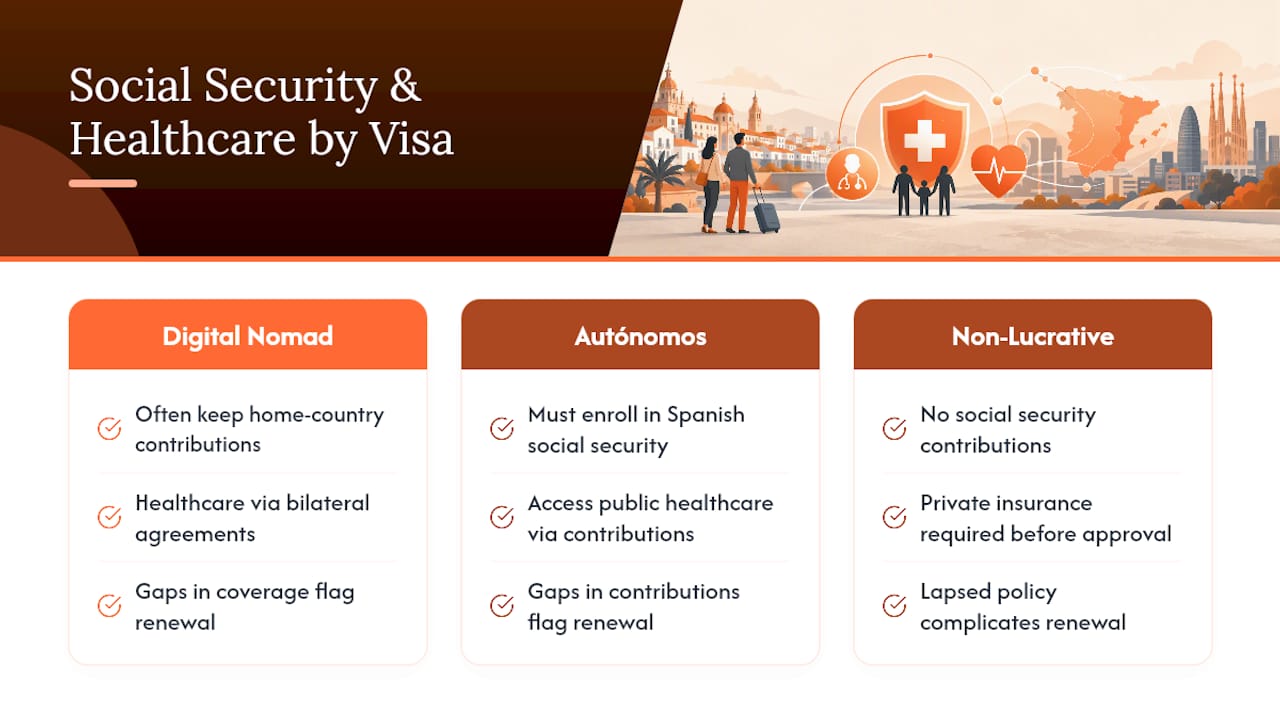
Your residency status, not a strict 183-day count, determines whether you pay into Spain’s social security system and what healthcare you can access. Digital Nomad Visa holders working for a foreign employer often continue contributing to their home country’s system under bilateral agreements, while those registered as self-employed in Spain (autónomos) generally must enroll in Spanish social security and pay monthly contributions.
Non-Lucrative Visa holders don’t contribute to social security at all, since the visa prohibits work. Instead, NLV applicants must show private health insurance with no copays before approval and maintain it throughout their residence, since they typically can’t access the public system through employment contributions.
This matters at renewal time because gaps in health coverage or contribution records raise the same red flags as gaps in your day count. An officer reviewing your file wants to see a continuous, coherent picture: where you lived, how you supported yourself, and how you covered medical costs the entire period. A lapsed insurance policy for even a few months can complicate an otherwise strong renewal application, so treat your coverage the same way you treat your Padrón certificate: something to check and refresh, not something you set up once and forget.
If you switch from NLV to Digital Nomad Visa status, or vice versa, your social security and healthcare obligations change with it. That’s a conversation worth having with a consultant before you file, not after a renewal gets flagged.
What Applicants Consistently Get Wrong
Most guidance on this topic treats the 183-day figure like a light switch: hit it and you’re fine, miss it and you’re not. That’s not how renewal officers actually evaluate a file. They’re building a picture of a real life in Spain, and a clean day count with no supporting evidence can still lose to a slightly messier count backed by a Padrón history, utility bills, and a lease that’s been renewed on time.
The mistake I see most often isn’t miscounting days. It’s treating documentation as an afterthought, something to assemble in the two weeks before a renewal appointment. By then, six months of missing utility bills or a lapsed Padrón registration is a problem you can’t solve retroactively.
Start the habit early, even if your first renewal is a year away. The applicants who sail through are rarely the ones who counted most obsessively. They’re the ones who could hand over a folder, unprompted, and answer any question about their year in Spain without hesitation.
— Joshua
How Digital Nomad in Spain Keeps Your Renewal on Track
Tracking entry and exit dates against EES records, keeping a Padrón certificate current, and timing a TIE renewal to the exact day a 60-day window opens is a lot to manage alone, especially from a different time zone than Spain’s immigration offices. Digital Nomad in Spain built its renewal support around exactly this gap.
The service includes day-count audits before renewal season, guidance on registering and refreshing your Padrón, filing your renewal the moment your 60-day window opens, and full TIE appointment support. Clients get end-to-end help, from initial application through post-approval logistics, and it’s why applicants from more than 50 countries have used Digital Nomad in Spain to keep their residency intact.
If you’re not sure whether your current day-count history would pass a renewal review, start with the Digital Nomad Visa service page or run your situation through the eligibility checker to see where you stand before your window opens.
Sources
FAQ
Does the Digital Nomad Visa require 183 days in Spain?
No fixed day count is written into the official procedure, but renewal officers expect continuity of residence and ongoing income activity, not sporadic visits.
What happens if I miss the Non-Lucrative Visa’s effective residence requirement?
Falling well short of the roughly 183-day benchmark without strong documentation puts your renewal at risk, since consulate guidance ties NLV renewal to effective residence in Spain.
How many days can I be absent from Spain without losing residency?
Practitioner guidance suggests keeping total absences under 10 months across five years and avoiding any single absence over six months unless you can document a work-related reason.
What is the Padrón and why does it matter for renewals?
The Padrón is your municipal residence registration, and immigration officers treat it as core evidence of effective residence during renewal reviews.
How long do I have to renew my TIE before it expires?
You can file as early as 60 days before expiry, and Spain allows a 90-day grace period after expiry, though late filing risks fines and complications.
Can Digital Nomad in Spain help if I’m close to missing my renewal deadline?
Yes, Digital Nomad in Spain provides day-count audits and renewal filing support designed to catch these issues before they become missed deadlines.