After your Spain visa approval, follow these crucial steps to ensure a smooth arrival and settle in quickly for your new adventure.
After Visa Approval Spain: What To Do Next
Your Spain visa approval is the hard part done, not the finish line. The moment you get word, here’s the immediate sequence: collect your passport and visa sticker, confirm the exact validity dates and entry type before touching a booking site, and start assembling what you’ll need for your first month on the ground. Skip any of these steps and you risk paying for a flight you can’t use, or missing the 30-day window to apply for your TIE once you land.
Do these, in order, this week:
- Confirm how you’ll get your passport back: consulate pickup, visa center collection, or mail return.
- Check the visa’s validity dates and entry type (single or multiple entry) the moment you have it in hand.
- Scan every page and email you received, and store copies in two separate places.
- Verify your travel insurance still meets the coverage terms your visa application listed.
- Start (or finalize) your Spain housing search since you’ll need an address fast.
- Gather documents you’ll need for empadronamiento (municipal registration) before you land.
- Mark your calendar to book a TIE appointment within days of arrival, not weeks.
- Research your local Agencia Tributaria or tax obligations if you’re self-employed.
Pro Tip: Take a photo of your visa sticker the day you get it and email it to yourself. Consulates and visa centers occasionally make small errors, and catching one before you fly saves weeks of correction requests later.
Key Takeaways
Completing Spain’s post-approval sequence correctly, empadronamiento before bank account before TIE, is what determines whether your first month runs smoothly or stalls for weeks.
| Point | Details |
|---|---|
| Confirm dates before booking travel | Check your visa’s validity period and entry type before purchasing any nonrefundable flight. |
| Empadronamiento comes first | Register your address at the town hall before attempting a bank account or TIE appointment. |
| Book TIE within days, not weeks | File within your 30-day window and keep the resguardo receipt as proof of timely initiation. |
| Expect 30 to 45 days for TIE production | Budget up to 60 days in high-volume provinces like Madrid. |
| Consider professional support | Digital Nomad In Spain offers paid post-approval assistance for TIE booking, empadronamiento prep, and bank introductions. |
Table of Contents
- How Do You Collect Your Visa After Approval?
- What Do the Visa Sticker Dates Actually Mean?
- What Should You Pack Before Flying to Spain?
- What Order Should You Complete Tasks in Spain?
- How Long Does It Take To Get a TIE Card?
- What If Something Goes Wrong With Your Visa or Documents?
- Why Does Empadronamiento Come Before Everything Else?
- What I Tell Every New Visa Holder
- Get Help With Your Post-Approval Steps
- Official Resources Worth Bookmarking
- Sources
- FAQ
How Do You Collect Your Visa After Approval?
Where you pick up your passport depends on which consulate or visa application center processed your case. Some consulates require in-person pickup with an appointment; others release passports through a visa center like BLS International, which handles Spain visa processing for a growing number of jurisdictions. A smaller number of posts return passports by mail, particularly for applicants who used a courier service during submission.
For in-person pickup, follow this sequence:
- Confirm the exact pickup notification (email or text) and read it carefully for required documents.
- Bring your government-issued photo ID and the original application receipt or tracking slip.
- Check whether the consulate requires the appointment confirmation printed, not just on your phone.
- If someone else is collecting on your behalf, bring a signed authorization letter plus a copy of your ID.
- Verify the visa sticker is correctly affixed and the dates match your application before you leave the counter.
Bring these to any pickup appointment:
- Passport receipt or collection notification
- Government photo ID
- Any outstanding fee payment confirmation
- Power of attorney letter, if someone else is collecting for you
If your passport is coming by mail, ask whether the shipment includes tracking and insurance. A lost passport in transit is rare, but it happens, and an uninsured envelope means you’re starting from scratch with a replacement application.
Processing itself typically runs a few weeks from submission to decision, though expedited services in some jurisdictions claim turnarounds as short as several days for complete, error-free applications. Arrive early for any pickup appointment. Consulates and visa centers often process walk-ins slower than scheduled slots, and posted hours shift around holidays more than people expect.
What Do the Visa Sticker Dates Actually Mean?
Read your visa sticker before you book anything. Three fields matter more than the rest: the validity period (from and to dates), the number of entries permitted (single or multiple), and the authorized purpose, which should match your visa category.
A single-entry visa means exactly what it sounds like. If you fly into Spain, then hop to Portugal for a weekend before your residency paperwork is filed, re-entry could become a real problem. Multiple-entry visas remove that risk, but you still need to enter before the “valid from” date expires or you lose the visa entirely. This trips up more travelers than you’d think, especially those who assume they can delay their trip a few months after approval.
The entry stamp you get at passport control on your first arrival is what starts your legal clock, and Spanish police reference that stamp date when you show up for your TIE appointment weeks later. If you land at another Schengen airport first, hold onto your boarding pass as backup proof of your actual entry date.
Before booking any flight, confirm:
- The visa’s “valid from” and “valid until” dates
- Whether your visa is single or multiple entry
- Whether the authorized activity matches your visa type
- Whether the sticker has any printed errors (name, dates, category)
Pro Tip: Never buy a nonrefundable flight until you’ve physically checked the visa sticker. Errors happen more often than consulates admit, and correcting one after you’ve locked in travel plans is a logistical headache you don’t need.
What Should You Pack Before Flying to Spain?
Your carry-on should hold every document that proves who you are and why you’re allowed to be in Spain, not just your boarding pass. Pack your passport with the visa sticker, a printed copy of your visa approval letter, proof of accommodation (a signed lease or a confirmed reservation), and evidence of funds if your visa category requires it.
Health and travel insurance deserves a second look here. Your visa application almost certainly specified minimum coverage terms, and immigration officers at some entry points do spot-check policy documents. Confirm your policy still meets those terms, not just that you have “some” insurance.
If your visa process required a U.S. criminal background check, that document likely needed authentication before submission. The same rule applies going forward: any American document you’ll use for Spanish bureaucracy later, like a birth certificate for family reunification, needs an apostille through the U.S. Department of State before it’s valid abroad. Applicants who needed a background check for their original visa typically obtained it through the FBI’s Identity History Summary Check service, and it’s worth keeping a certified copy on hand for future paperwork.
Pack or prepare:
- Passport with visa sticker, plus two photocopies
- Printed visa approval letter or grant notification
- Proof of accommodation for at least your first weeks
- Insurance policy document showing coverage limits
- Digital backups of everything, stored in cloud storage and on a local drive
Spain follows standard EU customs allowances for personal effects, and there are no unusual restrictions tied specifically to visa holders. Health entry rules have returned to pre-pandemic norms for most travelers, but airlines and Spanish border authorities occasionally update requirements for specific routes, so check your carrier’s current policy a few days before departure rather than relying on what you read months earlier.
Pro Tip: Store one copy of every document in a password-protected cloud folder and keep a physical copy separate from your passport. If your bag gets lost, you’re not starting from zero.
What Order Should You Complete Tasks in Spain?
The sequence you follow in your first month matters more than how fast you move. Do these out of order, and you’ll get bounced between offices that all require a document the previous office was supposed to give you.
Here’s the sequence that actually works:
- Secure housing first. You need a fixed address before anything else can happen, whether that’s a signed lease or a notarized letter from whoever’s hosting you.
- Register for empadronamiento at the town hall. This municipal registration certificate proves your address and unlocks nearly every service that follows. Bring your passport, visa, and a rental contract or property deed. Many town halls issue the certificate the same day, though some cities require a booked appointment. Most municipalities want a rental agreement covering at least six months, so a short-term sublet might not qualify.
- Open a Spanish bank account. Once you have your passport, visa, and often the empadronamiento certificate, most banks in Spain will open an account for expats within one to two business days.
- Book your TIE appointment immediately. The TIE (Tarjeta de Identidad de Extranjero) is your physical residency card, and you’re legally required to apply within 30 days of your entry stamp. Appointment slots through the police extranjería booking system fill up fast in major cities, so check availability the moment you land, not after you’ve settled in.
- Register for social security and healthcare once your TIE process is underway, since your public health card application typically depends on it.
For each of these, bring extra passport photos, your original passport, and photocopies of every prior certificate you’ve collected. Losing a single document mid-sequence can send you back to step one.
Here’s what to have ready before you even schedule the TIE appointment:
- Passport and visa sticker (original plus copy)
- Empadronamiento certificate
- Paid Tasa 790-012 fee receipt
- Two passport-sized photos
- Completed application forms (EX-17 or equivalent for your visa type)
Pro Tip: Book your TIE appointment soon after arrival in Spain, even if the actual appointment date falls weeks out. The booking confirmation, called a resguardo, counts as proof you initiated the process within your legal window, even if the card itself takes longer to produce.
If your visa didn’t come with an NIE (foreigner identification number) already assigned, you may need to apply for one separately before or alongside your TIE application, and the Tasa 790-012 fee form needs to be paid and its receipt brought to your appointment.
How Long Does It Take To Get a TIE Card?
Set your expectations early, because Spanish bureaucracy runs on its own clock. Empadronamiento is often same-day. Opening a bank account usually takes one to two business days once you have your documents in order. The TIE itself is the long pole: production typically runs 30 to 45 days, though Madrid and other high-volume provinces can stretch that to 60 days or more during busy periods.
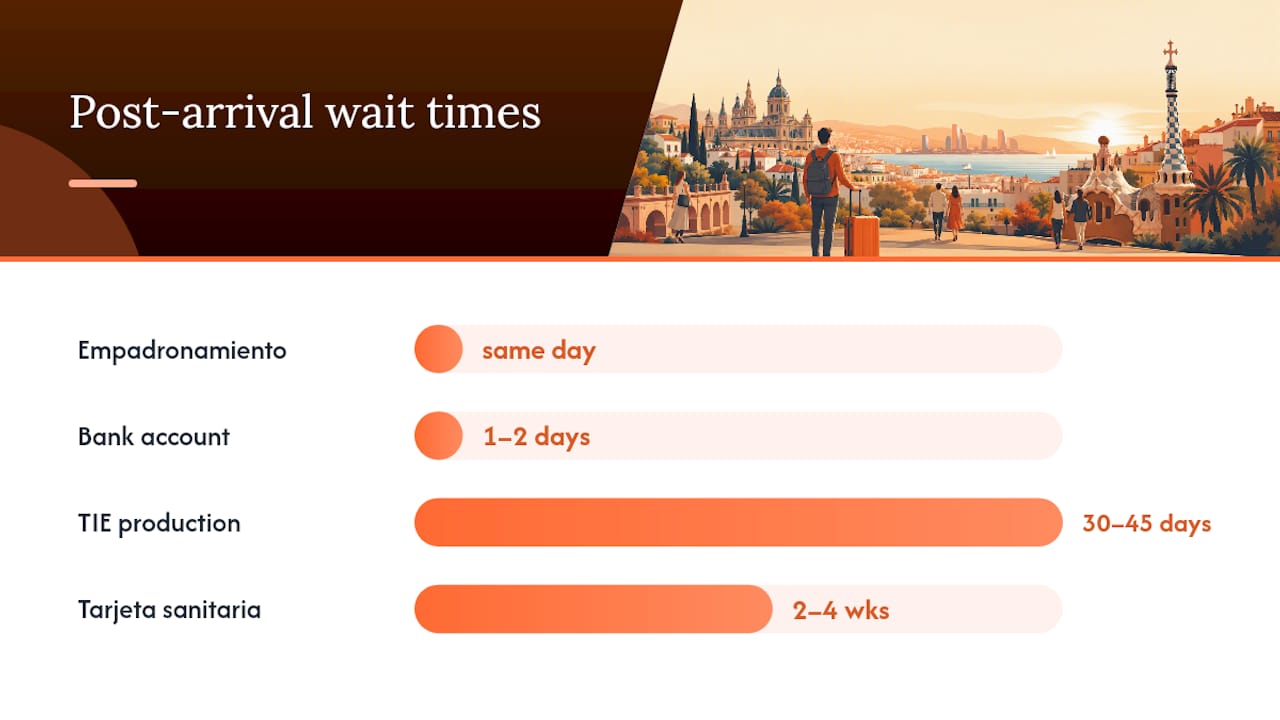
Your public health card (tarjeta sanitaria) usually follows two to four weeks after your TIE is issued. Overall, budget six to ten weeks to complete the full first-month sequence from empadronamiento through healthcare registration, assuming no appointment backlogs.
Rough planning windows:
- Empadronamiento: often same day, sometimes requiring an appointment
- Bank account: usually a few business days
- TIE production: 30 to 45 days (up to 60 in busy cities)
- Tarjeta sanitaria: a few weeks after TIE issuance
Hold onto every receipt, especially your TIE appointment resguardo. If your card takes longer than expected, that piece of paper is your proof you followed the rules. Avoid booking nonrefundable travel during the window your TIE is pending; leaving Spain mid-process can complicate your appointment or card collection.
What If Something Goes Wrong With Your Visa or Documents?
Problems happen, and most have a straightforward fix if you catch them early. Here’s how to handle the most common ones:
- Visa sticker has an error (wrong name, dates, or category): contact the issuing consulate immediately, before you travel if possible. Corrections are far easier before you’ve left the country.
- Passport lost in transit after being sent for visa affixing: report it to the consulate and local authorities right away, and request a replacement passport process alongside a reissued visa.
- Can’t get a TIE appointment within your window: book anything available, even if the date falls slightly outside 30 days, and keep your booking confirmation as evidence you tried within the deadline.
- Visa refused or issued with conditions you don’t understand: request written clarification from the consulate and consider a consultation with an immigration specialist before making irreversible travel plans.
Escalation paths worth knowing:
- Consulate general inquiries line or email (check the specific post’s page)
- Visa center complaint or support channels (BLS or equivalent)
- Local extranjería office for TIE-related issues once you’re in Spain
Pro Tip: Keep postal tracking numbers, appointment confirmation emails, and scanned documents in one folder from day one. When something goes sideways, the person who can produce a timestamped confirmation gets resolved faster than the person who can’t.
Why Does Empadronamiento Come Before Everything Else?
Skip empadronamiento or delay it, and everything downstream stalls. It’s the certificate that proves your Spanish address, and without it, banks hesitate, the TIE application stalls, and public healthcare registration goes nowhere. Town halls treat it as the foundational document because it’s what every other office relies on to verify you’re actually living where you say you are.
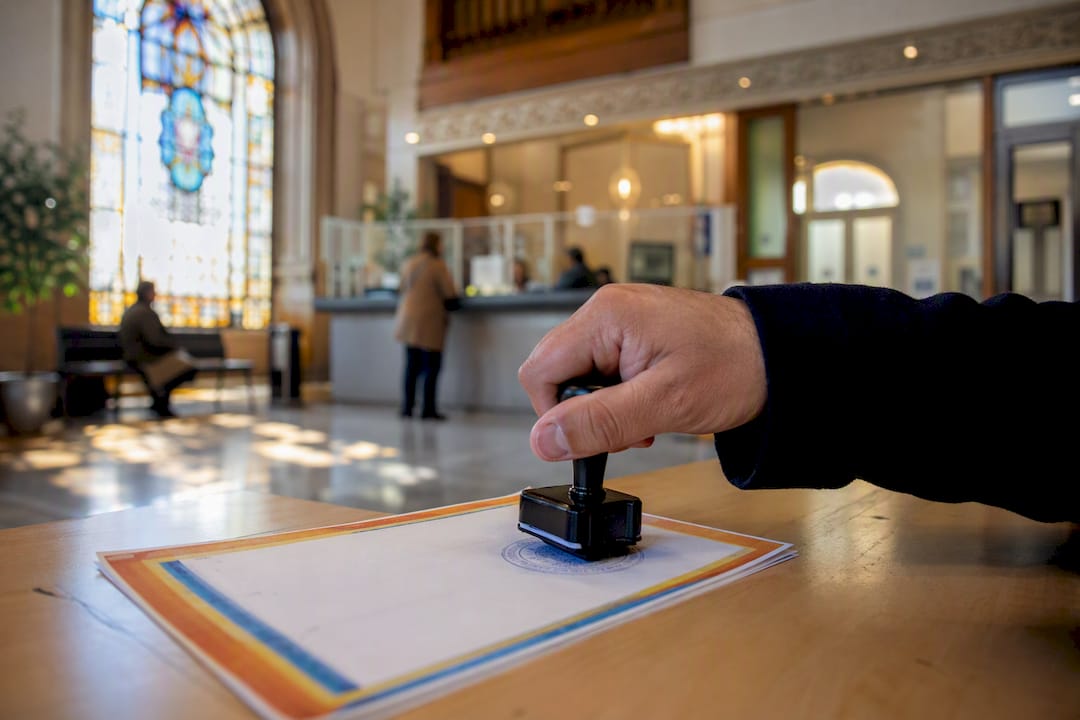
Real rejections happen when applicants try to skip ahead. Show up to a TIE appointment without empadronamiento, and you’ll be sent home to get it first, losing days you didn’t have to lose in your 30-day window. The correct order, confirmed by multiple relocation guides and consistent with practitioner experience, is empadronamiento first, then bank account, then TIE, then healthcare.
Before you walk into the town hall, prepare your rental agreement or property deed carefully. Most municipalities want a lease covering at least six months, and a short-term Airbnb booking often won’t satisfy the requirement. If your landlord is slow to provide a signed contract, that single delay can cascade through your entire first month.
Doing the paperwork out of order is one of the most common and most avoidable causes of delay in a Spain relocation. Empadronamiento first isn’t a suggestion; it’s what unlocks the bank account, the TIE, and the health card that come after it.
Pro Tip: Ask your landlord for the signed lease before you fly, not after. Town halls in larger cities sometimes book appointments weeks out, and a missing signature is the single most common reason applicants get turned away at the counter.
What I Tell Every New Visa Holder
Most delays I see aren’t caused by Spanish bureaucracy being difficult. They’re caused by applicants doing things in the wrong order, or assuming a step is optional when it’s actually load-bearing for everything after it. Empadronamiento is the clearest example: skip it, and your bank, your TIE, and your health card all wait on a piece of paper you could’ve gotten in a single morning.
The applicants who move through this fastest aren’t the ones who work harder. They’re the ones who know the sequence before they land, book appointments before they need them, and treat their resguardo receipts like gold. That’s the entire game here.
Get Help With Your Post-Approval Steps
Sorting out empadronamiento, TIE appointments, and bank accounts on your own is doable, but it eats weeks you’d rather spend actually settling into Spain. Digital Nomad In Spain’s post-approval support handles the parts that trip people up most: booking your TIE appointment before slots disappear, preparing your empadronamiento paperwork correctly the first time, and connecting you with banks that work with newcomers.

This is a paid consultancy service, and it’s built for people who’ve already secured their visa and want the first-month sequence handled without guesswork. Whether you came through the Digital Nomad Visa or the Non-Lucrative Visa, the after-approval steps are largely the same, and getting them wrong costs real time inside your 30-day window. If you’d rather have someone who does this daily manage your appointments and paperwork, book a consultation and get your first month mapped out before you land.
Official Resources Worth Bookmarking
Bookmark these before you travel, since appointment systems and requirements shift without much notice:
- U.S. Department of State apostille guidance: use this for authenticating U.S. documents before Spanish bureaucracy accepts them.
- FBI Identity History Summary Check: the official channel for U.S. criminal background checks tied to visa applications.
- Digital Nomad In Spain’s blog: practical, updated guides on TIE booking, banking, and administration for U.S. expats.
Official government sources change faster than most guides can track, so treat them as the final word over anything else you read, including this article.
This article is general information, not a substitute for advice from a qualified lawyer. Consult a qualified legal professional about your own circumstances before acting on anything here.
Sources
- Spain Student Visa TIE Card Application: Complete
- Moving to Spain 2026: Complete Checklist
- NIE, TIE and Empadronamiento: Your First Month in Spain — Xpat Journeys
- Apostille requirements | U.S. Department of State
- Identity History Summary Checks | FBI
FAQ
What Is the First Thing To Do After Your Spain Visa Is Approved?
Collect your passport and visa sticker, then confirm the exact validity dates and entry type before booking any travel. Start gathering empadronamiento documents and researching TIE appointment availability at the same time.
How Long Does Spain Take To Approve a Visa?
Processing times vary by consulate and visa type, but most decisions arrive within a few weeks of a complete, error-free application. Consultancy support can shorten this by ensuring documents are correct the first time, since resubmissions are what typically add delay.
Can You Get a Spain Visa in Five Days?
Some consulates offer expedited processing for specific visa categories, but a five-day turnaround is the exception, not the standard, and usually requires a fully complete application with no missing documents. Most applicants should plan for several weeks rather than count on an expedited timeline.
Can You Get a Spain Visa in Two Days?
A two-day approval is extremely rare and generally not something to plan around for standard visa categories like the Digital Nomad Visa or Non-Lucrative Visa. Build your travel plans around the consulate’s typical processing window instead of an outlier timeline.
How Long After Arriving in Spain Do You Need To Apply for a TIE?
You must apply for your TIE within 30 days of your entry stamp date, and your appointment booking confirmation, the resguardo, counts as proof you started the process on time even if the card itself takes longer to produce.