U.S. applicants to Spain: which office issues your apostille, how state vs federal lanes work, the correct sequencing, and why sworn translation must follow.
Apostille vs Notarization: State v Federal Lanes, Americans in Spain

Notarization and apostille are not the same thing, and mixing them up is the single fastest way to get a document rejected in Spain. A notary confirms who signed a document; an apostille confirms that the notary (or the official who signed it) actually holds that authority. It’s what makes a U.S. document valid in Hague Apostille Convention countries like Spain. If you’re prepping paperwork for a Spanish visa or residency file, the order matters: finalize the document, notarize it if the issuing office requires that, get the apostille from the correct authority, then have it translated by a sworn translator.
TL;DR:
- Always obtain the apostille from the correct authority, as state documents require the Secretary of State and federal documents the U.S. Department of State; mixing these up leads to rejection.
- Notarization confirms the signature locally, but the apostille certifies the notary’s authority for international recognition; both are necessary for most Spanish visa documents.
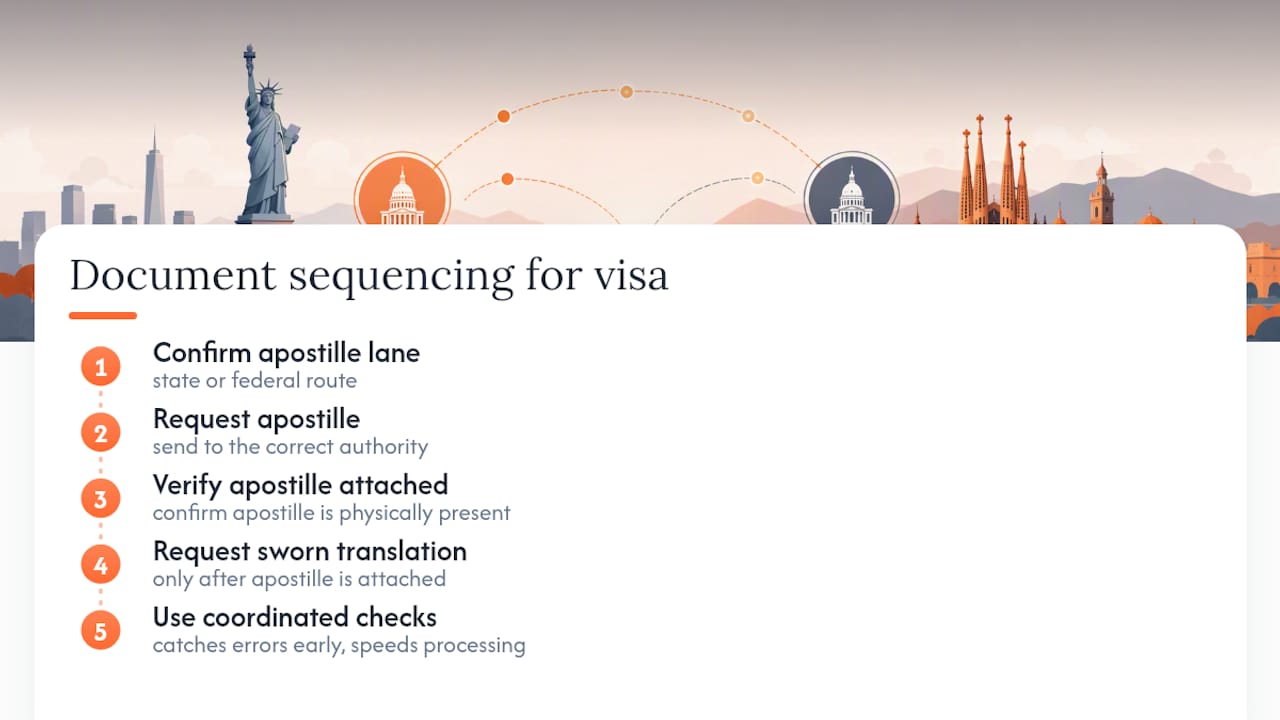
- The document must be finalized, notarized if needed, and then routed to the proper apostille authority before applying for a sworn translation; skipping steps or doing them out of order causes delays.
- Validity windows for apostilled civil and criminal documents typically range from 90 to 180 days, and applying within this period is essential to avoid rejection.
- For documents issued outside the Hague Convention, legalisation and consular stamping replace the apostille; Spain qualifies for the apostille route, but other countries may not.
Table of Contents
- Apostille vs Notarization: What Each One Actually Does
- Who Actually Issues an Apostille?
- How to Prep a U.S. Document for Spain, Step by Step
- What Documents Usually Need an Apostille for Spain?
- Why You Should Get a Sworn Translation After the Apostille, Not Before
- The Mistakes That Get Documents Rejected, and How to Avoid Them
- When You Need Consular Legalization Instead of an Apostille
- How Digital Nomad in Spain Handles Apostille and Translation Sequencing
- Verify First, Rush Never
- Get Your Documents Apostille-Ready Before You Submit
- Sources
- FAQ
Apostille vs Notarization: What Each One Actually Does
A notary’s job is narrow and local. They confirm your identity, watch you sign a document, or certify that a copy matches an original. That’s it. A notary in Ohio has zero authority over whether Spain accepts your document. Notaries typically perform one of two acts, and the language matters because Spanish authorities sometimes ask about it directly:
- A jurat: the notary watches you sign and administers an oath about the content’s truthfulness (common on affidavits).
- An acknowledgment: you sign the document beforehand, then appear before the notary to confirm it’s your signature (common on powers of attorney).
An apostille works one level up. It doesn’t touch the content of your document at all. It certifies the authenticity of the signature, the capacity in which the signer acted, and the seal or stamp attached to the document, according to the U.S. Department of State. Think of it as a certificate that vouches for the notary or official, not for the underlying facts on the page.
The National Notary Association frames these as complementary, not interchangeable: notarization proves local authenticity, and the apostille takes that local authentication and makes it recognizable internationally. Skip either step out of order and Spanish officials have no way to trust the paper trail.
Here’s how that plays out with real document types:
- Birth certificate: usually issued with a raised seal by a state vital records office. No notarization needed. It goes straight to the state Secretary of State for an apostille.
- Power of attorney: you sign this in front of a notary (usually an acknowledgment), then the notarized document goes to the Secretary of State for the apostille.
- FBI background check: issued at the federal level, so it never touches a notary. It follows the federal apostille lane through the U.S. Department of State.
- College diploma: often needs to be notarized as a true copy first, since the issuing university usually won’t apostille a diploma directly.
Confusing these lanes is the single most common paperwork mistake U.S. applicants make, and it’s the reason so many documents bounce back for corrections. Notarization answers “did this person really sign this?” An apostille answers “is the office that signed or sealed this actually who they claim to be?” Spain wants both questions answered before your paperwork counts as usable.
Who Actually Issues an Apostille?
A notary cannot issue their own apostille, no matter how convenient that would be. Apostilles come from a separate governmental authority entirely, and knowing which one to contact depends on where your document originated.
For any document issued or notarized within a single state, your apostille comes from that state’s Secretary of State (or equivalent office, sometimes called the Lieutenant Governor’s office in a handful of states). That covers birth certificates, marriage certificates, notarized powers of attorney, and diplomas that a state university registrar has certified.
For documents issued by the federal government, the apostille comes from the U.S. Department of State in Washington, D.C. This is the lane most people get wrong, and it trips up nearly everyone applying for a Spanish visa at least once, because the most common federal document in a Spain visa file is an FBI background check. People assume it works like a state document and send it to their state capital. It doesn’t belong there. FBI checks, along with documents from other federal agencies, go through the federal apostille process instead.
On the Spain side, the country’s own domestic authentication and legalization process is handled through channels described by the Ministry of Foreign Affairs, European Union and Cooperation. That matters mostly if you’re dealing with a Spanish-issued document that needs to travel the other direction, but it also explains why Spanish consulates and immigration offices are strict about seeing the correct U.S. issuing authority on your apostille. They’re trained to spot a mismatch.
Quick reference for the two U.S. lanes:
- State lane: birth/marriage/death certificates, state notarized documents, state court records, state-issued diplomas. Apostille from the state Secretary of State.
- Federal lane: FBI background checks, IRS documents, documents issued by federal courts or federal agencies. Apostille from the U.S. Department of State.
Getting this wrong doesn’t just cost you time. Processing an apostille through the wrong office usually means the request gets rejected outright once the office realizes it lacks jurisdiction over the document, and you start the clock over from zero. Multiply that by two or three documents in a typical Spain visa file, and a simple mix-up can add weeks to a timeline that was already tight.
How to Prep a U.S. Document for Spain, Step by Step
Getting a document from your file cabinet to a Spanish official’s desk, in a form they’ll actually accept, follows a specific order. Skip a step or do them out of sequence and you’ll likely be redoing work.
- Confirm what the receiving office actually wants first. Before you touch a single document, find out exactly what the Spanish consulate, immigration office, or civil registry expects: original vs. certified copy, how recent the document needs to be, and whether they want the apostille physically attached or accompanying it. Requirements shift between consulates and even between individual case officers, so don’t assume last year’s checklist still applies.
- Finalize the document. Never apostille a draft, an unsigned copy, or anything you plan to edit later. Apostilles attach to a specific, final version of a document. If you change so much as a name spelling afterward, you’ll need a new apostille.
- Notarize it, if the document type requires notarization. Powers of attorney, affidavits, and certified copies of records typically need a notary’s jurat or acknowledgment before they’re eligible for an apostille. Vital records with an official raised seal, like most birth certificates, usually skip this step entirely and go straight to apostille.
- Route the document to the correct apostille authority. State documents go to the state Secretary of State; federal documents go to the U.S. Department of State. Most states offer in-person, mail-in, and expedited third-party courier options, and processing times swing wildly between them, from same-day at a walk-in counter to several weeks by mail during busy seasons.
- Order the sworn translation only after the apostille is physically attached. The sworn translator needs to see and translate the complete packet, apostille page included, or Spanish authorities may reject the translation as incomplete.
Pro Tip: Photograph or scan every document at each stage, before notarization, after notarization, and after the apostille is attached. If a page goes missing in the mail or a translator flags something, you’ll have proof of exactly what you sent and when.
The step people skip most often is step one. It feels like a delay when you just want to get moving, but a five-minute email or phone call to the receiving office can save you from apostilling the wrong document type entirely, or from Spain’s Ministry outlining a legalization exemption you didn’t know applied to your case.
Third-party apostille services exist for a reason: state offices vary enormously in turnaround time, and if you’re on a visa deadline, paying a courier service to walk your document through in person can be worth every dollar compared to a three-week mail queue.
What Documents Usually Need an Apostille for Spain?
Most U.S. applicants moving to Spain end up apostilling some combination of five document types, according to guidance on which U.S. documents typically need it for Spanish use:
- Birth certificates, almost universal for any visa or residency application, and for family reunification cases.
- Marriage certificates, needed if you’re applying alongside a spouse or claiming marital status for benefits.
- Criminal record checks (FBI background checks for most applicants, or state-level checks depending on the visa type).
- Diplomas and academic transcripts, common for work visas or any category requiring proof of education.
- Powers of attorney, useful if someone else is handling parts of your application or property matters on your behalf.
- Medical certificates, required for some visa categories to confirm the absence of certain diseases.
Not every document needs the original. Vital records offices typically issue multiple certified copies of birth and marriage certificates, and it’s smart to apostille a certified copy rather than your only original, since the apostille stays permanently attached to whatever version you submit. FBI background checks and diplomas usually only exist as one authoritative version, so those go through as issued.
Validity windows catch people off guard more than almost anything else in this process. Spanish offices commonly treat apostilled civil documents like birth and marriage certificates, along with criminal background checks, as valid for somewhere in the range of 90 to 180 days from either the issue date or the apostille date, depending on the specific office and visa category, per practical guidance for Spain-bound documents. That window is not fixed by law the way the Hague Convention itself is. It varies by consulate and by document type, so confirm the exact number with your receiving office before you start the clock. An apostille that’s technically valid can still get rejected if the underlying document has aged past what that specific office accepts.
If you’re assembling a visa packet with several documents, stagger your apostille requests so the youngest one doesn’t force you to redo the others. Applicants who get an FBI check apostilled in January and then wait until April to apostille everything else sometimes find the background check has already aged out of the acceptable window by the time they submit.
Why You Should Get a Sworn Translation After the Apostille, Not Before
Spain requires a sworn translation, called a traducción jurada, for most foreign-language documents submitted to government offices. This isn’t the same as a certified translation from a standard translation agency in the U.S. A sworn translation in Spain must come from a Traductor Jurado, a translator specifically authorized by Spain’s Ministry of Foreign Affairs to produce translations with legal standing.
The sequencing question trips up almost everyone once: should you translate the document first and then apostille it, or the other way around? Translate after the apostille is attached, always. The sworn translator needs to render the entire document as submitted, including the apostille certificate itself, its seal, its reference numbers, and any attached cover pages. Practical guidance on Spanish visa document sequencing confirms that translating a document before the apostille lands on it means redoing the translation from scratch once the apostille arrives, since the translated packet is now missing a page the receiving office expects to see.
Finding a sworn translator isn’t hard, but sending them the right materials makes a real difference in turnaround:
- Send a clear, complete scan of the full apostilled document, apostille page included.
- Confirm they’re authorized specifically for English-to-Spanish sworn translation, not just general certified translation.
- Ask about turnaround time upfront; sworn translators in Spain are often booked out during peak visa season in spring and late summer.
Pro Tip: Ask your sworn translator whether they can work from a high-resolution scan or if they need the physical apostilled original mailed to them. Some require the physical document for their official stamp and signature, which adds shipping time you’ll want to plan around.
The Mistakes That Get Documents Rejected, and How to Avoid Them
Four errors account for most of the rejections and rework applicants report during document prep for Spain.
- Sending a document to the wrong apostille authority, most often an FBI background check mailed to a state office instead of the U.S. Department of State.
- Apostilling a draft or an unsigned document, which forces a redo once the final version is signed.
- Missing pages in the submission packet, especially the apostille certificate itself getting separated from the underlying document during scanning or mailing.
- Translating a document before the apostille is attached, which means the sworn translation omits the apostille page entirely.
Practical guides on Spanish visa document sequencing point to these four issues as the recurring cause of delays reported by applicants working through the process on their own.
If a Spanish office questions your apostille’s validity, which does happen occasionally with older documents or unusual formats, your first move is verifying it against the issuing authority’s own records. Most Secretary of State apostille offices maintain a lookup or verification system, and the U.S. Department of State can confirm federal apostilles it has issued. Having that verification ready beats arguing with a case officer.
Before you submit anything, run through this list:
- Is every document the final, signed version, not a draft?
- Does the apostille match the correct lane, state for state documents, federal for federal ones?
- Is the apostille physically attached to or clearly paired with the underlying document?
- Was the sworn translation done after the apostille, covering the complete packet?
- Does the document fall within the receiving office’s validity window?
When You Need Consular Legalization Instead of an Apostille
The apostille only works between countries that belong to the Hague Apostille Convention. Spain is a member, so nearly every U.S. document headed there follows the apostille route described throughout this guide. But apostilles are not universal, and if you’re dealing with a country outside that membership list, the process looks completely different.
For non-Hague countries, the process is authentication followed by consular legalization: the document gets certified by the U.S. Department of State and then physically legalized by that country’s embassy or consulate in the United States, according to a breakdown of the difference between apostille and legalization. That second step, the consular stamp, doesn’t exist in the apostille process at all. It’s a separate visit or mail submission to an embassy, often with its own fees and processing times.
Since Spain is squarely on the apostille side of that line, you generally won’t need consular legalization for documents headed there. But if you’re also handling paperwork for a country that isn’t a Hague member, check membership status before assuming the apostille process applies. The current Hague Convention membership list and a practical breakdown of which countries require apostilles versus legalization are both worth checking if your situation involves more than one country.
How Digital Nomad in Spain Handles Apostille and Translation Sequencing
Two patterns show up constantly among U.S. applicants preparing documents for a Spanish visa. The first involves the FBI background check: someone sends it to their state’s Secretary of State by mistake, gets it bounced back weeks later, and only then discovers the federal apostille route it actually needed. The second involves a state-issued birth certificate that gets translated before the apostille arrives, forcing a second, costly round with the sworn translator once the apostille is finally attached.
Both mistakes are avoidable with the right sequencing built in from the start, which is exactly where structured document preparation for the Digital Nomad Visa earns its keep. Applicants moving through the process with document checks in place tend to catch a wrong-lane apostille request or an out-of-order translation before it costs them a resubmission, rather than after.
This approach involves handling document preparation, apostille routing, and translation sequencing as one coordinated process rather than separate errands, which tends to increase success rates on visa applications. Applications processed with coordinated document handling also tend to move faster than those handled without that coordination, largely because paperwork errors causing resubmission delays get caught early.
For readers assembling their own checklist of Digital Nomad Visa documents, the takeaway from these cases is consistent: confirm the lane before you request the apostille, and confirm the apostille is attached before you request the translation.
Verify First, Rush Never
The paperwork mistakes that cost people the most time aren’t complicated ones. They’re small assumptions, like assuming a document doesn’t need notarization when the receiving office actually wants it, or assuming last year’s validity window still applies this year. Every one of those assumptions is checkable in a five-minute call or email, and almost nobody makes that call until after something bounces back.
My honest read on this process: the applicants who move fastest aren’t the ones who rush the apostille step, they’re the ones who slow down at the very beginning to confirm exactly what the Spanish office wants, in what form, and by what deadline. That single conversation prevents more rework than any amount of speed later in the process. If your timeline is tight, or you’re juggling documents across multiple states and federal agencies, that’s usually the point where hiring someone who does this daily stops being a convenience and starts being the thing that keeps your visa filing on schedule.
— Joshua
Get Your Documents Apostille-Ready Before You Submit
Sorting out which apostille lane applies to an FBI check versus a state birth certificate, then timing a sworn translation correctly, is exactly the kind of detail that eats weeks when you’re doing it solo for the first time. The service process is designed to catch sequencing errors before documents reach a Spanish consulate, not after.

The service includes document checks against the receiving office’s actual requirements, guidance on which apostille authority applies to each document, coordination with sworn translators who wait for the apostille page, and support through visa submission and consulate follow-up. If you’re preparing a Digital Nomad Visa application and want your apostille and translation sequence checked before you submit, book a consultation and get a document review started this week.
Sources
- Authentications and apostilles | U.S. Department of State
- Diplomatic Legalization | Ministry of Foreign Affairs, European Union and Cooperation (Spain)
- Notary Basics: Understanding apostilles | National Notary Association
FAQ
Are Apostille and Notarization the Same Thing?
No. Notarization confirms a signature or copy locally, while an apostille certifies the authenticity of the notary’s or official’s signature and seal for international use. Spain requires both, in that order, for most U.S. public documents.
Can a Regular Notary Issue an Apostille?
No. Notaries verify identity and witness signatures, but a separate government authority, the state Secretary of State or the U.S. Department of State, issues the actual apostille.
What Documents Need to Be Apostilled for Spain?
Birth certificates, marriage certificates, criminal background checks, diplomas, transcripts, and powers of attorney are the documents most commonly apostilled for Spanish visa and residency filings.
Should a Document Be Notarized Before It’s Apostilled?
Only if the document type requires notarization in the first place, such as a power of attorney or affidavit. Vital records with an official seal, like most birth certificates, usually skip notarization and go straight to the apostille stage.
Do I Need a Sworn Translation Before or After the Apostille?
Always after. A sworn translator needs to translate the complete document, apostille page included, or Spanish authorities may reject the translation for missing content.