
Need a bank statement translated in Spain? Discover how to get a sworn translation that meets legal requirements quickly and easily.
Bank Statement Translation in Spain: What You Need to Know

If you need a bank statement translated for a Spanish visa, residency appointment, or tax filing, the answer is almost always the same: you need a sworn translation by a MAEC-authorized traductor jurado. A standard bilingual translation from a general service will not pass. Spanish authorities, including the Oficina de Extranjería and Agencia Tributaria, require sworn translations because only a traductor jurado’s certified output carries legal equivalence to the original document.
The fastest route is an online sworn-translation portal that accepts scanned PDFs and returns a digitally signed certified PDF, often within one business day for short documents.
Start here — what you need before you order:
- Full statement (every page, including cover, footer, and summary pages)
- Acceptable file formats: PDF, JPG, or PNG scanned at 300 dpi minimum
- Key information visible: full account holder name, IBAN, account number, transaction dates, and currency
- Confirm whether the receiving office also requires an apostille or notarization
Pro Tip: Scan the entire statement, not just the transaction pages. Missing a cover page or a footer with the bank’s name and address is one of the most common reasons Spanish authorities reject a submission.
Key Takeaways
A sworn translation by a MAEC-authorized traductor jurado is the standard requirement for bank statement translation in Spain, and submitting anything less to an official body will typically result in rejection.
| Point | Details |
|---|---|
| Sworn translation is required | Spanish authorities require a traductor jurado certified by MAEC; general translations are rejected. |
| Scan quality matters | Submit full statements at 300 dpi minimum, including cover and footer pages, to avoid rejection. |
| Confirm apostille needs | Check with the receiving office whether an apostille or notarization is also required before ordering. |
| Pricing and turnaround | Per-page prices start around —–—; standard delivery runs 1–2 business days for short documents. |
| Digitalnomadinspain bundles it | Digitalnomadinspain coordinates sworn translations as part of a full visa document-prep package with a 98% success rate. |
Table of Contents
- What does bank statement translation in Spain actually require?
- When do you actually need a translated bank statement for Spain?
- How does the process work, step by step?
- What does sworn bank statement translation typically cost?
- Common mistakes that get bank statement translations rejected
- How should you protect your financial data when uploading bank statements?
- How Digitalnomadinspain helps with sworn translations and visa documents
- What most guides get wrong about sworn translations
- Digitalnomadinspain handles the translation and the whole application
- Sources
- FAQ
What does bank statement translation in Spain actually require?
A sworn translation, known in Spain as a traducción jurada, is a certified translation produced by a translator officially appointed by Spain’s Ministry of Foreign Affairs (MAEC). It is not just a translation. It is a legal document. The translator attaches a signed certification statement declaring the translation is accurate and complete, applies their official MAEC stamp (or digital equivalent), and includes their full name and appointment details.
The certified output typically contains:
- The original text and the Spanish translation presented together
- A certification statement signed by the translator
- The translator’s MAEC-assigned stamp or digital signature
- The translator’s contact information and appointment reference
Spanish public bodies require this even for bank statements that are mostly numbers. The reason is procedural: non-sworn translations are routinely rejected by consulates and Oficina de Extranjería offices because they lack the legal force that only a traductor jurado’s certification provides. A bilingual PDF from a general translation app carries no official weight.
To verify a translator is genuinely MAEC-authorized, check the official MAEC list of sworn translators. Cross-reference the translator’s name and stamp wording against that published registry before submitting your documents.
When do you actually need a translated bank statement for Spain?
Most official processes in Spain that involve proving financial solvency will require a sworn translation of your bank records. Common situations include:
- Digital Nomad Visa application: Financial proof is a core requirement; the consulate expects sworn translations of bank statements
- Non-Lucrative Visa application: Demonstrating passive income or savings requires certified financial documents including bank statements, payslips, and tax returns
- TIE (residency card) appointments: The Oficina de Extranjería may request sworn translations of supporting financial documents
- Agencia Tributaria filings: Tax-related submissions involving foreign income or accounts
- Mortgage or property purchase: Spanish banks and notaries often require sworn translations of foreign bank statements
- Family reunification: Sponsors must prove financial capacity with certified documents
- Court or legal proceedings: Any financial document submitted as evidence requires sworn translation
One important edge case: if a Spanish private bank is simply doing an internal suitability check, they may accept an unofficial translation. But the moment a document goes to a public body, sworn translation is the standard. When in doubt, call the receiving office directly and ask. Minor regional differences between consulates and Oficina de Extranjería offices do exist, and the Spanish administration guide for U.S. expats covers how to navigate those interactions.
How does the process work, step by step?
The full workflow runs like this: prepare a clean digital copy of your statement, order a sworn translation from a MAEC-authorized translator, and receive a signed and stamped certified PDF (plus a printed copy if needed).
- Collect the full statement. Every page matters, including the cover, account summary, and any footer pages. Partial submissions are a leading cause of rejection.
- Scan at 300 dpi or higher. Blurry scans, cropped IBAN lines, or cut-off transaction rows will slow or stop the process. Most sworn translators accept high-quality phone photos, but a flatbed scan is more reliable.
- Choose your translation route. Options include: an online sworn-translation portal (fastest, often 24 hours), a Spain-based traductor jurado you contact directly, or a visa consultancy that bundles sworn translation with document preparation.
- Upload your files and supply required details. You will typically need to provide your full name as it appears on the account, IBAN, account number, transaction date range, and currency. Do not ask the translator to convert currency amounts unless you explicitly need that and understand the implications (more on this below).
- The translator certifies the document. They produce the Spanish translation, attach the certification statement, and apply their MAEC stamp or digital signature. Online portals consolidate the original and translation into a single signed PDF, which Spanish authorities accept in place of a paper original.
- Receive and verify your certified translation. Check that the translator’s name, stamp, and certification wording are clearly visible before submitting to any authority.
Documents and details to have ready:
- Original statement file (PDF, JPG, or PNG)
- Full account holder name
- IBAN and account number
- Transaction date range and currency
- Any specific wording the receiving office requires on the certification
Typical timelines: Standard turnaround for 1–4 pages runs about one business day; 5–10 pages typically takes two business days. Rush options are available from most online portals.
Pro Tip: Ask the translator to include their direct contact information in the certified document. Some Oficina de Extranjería officers will call to verify the certification, and having the translator’s details on the document speeds that process considerably.
What does sworn bank statement translation typically cost?
Price depends on four variables: language pair, page count, turnaround speed, and whether you also need an apostille or notarization.
- Per-page pricing: Some online sworn-translation portals advertise fixed low per-page pricing for sworn bank statement translations with delivery as a digitally signed PDF. U.S.-based certified translation vendors similarly offer per-page pricing with 24-hour delivery and a signed certificate of accuracy included.
- Rush fees: Expedited handling typically adds 30–50% to the base price, depending on the vendor.
- Apostille or notarization: These are separate services with separate fees; costs vary by state and provider.
- Payment methods: Most online portals accept major credit cards and PayPal. International wire transfers are available for larger document bundles.
VAT may apply depending on where the vendor is based and where you are ordering from. Confirm the final invoice amount before paying.
Common mistakes that get bank statement translations rejected
Spanish authorities are consistent about what they will and will not accept. These are the errors that cause the most delays:
- Submitting only the transaction pages and leaving out the cover or summary page
- Low-resolution scans where the IBAN, bank name, or account holder name is unreadable
- Cropped pages that cut off transaction lines or footer information
- Using a non-sworn translator (a bilingual friend, a general translation service, or an AI tool)
- Missing the translator’s certification stamp or signature on the final document
- Converting currency amounts in the translation without a translator’s note explaining the rate and date used
On that last point: professional translators advise against converting currency totals unless explicitly instructed, because the translator can be held liable for errors in the conversion. If the receiving office needs amounts in euros, request a translator’s note rather than a converted figure.
Acceptance tips:
- Submit the original alongside the certified translation when the office requests it
- Include the translator’s contact details in the document
- Confirm apostille requirements with the receiving office before ordering
- If currency conversion is included, verify the translator has added a dated note with the exchange rate source
Pro Tip: Check the specific consulate or Oficina de Extranjería guidance before placing your order. What one office accepts without question, another may flag. A two-minute phone call can save you a week of delays.
How should you protect your financial data when uploading bank statements?
Bank statements contain some of the most sensitive personal and financial data you have. Before uploading to any translation service, ask three questions: How is the file transferred? Who can access it? When is it deleted?
What to ask any vendor before uploading:
- Does the upload portal use TLS encryption?
- Are files stored on encrypted servers with restricted access?
- Do translators sign NDAs or confidentiality agreements?
- What is the file deletion policy, and can you request early deletion?
- Is the final PDF delivered through a secure link or encrypted email?
A professional sworn translator will use a secure client portal, apply a digital signature to the final PDF, and offer secure delivery options for printed copies. The American Translators Association member directory is a useful starting point for vetting a vendor’s professional standing before you commit.
Red flags to watch for:
- File upload via a public, unsecured link (no HTTPS)
- Vague or missing privacy policy
- No stated data deletion timeline
- No option to request file removal after delivery
How Digitalnomadinspain helps with sworn translations and visa documents
Digitalnomadinspain provides MAEC-aware document preparation and coordinates sworn translations as part of a full visa application package, so your bank statement arrives at the consulate or Oficina de Extranjería in exactly the format the receiving office expects.
The service covers:
- Document review to catch formatting or completeness issues before translation is ordered
- Sworn translation coordination with MAEC-authorized translators
- Submission support for consulate and Oficina de Extranjería appointments
- Apostille and notarization guidance where required
- Expedited handling when application deadlines are tight
With a 98% success rate across clients from over 50 countries, Digitalnomadinspain’s approach is built around pre-checking receiving-office requirements and tailoring translator certification wording to the specific authority reviewing your file. That pre-check step is what separates a bundled service from ordering a translation independently and hoping it clears.
For readers pursuing the Digital Nomad Visa or the Non-Lucrative Visa, sworn bank statement translations are part of the standard financial proof package. Bundling them with the full document-prep service means one review, one submission, and a single point of contact if the receiving office has questions.
Pro Tip: When you bundle translation with visa document preparation, the consultant can request specific certification wording that matches what the consulate has asked for in previous submissions. That small detail has a measurable effect on first-time acceptance.
To get started, contact Digitalnomadinspain for a document-prep consultation. Bring your most recent three to six months of bank statements and a list of the authorities you will be submitting to.
What most guides get wrong about sworn translations
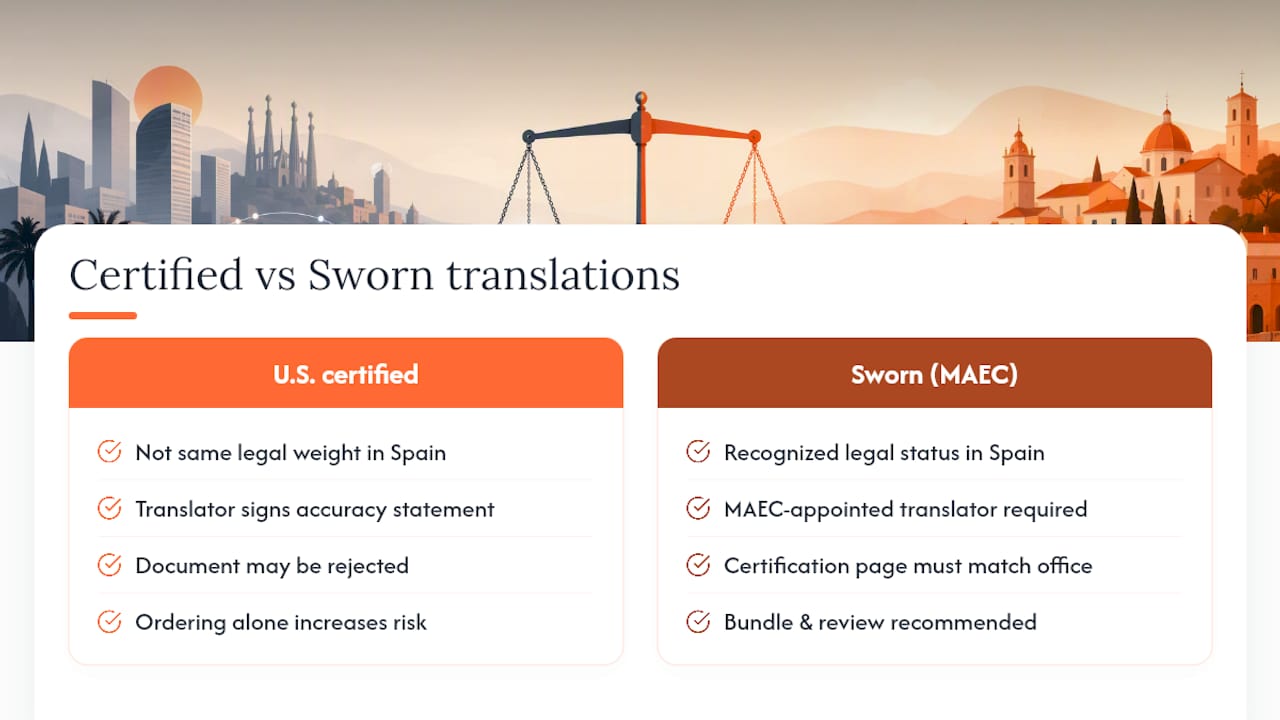
The standard advice on this topic is “get a certified translation.” That framing is technically accurate and practically incomplete. Certified and sworn are not the same thing in Spain’s legal framework, and conflating them is exactly what causes applicants to submit a document that looks official but gets rejected on arrival.
A certified translation in the U.S. sense, where a translator signs a statement of accuracy, does not carry the same legal weight in Spain as a traducción jurada from a MAEC-appointed translator. The MAEC appointment is the credential that matters. Without it, the certification statement on the document is just a piece of paper.
The second thing most guides underplay is the bundling advantage. Ordering a sworn translation independently is fine if you know exactly what the receiving office requires. But consulates and Oficina de Extranjería offices do have minor differences in what they expect on the certification page, and those differences are not always published. A visa consultant who has submitted to the same office dozens of times knows what wording clears and what triggers a follow-up request. That institutional knowledge is worth more than the marginal cost savings of ordering a translation on your own.
The practical takeaway: if you are filing for a Digital Nomad Visa or Non-Lucrative Visa and your bank statements are in English, do not treat the translation as a box to check independently. Treat it as part of the document package, and get it reviewed in context.
Digitalnomadinspain handles the translation and the whole application
Getting your bank statement translated correctly is one piece of a larger document puzzle. Digitalnomadinspain takes on the whole picture: sworn translation coordination, document review, consulate submission support, and after-approval steps like TIE registration and tax setup, all under one roof.

The difference from ordering a translation independently is straightforward. Digitalnomadinspain pre-checks what the receiving consulate or Oficina de Extranjería actually wants on your certification, coordinates with MAEC-authorized translators, and flags any gaps in your financial proof package before anything is submitted.
If you are preparing for a Digital Nomad Visa or a Non-Lucrative Visa application, book a consultation with Digitalnomadinspain and bring your last three to six months of statements. The team will tell you exactly what needs to be translated, certified, and submitted.
This article is general information, not a substitute for advice from a qualified lawyer. Consult a qualified legal professional about your own circumstances before acting on anything here.
Sources
Official and authoritative starting points for verifying translator credentials and local acceptance requirements:
- Sworn Translation Bank Statement | MANLOP Traducciones ®
- UK Financial Document Translation for Spanish Visa | BeTranslated
When in doubt about stamp wording, apostille requirements, or accepted file formats, contact the receiving office directly. Requirements can vary between consulates and regional Oficina de Extranjería offices, and a direct confirmation takes less time than a resubmission.
FAQ
Do I need a sworn translator for a bank statement in Spain?
Yes, for any official submission to a Spanish public body, including visa applications, TIE appointments, and tax filings, you need a sworn translation by a MAEC-authorized traductor jurado. A general certified translation is not sufficient.
How do I translate a bank statement into Spanish?
Order a sworn translation from a MAEC-authorized traductor jurado. You can find one through the official MAEC list or use an online sworn-translation portal that accepts scanned PDFs and returns a digitally signed certified document.
What is “estado de cuenta” in Spanish?
Estado de cuenta is the standard Spanish term for a bank statement or account statement. Extracto bancario is also commonly used and refers to the same document.
Can I translate my own bank statement for Spain?
No. Self-translated documents are not accepted by Spanish authorities for official purposes. The translation must come from a MAEC-appointed sworn translator whose certification gives the document legal force.
How long does a sworn bank statement translation take?
Standard turnaround for 1–4 pages is typically one business day; 5–10 pages usually takes two business days. Rush options are available from most online portals for same-day or next-morning delivery.