
Discover the best places to retire in Spain in 2026. Explore top locations with great weather, healthcare, and vibrant expat communities!
What are the best places to retire in Spain?
For US retirees in 2026, the Costa del Sol, Costa Blanca, and Valencia consistently top the list, combining warm climate, strong healthcare, and well-established English-speaking communities. If you want authentic Spanish culture at a lower price, Seville and Granada deliver. Prefer a quieter pace? Smaller towns like Ronda, Alicante, and Antequera offer real daily life without the tourist noise.
The table below compares all 20 featured locations across the dimensions that matter most for long-term retirement.
| Location | Lifestyle and Amenities | Cost of Living | Healthcare Access | Climate | Best For |
|---|---|---|---|---|---|
| Costa del Sol | Beach, golf, dining, outdoor social life | Moderate to high | Excellent private and public; English-speaking clinics | Hot summers, mild winters | Year-round sun, large expat community |
| Costa Blanca | Relaxed coastal, strong expat services | Low to moderate | Strong private hospital network | mild, sunny climate | Budget-conscious retirees |
| Valencia | City beaches, arts, food scene, public transit | Moderate | High-quality public healthcare | Mediterranean | Urban life with beach access |
| Madrid | World-class culture, restaurants, transport | High | Top-tier hospitals, specialists | Hot summers, cold winters | Capital city lifestyle |
| Barcelona | Architecture, culture, nightlife, beaches | High | Excellent public and private | Mediterranean | Culture and design over cost |
| Malaga | Airport hub, coastal living, expat services | Moderate | Good public and private; English-speaking | Hot summers, mild winters | Connectivity and community |
| Seville | Flamenco, history, tapas culture | Low to moderate | Adequate public; private available | Very hot summers, mild winters | Authentic Spanish culture |
| Alicante | Promenade, beaches, expat infrastructure | Low | Solid public and private | Warm, dry, sunny | Affordable sunny lifestyle |
| Granada | Alhambra, mountains, university city | Low | Public hospitals; private available | Mountain climate, cooler | Budget living, scenic setting |
| Antequera | Historic center, accessible services | Low | Basic public; Malaga nearby | Inland Mediterranean | Quiet, affordable inland option |
| Ronda | Gorge views, small-town pace | Low | Limited local; Malaga for specialists | Mild mountain | Scenic small-town living |
| Guadix | Cave dwellings, rural character | Very low | Limited; Granada nearby | Semi-arid, warm | Unique budget experience |
| Priego de Córdoba | Baroque architecture, Andalusian village life | Very low | Basic local; Córdoba nearby | Inland Mediterranean | Peaceful cultural living |
| Loja | Mountain scenery, quiet streets | Very low | Basic; Granada nearby | Temperate mountain | Tranquility and affordability |
| Monforte de Lemos | Galician heritage, slower pace | Low | Regional services; Lugo nearby | Atlantic, mild and wet | Quiet, affordable north |
| Baza | Inland town, moderate services | Very low | Basic; Granada nearby | Semi-arid | Low-cost inland living |
| Adra | Coastal access, quiet beaches | Low | Basic; Almería nearby | Mediterranean | Budget coastal access |
| Úbeda | Renaissance architecture, UNESCO heritage | Low | Basic local; Jaén nearby | Inland Mediterranean | Culture and history |
| Luarca | Fishing village, dramatic coastline | Low | Regional; Oviedo nearby | Atlantic, cool and green | Mild summers, authentic north |
| Santillana del Mar | Medieval streets, preserved heritage | Low | Regional; Santander nearby | Atlantic, mild | Small-town cultural richness |
A few patterns stand out immediately. The coastal heavyweights (Costa del Sol, Costa Blanca, Valencia, Alicante) offer the most complete package of healthcare, community, and climate. The inland Andalusian towns (Ronda, Guadix, Priego de Córdoba, Loja, Baza) trade services and connectivity for dramatically lower costs. The northern towns (Luarca, Santillana del Mar, Monforte de Lemos) suit retirees who actively dislike heat and want a greener, quieter Spain.
Valencia has been voted one of the best cities worldwide for retirement, combining affordable costs, strong public healthcare, beach access, and a manageable city size. Alicante and the Costa Blanca provide a slower pace, budget-friendliness, and a well-developed expat support network that makes the first year far less disorienting.
How do lifestyle, cost, healthcare, and climate compare across Spain’s top retirement spots?
Lifestyle and amenities: urban vs. coastal vs. inland
Madrid and Barcelona sit at one end of the spectrum. Both cities offer world-class museums, restaurants, and transport, but you pay for it. Monthly budgets in Madrid run on the higher side for a comfortable retirement, while Barcelona sits in a similar range. The tradeoff is access: specialists, international airports, and cultural programming that smaller towns simply cannot match.
The coastal belt from Malaga through Alicante hits a sweet spot for most US retirees. Costa del Sol towns like Marbella, Fuengirola, and Nerja offer a social outdoor lifestyle with strong English-speaking expat communities. Malaga itself adds an international airport and a genuinely vibrant city center. Alicante’s flat, iconic Explanada promenade is exactly the kind of daily walk that makes retirement feel like a reward rather than a compromise.

Inland towns like Ronda, Antequera, Úbeda, and Priego de Córdoba offer something different: authentic Spanish daily life, low prices, and real cultural depth. The catch is that services thin out quickly. Ronda is picturesque, but for specialist medical care you’re looking at a drive to Malaga. Guadix and Baza are genuinely affordable, with cave-dwelling culture that’s unique in Europe, but both rely on Granada for anything beyond basic healthcare.
Cost of living: where your dollar actually goes further
Monthly budgets for a comfortable retirement range from roughly €1,200–€1,700 in Granada to €2,000–€3,000 in Madrid, according to cost-of-living data. Seville and Alicante sit in the €1,400–€2,200 range. The very small inland towns (Guadix, Priego de Córdoba, Loja, Baza, Adra) come in well below those figures, though you’ll spend more on a car and occasional travel to larger cities for services.
Housing is the biggest variable. Coastal hotspots and city centers have become substantially more expensive over the past several years. Better value appears in smaller towns, inland edges of coastal regions, and less internationally recognized neighborhoods. Renting before buying is standard advice for a reason: property regulations, community fees, and local market dynamics vary enough that a year of renting tells you things no amount of research can.
Healthcare access: the factor retirees underestimate
Spain’s public healthcare system consistently ranks among the best in Europe. Spain’s health system places near the top of global rankings, and the private sector adds a layer of English-speaking clinics that make daily healthcare navigation far easier for expats. Private health insurance is both required for the Non-Lucrative Visa and genuinely affordable in Spain, with monthly premiums typically ranging from €60–€120 depending on age and coverage level.
The gap between cities and small towns is real. Madrid, Barcelona, Valencia, Malaga, and Alicante all have strong hospital networks with English-speaking staff. Inland villages like Guadix, Loja, or Baza have basic local clinics but depend on Granada or Almería for anything serious. Retirees who prioritize healthcare and infrastructure over scenic remoteness consistently report better long-term satisfaction. The allure of a beautiful village can fade quickly when a specialist appointment means a 90-minute drive.
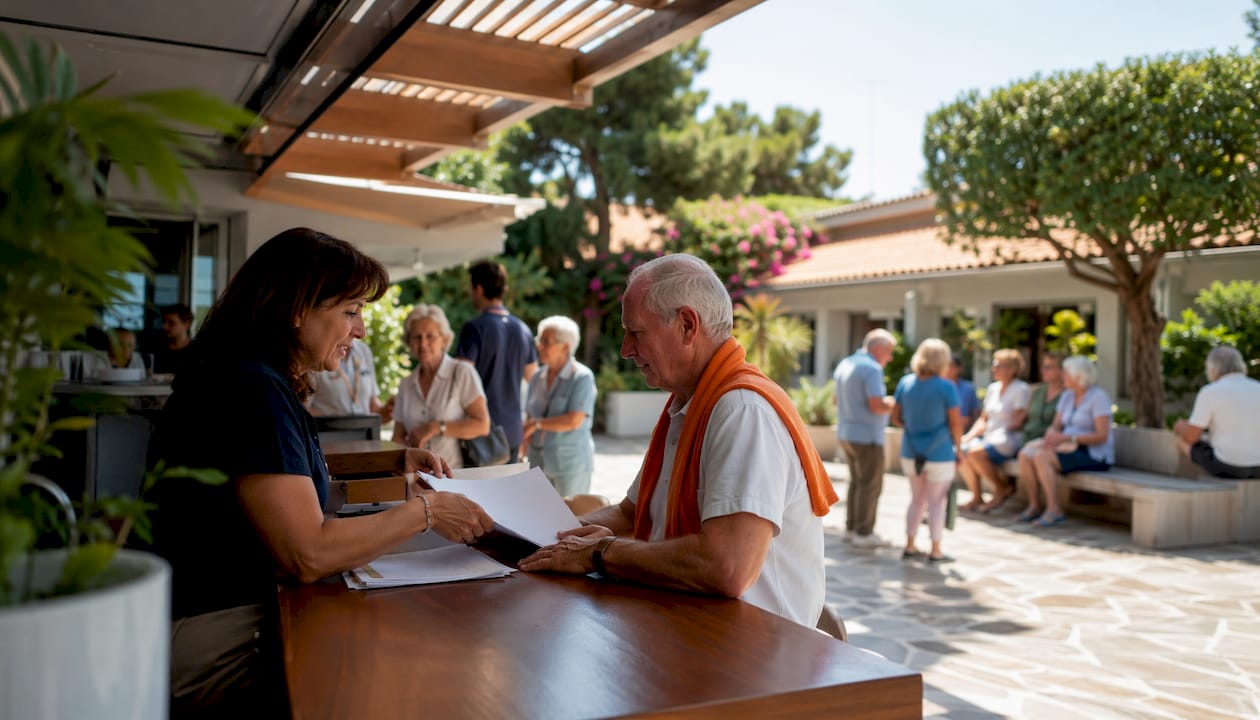
Climate: more variation than most people expect
Spain is not uniformly hot and sunny. The Costa del Sol and Costa Blanca deliver the warmth most US retirees picture, with mild winters and long summers. Seville and inland Andalusia get genuinely brutal heat in july and august, regularly exceeding 40°C (104°F). That summer intensity is one of the most common reasons retirees eventually leave Andalusia.
Granada and Ronda sit at elevation, which moderates summer heat but brings cold winters. The northern towns (Luarca, Santillana del Mar, Monforte de Lemos) have Atlantic climates: green, mild, and frequently rainy. They suit retirees who actively dislike heat and want something closer to the Pacific Northwest than the Mediterranean. Valencia and Alicante hit the middle ground: warm without the Seville extremes, sunny without the northern dampness.
Pros and cons by major location:
- Costa del Sol: Excellent climate and infrastructure; premium housing costs in popular areas; strong English-speaking community
- Costa Blanca / Alicante: Best balance of cost, climate, and expat services; slightly less culturally rich than larger cities
- Valencia: Top-tier public healthcare, beaches, and city life; growing popularity is pushing rents up
- Madrid: Unmatched urban amenities and healthcare; higher cost, cold winters, no beach
- Barcelona: Culturally exceptional; most expensive city on this list; Catalan language adds a layer of complexity
- Seville: Authentic, affordable, lively; summer heat is a genuine lifestyle challenge
- Granada: Very affordable, scenic, university-city energy; limited specialist healthcare locally
- Ronda / Antequera / Úbeda: Quiet, beautiful, cheap; car-dependent, limited English-speaking services
- Guadix / Baza / Loja / Priego de Córdoba / Adra: Lowest costs on the list; best for retirees who want total immersion and minimal tourist presence
- Luarca / Santillana del Mar / Monforte de Lemos: Authentic northern Spain; cool, green, genuinely off the expat radar
How do you choose the right place to retire in Spain?
Start with healthcare, not scenery
The single biggest mistake US retirees make is choosing a location based on how it looks in photos rather than how it functions as a place to age. Successful retirees prioritize healthcare access and public infrastructure over affordable housing or beach access for long-term stability. A charming village with no English-speaking doctor and a 45-minute drive to the nearest hospital is a different proposition at 75 than it is at 62.
The practical test: identify the nearest public hospital, the nearest private clinic with English-speaking staff, and how you’d get there without a car. If those answers are unsatisfying, reconsider the location regardless of how much you love the town square.
Visit in summer and winter before committing
Coastal towns get overcrowded in summer, and the quality of daily life shifts dramatically between July and January. A town that feels perfect in April can be genuinely unpleasant in August, with packed beaches, noise, and prices that spike. Visiting in both peak and off-peak seasons is the most reliable way to understand what you’re actually signing up for.
Pro Tip: Book a one-month rental in your shortlisted town during late july or early august. If you can genuinely enjoy daily life during peak heat and tourist season, you’ve found a location that will work year-round.
Factor in connectivity from day one
Connectivity to airports and railways ranks highly in retiree satisfaction alongside healthcare and lifestyle. For US retirees, maintaining ties back home means regular transatlantic flights. Malaga, Madrid, Barcelona, Valencia, and Alicante all have international airports with direct or one-stop US connections. Smaller towns like Ronda or Guadix require a drive to a major hub, which adds friction every time you travel.
Practical steps for choosing your location
- Shortlist 3–4 locations based on climate preference and budget range
- Research the nearest hospital and private clinic for each; confirm English-speaking availability
- Rent for at least one month in your top choice before signing any long-term lease or purchase
- Visit during both summer and a quieter month (november or february work well)
- Test daily logistics: grocery stores, pharmacy, public transport, walking routes
- Connect with local expat groups on Facebook or Internations to get unfiltered current opinions
- Check airport connections and typical flight times to your home city in the US
Language and integration
Spanish language skills make a measurable difference in daily satisfaction. Retirees who balance expat community comfort with active local engagement and Spanish language learning report better integration and long-term happiness. You don’t need fluency to retire comfortably in Alicante or Malaga, where English is widely spoken. But in smaller inland towns, basic Spanish is not optional.
The dual-network approach works well: lean on expat communities during the first year for practical support, then gradually build local friendships and language skills. Retirees who skip the local engagement entirely often find themselves in a comfortable but isolated bubble, which tends to wear thin after a few years.
Housing: rent first, buy later
Spain’s rental market varies enormously by region. Coastal hotspots and city centers have seen significant price increases, while inland towns remain genuinely affordable. Buying property as a non-resident involves additional legal steps, taxes, and due diligence that make a rushed purchase risky. A citizenship by descent consultation can also open EU residency pathways worth exploring before committing to a visa-based route.
What are the visa requirements for US retirees moving to Spain?
The Non-Lucrative Visa: the standard route for US retirees
The Non-Lucrative Visa (NLV) is the primary legal pathway for US retirees who want to live in Spain without working. It’s designed for people with passive income: pensions, Social Security, investment returns, or rental income. The visa does not permit employment in Spain, which suits most retirees perfectly.
The Non-Lucrative Visa requires demonstrating sufficient financial means, private health insurance with no copayments and no repatriation exclusion, a clean criminal background check, and a medical certificate. Income thresholds and exact documentation requirements vary by consulate, so the figures published in generic guides don’t always match what your specific consulate will ask for. Preparing according to your consulate’s current requirements, rather than a general internet estimate, is the approach that avoids rejections.
Step-by-step NLV application process:
- Identify your assigned Spanish consulate in the US (determined by your state of residence)
- Confirm that consulate’s current income threshold and documentation checklist
- Obtain private health insurance from a Spain-approved provider with no copayments
- Gather financial proof: bank statements, pension letters, Social Security award letters
- Obtain an FBI criminal background check (apostilled) and a medical certificate from a licensed physician
- Complete the official visa application form (Modelo Nacional de Visado) and pay the fee
- Submit the full package in person at your consulate; some require appointments booked weeks in advance
- Wait for processing (typically 1–3 months, though timelines vary)
- Upon approval, enter Spain within the visa validity window and register with local authorities
- Apply for your TIE (Tarjeta de Identidad de Extranjero) residency card within 30 days of arrival
The US and Spain have a Social Security totalization agreement, which prevents double taxation of Social Security benefits and can affect how your retirement income is treated under Spanish tax law.
Private health insurance: required, not optional
Private health insurance is essential from the moment you apply. The policy must cover you in Spain with no copayments and no clause excluding repatriation. Spanish private healthcare for expats is widely affordable and accepted, and the private hospital infrastructure on the Costa del Sol and Costa Blanca is specifically built for English-speaking patients. Budget €60–€120 per month depending on age and coverage level.
Alternative visa options
The Digital Nomad Visa suits retirees who still earn income from remote work or freelance contracts with non-Spanish clients. It offers a path to residency with a higher income threshold but allows active work. The Golden Visa (investment-based residency) remains an option for retirees with significant capital to invest in Spanish real estate or financial instruments, though it requires a minimum investment that puts it out of reach for most.
Tax considerations for US retirees
The US taxes its citizens on worldwide income regardless of where they live, so retiring to Spain does not eliminate your US tax obligations. Spain also taxes residents on worldwide income once you spend more than 183 days per year in the country. The US-Spain tax treaty reduces but does not eliminate double taxation. Consulting a tax advisor who specializes in US expat taxation before you move is not optional if you have pension income, Social Security, IRAs, or investment accounts. The exteriores.gob.es consulate page publishes official NLV requirements for the Los Angeles consulate, which is the assigned consulate for many western US states.
What are the pros and cons of retiring in Spain as a US retiree?
Spain offers US retirees a genuinely compelling package, but it’s not without friction. The retirees who thrive are the ones who went in with clear eyes about both sides.
Pros:
- Climate: Most of Spain delivers more sunshine and warmth than anywhere in the continental US at a comparable cost
- Healthcare quality: Spain’s public system ranks among the best globally, and private coverage is affordable
- Cost of living: Outside Madrid, Barcelona, and premium coastal hotspots, daily expenses run well below US equivalents for food, dining out, and local services
- Safety: Spain consistently ranks as one of the safest countries in Europe, with low violent crime rates in retirement-popular areas
- Expat community: The Costa del Sol, Costa Blanca, and Valencia have large, active English-speaking communities that ease the transition
- Culture and lifestyle: Food, history, architecture, and a social outdoor culture that most US cities simply don’t replicate
- US-Spain Social Security agreement: The totalization agreement prevents double Social Security taxation for qualifying retirees
Cons:
- Bureaucracy: Spanish administrative processes are slow, paper-heavy, and often require in-person visits. Visa renewals, residency registration, and tax filings all demand patience and organization
- Summer heat: Seville, inland Andalusia, and parts of Madrid get genuinely extreme in july and august. This is one of the most cited reasons US expats eventually leave
- Language barrier: Outside major expat hubs, daily life requires at least functional Spanish. Medical appointments, legal matters, and local government interactions are conducted in Spanish
- Social integration: Building genuine local friendships takes years. Retirees who rely entirely on expat networks can feel isolated from the country they moved to
- Seasonal tourism: Coastal towns transform in summer. Crowds, noise, and price spikes affect quality of life in ways that are hard to appreciate until you’ve lived through a full season
- US tax obligations: Moving to Spain does not simplify your US tax situation. It often adds complexity, requiring a specialist advisor
- Distance from family: A transatlantic flight is a 9–10 hour commitment. Retirees with grandchildren or aging parents in the US feel this acutely
The retirees who stay long-term tend to share a few traits: they learned at least conversational Spanish, they chose a location with solid healthcare nearby, and they built connections beyond the expat bubble. Those who leave usually cite heat, bureaucracy, or isolation, and most of those issues were predictable before the move.
Digitalnomadinspain makes the Non-Lucrative Visa process manageable
Getting the Non-Lucrative Visa right the first time saves months of delay. Digitalnomadinspain specializes in exactly this: full-service visa support for US retirees applying for the Non-Lucrative Visa, from eligibility check through document preparation, consulate submission, and post-approval setup including TIE cards and tax registration.

The practical difference is speed and certainty. Digitalnomadinspain’s clients process applications roughly 30% faster than self-applicants, and the service carries a 98% success rate across clients from more than 50 countries. That track record comes from deep familiarity with consulate-specific requirements, which vary more than most online guides acknowledge. If you want to check whether you qualify before committing to anything, the eligibility checker takes a few minutes and gives you a clear answer.
Key Takeaways
Spain’s best retirement locations for US retirees combine accessible healthcare, manageable cost of living, and established expat communities, with the Non-Lucrative Visa as the primary legal pathway.
| Point | Details |
|---|---|
| Top locations for most retirees | Costa del Sol, Costa Blanca, Valencia, and Alicante offer the strongest balance of climate, healthcare, and expat community. |
| Cost varies widely by location | Monthly budgets range from roughly €1,200 in Granada to €2,000–€3,000 in Madrid; inland towns cost less but require a car. |
| Healthcare access drives long-term satisfaction | Retirees who prioritize proximity to hospitals and English-speaking clinics report better outcomes than those who choose purely on scenery. |
| Visit in summer and winter before committing | Coastal towns shift dramatically between seasons; a july or august stay reveals conditions that an april visit will not. |
| Digitalnomadinspain for visa support | Digitalnomadinspain handles Non-Lucrative Visa applications end-to-end, with a 98% success rate and processing times 30% faster than self-applicants. |