
Discover how a US Certificate of Coverage can help fulfill Spain's social security requirements for your move. Act now for smooth relocation.
A US Certificate of Coverage Can Cover Your Spain Move

A US Certificate of Coverage (CoC) can satisfy Spain’s social-security requirement, but only in specific situations: an employer posting you temporarily to Spain, or another arrangement that genuinely mirrors a traditional assignment. It is not an automatic pass for someone quitting a US job, going independent, and applying for the Digital Nomad Visa on their own terms.
The Social Security Administration’s Office of International Programs issues CoCs under the US–Spain Totalization Agreement. Spain’s General Treasury of Social Security (TGSS) and Spanish consulates decide, case by case, whether to accept one.
- Start now, not later. Processing can stretch for months, and visa appointments don’t wait.
- Know your category. Posted employees have a much stronger case than voluntary relocators.
- Build a backup plan. Spanish registration or private insurance may end up doing the job instead.
Pro Tip: If your employer is small or unfamiliar with international assignments, ask about the CoC request in the same conversation where you propose working from Spain. Waiting until your visa appointment is already booked leaves no room for a rejected request.
Key Takeaways
A US Certificate of Coverage satisfies Spain’s social-security requirement only when the arrangement genuinely resembles a temporary employer posting, not a voluntary self-employed relocation.
| Point | Details |
|---|---|
| CoC works for posted employees | Workers temporarily sent by a US employer can stay on US coverage under the treaty for a period defined by the agreement. |
| Self-employed face a harder case | Coverage generally follows residence, so independent movers are expected to register with Spanish Social Security instead. |
| Start the SSA request early | Processing commonly takes several months, so file through OPTS well before any visa appointment. |
| Consular scrutiny has increased | Consulates and the UGE now review voluntary relocations more closely than traditional posted-worker assignments. |
| Build a fallback in parallel | Spanish registration, employer CCC enrollment, or private insurance are realistic alternatives if the CoC route stalls. |
| Get expert help when it’s complex | Digitalnomadinspain handles eligibility checks, employer liaison, and consulate packaging for applicants who want a faster, cleaner process. |
Table of Contents
- What a Certificate of Coverage in Spain Actually Does
- Who Requests a US Certificate of Coverage and Where to Start
- How to Request a Certificate of Coverage Step by Step
- How Spain’s Digital Nomad Visa Program Treats a Certificate of Coverage
- How Long a Certificate of Coverage Takes and What Goes Wrong
- What to Do When a Certificate of Coverage Isn’t Realistic
- Getting Professional Help With Your Certificate of Coverage
- Why the CoC Question Deserves More Skepticism Than It Gets
- Get Help With Your Digital Nomad Visa Application
- Sources
- FAQ
What a Certificate of Coverage in Spain Actually Does
The US and Spain signed a Totalization Agreement in 1986 to stop workers from paying into two social security systems at once and to let people combine coverage periods from both countries toward eventual benefits. A Certificate of Coverage is the paperwork that puts that treaty into action for your specific case.
Once SSA issues a CoC, it confirms you remain covered under the US Social Security system for a defined stretch of time. That exempts both you and your employer from paying into the Spanish system during that window, which matters because Spanish social contributions run high relative to US payroll taxes.
The treaty splits into two tracks that behave very differently:
- Posted workers: an employee sent temporarily by a US employer can stay on US coverage for up to five years under the agreement’s detachment rule.
- Self-employed people: coverage generally follows residence, meaning someone who relocates and works independently from Spain is expected to contribute to the Spanish system rather than lean on a CoC.
That distinction is the whole story for most digital nomads, and it’s the part general “how to move to Spain” guides tend to gloss over.
Who Requests a US Certificate of Coverage and Where to Start
- Employer-initiated requests. In the traditional posted-worker scenario, the US employer submits the request to SSA, not the employee. SSA’s guidance lists the exact fields required: the worker’s name and Social Security number, hire date, the US employer’s address, the Spanish work address, and the start and end dates of the assignment, SSA notes.
- Self-employed applicants. If you run your own business from the US and plan to keep doing so from Spain, SSA expects evidence that the business is genuinely US-based: Schedule SE filings, a description of the work, and clear dates. Spain’s side of this, handled through TGSS provincial offices, treats self-employed movers differently depending on whether they’re establishing residence or just passing through.
- The online entry point. SSA runs an Online Certificate of Coverage Service (OPTS) that most employers use to file requests directly rather than mailing paper forms.
How to Request a Certificate of Coverage Step by Step
Before anyone submits anything, gather the basics: your Social Security number, a signed contract or assignment letter, your US employer’s full address, the Spanish work address, exact start and end dates, and documentation showing the move is temporary rather than permanent. If a Spanish entity is involved, note whether it’s a legally affiliated branch of the US company.
- Employer path. HR or a mobility specialist logs the request through OPTS or submits it by mail or fax to SSA’s Office of International Programs, filling in every field SSA lists, including affiliate status if the Spanish office is a subsidiary.
- Follow up in writing. SSA doesn’t publish a service-level guarantee, so a dated follow-up email every few weeks keeps the request from getting lost in the queue.
- Self-employed path. Assemble Schedule SE filings, invoices or contracts showing ongoing US business activity, and a written description of what you do and where you do it. Contact TGSS directly if Spanish authorities request confirmation of your Spanish-side status.
- Package it for the consulate. Once the CoC arrives, pair it with a short employer letter stating the assignment is temporary, the expected return date, and confirmation that Spanish contributions are being waived under the treaty. Consulates and Spain’s Unidad de Grandes Empresas (UGE) respond better to a tight, purpose-built packet than a folder of loose documents.
Pro Tip: Draft the employer letter yourself and send it to HR for a signature rather than asking them to write it from scratch. Busy HR departments often stall on tasks they don’t know how to start, and a ready-to-sign draft removes that friction entirely.
How Spain’s Digital Nomad Visa Program Treats a Certificate of Coverage
Every Digital Nomad Visa applicant has to prove social-security coverage one way or another. A CoC satisfies that requirement, and so does direct Spanish registration, but which one a given consulate or the UGE will accept has gotten harder to predict.
Practitioner reports describe a real shift: scrutiny for voluntary relocations using a CoC has tightened, while employer-posted assignments still tend to sail through. The legal text of the agreement hasn’t changed. What’s changed is how consular officers interpret a case that doesn’t look like a classic posting, according to a recent Digital Nomad Visa explainer.
That leaves a few practical takeaways:
- If your employer can honestly frame your move as a temporary assignment, ask them to say so explicitly in writing.
- If you left your job to freelance or you’re bringing your own US business with you, expect more questions from the UGE and prepare Spanish registration as a real option, not just a backup.
- Bring more documentation than the bare minimum. Consulates that are already skeptical of a case respond better to a thick packet than a thin one.
None of this is arbitrary bureaucratic mood swings. It reflects a genuine tension between a treaty written for classic corporate transfers and a visa program built for people who work nothing like that.
How Long a Certificate of Coverage Takes and What Goes Wrong
SSA doesn’t publish a standard turnaround time for CoC requests, and that absence of a published number is itself useful information: it means nobody can promise you a date. Practitioners who handle these requests regularly report processing commonly taking several months, sometimes longer when a case needs extra review.
Most delays trace back to the same handful of problems:
- Incomplete employer information, especially missing Spanish addresses or affiliate details.
- Weak evidence that a posting is genuinely temporary rather than a one-way move.
- Self-employed applicants submitting thin documentation of their US business activity.
- SSA reviewing borderline cases individually rather than applying a fixed checklist.
Starting the request the moment a move to Spain becomes real, rather than once your visa appointment is already scheduled, is the single biggest lever you control. Loop in a mobility specialist or CPA early if your employer has never handled an international transfer before.
What to Do When a Certificate of Coverage Isn’t Realistic
If your employer won’t cooperate, or your situation clearly falls outside the posted-worker rule, you still have workable paths into Spain.
- Register directly with Spanish Social Security. Employees go through the Régimen General; self-employed people register under RETA. Either route means paying into the Spanish system, but it removes any ambiguity for consular officers.
- Have your employer register in Spain. A US company can obtain a Código de Cuenta de Cotización (CCC) and enroll you as a Spanish employee, which sidesteps the CoC question entirely, though it’s a bigger administrative lift for the employer.
- Carry private comprehensive health insurance. Many consulates accept qualifying private coverage to meet the visa’s health-insurance requirement, but understand that insurance and social-security contributions are separate obligations. Meeting one doesn’t automatically satisfy the other.
- Separate tax residency from social security. Spending more than 183 days in Spain in a calendar year generally makes you a Spanish tax resident regardless of your social-security arrangement. The two systems run on different rules, and conflating them is a common, costly mistake.
Pro Tip: If you’re weighing private insurance against Spanish registration, check a few international health insurance options before committing. Not every policy meets Spain’s specific visa requirements, and finding that out after you’ve paid for a year of coverage is an expensive lesson.
Getting Professional Help With Your Certificate of Coverage
Sorting out a CoC request, gathering employer documentation, and building a consulate-ready packet is a lot to manage alongside an actual international move. Digitalnomadinspain works through exactly this process with clients: eligibility checks up front, direct liaison with employers who need help understanding what SSA is asking for, full document preparation, and consulate packaging built to withstand the scrutiny voluntary relocations now face.
Digitalnomadinspain reports a 98% success rate on visa applications and processing roughly 30% faster than self-applicants, a gap that often comes down to catching missing employer details or weak self-employment evidence before a consulate ever sees the file.
Hiring help makes the most sense when your employer is small and has never done this before, your self-employment records are scattered across several years, your visa timeline is already tight, or you’ve had an application refused once already.
Why the CoC Question Deserves More Skepticism Than It Gets
Most guides to the Digital Nomad Visa treat the Certificate of Coverage as a box to check, as if getting one is purely a matter of filling out the right SSA form. That framing undersells how much judgment calls now shape the outcome. The treaty language hasn’t moved since 1986, but consular interpretation clearly has, and a document that would have sailed through five years ago can draw real questions today.
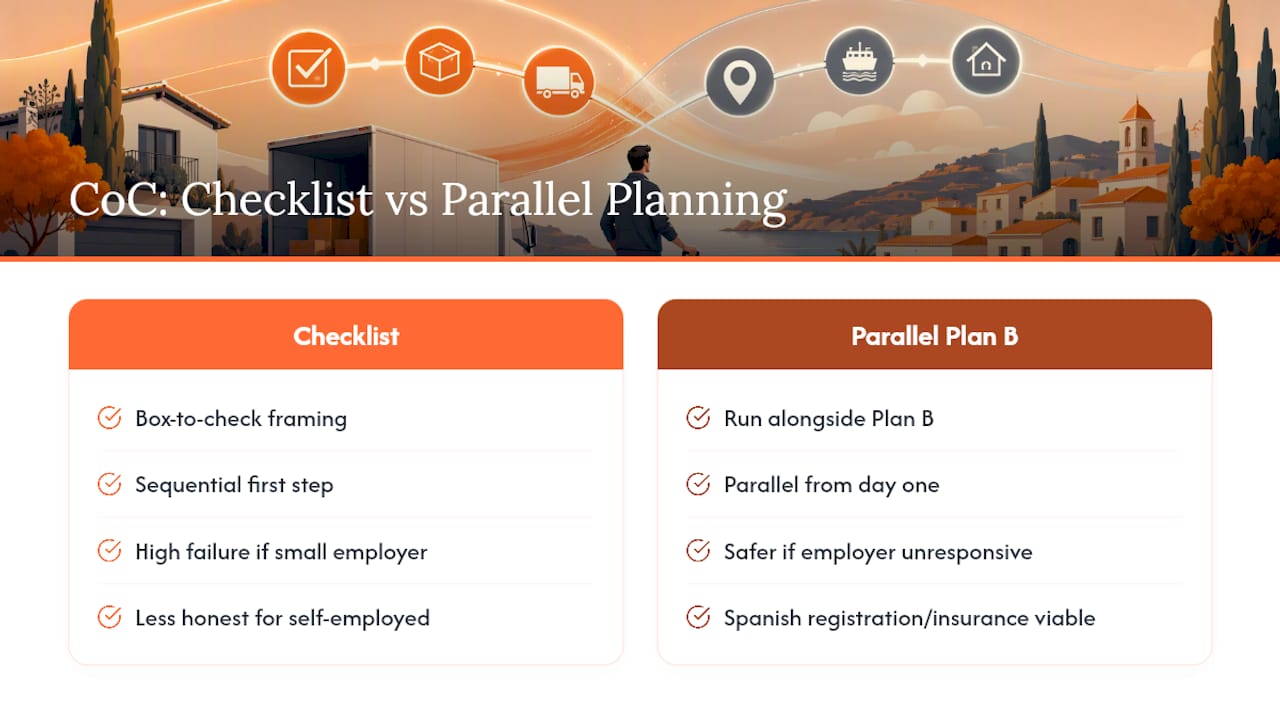
The bigger blind spot is timing. Applicants often treat the CoC as step one in a linear checklist, when it should run in parallel with a Plan B from day one. If your employer is small, unresponsive, or simply unfamiliar with international assignments, that alone can sink a CoC request faster than any SSA processing delay. Spanish registration or private insurance isn’t a consolation prize. For a lot of self-employed movers, it’s the more honest path from the start.
What I’d prioritize differently: don’t ask “can I get a CoC?” Ask “does my situation actually look like a posting, or am I forcing a square peg into a round hole?” That answer should drive which path you build first.
— Joshua
Get Help With Your Digital Nomad Visa Application
Working through Certificate of Coverage paperwork on top of an international move is exactly the kind of tangle Digitalnomadinspain exists to untangle. Unlike piecing together SSA forms and consular requirements on your own, working with a consultancy that handles this daily means someone is checking your employer’s documentation and your Spanish-side paperwork before a consulate finds the gaps for you.

If you’re not sure whether the CoC route applies to your situation or whether Spanish registration makes more sense, start with the eligibility checker to see where you stand. From there, the Digital Nomad Visa service covers everything from employer liaison to document preparation to consulate packaging, so you’re not guessing which documents actually move your application forward.
Sources
- Totalization Agreement with Spain | International Programs
- Americans on Spain’s digital nomad visa: the Certificate of Coverage question | Remote Work Europe
FAQ
How long does it take to get a Certificate of Coverage?
SSA doesn’t publish a standard timeline, but practitioners commonly report the process taking several months, so start the request as early as possible.
How do I get a Certificate of Coverage?
Employers typically submit the request through SSA’s OPTS portal with the worker’s Social Security number, hire date, and assignment dates; self-employed applicants submit Schedule SE filings and business activity evidence instead.
How long can I live outside the US without losing Social Security?
Living abroad doesn’t cause US citizens to lose Social Security benefits, but staying covered by the US system rather than paying into Spain’s requires a valid Certificate of Coverage for the period you’re outside the country.
What is a CoC in Spain?
A CoC is a document issued by the SSA under the US–Spain Totalization Agreement confirming a worker remains covered by US Social Security, which Spanish authorities and consulates can accept in place of Spanish contributions for qualifying temporary assignments.
Can Digitalnomadinspain help with a Certificate of Coverage request?
Yes. Digitalnomadinspain assists with eligibility checks, employer liaison, and document packaging for CoC requests, plus full support for the Digital Nomad Visa application itself.