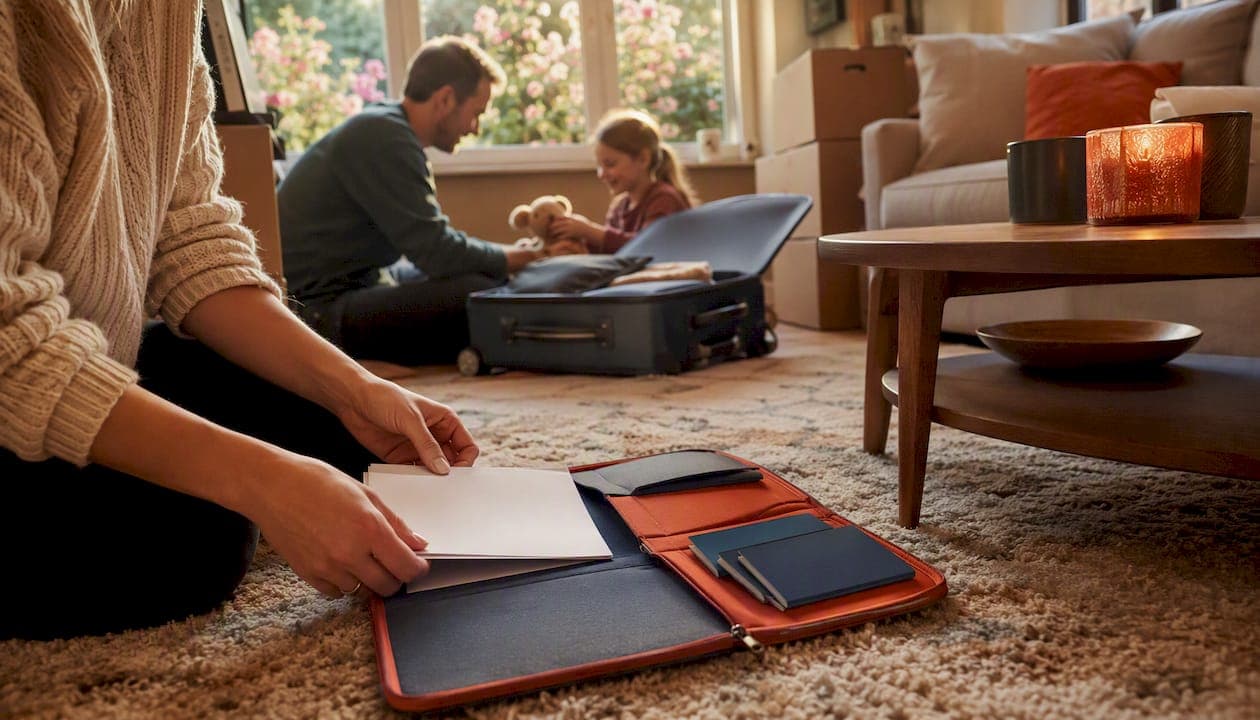
Explore how different countries handle digital nomad visa dependents. Learn which locations best support family reunification for remote workers.
Digital Nomad Visa Dependents: Country Rules for Families
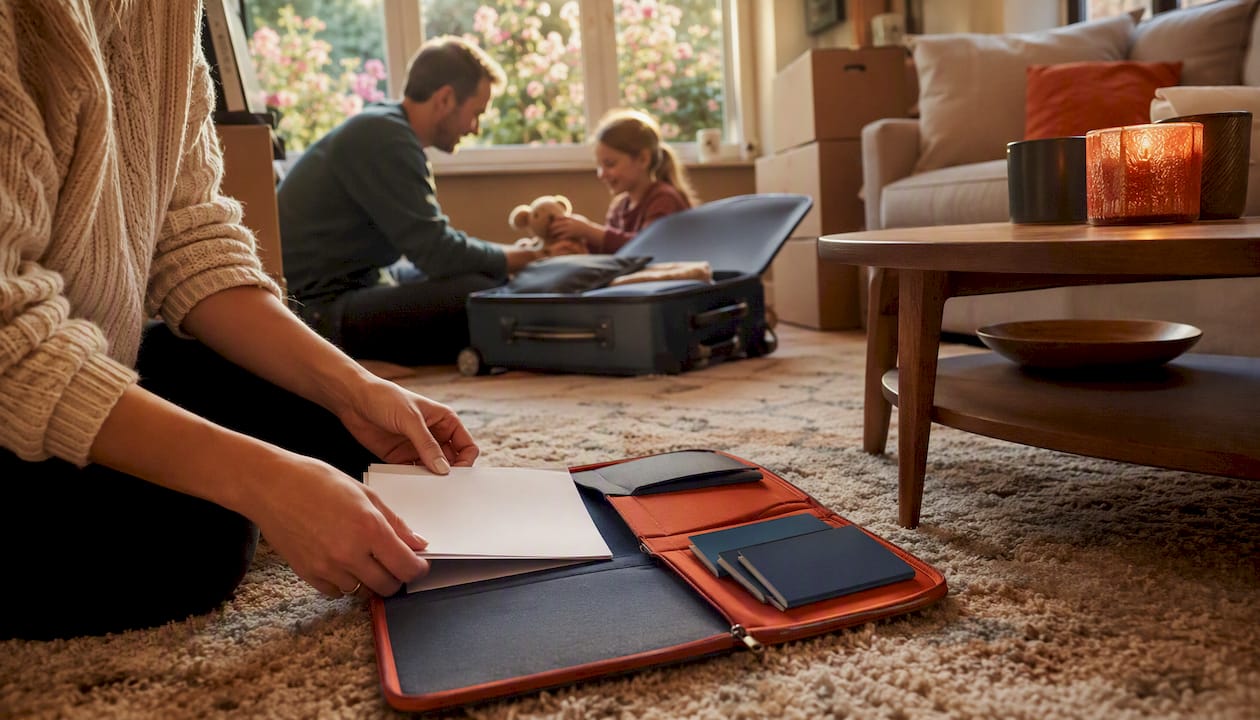
Yes — most digital nomad visas allow dependents, but the rules vary enough by country that “can my family come?” is rarely a simple yes or no. Spain, Portugal, Greece, Italy, Cyprus, Colombia, and Japan all permit family members to join the primary visa holder. A handful of programs, including Hungary’s White Card, do not allow family reunification at all.
The typical dependent categories are: a spouse or registered partner, minor children, adult children who are financially dependent and haven’t formed their own household, and in some countries, ascendant relatives (parents or grandparents) under the applicant’s care. What trips families up isn’t eligibility — it’s the financial proof, the apostille requirements, and the document timing.
Here’s a quick picture of which countries are most family-friendly for digital nomad visa dependents:
- Spain — Full family reunification; income scales by dependent count; dependents can work
- Portugal — Spouse and children permitted; income add-ons apply; strong public school access
- Greece — Spouse and minor children; income threshold increases per dependent
- Italy — Spouse and children under 18 sponsored after arrival; adult relatives more restricted
- Cyprus — Family resides for the same permit period; dependents cannot work locally
- Colombia — Spouse and children included; income threshold applies to the household
- Japan — Dependent visa available for spouse and children; work rights limited without separate permit
Key Takeaways
Most digital nomad visa programs allow dependents, but Spain stands out for combining full family eligibility, a transparent income formula, and broad work rights for dependents — making it the most practical choice for families relocating together.
| Point | Details |
|---|---|
| Verify dependent eligibility per country | Not all programs cover adult children, ascendants, or unmarried partners — confirm before ordering documents. |
| Calculate family income needs early | Spain requires 200% SMI base plus 75% and 25% add-ons per dependent; Cyprus sets a flat €3,500/month floor. |
| Apostille and translate documents in sequence | Apostille first, then commission sworn translations — reversing the order often means paying twice. |
| Secure family health insurance before applying | Private coverage for the full family is required at application; public access typically follows residence registration. |
| Digitalnomadinspain for Spain family applications | The consultancy handles eligibility checks, document coordination, and post-arrival TIE support with a 98% approval rate. |
Table of Contents
- Digital nomad visa dependents: at a glance by country
- Who counts as a dependent and what documents prove it
- How to apply with dependents: a step-by-step checklist
- Country-by-country rules for families on digital nomad visas
- Work, schooling, and healthcare rights for dependents
- How countries calculate financial sufficiency for dependents
- Common pitfalls families trip over and how to avoid them
- How Digitalnomadinspain supports families applying for Spain visas
- Bringing your family to Spain: what Digitalnomadinspain offers
- Sources
- FAQ
Digital nomad visa dependents: at a glance by country
Before diving into the full country breakdowns, this snapshot lets you shortlist your best options fast.
| Country | Who qualifies | Income scaling for dependents | Dependents can work? | Visa length / renewal | Processing notes |
|---|---|---|---|---|---|
| Spain | Spouse/partner, minor children, adult dependent children, ascendants | +75% SMI (first dependent), +25% SMI (each additional) | Yes (broad work rights) | 1 year; renewable for 2-year residence permits | Apply at consulate; TIE card after arrival |
| Portugal | Spouse/partner, minor children, adult dependent children | Percentage add-ons to base threshold | Yes | 1–2 years; renewable | D8 visa; apply at Portuguese consulate |
| Greece | Spouse, minor children | Income threshold increases per dependent | Limited | 1 year; renewable | Apply at Greek consulate |
| Italy | Spouse, children under 18 | Sponsor after arrival; income proof required | Limited | 1 year; renewable | Questura process post-arrival |
| Cyprus | Spouse, children | €3,500/month net (primary holder); no add-on published | No | 1 year; renewable | Apply at Civil Registry and Migration Dept. |
| Colombia | Spouse, children | Household income threshold | Yes | 1–2 years; renewable | Apply at Colombian consulate |
| Japan | Spouse, children | Separate dependent visa; income proof for sponsor | Restricted (separate permit needed) | 1–5 years; renewable | Apply at Japanese embassy |
Always verify requirements directly with the relevant consulate before submitting. Document requirements, income thresholds, and processing times change. Apostilles and certified translations are almost universally required for foreign civil documents — budget time for both.
Key stat: Comparative reporting by Remote Work Europe ranks Spain and Portugal as the most family-friendly digital nomad visa destinations in Europe, citing their income-scaling formulas and access to public schools and healthcare for residents.
Who counts as a dependent and what documents prove it
Governments don’t use a single universal definition of “dependent,” but most digital nomad visa programs cluster around the same categories.
Typical dependent categories:
- Spouse or registered partner — a legally married spouse is the most straightforward; registered civil partnerships are accepted in most European countries with the appropriate certificate
- Unmarried partner — accepted in some countries (Portugal, Spain) but usually requires proof of at least one year of stable cohabitation or a registered partnership; having children in common can simplify this
- Minor children — children under 18 (or under 21 in some programs) with a birth certificate showing the relationship to the primary applicant
- Adult dependent children — accepted in Spain and Portugal if the child is financially dependent on the applicant and has not formed an independent household; requires proof of financial dependence (bank statements, enrollment in education, or a declaration of dependence)
- Ascendant relatives — parents or grandparents under the applicant’s direct care; accepted in Spain under the telework visa rules but requires documented proof of care and financial dependence
Documents governments typically require:
- Marriage certificate or registered partnership certificate
- Birth certificates for each child
- Proof of financial dependence for adult children (bank statements, enrollment records, or a notarized declaration)
- Proof of cohabitation for unmarried partners (utility bills, lease agreements, or municipal registration)
- Passports for all family members
- Criminal background checks for adult dependents (country-specific; some require only the primary applicant)
- Proof of health insurance covering all family members
Pro Tip: Apostille and sworn translation requirements add weeks to document preparation. Order civil records (birth and marriage certificates) first, then send them for apostille, and only commission sworn translations after apostille is complete — translating before apostille means you may need to redo the translation if the apostilled document differs from the original.
How to apply with dependents: a step-by-step checklist
The biggest mistake families make is treating dependent applications as an afterthought. Dependents usually apply at the same time as the primary holder, and their documents take just as long to prepare.
Step 1: Gather documents for every family member
- Valid passport (minimum 6 months beyond intended stay) for each person
- Birth certificates for all children (apostilled and translated)
- Marriage or partnership certificate (apostilled and translated)
- Criminal background check for each adult dependent (check country-specific requirements — Spain requires these for adults)
- Proof of health insurance covering the full family
- Passport-size photos meeting the destination country’s specifications
- Proof of financial dependence for adult children or ascendants
Step 2: Sequence your document preparation
- Order civil records from the issuing authority first — these have the longest lead times
- Submit for apostille once originals are in hand
- Commission sworn translations only after apostille is complete
- Obtain background checks last — most consulates require them to be issued within 3–6 months of the application date, so ordering too early wastes the validity window
Step 3: Decide whether to apply together or separately
Applying together is almost always the better strategy. Most consulates process family applications as a unit, and a joint application reduces the risk of the primary holder’s visa being granted while dependents are still in the queue. The main exception: if a dependent’s documents are significantly delayed, it can make sense to submit the primary application first and add dependents later — but confirm this is permitted at your specific consulate before splitting the application.
Pro Tip: Some consulates require the primary visa holder’s approval letter before accepting dependent applications. Confirm the exact sequencing requirement with your target consulate at least 3 months before your planned submission date.
Step 4: After visa grant
- Book travel and arrange temporary accommodation before arrival
- Register at the local municipality (empadronamiento in Spain) within the first weeks
- Apply for residence cards (TIE in Spain) — applications must be submitted before the initial visa expires, typically within two months of expiration
- Enroll children in school using the residence registration as proof of address
- Register with the national health system once residence is established (private insurance is required at application; public access typically follows after registration)
Country-by-country rules for families on digital nomad visas
Spain
Spain’s telework visa is the most detailed and arguably the most family-friendly in Europe. The official consular guidance explicitly lists who qualifies: the spouse or unmarried partner, minor children, adult children who are financially dependent and haven’t formed their own household, and ascendant relatives under the applicant’s care.
Who qualifies: Spouse/partner, minor children, adult dependent children, ascendants under care.
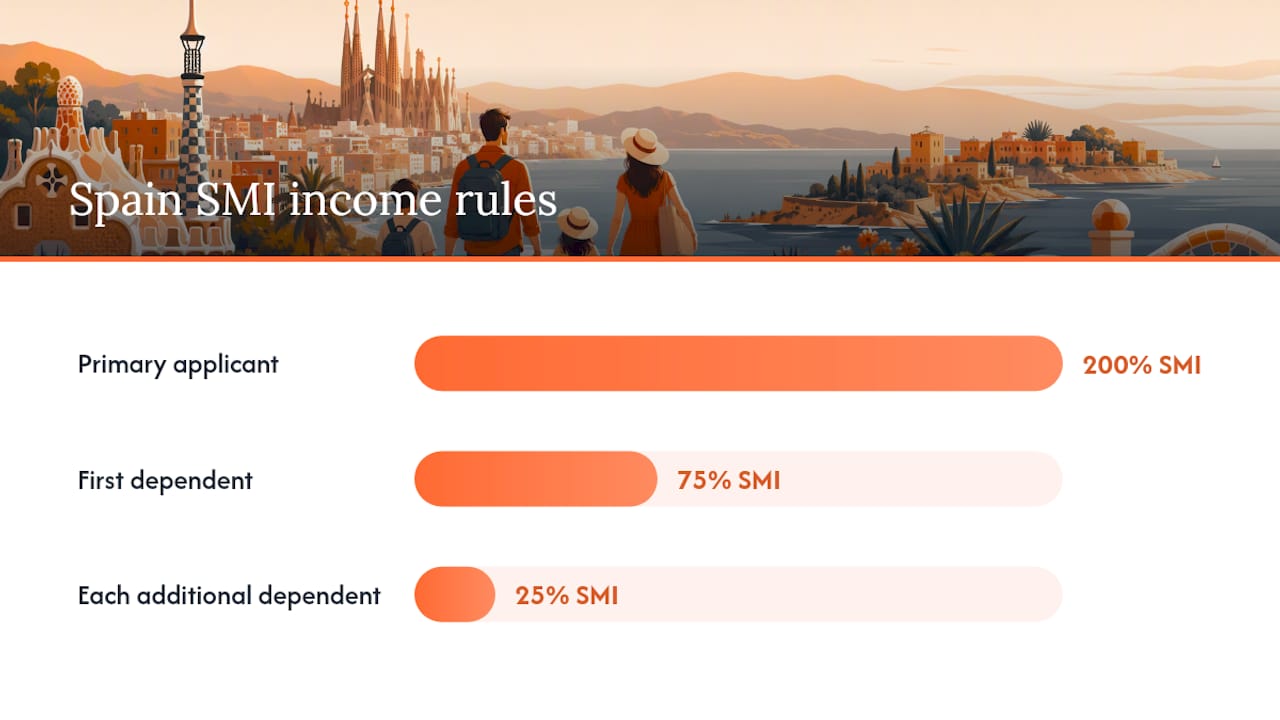
Financial threshold: Spain uses a minimum wage (SMI) multiplier. Per Spain’s official guidance, the primary applicant must show 200% of the SMI per month, plus at least 75% of the SMI for the first dependent and 25% for each additional dependent. See the worked examples in the financial section below.
Key documents for dependents: Marriage or partnership certificate, birth certificates, proof of financial dependence for adult children, criminal background checks for adults — all apostilled and accompanied by sworn Spanish translations. Spain’s consular guidance requires originals and copies of all documents proving family relationships.
Can dependents work? Yes. Spain grants dependents broad work rights, which is a meaningful advantage over Cyprus and Japan.
Visa length and renewal: 1-year initial visa; renewable for 2-year residence permits. Apply for the TIE residence card before the visa expires.
Processing notes: Apply at the Spanish consulate in your home country. For U.S. applicants, the Spain digital nomad visa process involves submitting at the consulate with jurisdiction over your state of residence. Processing typically runs 1–3 months.
Portugal
Portugal’s D8 Digital Nomad Visa accepts spouses, registered partners, minor children, and adult dependent children. Income add-ons apply for each dependent, though the exact published percentages vary by consulate. Remote Work Europe’s comparative reporting ranks Portugal alongside Spain as one of the most family-friendly options in Europe, noting strong public school and healthcare access for residents.
Can dependents work? Yes, with a residence permit.
Visa length and renewal: 1–2 years; renewable. Portugal also offers a path to long-term residency.
Processing notes: Apply at the Portuguese consulate. Document requirements mirror Spain’s: apostilled civil documents with certified translations into Portuguese.
Italy
Italy’s remote-worker visa takes a different approach. The Italian consulate’s guidance makes clear that a digital nomad can sponsor a spouse and children under 18 for family visas — but this sponsorship typically happens after arrival, through the Questura (local police headquarters). Sponsoring adult children or parents is more restricted under current rules.
Who qualifies: Spouse and children under 18 (post-arrival sponsorship); adult relatives face significant restrictions.
Can dependents work? Limited; dependent permits in Italy generally restrict local employment.
Visa length and renewal: 1 year; renewable.
Processing notes: The post-arrival sponsorship step adds time and administrative complexity. Families should plan for a gap between the primary holder’s arrival and dependent visa finalization.
Greece
Greece’s digital nomad visa permits the spouse and minor children to join the primary holder. The income threshold increases per dependent, though Greece has not published a fixed percentage formula as clearly as Spain.
Can dependents work? Limited work rights under the dependent permit.
Visa length and renewal: 1 year; renewable.
Processing notes: Apply at the Greek consulate. Document requirements follow the standard European pattern: apostilled civil documents with certified Greek translations.
Cyprus
Cyprus’s Digital Nomad Visa scheme allows family members to reside with the primary holder for the same permit period. The income requirement is a net monthly income of at least €3,500 for the primary applicant. One important restriction: family members generally do not have the right to work in Cyprus under the family permit.
Who qualifies: Spouse and children.
Financial threshold: €3,500 net monthly income for the primary holder; no published add-on formula for dependents.
Can dependents work? No — this is explicitly stated in Cyprus’s scheme documentation.
Visa length and renewal: 1 year; renewable.
Processing notes: Apply through Cyprus’s Civil Registry and Migration Department. The no-work restriction for dependents is a real constraint for dual-income families.
Colombia
Colombia’s digital nomad visa includes the spouse and children in the household income calculation. The program is popular for its relatively straightforward application process and lower cost of living.
Who qualifies: Spouse and children.
Can dependents work? Yes, with the appropriate permit.
Visa length and renewal: 1–2 years; renewable.
Processing notes: Apply at the Colombian consulate. Document requirements include apostilled civil documents; Spanish translations are required.
Japan
Japan offers a dependent visa for the spouse and children of a primary visa holder, but work rights are restricted. Dependents who want to work locally typically need a separate work permit.
Who qualifies: Spouse and children.
Can dependents work? Restricted — a separate work permit is generally required.
Visa length and renewal: 1–5 years depending on the primary visa; renewable.
Processing notes: Japan’s immigration process is thorough and document-intensive. Processing times can run 1–3 months. The dependent visa application is submitted at the Japanese embassy.
A note on programs that exclude families: Hungary’s White Card digital nomad program does not permit family reunification. If family inclusion is a priority, Hungary should be removed from your shortlist early.
Work, schooling, and healthcare rights for dependents
Whether a dependent can work, attend public school, or access national healthcare depends heavily on the country and the specific permit type.
Work rights:
- Spain grants dependents broad work authorization, making it one of the few countries where a spouse can take local employment without a separate permit
- Portugal also permits dependents to work once they hold a residence permit
- Cyprus explicitly prohibits dependents from working under the family permit — a meaningful limitation for families where both adults want to earn income
- Japan requires a separate work permit for dependents who want local employment; the dependent visa alone does not authorize work
- Italy and Greece have more limited dependent work rights; check the specific permit conditions at your consulate
Public schooling:
Public school access generally follows residence registration, not visa type. Once a family is registered at a local address, children are typically entitled to enroll in public schools. Spain and Portugal both offer this access to resident families, and Remote Work Europe’s reporting notes this as a key advantage for families choosing European destinations. Japan’s public schools are accessible to resident children, though language barriers are a practical consideration.
Healthcare:
Private health insurance is required at the application stage in virtually every country on this list. Public healthcare access usually comes after residence registration, not immediately upon arrival. In Spain, once a family registers at the municipality and obtains TIE cards, they can access the public health system. Cyprus and Japan require private insurance throughout the visa period; public access is more limited for non-residents.
Action items before and after arrival:
- Before arrival: secure a family health insurance policy that meets the destination country’s minimum coverage requirements
- After arrival: register at the local municipality as soon as possible — this registration triggers access to schools and, in many countries, the public health system
- Enroll children in school using the residence registration certificate as proof of address
How countries calculate financial sufficiency for dependents
Most programs use one of two approaches: a fixed monthly income floor, or a formula tied to a national wage benchmark. Spain uses the latter, which makes the math predictable.
Spain’s formula:
Spain’s official guidance ties the income requirement to the Spanish national minimum wage (SMI). The 2026 SMI is €1,184/month.
These figures use the 2026 SMI of €1,184/month. Consulates may use slightly different base figures depending on the year of application — always confirm the current SMI with your consulate or check the Spain digital nomad visa cost guide for the latest breakdown.
Cyprus’s approach:
Cyprus sets a flat floor: €3,500 net monthly income for the primary holder. There is no published percentage add-on for dependents in the official scheme documentation.
Portugal’s approach:
Portugal applies percentage-based add-ons to its base income threshold, similar in structure to Spain’s formula. The exact figures vary by consulate and are updated periodically — verify directly with the Portuguese consulate serving your jurisdiction.
Colombia and Japan:
Both use household income thresholds rather than wage-multiplier formulas. The specific amounts are set by each country’s immigration authority and are subject to annual revision.
A formula you can apply to your household:
- Find the base income requirement for the primary applicant in your target country
- Add the published percentage or fixed amount for your spouse/partner
- Add the per-child increment for each minor child
- Add any increment for adult dependents or ascendants if applicable
- Confirm the total against the consulate’s current published threshold — not a third-party summary
Income proof typically means 3–6 months of bank statements, employment contracts, or accountant-certified income documentation. Self-employed applicants often need additional documentation such as client contracts or tax returns.
Common pitfalls families trip over and how to avoid them
Analysis of family digital nomad visa applications consistently points to the same cluster of mistakes. Most are avoidable with early planning.
Pitfall 1: Expired background checks Criminal background checks have short validity windows — typically 3–6 months from the date of issue. Ordering them too early means they expire before the application is submitted. Order them last, after all other documents are ready.
Pitfall 2: Missing or incorrect apostilles A document without an apostille is not accepted as a foreign official document by most consulates. The apostille must be obtained from the competent authority in the country that issued the document — not the destination country. For U.S. applicants, this means the Secretary of State’s office for state-issued documents and the U.S. Department of State for federal documents.
Pitfall 3: Insufficient proof of financial dependence for adult children Consulates want to see that an adult child is genuinely financially dependent on the applicant — not just living with them. Bank statements showing the applicant as the source of funds, enrollment records for full-time students, or a notarized declaration of dependence all help. A birth certificate alone is not enough.
Pitfall 4: Wrong translation type Standard translations are not accepted. Spain requires sworn translations by a translator registered with the Spanish Ministry of Foreign Affairs. Other countries have equivalent requirements. Using a non-certified translator is one of the fastest ways to get an application rejected.
Pitfall 5: Underbudgeting for family health insurance Family health insurance policies that meet consulate requirements cost significantly more than individual policies. Get quotes early — some families are surprised by the premium for comprehensive coverage for a spouse and two children, and scramble to find a qualifying policy at the last minute.

Pitfall 6: Mistiming school enrollment Public school enrollment in most countries requires a local residence registration. Families who arrive without completing empadronamiento (Spain) or the equivalent registration quickly find that school enrollment is blocked until the address registration is in place.
Pro Tip: Coordinate document dates so nothing expires mid-process. If you’re applying for a family of four, create a simple spreadsheet tracking each document’s issue date, apostille date, translation date, and expiration date. A background check that expires two weeks before your consulate appointment is a common and entirely preventable delay.
How Digitalnomadinspain supports families applying for Spain visas
For families applying to Spain specifically, the document coordination challenge is real. Apostilles, sworn translations, income calculations, and consulate-specific formatting requirements all have to come together at the same time — for every family member simultaneously.
Digitalnomadinspain handles the full workflow for family applications:
- Eligibility check — confirms which family members qualify under Spain’s telework visa rules and flags any complex cases (adult dependents, unmarried partners, ascendants) before documents are ordered
- Document checklist and formatting — provides a personalized checklist for each family member and reviews documents for consulate-specific formatting requirements
- Apostille and translation coordination — guides clients through the apostille process and connects them with sworn translators registered with the Spanish Ministry of Foreign Affairs
- Application submission and consulate follow-up — submits the complete family application and manages communication with the consulate through to approval
- Post-arrival support — covers TIE card applications, empadronamiento guidance, and health system registration for the full family
Success rate: Digitalnomadinspain reports a 98% approval rate across applications from clients in over 50 countries, with processing times typically running 30% faster than self-submitted applications.
Families who benefit most from professional help are those with complex dependent relationships (adult children, unmarried partners, ascendants), non-native English or Spanish speakers managing foreign-language document requirements, and applicants from countries where civil document legalization is particularly time-consuming. A straightforward couple with standard civil documents and a clear income trail can often manage the process independently — but for anyone outside that narrow profile, the coordination cost of a family application adds up quickly.
What families usually underestimate about moving abroad
The paperwork is the easy part to quantify. What’s harder to plan for is the emotional weight of moving a family across borders — the school transition for children, the spouse who’s leaving their own professional network, the grandparent who may or may not qualify as a dependent. These aren’t visa problems; they’re life problems that happen to have visa implications.
What I’ve seen repeatedly is that families who plan 6 months out handle the process with relative calm. Families who start 6 weeks out are in crisis mode by week three. The document timelines aren’t flexible — apostilles take as long as they take, and consulate appointments in peak months book out weeks in advance.
The other thing families consistently underestimate is the income threshold. A couple with two children applying to Spain needs to show roughly €4,000/month in documented income. That’s not a hardship for many remote workers, but it’s a number that needs to be verified against actual bank statements, not estimated. Consulates look at the documentation, not the intention.
If you’re considering Spain, start the eligibility conversation early. The Spain digital nomad visa requirements guide is a good first read, and a consultation with a specialist before you order a single document can save weeks of rework.
Bringing your family to Spain: what Digitalnomadinspain offers
Spain’s telework visa is one of the most complete family options in Europe — but it’s also one of the most document-intensive. For a family of three or four, the apostille and sworn-translation requirements alone can involve a dozen separate documents across multiple issuing authorities.
Digitalnomadinspain’s family application package covers the full process: eligibility screening for every family member, a personalized document checklist, apostille and sworn-translation coordination, application submission, and post-arrival support through TIE cards and municipal registration.
If your household income comfortably clears the SMI-based threshold, your civil documents are straightforward, and you’re comfortable managing consulate communication in Spanish, a DIY application is genuinely feasible. For everyone else — multinational families, complex dependent relationships, or anyone who simply doesn’t want to spend weeks decoding consulate requirements — professional support pays for itself in time and stress avoided.
Check your eligibility or book a consultation to get a clear picture of what your family’s application involves before you commit to a timeline.
Sources
Official government and consulate pages are the only reliable source for current visa requirements. These change — sometimes with little notice — so treat any third-party summary (including this article) as a starting point, not a final authority.
- Telework (Digital nomad) Visa - Consular Section
- Cyprus Digital Nomad Visa Scheme and family members
- Application: digital nomad visa — Spain (ONE)
- Digital Nomad / Remote Worker VISA – Consolato Generale d’Italia a New York
- Family Remote Moves: Digital Nomad Visas with Dependants in Europe | Remote Work Europe
Always confirm requirements directly with the consulate serving your jurisdiction — the same country’s requirements can differ between consulates.
This article is general information, not a substitute for advice from a qualified lawyer. Consult a qualified legal professional about your own circumstances before acting on anything here.
FAQ
Can dependents work on a digital nomad visa?
It depends on the country. Spain and Portugal grant dependents broad work rights once they hold a residence permit. Cyprus explicitly prohibits dependents from working under the family permit, and Japan requires a separate work permit for any local employment.
What is the easiest country to get a digital nomad visa with family?
Spain and Portugal are consistently ranked as the most family-friendly options in Europe, offering full family eligibility, income-scaling formulas, and access to public schools and healthcare for residents. Colombia is a strong option outside Europe for its straightforward process and lower income thresholds.
How much income do you need for a digital nomad visa with dependents?
A family of four needs approximately €4,029/month in documented income. Cyprus sets a flat €3,500/month floor for the primary holder.
Do digital nomad visa holders pay taxes in their host country?
Tax residency rules are separate from visa rules. Staying long enough in a country typically triggers tax residency there. Spain offers a special tax regime (Beckham Law) for qualifying new residents. For a full breakdown of how this applies to Spain visa holders, the Spain digital nomad visa tax guide covers the key rules. Always consult a qualified tax professional for your specific situation.
What are the new visa rules for dependents in 2026?
No single global rule change applies across all programs in 2026. Spain’s income thresholds adjust annually with the SMI, which increased for 2026. Cyprus, Portugal, and Italy have maintained their existing dependent frameworks. Always check the current consulate page for the country you’re targeting, as thresholds and document requirements are updated without broad announcement.