
Discover essential digital nomad visa documents for U.S. applicants in 2026. Simplify your application process with our detailed guide.
Digital Nomad Visa Documents: 2026 Guide for U.S. Applicants

TL;DR:
- Every digital nomad visa application requires core documents like a passport, proof of remote work, funds, health insurance, and a criminal record certificate. Spain adds requirements for a university degree or professional experience, apostilled documents, and sworn Spanish translations, while Japan emphasizes demonstrating substantial funds through bank letters and client contracts. Proper authentication, accurate translations, and organized submissions are essential to avoid immediate refusals and ensure smooth processing.
Every digital nomad visa application requires the same core set of documents: a valid passport, completed visa application form, passport photos, proof of remote work, proof of funds, health insurance, and a criminal record certificate. Spain adds a university degree (original and copy) or at least three years of relevant professional experience, an apostilled criminal record, and a sworn Spanish translation of foreign documents. Japan’s path without a Certificate of Eligibility centers on demonstrating substantial funds through a bank-issued letter and client contracts.
Start here:
- Passport: Original with at least 12 months of validity and two blank pages
- Visa application form: Completed and signed (Spain uses the national visa form plus EX-01; Japan uses its own consular form)
- Passport photos: ICAO-compliant, recent (typically within 6 months)
- Proof of remote work: Employment contract, employer letter, client contracts, or invoices
- Proof of funds: Bank statements (typically 3–6 months), payslips, or income letters
- Health insurance: Policy document showing coverage valid in the destination country
- Criminal record certificate: From every country of residence, apostilled, within the required timeframe
Spain highlights (2026): Income must equal at least 200% of the Spanish national minimum wage, plus supplements for family members. You also need a university degree or proof of three years of relevant professional experience, and all foreign documents must be apostilled and, where required, translated by a sworn translator.
Japan highlights: Without a Certificate of Eligibility, consular guidance points to demonstrating approximately ¥10,000,000 in funds, supported by a bank-issued income letter and client contracts.
Immediate next steps: Locate your original documents, request apostilles from your state Secretary of State, schedule sworn translations for Spain, and book your consulate appointment. Verify the checklist for your specific consular district before submission, since requirements can vary.
Table of Contents
- What documents does every digital nomad visa require?
- What does Spain specifically require from U.S. applicants in 2026?
- What does Japan require for a digital nomad arrangement?
- How do you apostille, translate, and notarize documents from the U.S.?
- What document mistakes cause immediate visa refusal?
- How long does the process take, and what will it cost?
- How do you prepare your documents and what should you bring to the appointment?
- How did Digitalnomadinspain verify this checklist?
- Key Takeaways
- When does it make sense to hire a specialist instead of doing it yourself?
- Digitalnomadinspain handles the document complexity so you don’t have to
- Authoritative sources to verify the latest Spain and Japan requirements
- FAQ
What documents does every digital nomad visa require?
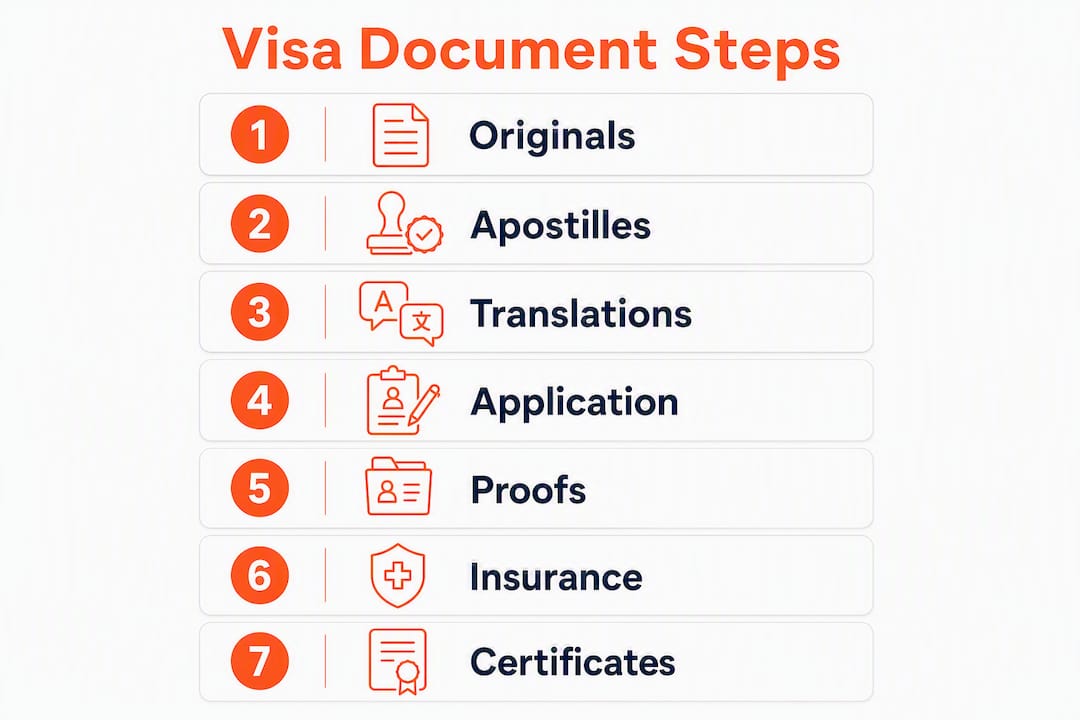
The universal checklist covers seven categories. Each one has a specific form the consulate expects, and getting the format wrong is just as costly as missing the document entirely.
Passport: Original with at least 12 months of remaining validity and two blank pages. Most consulates also want a photocopy of the bio-data page. Per BLS International’s consular checklist, the passport stays with the consulate during processing and is returned through the processing agency once the visa is stamped.
Visa application form: Each country has its own form. Spain requires both the national visa application form and the EX-01 temporary residence permit form, each completed and signed. Japan uses a standard consular application form available from the embassy or consulate website. Every section must be filled in, not left blank.
Passport photos: ICAO-compliant means white background, no glasses, full face visible, taken within the last six months. The BLS checklist enforces these specs strictly. Bring extras.
Proof of remote work: This is where applications get complicated. Employees need an employment contract and a signed employer letter confirming the remote arrangement. Freelancers and self-employed applicants need client contracts, recent invoices, and ideally a letter from their accountant or a business registration document. If you work for multiple clients, combine contracts and invoices to show consistent, ongoing income. The key is demonstrating that your work is genuinely remote and originates outside the destination country.

Proof of funds: Three to six months of bank statements is the standard. Some consulates also want payslips or a bank-issued income summary letter. Statements should show regular income deposits, not just a current balance. If you have multiple income streams, include statements for each account.
Health insurance: The policy document must show your name, coverage dates, the policy number, and that the insurer is licensed to operate in the destination country. For Spain, coverage must be comprehensive, with no co-payments and no coverage gaps. Bring the full policy, not just a summary card.
Criminal record certificate: Required from every country where you have lived for a significant period, typically one year or more. Most consulates specify the certificate must be issued within the last three to six months. The certificate must be apostilled (more on that in the authentication section), and for Spain, it must also be translated by a sworn translator if it is not in Spanish.
Pro Tip: Prepare a labeled file folder with a one-page index listing every document, its issue date, and whether it has been apostilled or translated. Consular officers process dozens of applications; a clean, indexed package speeds review and signals you know what you are doing.
What does Spain specifically require from U.S. applicants in 2026?
Spain’s digital nomad visa requirements go beyond the universal checklist. Here is the complete Spain-specific list:
- National visa application form — (signed by each applicant)
Spain income threshold: 2026 calculation
Note: The Spanish national minimum wage (SMI) is set by the Spanish government and subject to annual revision. Verify the current SMI figure with your consular district before applying, as these calculations are based on the most recently published rate.
Employees vs. self-employed: the responsible declaration difference
Employees need a signed letter from their employer confirming the remote work arrangement and a company certificate showing the employer is registered with Spanish social security. Self-employed applicants need proof of registration with RETA (Spain’s self-employed social security regime), plus client contracts and invoices that demonstrate ongoing remote income. This distinction trips up a lot of applicants. An employer letter that does not mention social security registration, or a freelancer who submits contracts without RETA proof, will typically get refused.
Foreign documents must be apostilled and, where required, accompanied by an official sworn translation into Spanish. That includes your criminal record, degree certificate, and any civil status documents for family members.
Pro Tip: Order your apostilles and sworn translations at the same time, not sequentially. The apostille process can take two to four weeks through your state Secretary of State; sworn translators need the apostilled original to produce a valid translation. Starting both simultaneously wastes time you do not have.
What does Japan require for a digital nomad arrangement?
Japan’s path for remote workers without a Certificate of Eligibility (COE) is less codified than Spain’s, but the Ministry of Foreign Affairs of Japan is clear about what applicants need to demonstrate.
Japan document checklist:
- Visa application form: — Completed consular form, available from the Japanese embassy or consulate
How to prove ¥10,000,000 in funds
A bank-issued income letter is the most accepted form of evidence. This is not a standard bank statement. It is a formal letter, printed on bank letterhead, signed by an authorized bank officer, summarizing your yearly earnings deposited to the account. Combine this with 12 months of bank statements and signed client contracts that show the total contract value. If your contracts are long-term (12+ months), include the full contract value in your supporting summary letter.
The COE route is more structured: a Japanese sponsor or employer applies to the Japan Immigration Services Agency on your behalf, and the COE is then presented at the consulate. Without a COE, the consulate has more discretion, which means your financial documentation needs to be airtight.
Pro Tip: Before submitting to a Japanese consulate, check the MOFA Japan website and your specific consulate’s page for any updated guidance. Japan’s digital nomad arrangements are still evolving, and consular requirements can differ by district.
How do you apostille, translate, and notarize documents from the U.S.?
The correct order is: get the original document, apostille it, then commission the sworn translation. Translating before apostilling is one of the most common and costly mistakes applicants make, because the sworn translator needs to work from the final, authenticated version of the document.
-
Identify the issuing authority. Each document has a specific issuing body. FBI criminal background checks are apostilled through the U.S. Department of State. State-level documents (birth certificates, state criminal records) are apostilled through your state’s Secretary of State office. University degrees are typically notarized by the institution and then apostilled at the state level.
-
Request the apostille from the correct authority. For U.S. documents, go to your state Secretary of State’s website for state-issued documents, or the U.S. Department of State’s Office of Authentications for federal documents. Consulates cannot apostille documents they issued; that responsibility falls to the local authorities in the country where the consulate is located.
-
Get the criminal record apostille right. For Spain, the apostille must certify the government authority’s signature on the criminal record, not a notary’s signature. An apostille that only authenticates a notary is rejected on sight. Request the FBI Identity History Summary (the standard federal background check) and apostille it through the U.S. Department of State.
-
Commission a sworn translation for Spain. Spain requires sworn translators who are officially accredited by the Spanish Ministry of Foreign Affairs. Check the official registry of sworn translators on the Spanish Ministry of Foreign Affairs website. Do not use a general translation agency unless they can confirm the translator holds this specific accreditation.
-
Request a bank-issued income letter. Contact your bank directly and ask for a formal letter on bank letterhead, signed by an authorized officer, summarizing your annual income. This is different from a standard account statement and usually requires a few business days to prepare.
-
Understand the distinction between apostille, legalization, and notarization. An apostille applies between countries that are party to the 1961 Hague Convention, which includes the U.S., Spain, and Japan. Legalization (also called consular legalization) is the older process used for countries outside the Convention. Notarization is a domestic process where a notary public certifies a signature or copy, but it does not replace an apostille for international use.
What document mistakes cause immediate visa refusal?
Most refusals come down to a short list of errors, and every one of them is preventable.
-
Missing apostille: Any foreign public document submitted without an apostille is refused immediately. This includes criminal records, degree certificates, and civil status documents. There are no exceptions for Spain.
-
Translation by a non-sworn translator: Spain will not accept translations from general agencies or bilingual individuals. The translator must be on the Spanish Ministry of Foreign Affairs’ official sworn translator registry. A translation that looks professional but lacks the sworn translator’s stamp and accreditation number is worthless at the consulate window.
-
Expired criminal record certificate: Most consulates require the certificate to be issued within the last three to six months. A certificate that was valid when you ordered it but expired by the time you submit is a refusal. Build in buffer time.
-
Apostille authenticating the wrong signature: As noted above, an apostille on a criminal record must certify the government authority’s signature, not a notary’s. This specific error is common with FBI background checks processed through third-party services.
-
Missing originals: Consulates only accept complete applications, and incomplete submissions are refused on the spot. Bring originals plus photocopies of every document. Do not assume a photocopy alone will suffice.
-
Insufficient proof of funds: Bank statements that show a high balance but no regular income deposits raise flags. Consulates want to see consistent income over time, not a lump sum. Combine statements with payslips, invoices, or a bank income letter.
-
Missing employer responsible declaration or RETA proof: For Spain, this is the single most common self-employed failure point. A contract alone does not confirm social security registration. Get the signed declaration or RETA certificate before you do anything else.
Pro Tip: Two days before your appointment, run a completeness check against the official consular checklist for your district. Lay every document on a table, match it to the checklist line by line, and confirm each one is apostilled (where required), translated (where required), and within its validity window. Then organize everything in a numbered binder with an index page at the front.
How long does the process take, and what will it cost?
The total timeline from starting document collection to receiving your stamped passport typically runs 10–16 weeks, though it can compress or extend depending on apostille processing times and consulate backlogs.
| Stage | Typical duration | Typical cost (USD estimate) |
|---|---|---|
| Document collection and employer letters | 1–2 weeks | Minimal (your time) |
| FBI background check | 2–4 weeks (standard) | ~$18 federal fee |
| Apostille (federal documents) | 6 weeks (standard) or 1–2 weeks (expedited) | state fees vary per document |
| Sworn translation (per document) | 1–2 weeks | per document fees vary widely |
| Consulate appointment scheduling | 1–4 weeks (varies by district) | Varies |
| Consulate processing (Spain) | 10 days to several weeks | visa fees vary by consulate |
| Passport return | 1–2 weeks after approval | Courier fee |
All USD figures are ballpark estimates; fees vary by state, service provider, and consulate. The Spain visa fee is denominated in euros as set by the Spanish government.
Pro Tip: Budget a contingency of $300–$500 for expedited background checks, translation rework, or additional consular requests. Apostille delays are the most common bottleneck; if your timeline is tight, pay for expedited processing from day one.
How do you prepare your documents and what should you bring to the appointment?
A timed plan keeps you from scrambling. Here is the sequence from eight weeks out through the day of your appointment.
- Two weeks out: — Review every document against the consular checklist for your district. Confirm your appointment date and any specific requirements your consulate has added. Prepare your cover letter (one page, summarizing your package, your contact details, and a brief description of your remote work).
Pro Tip: Write a one-page cover letter addressed to the consular officer. List every document in the order it appears in your binder, with a one-line description of each. Officers reviewing dozens of applications in a day will notice the clarity, and it reduces the chance of a document being overlooked.
How did Digitalnomadinspain verify this checklist?
This checklist was built by cross-referencing official Spanish consular guidance, the Spanish Ministry of Foreign Affairs’ digital nomad visa pages, the BLS International consular checklist PDF, the MOFA Japan visa information page, and direct client outcomes from Digitalnomadinspain’s application work.
- Spanish consular sources checked: The Spanish Consulate in Washington D.C. telework visa page, the Spanish Consulate in London digital nomad visa page, and the BLS International checklist PDF for the London consulate
- Japan source checked: MOFA Japan visa information page covering applicants without a Certificate of Eligibility
- Authentication guidance: The Hague Apostille and Legalization page from the Spanish Consulate in Chicago and sworn translation guidance from accredited translator sources
- Client outcomes: Practical advice on document order, translation vendors, and common fixes was informed by Digitalnomadinspain’s case experience across clients from over 50 countries, with a 98% success rate on Spain visa applications
Consular requirements change. The figures and document lists in this article reflect guidance current as of 2026, but consulates can update their checklists without notice. Always verify the checklist for your specific consular district the week before you submit.
Key Takeaways
Preparing a complete, correctly authenticated document package is the single most important factor in a successful digital nomad visa application, because incomplete or improperly apostilled submissions are refused on the spot.
| Point | Details |
|---|---|
| Start with originals and apostilles | Gather original documents first, then apostille them before commissioning any sworn translations. |
| Spain income threshold | Proof of funds must equal at least twice the Spanish national minimum wage, with supplements for family members. |
| Apostille the right signature | For criminal records, the apostille must certify the government authority’s signature, not a notary’s. |
| Japan funds threshold | Without a Certificate of Eligibility, demonstrate significant funds with a bank-issued income letter and client contracts. |
| Digitalnomadinspain | Offers full-service Spain visa document preparation, apostille coordination, sworn translation referrals, and consulate submission with a 98% success rate. |
When does it make sense to hire a specialist instead of doing it yourself?
DIY document prep works when your situation is straightforward: you have one employer, all your documents are U.S.-issued, you have time to manage the apostille and translation process yourself, and you are applying alone. If that describes you, the checklist above is enough to get started.
Hire a specialist when complexity enters the picture. Multiple countries of residence mean multiple criminal records, each needing its own apostille and translation. Self-employed applicants with several clients need a coherent income narrative across contracts, invoices, and RETA documentation that holds up under consular scrutiny. Family members add civil status documents, each requiring apostilles and translations. Anyone who needs fast processing, or who cannot afford a refusal and a restart, benefits from professional oversight.
The decision criteria worth thinking through:
- Do you have documents issued in more than one country?
- Are you self-employed with multiple clients rather than a single employer?
- Are you adding family members to the application?
- Do you need social security coordination (RETA registration, employer declaration)?
- Is your timeline tight enough that a single refusal would cost you significantly?
First-time applicants consistently underestimate how much the authentication sequence matters. Getting the apostille on the wrong document, or using a translator who is not on the Spanish Ministry’s registry, means starting over. That is a six-to-eight-week setback, minimum.
Digitalnomadinspain handles the document complexity so you don’t have to
Getting every document right, in the right order, with the right authentication, is the part of the Spain visa process that costs applicants the most time and the most refusals. Digitalnomadinspain’s full-service package covers exactly that: eligibility assessment, personalized document checklists, apostille coordination, sworn translation referrals, consulate appointment scheduling, application submission, and consulate follow-up.

The practical difference is that you hand over a complex, multi-step process to a team that has done it hundreds of times, with a 98% success rate and processing times that run roughly 30% faster than self-applicants typically achieve. That is not a marketing claim; it is the result of knowing which documents each consular district wants in which order, and catching errors before they reach the consulate window.
If you are ready to start, check your eligibility and review the Spain digital nomad visa service to see what the full-service package includes. Results depend on individual circumstances; applicants must provide accurate originals and complete information.
Authoritative sources to verify the latest Spain and Japan requirements
Before you submit, check these official pages directly for any updates to document lists, fees, or appointment procedures:
- Spanish Consulate in London (digital nomad visa page): — exteriores.gob.es/Consulados/londres — useful for income threshold details and authentication rules
- Spain’s One-Stop Platform for digital nomad visa applications: one.gob.es — official Spanish government portal for the digital nomad visa procedure
- MOFA Japan visa information: mofa.go.jp — the Ministry of Foreign Affairs page covering applicants without a Certificate of Eligibility
Check the specific consular district where you will apply, not just the general country page. Requirements can differ between districts, and the checklist PDF is the controlling document.
FAQ
How much money do you need for a Spain digital nomad visa?
Spain requires proof of funds equal to at least 200% of the Spanish national minimum wage for the main applicant, with an additional 75% for the first family member and 25% for each subsequent one. Verify the current SMI figure with your consular district, as the minimum wage is revised annually.
How hard is it to get a digital nomad visa?
The application is manageable if your documents are complete and correctly authenticated, but the apostille and sworn translation requirements catch many applicants off guard. Spain’s refusal rate for incomplete applications is high because consulates reject incomplete submissions on the spot.
How do you prove income for a digital nomad visa?
Employees should provide an employment contract and a signed employer letter confirming the remote arrangement; self-employed applicants need client contracts, recent invoices, and RETA registration proof for Spain. A bank-issued income letter summarizing annual earnings strengthens any application, and Japan’s consular guidance specifically calls for this type of letter alongside contracts.
What is the easiest digital nomad visa for U.S. citizens?
Spain’s digital nomad visa is one of the more accessible options for U.S. applicants because the U.S. is a Hague Convention country, which simplifies the apostille process, and the income threshold is clearly defined. The documentation requirements are specific but predictable once you understand the authentication sequence.
Do you need a sworn translator for the Spain visa?
Yes. Spain requires that all foreign-language documents be translated by a sworn translator officially accredited by the Spanish Ministry of Foreign Affairs. Translations from general agencies or bilingual individuals are not accepted, regardless of quality.