
Learn the key requirements for digital nomad visa eligibility in 2026. Ensure you meet all criteria to thrive while working remotely abroad.
Digital Nomad Visa Eligibility: Your 2026 Guide

Most remote workers earning a stable income from foreign clients, carrying comprehensive health insurance, and holding a clean criminal record will meet the baseline digital nomad visa eligibility requirements for the most popular destinations. The harder question is which country’s rules you actually satisfy, and whether your paperwork proves it convincingly.
Check these five must-haves before you do anything else:
- Proof of remote employment or self-employment with a non-local company (employee letter, contracts, or invoices)
- Minimum monthly income that clears the destination’s threshold (Spain’s is 200% of the IPREM; Brazil’s is roughly US$1,500/month)
- Comprehensive health insurance valid in the destination country, not a travel policy
- Clean criminal record from every country you’ve lived in for the past five years
- Valid passport with at least six months of validity beyond your intended stay
Your immediate next step: pull your last three months of bank statements and your current insurance policy, then run a quick eligibility check to confirm which route fits your situation before spending time on documents.
Key Takeaways
Meeting digital nomad visa eligibility comes down to four verifiable facts: your income clears the destination’s threshold, your insurance explicitly covers that country, your employment is provably remote, and your criminal record is clean.
| Point | Details |
|---|---|
| Income threshold varies by country | Spain requires 200% of the monthly IPREM; Brazil sets the floor at ~US$1,500/month. |
| Insurance must be comprehensive | 53 of 54 nomad visa routes require health insurance; travel policies are routinely rejected. |
| Spain’s 20% rule for self-employed | Freelancers may work for Spanish clients, but that income cannot exceed 20% of total activity. |
| U.S. tax obligations persist abroad | U.S. citizens must file federal returns on worldwide income; consult a tax pro before applying. |
| Digitalnomadinspain for Spain applications | The service achieves a high approval rate through complete document preparation and UGECE representation. |
Table of Contents
- What are the core digital nomad visa eligibility requirements?
- What documents do you need to apply?
- How do rules change for employees, contractors, and self-employed applicants?
- How do you prove income, and what counts as eligible funds?
- Which countries have the most distinct eligibility rules?
- What does the application process actually look like?
- What U.S. citizens need to know about taxes and social security
- My take on when to self-apply and when to get help
- Digitalnomadinspain handles the Spain complexity for you
- Sources
- FAQ
What are the core digital nomad visa eligibility requirements?
Nearly every digital nomad visa program worldwide converges on the same five criteria. Knowing them lets you self-assess in minutes.
- Remote employment or self-employment proof. You must show that your income comes from a company or clients outside the destination country. An employee letter on company letterhead, a signed contract, or a portfolio of invoices all work, depending on your status.
- Minimum provable income. Every country sets a floor. Spain uses a percentage of its minimum wage index; others set a flat monthly figure. The number must be documentable, not just claimed.
- Comprehensive health insurance. 53 of 54 long-stay and digital-nomad visa routes require health insurance, and most reject standard travel policies. Spain specifically requires coverage equivalent to its national health system.
- Clean criminal record. Most consulates want a background check from your home country and any country where you’ve lived for more than six months in the past five years.
- Passport validity. Your passport typically needs to be valid for at least six months beyond your planned entry date, and some consulates require it to have blank visa pages.
Some routes add a sixth criterion: a university degree or a minimum of three years’ professional experience in your field. Spain’s telework visa is the clearest example. Portugal’s D8 and Estonia’s nomad visa do not impose this requirement, which is worth knowing if your background is non-traditional.
Pro Tip: The two items that cause the most denials are insurance and documented income. Buy your insurance policy before you gather any other document, and make sure the policy certificate explicitly states the coverage territory and that it has no coverage gaps. Then pull your bank statements and income records at the same time, so you can spot a shortfall early.
What documents do you need to apply?
The full document checklist for U.S. applicants is longer than most people expect. Here is what you need to prepare before your consulate appointment.
Documents required at application:
- Valid passport plus copies of the bio-data page
- Recent passport-sized photos (check the exact format your consulate specifies)
- Criminal background check from the FBI and from any country where you’ve lived for six or more months in the past five years
- Proof of remote employment: employer letter, signed contract, or a portfolio of client invoices
- Bank statements covering the past three to six months, showing income above the threshold
- Health insurance certificate showing coverage in the destination country, policy limits, and validity dates
- Proof of residence in the consular district you’re applying through
- Degree certificate or evidence of three or more years’ professional experience (required for Spain; check for your target country)
Documents often needed after arrival:
- Social-security responsible declaration (Spain requires this before you begin working)
- NIE registration (Spain’s foreigner identification number, obtained in-country)
- TIE card application (Spain’s biometric residence card, filed after entry)
- Local tax registration if you become a Spanish tax resident
Foreign documents almost always need an apostille. The apostille is a standardized certification that verifies a document’s authenticity for use in countries that are signatories to the Hague Convention. FBI background checks, for example, require an apostille from the U.S. Department of State before a Spanish consulate will accept them. Certified translations into Spanish are required for any document not originally in Spanish. Use a sworn translator, not a general translation service, because consulates will reject uncertified translations.
Pro Tip: Order your FBI background check through the FBI’s Identity History Summary service and request the apostille from the U.S. Department of State at the same time. The combined process takes four to eight weeks, so start it the moment you decide to apply.
How do rules change for employees, contractors, and self-employed applicants?
Your employment status shapes both the documents you submit and the local-work restrictions you’ll face. Getting this wrong is one of the most common reasons for a request for supplementary documentation.
Employees need a letter from their employer on company letterhead confirming remote work authorization, the start date of employment (most consulates want at least three months of seniority), the nature of the role, and explicit permission to work from abroad. The employer’s company registration documents are sometimes requested as well.
Self-employed applicants and contractors face a heavier documentation burden. You’ll need commercial contracts with your clients, a portfolio of recent invoices, bank statements showing consistent deposits, and, if you operate through a registered entity, your company registration certificate. Continuity matters: a single large contract looks weaker than six months of recurring invoices from multiple clients.
Spain’s 20% rule is the most consequential country-specific constraint for self-employed applicants. Under Spain’s telework visa framework, self-employed individuals may work for Spanish-based companies, but that Spanish-origin work cannot exceed 20% of their total professional activity. In practice, this means your Spanish client revenue must stay below one-fifth of your total income. If you’re a freelancer with a mix of U.S. and Spanish clients, document the income split clearly in your application. Consulates have asked for annotated invoice portfolios showing the percentage breakdown.
Employee document set (summary):
- Employer letter with remote-work authorization
- Employment contract
- Three months of pay stubs
- Employer’s company registration (if requested)
Freelancer/contractor document set (summary):
- Signed client contracts
- Six months of invoices
- Bank statements showing deposits
- Company registration certificate (if applicable)
- Accountant’s letter confirming annual income (recommended for Spain)
How do you prove income, and what counts as eligible funds?
Income proof is where applications fall apart most often. The standard is not just showing that money arrived in your account; it’s showing that the income is stable, recurring, and above the threshold.
Accepted forms of income evidence:
- Pay stubs from an employer (three to six months)
- Employer letter stating annual salary
- Bank statements showing regular deposits
- Long-term client contracts with stated fees
- Invoices and corresponding bank receipts
- Accountant’s certified statement of annual income (especially useful for self-employed applicants)
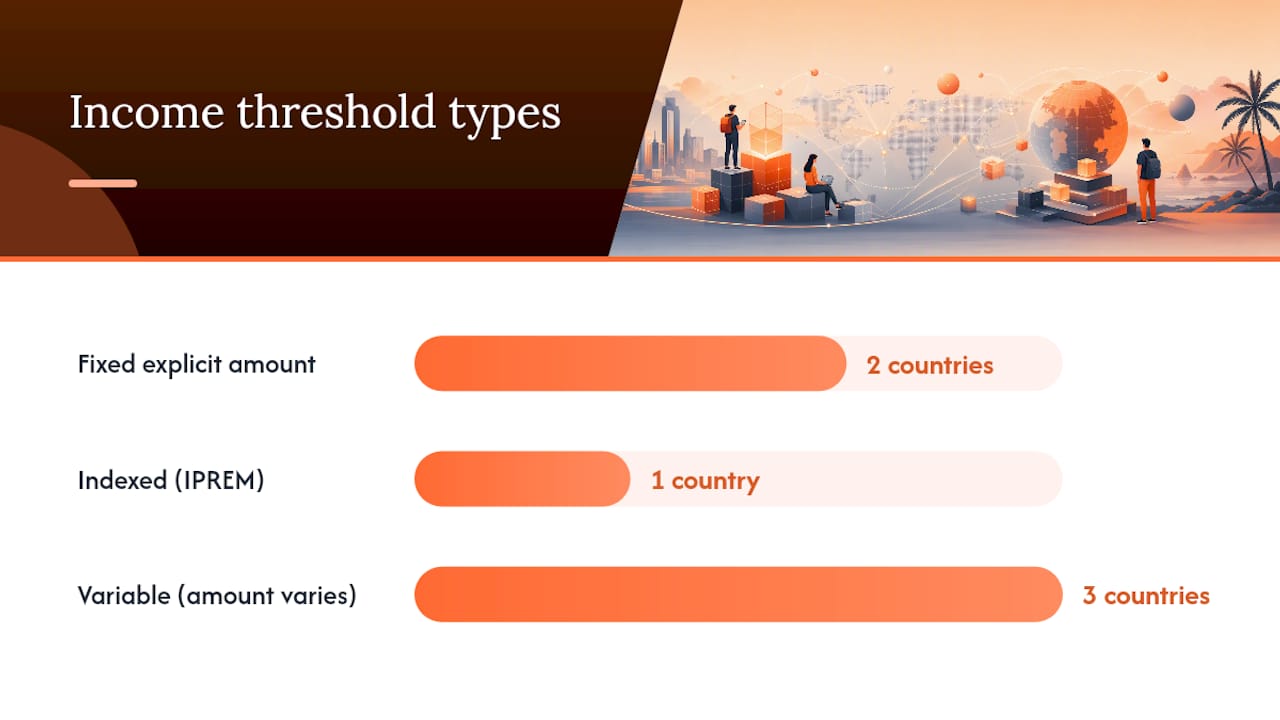
Countries measure minimums differently. Spain ties its threshold to the IPREM (the Spanish public income indicator of multiple effects), requiring financial means equal to 200% of the monthly Spanish minimum wage. That figure updates annually, so always verify the current IPREM value at the time you apply. Brazil sets a flat floor of around US$1,500 per month or an equivalent bank balance. Mexico’s consulates typically look for stable monthly income or a savings balance, with the exact figure varying by consulate.
When your income is in U.S. dollars and the threshold is in euros, convert at the exchange rate on your application date and document that rate. Print a screenshot from a recognized source (the European Central Bank or a major bank’s published rate) and include it with your bank statements.
| Country | Income threshold | Insurance requirement |
|---|---|---|
| Spain | 200% of monthly IPREM | Comprehensive, equivalent to national system |
| Cyprus | €3,500 net/month | Comprehensive health insurance |
| Brazil | A specified minimum monthly income or equivalent bank balance | Valid in Brazil |
| Mexico | Stable income or savings (consulate-specific) | Health insurance recommended |
| Estonia | Stable remote income (amount varies) | Comprehensive health insurance |
| Croatia | Stable remote income (amount varies) | Comprehensive health insurance |
Which countries have the most distinct eligibility rules?
Portugal D8 visa
Portugal’s D8 is one of the more accessible routes for U.S. applicants. It does not require a degree or years of experience, and the income threshold is lower than Spain’s. Health insurance and proof of remote income are still required. The D8 is applied for at a Portuguese consulate before entry.
Mexico temporary resident visa
Mexico’s Temporary Resident Visa is a practical option for remote workers who want a North American base. Consulate requirements vary more than in Europe, so check with the specific Mexican consulate in your U.S. city. Income proof via bank statements or pension documentation is the standard approach.
Brazil VITEM XIV
Brazil’s VITEM XIV grants an initial residency period of up to one year and allows remote professional activity. You’ll need proof of income at approximately US$1,500 per month or a bank balance covering a year’s equivalent, plus health insurance valid in Brazil and a clean criminal record.
Cyprus digital nomad permit
Cyprus requires a minimum net monthly income of €3,500 and initially caps the number of permits at 500. Family members can join you but cannot work locally under the same permit. The income bar is the highest of the common routes, which makes Cyprus a better fit for senior remote professionals than for early-career freelancers.
Estonia and Croatia
Both Estonia and Croatia publish clear temporary-stay routes for digital nomads, each requiring comprehensive health insurance and proof of stable remote income. Estonia’s route is particularly well-documented and appeals to tech-sector workers already familiar with its e-Residency program.
Spain: the deep dive
Spain’s telework visa is the most structured and document-intensive of the common routes. The Spanish consulate’s official guidance requires a graduate or postgraduate degree from a recognized institution, or at least three years of relevant professional experience. Health insurance must be comprehensive and equivalent to Spain’s national system, not a basic travel policy.
Spain also distinguishes between two pathways: the one-year telework visa and a residence permit valid for up to three years. If you’re already legally in Spain, you may be able to apply directly for the longer residence permit, skipping the one-year visa entirely. That distinction changes your document strategy and your timeline significantly.
The social-security responsible declaration is a step many applicants underestimate. Spain’s consulate guidance requires a signed declaration committing to comply with Spanish social-security obligations. If you’re covered by a portability agreement between the U.S. and Spain, you’ll need a certificate from the U.S. Social Security Administration confirming that coverage. Getting this wrong, or submitting a vague declaration, is one of the most common reasons Spain applications stall at the UGECE unit.
Pro Tip: Prepare both a degree-based and an experience-based evidence package for Spain. Consulates interpret the degree-or-experience requirement differently, and having both ready means you won’t lose weeks responding to a supplementary documentation request.
For a complete, updated Spain checklist, the 2026 Spain Digital Nomad Visa requirements guide covers every document in detail.
What does the application process actually look like?
The steps below apply broadly, with Spain used as the primary example.
- Run an eligibility check. Confirm your income, employment status, and insurance meet the destination’s threshold before spending money on documents.
- Gather and legalize documents. Order your FBI background check with apostille, collect three to six months of bank statements, and get your insurance policy certificate. Allow four to eight weeks for the background check.
- Get certified translations. Any document not in Spanish needs a sworn translation. Budget one to two weeks for this step.
- Book your consulate appointment. U.S. applicants apply at the Spanish consulate in their consular district. Appointment availability varies; book as early as possible.
- Submit your application and pay fees. Consulate fees for Spain’s telework visa are set by the consulate and payable at submission. Check the current fee schedule directly with your consulate.
- Wait for a decision. Processing typically takes several weeks. The consulate may request additional documents during this period.
- Enter Spain and complete post-arrival steps. After entry, register for your NIE, apply for your TIE card, and file your social-security responsible declaration before you begin working.
90-day countdown checklist:
- 90 days out: order FBI background check with apostille; confirm insurance policy meets Spain’s standard
- 60 days out: gather bank statements, contracts, and invoices; get certified translations underway
- 30 days out: book consulate appointment; prepare the social-security declaration draft
- 7 days out: organize originals and copies in the order the consulate checklist specifies; double-check passport validity
What U.S. citizens need to know about taxes and social security
This is the section most applicants skip, and it’s the one that creates the most expensive surprises.
U.S. citizens and green card holders must file a U.S. federal tax return and report worldwide income, regardless of where they live or work. Moving to Spain does not suspend your IRS filing obligation. IRS Publication 54 covers the Foreign Earned Income Exclusion (FEIE) and the Foreign Tax Credit (FTC), both of which can reduce your U.S. tax liability when you’re paying taxes in Spain.
Key points for U.S. applicants:
- FEIE and FTC are not automatic. You must claim them on your return. The FEIE requires meeting either the bona fide residence test or the physical presence test.
- Spain may also tax you. If you spend more than 183 days in Spain in a calendar year, you become a Spanish tax resident and owe Spanish income tax on worldwide income. The U.S.-Spain tax treaty provides some relief, but it does not eliminate double-filing obligations.
- Social-security portability. The U.S. and Spain have a totalization agreement. If your U.S. employer continues to pay U.S. Social Security taxes on your behalf, you may be exempt from Spanish social-security contributions. You’ll need a certificate of coverage from the Social Security Administration to prove this.
- FBAR and FATCA. If you hold more than $10,000 in foreign bank accounts at any point during the year, you must file an FBAR. FATCA thresholds are higher but also apply.
Consult a U.S. international tax professional before you apply if your income structure is complex. The cost of a consultation is small compared to the cost of a missed filing or an incorrect FEIE claim.
My take on when to self-apply and when to get help
The self-apply route works well for applicants with straightforward situations: a single employer, a salary clearly above the threshold, a clean criminal record, and no prior visa complications. If that’s you, the document checklist in this guide and the official consulate pages give you everything you need.
Where it gets genuinely difficult is Spain, specifically the social-security declaration and the UGECE submission. These are not bureaucratic formalities; they’re substantive legal declarations that consulates scrutinize. Applicants who draft them vaguely, or who miss the portability certificate requirement, regularly receive requests for supplementary documentation that add months to their timeline.
My practical recommendation for this week: gather your employer letter or three months of invoices, confirm your insurance policy explicitly covers Spain with no deductible gaps, and pull your FBI background check. Those three actions clear the biggest bottlenecks. If the social-security piece looks complicated, or if your income is self-employed and partially from Spanish clients, bring in professional help before you submit, not after a rejection.
Digitalnomadinspain handles the Spain complexity for you
The service covers every step that trips up self-applicants: a full eligibility assessment, a personalized document checklist, sworn translations, the social-security responsible declaration, UGECE and UGE representation, consulate submission, and post-arrival support for your NIE, TIE card, and tax registration. Clients from over 50 countries have used this process, and applications typically move 30% faster than self-submissions because the documents arrive complete the first time.
If you’re ready to confirm whether you qualify and what your next step is, start with a free eligibility check and get a clear answer before you spend a dollar on documents.
Sources
Visa rules change without notice. Verify every detail on the destination’s official government page before you submit.
- Telework (Digital nomad) Visa - Consular Section
- ONE Platform – Application for digital nomad visa
- VITEM XIV (Digital nomad) — Brazilian consular guidance
- Taxpayers living abroad — IRS
Visa requirements change frequently. Always confirm current rules directly with the official consulate or government immigration authority for your destination before applying.
This article is general information, not a substitute for advice from a qualified lawyer. Consult a qualified legal professional about your own circumstances before acting on anything here.
FAQ
How do I qualify for a digital nomad visa?
You typically need proof of remote employment or self-employment with a non-local company, income above the destination’s minimum threshold, comprehensive health insurance valid in that country, a clean criminal record, and a valid passport. Some countries, including Spain, also require a university degree or at least three years of relevant professional experience.
How hard is it to get a digital nomad visa?
Difficulty varies by country and applicant profile. Portugal’s D8 and Mexico’s Temporary Resident Visa are generally more accessible; Spain’s telework visa is more document-intensive, particularly because of the social-security responsible declaration and the UGECE review process. Applicants with complete, correctly legalized documents move through significantly faster.
Which country is easiest to get a digital nomad visa?
Portugal’s D8 visa is widely considered one of the more accessible routes for U.S. applicants because it does not require a degree or years of experience, and its income threshold is lower than Spain’s. Mexico’s Temporary Resident Visa is another practical option, though consulate requirements vary by location.
Do digital nomads pay U.S. taxes?
Yes. U.S. citizens and green card holders must file a federal tax return reporting worldwide income regardless of where they live. The Foreign Earned Income Exclusion and Foreign Tax Credit, both detailed in IRS Publication 54, can reduce the U.S. tax owed, but neither eliminates the filing obligation. A U.S. international tax professional can help you structure your situation correctly before you relocate.