
Avoid digital nomad visa rejection by matching consulate wording and insurer authorization. Read a step by step checklist and country examples.
Why Consulates Reject Insurance Wording for Digital Nomad Visas

Most digital nomad and long-stay visas require health insurance that goes well beyond a standard travel policy, and the single factor that decides approval or rejection is not the brand you buy from but the policy’s exact wording and certificate format. Before you shop, pull up your target consulate’s official checklist and match your policy against it line by line. Buy the wrong product and you can lose weeks resubmitting paperwork.
TL;DR:
- Most digital nomad and long-stay visas require insurance policies that explicitly meet the consulate’s exact wording, not just broad coverage or recognition.
- International private medical insurance plans with no deductibles, full coverage, and proper certificates in the required language are the most reliable for visa approval.
- Policies must align with specific country requirements, such as Spain’s strict demand for insurer authorization, unlimited coverage, and Spanish-language certificates.
- Short-term travel insurance typically does not satisfy the long-term, comprehensive coverage criteria needed for visa approval.
- Applicants should verify insurer authorization, full policy coverage period, and certificate wording before purchasing to avoid common rejection triggers.
Table of Contents
- Which Visas Require Digital Nomad Visa Insurance (and the Three Common Patterns)
- Travel Insurance vs. Nomad Insurance vs. International (Expat) Health Insurance
- How to Choose a Visa-Compliant Health Insurance for Travelers Plan
- Country Examples: How Real Consulate Requirements Differ
- What Digital Nomad Visa Insurance Actually Costs
- Getting the Paperwork Right: Certificates, Wording, and Submission
- How to Handle Insurance Claims While on a Digital Nomad Visa
- Common Limitations and Exclusions in Digital Nomad Visa Insurance Plans
- Renewing or Extending Coverage for Longer Stays
- Why Specialist Visa Support Reduces Insurance-Related Rejections
- Let Us Handle the Insurance Paperwork for Your Spain Visa
- Sources
- FAQ
Which Visas Require Digital Nomad Visa Insurance (and the Three Common Patterns)
A comparative review of 54 long-stay and digital-nomad visa routes found that most require proof of health insurance before approval. Only one route skipped the requirement entirely. That is not a coincidence. Immigration authorities need assurance that a foreign resident will not become a burden on the public health system, and insurance is the easiest way to check that box on paper.
The requirements themselves are not uniform, though. Reading through consulate checklists for dozens of countries turns up three recurring patterns:
- Minimum coverage amount. Some visas simply set a floor, such as a baseline minimum coverage amount for medical and repatriation expenses for short-stay visas.
- Insurer authorization or territory restriction. Roughly a third of the routes studied require the insurer to be licensed or authorized specifically within the destination country, not just “internationally recognized.”
- Full comprehensive cover with no copay or deductible. The strictest category, which includes Spain’s digital nomad and non-lucrative visas, requires policies that effectively mirror national health coverage.
That last pattern is why generic travel insurance so often fails. A policy built to reimburse you for a broken ankle on a two-week vacation was never designed to prove ongoing, deductible-free coverage for a year or more. Consulates know the difference, and reviewing officers are trained to spot it.
Travel Insurance vs. Nomad Insurance vs. International (Expat) Health Insurance
These three product categories get lumped together constantly, but they solve different problems, and only one or two of them will satisfy a visa officer.
Short-term travel medical insurance covers emergencies during a defined trip window, usually capped at a short trip duration. The CDC notes that travel insurance typically covers emergency medical costs abroad but was never built to replace long-term health coverage for someone actually living in another country. It rarely covers routine checkups, and it almost never issues the specific certificate language consulates ask for.
Nomad or multi-trip insurance sits in the middle. It renews automatically, covers repeated border crossings, and often includes higher limits than travel policies. But many nomad plans still carry per-trip caps or exclude the kind of continuous, single-country coverage a residency visa wants to see.
International private medical insurance (IPMI), sometimes called expat insurance, is built for people relocating for a year or more. It typically includes routine and preventive care, mental health support, maternity add-ons, and, critically, the ability to issue a formal visa certificate in the format a consulate expects.
Here is the number that should reset how you shop: expat and higher-tier nomad plans are the products that most reliably clear visa checks, and the most common applicant mistake is buying a travel-only policy or one with a hidden per-trip cap. Common rejection triggers include:
- Certificates that list a per-incident limit instead of an annual aggregate.
- Policies with a stated deductible or copayment when the visa rules demand zero.
- Coverage windows that expire before the visa’s full validity period.
How to Choose a Visa-Compliant Health Insurance for Travelers Plan
Work through this checklist in order. Skipping steps is how applicants end up buying a policy, only to discover it does not qualify.
- Read the consulate’s exact wording first. Do not rely on a summary from a forum or a blog. Pull the official requirement text, since one phrase like “insurer authorized in [country]” eliminates half the market instantly.
- Confirm insurer authorization or territory. Some governments publish an approved insurer list. Others simply require the policy to be “valid” or “licensed” in-country. Email the insurer and ask directly whether they are authorized to operate there.
- Match the policy term to your full visa period. If the visa grants one year, the policy must cover the full year from day one, not renew mid-term with a coverage gap.
- Verify there is no deductible or copay, if required. Spain’s rules are explicit here. Other countries are more flexible, but always check.
- Check repatriation and medical evacuation coverage. Many minimum-coverage policies underfund this feature, yet it is often the single most valuable clause if you need emergency transport home.
- Request the consulate-formatted certificate in the required language before you pay in full. Some insurers can only produce a generic policy summary, which will not pass.
When emailing an insurer, ask precisely: “Can you issue a certificate stating this policy meets [country]'s visa requirement for continuous coverage with no deductible?” If they hesitate or need to check with underwriting, that is a signal to keep shopping.
Pro Tip: Get the certificate wording confirmed in writing before you pay the full annual premium. Refund policies on international health plans are often stricter than domestic ones, and a mismatched certificate discovered after payment can cost you both time and money.
For U.S.-based applicants, pay attention to currency conversion fees on international transfers, keep a PDF and printed copy of every document, and request translations early since some consulates require officially certified versions, not just a translated PDF you made yourself; also consider guidance on life insurance for non citizens to understand documentation and eligibility details.
Country Examples: How Real Consulate Requirements Differ
Spain is the strictest common example. The digital nomad visa and non-lucrative visa both require private insurance issued or authorized within Spain, with no copayments or deductibles, unlimited or near-unlimited coverage, and a certificate written in Spanish. A U.S. travel insurance printout, no matter how comprehensive it looks, gets rejected here almost every time.

Portugal and Greece take a looser approach for some categories, often accepting international policies as long as they meet a minimum sum insured and cover the full national territory. Schengen-area short-stay visas generally default to the €30,000 minimum baseline rather than demanding a specific national insurer.
Outside Europe, the pattern shifts again:
- Costa Rica asks for proof of coverage tied to a minimum monthly amount, with less emphasis on insurer authorization.
- Thailand’s long-stay categories focus heavily on full-period validity, meaning a policy that lapses one month before your visa does will not clear review.
- Several other non-EU programs weight repatriation and evacuation cover heavily, since local hospital networks may be limited outside major cities.
The lesson across all of these: read the specific country’s rule rather than assuming what worked for a friend’s Portugal application will work for your Spain one.
What Digital Nomad Visa Insurance Actually Costs
Premiums vary enormously by age, territory, and whether the plan includes routine care, but a few patterns hold. Entry-level travel medical policies often run the cheapest per month, but they exclude the features most digital nomad visas require, so the low price is misleading if the policy will not pass consulate review.
Mid-range nomad and IPMI plans typically cost more, scaling with age and the breadth of coverage. Full comprehensive plans built specifically for visa compliance, no deductible, wide network, evacuation included, sit at the top of the range, and pricing climbs noticeably for applicants over 60 or those with preexisting conditions.
A few ways to keep costs reasonable without sacrificing compliance:
- Pay annually instead of monthly where insurers offer a discount for it.
- Ask about family or partner bundle rates if you are relocating with a spouse.
- Trim optional riders like dental or vision if the visa does not require them, but never cut the required deductible-free or repatriation clause to save money.
Getting the Paperwork Right: Certificates, Wording, and Submission
Once you have a policy, the documentation step is where a lot of applications still stumble. Request these specific items from your insurer:
- A visa certificate using the consulate’s own required wording, not a generic “certificate of insurance.”
- The policy number and a stated coverage period that matches your visa’s full validity, with no gap.
- A written statement confirming zero copays and deductibles, if your target country requires it.
- The repatriation and medical evacuation clause, spelled out rather than implied.
- Proof of insurer registration or authorization in the destination country, if the visa rules call for it.
For Spain specifically, the compliant policy must run a minimum of 12 months, carry no copayments, cover the full national territory, and arrive with a Spanish-language visa certificate. Check the printed certificate against the consulate checklist before your appointment, not after.
If your current insurer cannot produce the correct wording, you have three options: switch to a provider that specializes in visa-compliant policies, hire a certified translator to convert an existing certificate, or work with a visa specialist who already knows which insurers issue acceptable documentation.
How to Handle Insurance Claims While on a Digital Nomad Visa
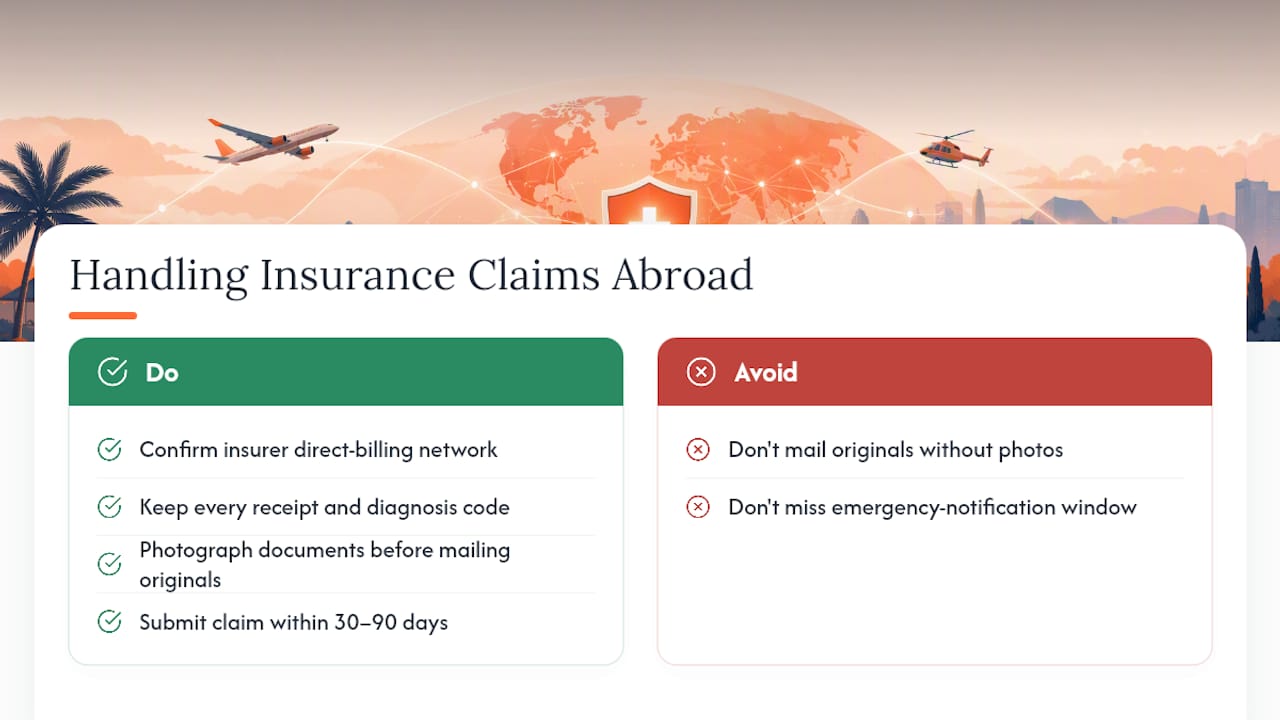
Filing a claim from abroad works differently than filing one at home, and the process depends heavily on whether your insurer has a direct billing network in your host country. Many IPMI providers maintain hospital partnerships that let you skip the reimbursement wait entirely; the hospital bills the insurer directly, and you only pay any applicable copay at the point of care.
If your plan does not have direct billing where you are staying, expect a reimbursement model: pay upfront, keep every receipt and diagnosis code, and submit a claim form within the insurer’s stated window, which is often 30 to 90 days from treatment. Photograph documents before mailing originals, since international mail can be slow and unreliable.
Keep a digital folder with your policy number, the insurer’s international claims hotline, and a translated summary of your coverage terms. If you need to care in a country where you do not speak the language, many insurers offer 24/7 multilingual assistance lines specifically to help you navigate local hospitals and confirm coverage before treatment starts.
One detail applicants overlook: some visa-compliant policies require you to notify the insurer within a set number of hours of an emergency admission, even if you are unconscious or unable to call immediately. Ask your insurer what their notification grace period looks like and put it in writing somewhere your travel companions or emergency contacts can find it.
Common Limitations and Exclusions in Digital Nomad Visa Insurance Plans
Even a policy that satisfies a consulate’s checklist can carry exclusions that surprise you later. Preexisting conditions are the most frequent one. Many visa-compliant plans will cover new illnesses and accidents but exclude anything diagnosed before the policy started, unless you pay for a specific preexisting-condition rider.
Extreme sports and high-risk activities are commonly excluded too, which matters if your version of remote work includes surfing, skiing, or scuba diving on weekends. Mental health coverage varies widely; some plans include therapy sessions as a standard benefit, others treat it as an expensive add-on, and a few exclude it entirely.
Dental and vision are almost never included in base plans built for visa compliance, since consulates typically care about emergency and primary medical coverage, not routine dental cleanings. Pregnancy and maternity coverage often carries a waiting period of six months to a year, so if you are planning a family during your stay, check this early rather than assuming standard coverage applies.
Finally, watch for age-band exclusions. Some policies cap enrollment or coverage generosity once you cross 65 or 70, which matters for retirees pursuing a non-lucrative visa rather than a digital nomad one specifically. Read the policy wording, not just the marketing summary, before you assume a gap does not apply to you.
Renewing or Extending Coverage for Longer Stays
Plans change. What starts as a one-year digital nomad visa often turns into an extension, a switch to permanent residency, or simply a longer stay than you originally budgeted for. Your insurance needs to keep pace with that shift.
Start the renewal conversation with your insurer at least 60 days before your policy expires, especially if your visa extension is still pending. Some insurers require proof of continuous coverage with no lapse, and even a short gap between an old policy and a new one can create problems at your next residency renewal appointment.
If your visa status changes, say, moving from a digital nomad visa toward long-term residency, your insurance requirements may shift too. A policy that satisfied a one-year nomad visa may not meet the more comprehensive standard some countries require for a multi-year residency renewal. Check the new requirement early rather than assuming your existing plan still qualifies.
Keep every renewal certificate in the same consulate-formatted language and structure as your original submission. Immigration offices often want to see an unbroken paper trail showing coverage from your first entry date through your current renewal, and a mismatched format between your original and renewal certificates can trigger unnecessary questions.
Why Specialist Visa Support Reduces Insurance-Related Rejections
Insurance paperwork is one of the most common reasons digital nomad and non-lucrative visa applications stall, not because applicants lack coverage, but because the coverage does not match what the consulate specifically asked for. That gap between “I have insurance” and “I have the right insurance, worded the right way” is where most rejections actually happen.
Digitalnomadinspain specializes in guiding remote workers, freelancers, and retirees through Spain’s Digital Nomad Visa and Non-Lucrative Visa process, including document preparation and personalized consultations tailored to each applicant’s situation. The firm reports a 98% success rate on visa applications, attributed to deep familiarity with Spanish immigration procedure, and processing that runs roughly 30% faster than typical self-filed applications. Clients from more than 50 countries have used that support to move through Spain’s residency process without the insurance-related back-and-forth that trips up so many DIY filers.
— Joshua
Let Us Handle the Insurance Paperwork for Your Spain Visa
Chasing down the right certificate wording, confirming insurer authorization, and translating documents into the format a Spanish consulate expects eats hours you could spend actually planning your move. Digitalnomadinspain builds insurance verification directly into the visa application package, checking your policy wording against current consulate requirements and requesting the correctly formatted certificate before submission, so you are not the one discovering a mismatch at your appointment.

Clients working with the team get document preparation, translation support, consulate follow-up, and a lower risk of rejection tied to paperwork errors, insurance included. If you are planning to apply for Spain’s Digital Nomad Visa, start with a free eligibility check to see where your current documentation, insurance included, stands before you submit anything.
Sources
Confirm every insurance detail against a primary source, not a secondhand summary, before you commit to a policy.
- VisaFact — Health-insurance requirements for long-stay and digital-nomad visa routes
- CDC — Health care abroad: travel insurance
- Feather — Digital nomad health insurance guide
- SpanishVisaHealthInsurance — Travel insurance vs health insurance for Spain visa
This article is general information, not a substitute for advice from a qualified doctor. Consult a qualified healthcare professional about your own circumstances before acting on anything here.
FAQ
How Much Does Digital Nomad Insurance Cost?
Costs vary by age, territory, and features, but plans built for visa compliance, no deductible, full comprehensive cover, typically cost more than basic travel medical policies because they cover far more than short emergencies.
What Is the Best Travel Insurance for Digital Nomads?
Standard travel insurance is rarely the right product for a visa application at all; international private medical insurance (IPMI) or higher-tier nomad plans more reliably meet consulate requirements for continuous, comprehensive coverage.
What Happens if I’m on Vacation Internationally and I Have Regular U.S. Health Insurance?
Most domestic U.S. health plans provide little to no coverage outside the country, which is why the CDC recommends dedicated travel or international insurance for any trip abroad, vacation or otherwise.
What Is the Best Health Insurance for Digital Nomads Applying for a Visa?
The best option is whichever policy matches your target consulate’s exact wording, insurer authorization, no-deductible rules, and full-period validity; for Spain specifically, that means a Spanish-authorized private policy with a Spanish-language certificate, not a generic international plan.
Can I Use My Existing Expat Insurance for a New Digital Nomad Visa?
Sometimes, but only if it meets the new country’s specific rules on insurer authorization, deductibles, and coverage period; always request an updated certificate rather than assuming your existing policy documentation will transfer automatically.