
The U.S. has no digital nomad visa. Learn five legal pathways to live and work in New York, why the O-1 with a U.S. agent fits many remote professionals,...
No Digital Nomad Visa in New York: 5 Legal Routes and the O-1 Agent

There is no digital nomad visa for New York or anywhere else in the United States. If you want to live in New York while working remotely for a foreign employer or your own overseas business, you’re choosing between a visitor entry that grants no work authorization, or a real work visa like the O-1, H-1B, E-2, or L-1. For accomplished remote professionals, an O-1 filed through a U.S. agent is often the closest functional equivalent, and it’s worth understanding before you book a one-way ticket.
TL;DR:
- Remote workers aiming to stay long-term in New York need a work visa like the O-1 or H-1B, as no digital nomad visa exists in the U.S.
- Visitor visas such as ESTA or B-2 strictly prohibit performing paid work while physically in the country, risking denial at entry and future bans if violated.
- The O-1 visa, filed through a U.S. agent, is the most viable option for accomplished freelancers and consultants with foreign clients, but requires extensive documentation and planning.
- Most U.S. work visas involve high costs, lengthy processing times, and must be filed before arriving in New York, not as a casual or post-entry application.
- Outside the U.S., over 50 countries, including Spain, now offer dedicated digital nomad visas designed for remote income and easier application processes.
Table of Contents
- Digital Nomad Visa in New York: Why It Doesn’t Exist and What to Do Instead
- Visitor Entries: What ESTA and B-2 Actually Let You Do
- Work Visas That Let You Live and Work in New York Legally
- The O-1 With a U.S. Agent: How It Actually Works for Remote Professionals
- Living the Digital Nomad Lifestyle in NYC: What It Actually Costs
- How to Plan Your Application Step by Step
- What Nobody Tells You About Chasing a U.S. Remote-Work Visa
- How Digitalnomadinspain Helps If Spain Fits Your Situation Better
- Sources
- FAQ
Digital Nomad Visa in New York: Why It Doesn’t Exist and What to Do Instead
Search “digital nomad visa New York” and you’ll find plenty of blog posts implying the U.S. has caught up with Portugal, Spain, or Costa Rica. It hasn’t. Congress has never created a visa category for someone who wants to sit in a Brooklyn coworking space and bill clients in Berlin. That gap is exactly why the topic generates so much confusion, and why so many remote workers accidentally violate their entry status without realizing it.
The practical reality is that you have to fit yourself into a visa category that already exists, built for a different purpose, and hope your situation qualifies. That means every remote worker eyeing New York falls into one of three buckets.
- Short visit, no work authorization needed: You’re coming for weeks, not months, and you can legitimately avoid any U.S.-source work while here.
- Long-term remote presence, work-authorized: You have a profile strong enough for O-1, H-1B, E-2, or L-1, and you’re willing to go through a formal petition.
- Pathway to residency: You want to eventually settle permanently, which points toward employment-based green card categories rather than a temporary nomad arrangement.
The decision heuristic is simple even if the paperwork isn’t: figure out how long you actually need to stay and whether any of your income touches U.S. soil, then work backward to the visa category that matches. Guessing your way through this with a tourist entry is how people end up with a stamped passport and a five-year ban.
Visitor Entries: What ESTA and B-2 Actually Let You Do
The Visa Waiver Program, accessed through ESTA for eligible passport holders, allows a stay of up to 90 days. The B-1/B-2 visitor visa, available to nationals who don’t qualify for the waiver program or who want more flexibility, generally permits stays of up to about six months. Neither authorizes employment while you’re physically in the country, and this is the part people misread constantly.
“No work” doesn’t just mean no W-2 job at a U.S. company. It means:
- No performing paid services for a U.S. client while sitting in a New York apartment, even if the invoice goes to a foreign entity’s bank account.
- No taking freelance gigs from U.S.-based platforms during your stay.
- Attending conferences, meeting clients socially, or scouting a future business move is generally fine; producing billable work is not.
Customs and Border Protection officers decide admission length and admissibility at the port of entry, and they have wide discretion to deny entry if they suspect you’re using tourist status as a workaround. Repeated long stays, vague answers about your income, or a laptop full of client invoices can all trigger a harder look, and a denial at the border follows you on every future application.
Pro Tip: If a CBP officer asks about your job during entry, answer honestly about your remote employer or business abroad. Claiming you’re “just visiting” while carrying six months of client contracts on your laptop is the single fastest way to get flagged for secondary screening.
Work Visas That Let You Live and Work in New York Legally
If you need real, sustained work authorization, five categories cover almost every plausible situation.
- O-1 (extraordinary ability). Built for people with a record of significant achievement in their field, whether that’s tech, media, business, or the arts. It requires a U.S. employer or agent to file the petition on your behalf, and it’s the category most relevant to accomplished freelancers and consultants because an agent can file on behalf of someone with multiple foreign clients rather than one employer. Duration typically runs up to three years, renewable.
- H-1B (specialty occupation). Requires a U.S. employer sponsor and a bachelor’s degree or equivalent in a specialized field. The catch is the annual lottery, which caps new petitions well below demand, and the timing window only opens once a year, usually in the spring.
- E-2 (treaty investor). Available only to nationals of countries with a qualifying treaty with the U.S. You (or your business) invest a substantial amount in a U.S. enterprise you’ll actively direct. This route doesn’t fit someone just working remotely for a foreign company, but it fits nomads who want to start something in New York.
- L-1 (intracompany transferee). For employees of a foreign company transferring to a related U.S. entity, useful if your employer has or opens a U.S. office and can transfer you as a manager or specialized-knowledge worker.
- Employment-based green card categories (EB-1, EB-2, EB-3). These are for people planning permanent residency rather than a temporary stay, often built on the same evidentiary strength as O-1 for the EB-1 route.
Every one of these involves real documentation: employer or agent letters, evidence of qualification, filing fees that run into the thousands of dollars, and processing times that stretch from a few months to over a year depending on category and premium processing availability.
Pro Tip: Don’t wait until you’re already in New York to start this process. Most of these petitions have to be filed and approved (or at least filed, for change-of-status cases) before you’re doing the work they authorize.
The O-1 With a U.S. Agent: How It Actually Works for Remote Professionals
Here’s the piece most articles gloss over. The O-1 visa requires a petitioner, and if you don’t have a single U.S. employer, a U.S. agent can file on your behalf. That agent doesn’t need to hire you or pay you. Their job is to file Form I-129 with an itinerary tying your various foreign engagements, freelance contracts, or consulting arrangements together into one coherent petition. This is why immigration commentators increasingly describe the O-1-with-agent structure as the closest thing to a U.S. digital nomad visa that currently exists, even though it was never designed for that purpose.
The evidence bar is high. USCIS wants proof of “extraordinary ability,” which sounds intimidating but translates into documented, specific criteria:
- Media coverage or press mentions of your work.
- Awards or recognitions in your field, even industry-specific ones.
- Evidence you’ve served in a critical or leading role for organizations with a distinguished reputation.
- A salary or fee structure significantly above the norm for your field.
- Strong recommendation letters from people who can speak credibly to your standing.
Experienced counsel generally recommend documenting at least three of the regulatory criteria and pairing them with detailed advisory letters, since a thin petition built on one or two weak categories is where most denials happen. Your foreign client contracts become part of the itinerary that shows what work you’ll actually be doing during the visa period, which is what makes this category workable for someone without a traditional employer.
None of this is fast or cheap. Between gathering evidence, drafting the petition, and waiting on USCIS processing (even with premium processing, which speeds things up for a fee), expect this to take real planning time, not a weekend.
Living the Digital Nomad Lifestyle in NYC: What It Actually Costs
New York earns its reputation as a magnet for remote professionals, and cities like it have built genuine coworking ecosystems and events that make short-term life easier. That infrastructure is real. It’s also completely separate from whether you’re legally allowed to work while using it.
Budget expectations vary enormously by neighborhood. A short-term furnished stay in Manhattan runs dramatically higher than one in Astoria, Sunnyside, or parts of Brooklyn, and coworking memberships range from casual day-pass access to premium all-inclusive plans. Internet speeds across most coworking spaces and decent apartments are reliable enough for video calls without much thought, and the subway gets you almost anywhere without needing a car.
Before you land, run through a short checklist:
- Health insurance: the U.S. has no public healthcare safety net for visitors, and an uninsured ER visit can run into the thousands.
- Phone and data: a U.S. SIM or eSIM avoids reliance on spotty public wifi for work calls.
- Banking: most U.S. banks require an in-person visit and often a Social Security number or ITIN for a full account; some fintech options work around this for shorter stays.
- Tax advisor consult: even brief remote work performed while physically in the U.S. can create tax exposure. Nonresidents receiving U.S.-source income may need to file forms like W-8BEN or deal with withholding questions, and state-level rules in New York add another layer on top of federal ones.
Pro Tip: Talk to a tax advisor before you land, not after. New York State has its own residency and income tax rules that can apply even to someone who never intended to become a tax resident, especially past 183 days in-state.
How to Plan Your Application Step by Step
A methodical approach saves you months of wasted effort and keeps you from accidentally overstaying a visitor entry while you figure things out.
- Clarify your real objective. Are you testing the city for a few weeks, planning a multi-year stay, or aiming for eventual residency? Each answer points to a different category.
- Identify candidate visa categories. Match your profile (employer relationship, achievements, nationality, investment capacity) against O-1, H-1B, E-2, L-1, or EB routes.
- Gather your evidence early. Contracts, press mentions, award documentation, recommendation letters, and financial records take weeks to assemble properly.
- Consult an immigration attorney or authorized agent. Ask directly: What’s the petition strategy? What’s your role as agent versus employer? What are total costs including filing and legal fees? What’s the realistic timeline, including premium processing?
- Build a timeline with contingencies. File early enough that a request for additional evidence doesn’t leave you stuck mid-process, and never let a visitor stay run out while you’re waiting on a decision.
For a full walkthrough of what documents U.S. applicants typically need for a comparable process abroad, Digitalnomadinspain’s guide to required visa documents is a useful reference for the kind of evidence organization this process demands, even outside the U.S. context.
Pro Tip: Ask any attorney or agent quoting you a flat fee exactly what happens if USCIS issues a Request for Evidence. Some fees cover that follow-up work; many don’t, and that gap is where costs balloon unexpectedly.
What Nobody Tells You About Chasing a U.S. Remote-Work Visa
The uncomfortable truth is that most people asking about a “digital nomad visa New York” are asking the wrong question entirely. They’re hoping there’s a simple registration process, something closer to what dozens of other countries now offer. There isn’t, and pretending otherwise by stretching a tourist entry into a working arrangement is how people burn a future travel history over what felt like a harmless six months.
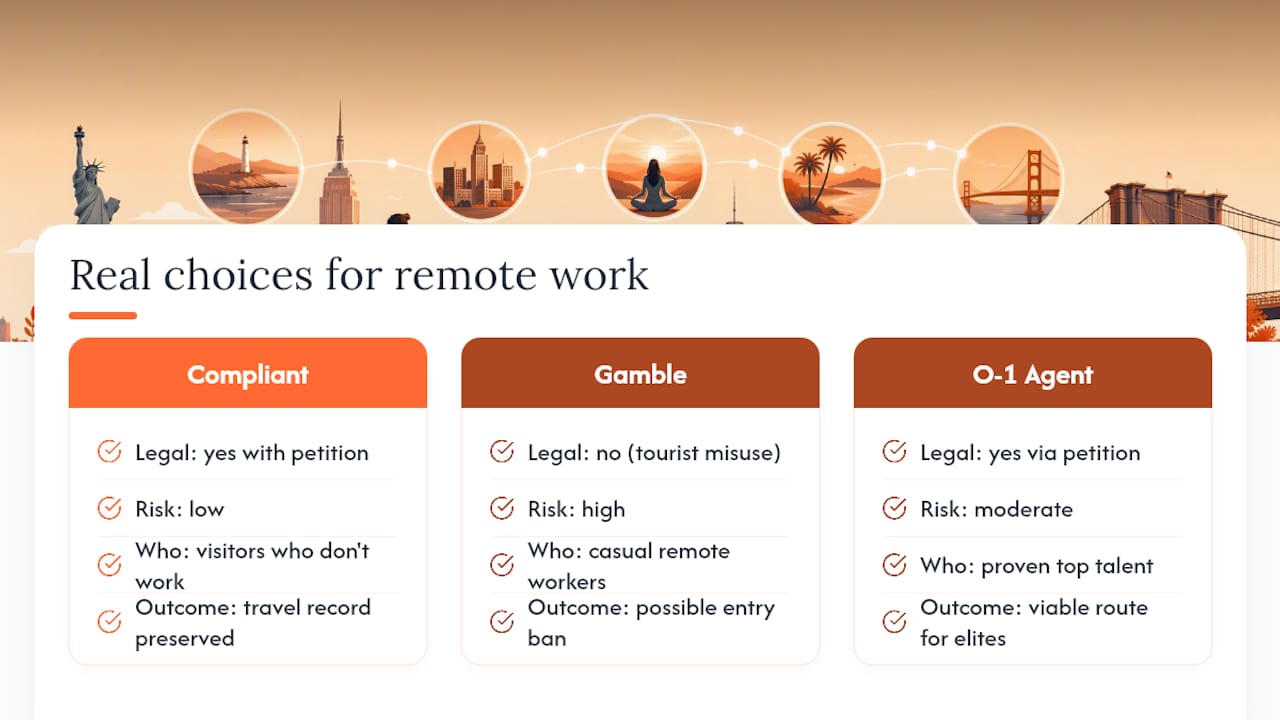
What I find most overlooked is how binary the real choice is. You’re either fully compliant, meaning you either don’t work while visiting or you go through a genuine petition process, or you’re gambling with your ability to enter the U.S. again. There’s no comfortable middle ground where you quietly work a little and hope nobody notices. For the subset of remote professionals with a genuinely strong track record, the O-1-with-agent route is real and worth pursuing seriously. For everyone else, the honest answer is that the U.S. isn’t currently built for casual remote work migration, while more than 50 countries now are.
That’s exactly why so many remote workers who look at New York end up looking at Spain instead. Spain’s Digital Nomad Visa exists specifically for people in this situation, and unlike the patchwork of U.S. work visas, it was designed with remote income in mind from the start. If your work and client base are portable, comparing both paths honestly, rather than defaulting to wherever you happen to be from, tends to produce better outcomes.
— Joshua
How Digitalnomadinspain Helps If Spain Fits Your Situation Better
If piecing together an O-1 petition or gambling on an H-1B lottery sounds like more risk and paperwork than you want to take on, Spain’s Digital Nomad Visa was built for exactly the situation you’re in: remote income, no U.S. employer, and a preference for a process that actually has a clear application track. This isn’t a workaround for U.S. immigration law, and it doesn’t grant any right to work inside the United States. It’s a separate, legitimate relocation option for remote professionals who’d rather move to a country with a visa built for them than force-fit themselves into one that wasn’t.
Digitalnomadinspain handles the eligibility check, document preparation, translation, and application submission for Spain’s Digital Nomad Visa and Non-Lucrative Visa, and follows through after approval with TIE card and tax registration support. Clients from more than 50 nations have used the service, and its immigration specialists know exactly which documents get rejected and why. If you’re weighing Spain against a U.S. work visa, start with the eligibility checker to see where you actually stand, or review the full Digital Nomad Visa requirements before you commit to either path.
Sources
Immigration rules change, and forms get updated without much notice. Before you file anything, verify current requirements against the primary sources.
For anything specific to your situation, a licensed immigration attorney gives you advice these pages can’t.
This article is general information, not a substitute for advice from a qualified lawyer. Consult a qualified legal professional about your own circumstances before acting on anything here.
FAQ
Can you get a digital nomad visa for the USA?
No. The United States has no dedicated digital nomad visa; remote workers rely on visitor entries with no work authorization or established work visas like O-1, H-1B, E-2, or L-1.
What is the easiest digital nomad visa to get?
Among U.S. options, none are “easy,” but the O-1 filed through a U.S. agent is the most accessible route for remote professionals with a strong track record, since it doesn’t require a traditional employer sponsor.
Which U.S. cities are best for digital nomads on a visitor stay?
New York, Chicago, and San Francisco offer strong coworking and networking infrastructure, but a robust local scene in any of these cities doesn’t change the fact that visitor status still prohibits performing paid work while there.
Which countries will be offering digital nomad visas in 2026?
More than 50 countries worldwide offer dedicated digital nomad visas, with Spain among the most established options for remote workers who want a clear, purpose-built application path outside the U.S.
Does working remotely from New York on ESTA or a B-2 visa create tax obligations?
It can. Performing any billable work while physically present, even for a foreign client, may trigger U.S. tax exposure and require forms like W-8BEN, which is why a tax advisor consult before travel matters.