
US applicants: a ready-to-submit employer-letter checklist and templates that cover apostilles, sworn translation, and bank-proof requirements to pass...
Americans: Pass Consulate Checks With an Employer Letter for Spain Visa

Your employer or remote-work letter has one job: prove the professional relationship is real, ongoing, and compatible with living in Spain. That means confirming your role and income, stating explicit consent for you to work remotely from Spain, and tying that income to documents a consular officer can verify against a company registry. It also needs an apostille and sworn Spanish translation on any foreign corporate paperwork. If you’re applying for the Non‑Lucrative Visa instead of the Digital Nomad Visa, the letter alone won’t carry your financial case — see this American’s guide to moving to Spain: visas and life for practical details on tax residency implications after visa approval. Bank statements do that work.
TL;DR:
- The employer or remote-work letter must explicitly state consent to work from Spain and match the company name precisely across all documents to avoid delays.
- A registry extract showing the company’s active status for at least one year is required, along with an apostille and sworn Spanish translation, to prove the company’s legitimacy.
- Self-prepared bank statements and income proof must be official PDFs that align with salary figures in the employer letter, especially for digital nomad visa applicants.
- Non‑Lucrative Visa applicants must submit 12 months of bank statements or passive income proof, not rely solely on the employer letter, with current income thresholds tied to Spain’s official index.
- Using a visa service can streamline preparation, ensuring documents are correctly formatted, ordered, and meet consulate requirements, reducing the risk of rejection.
Table of Contents
- What Belongs in an Employer or Remote-Work Certificate
- Backing It Up: Registry Extracts, Apostilles, and Translations
- How Does Financial Evidence Differ by Visa Type?
- Common Mistakes and a Pre-Submission Checklist
- Let Digital Nomad in Spain Handle the Paperwork for You
- Why Consulates Insist on This Exact Paperwork Order
- Where to Verify These Requirements Yourself
- Sources
- FAQ
What Belongs in an Employer or Remote-Work Certificate
Consular pages are specific about what this letter has to say, and vague phrasing is one of the fastest ways to get a request for more paperwork. The Digital Nomad Visa consulate guidance lists the exact content items officers check line by line.
Build the letter around these fields:
- Full legal name and passport number, matching your application exactly.
- Job title and a plain description of what the role actually involves.
- Start date, with most consulates wanting to see at least three months of seniority.
- Explicit consent to perform the work remotely from Spain, and confirmation the employer is not a Spanish company.
- Salary or contract value, stated with pay frequency (monthly, biweekly, per invoice).
- A statement that the relationship is expected to continue for at least one year.
For an employee, the letter should read something close to: “This letter confirms that [name] has been employed as [title] since [date], earning [amount] [frequency], and is authorized to perform this role remotely from Spain for the foreseeable future.” Freelancers and contractors can substitute a signed client confirmation or a summary of active invoices covering a similar period, since there’s no single “employer” to sign a certificate.
If your company handles its own social security filings, add a short responsible declaration clause naming whether you’ll keep home-country coverage through portability or register locally in Spain. Ambiguity on this point is one of the more common reasons consulates come back asking for clarification. One detail that trips up otherwise solid applications: the company name on the letter has to match the registry extract character for character, including suffixes like “LLC” or “Inc.”
Pro Tip: Sign the letter on company letterhead with a real signature, not a typed name. A director or HR representative should sign, and their title should appear under the signature so the officer can see who is vouching for you.
Backing It Up: Registry Extracts, Apostilles, and Translations
The employer letter means little to a consulate without a document proving the company itself is real and has been operating for a while. Telework Visa guidance from the Houston consulate names a certificate from the State Division of Corporations, or its equivalent, showing incorporation date and current active status. Officers typically want to see at least a year of activity, which is why a brand-new LLC formed right before your application tends to draw scrutiny.
Getting this ready from the U.S. side takes a few steps:
- Order a certificate of good standing or certified registry extract from your state’s Secretary of State office.
- Send that certificate to your state’s apostille authority, usually the same Secretary of State, which typically takes anywhere from a few days to a few weeks depending on the state.
- Get a certified sworn translation into Spanish. This has to be done by a translator recognized for legal document work, not a general translation service.
- Package the submission as three linked pieces: the original certificate, the apostille attached to it, and the Spanish translation stapled or clipped in that order.
Consulates want PDFs, not photos of paper documents, and each file should be labeled clearly (for example, “Certificate_of_Good_Standing_Apostilled.pdf”). Notarization is sometimes required before the apostille step, so check with your state’s specific process before assuming a plain printout will qualify. Foreign document requirements, including apostilles on criminal record certificates, follow this same translation and legalization pattern across most Spanish consulates.
How Does Financial Evidence Differ by Visa Type?
An employer letter proves the relationship exists. It doesn’t, by itself, prove the money is actually landing in your account, and that’s where bank documentation comes in, and the requirement looks different depending on which visa you’re filing.
Digital Nomad Visa applicants pair the employer letter with evidence the salary is real and recurring. That usually means:
- Three to six months of official bank statements, issued as PDFs with bank letterhead, not screenshots.
- Pay stubs or direct deposit confirmations that match the salary figure stated in the letter.
- A sentence in the letter or a cover note linking payments to a specific account, something like: “Salary is deposited monthly to account ending in 4821 at [bank name].”
Non‑Lucrative Visa applicants work from a different foundation entirely. Since there’s no employer relationship to lean on, the case rests almost completely on 12 months of bank statements or comparable proof of passive income, such as pension disbursements or investment account statements. The financial threshold is tied to IPREM, Spain’s official reference index, and that figure is published fresh each year, so always confirm the current number against an official source rather than an older article.
For retirement or brokerage accounts, don’t just show a balance. Include a note or statement excerpt confirming the funds are accessible, not locked in a product with withdrawal restrictions. Applicants routinely lose weeks by submitting screenshots of online banking apps instead of bank-issued PDFs with letterhead, which consulates generally reject outright.
Common Mistakes and a Pre-Submission Checklist
Most rejections and delays trace back to a small set of avoidable errors rather than genuine eligibility problems. Screenshots instead of bank-issued PDFs top the list, followed closely by a missing apostille on the registry certificate, an employer letter that never explicitly states consent to remote work from Spain, and a company name that doesn’t match across documents.
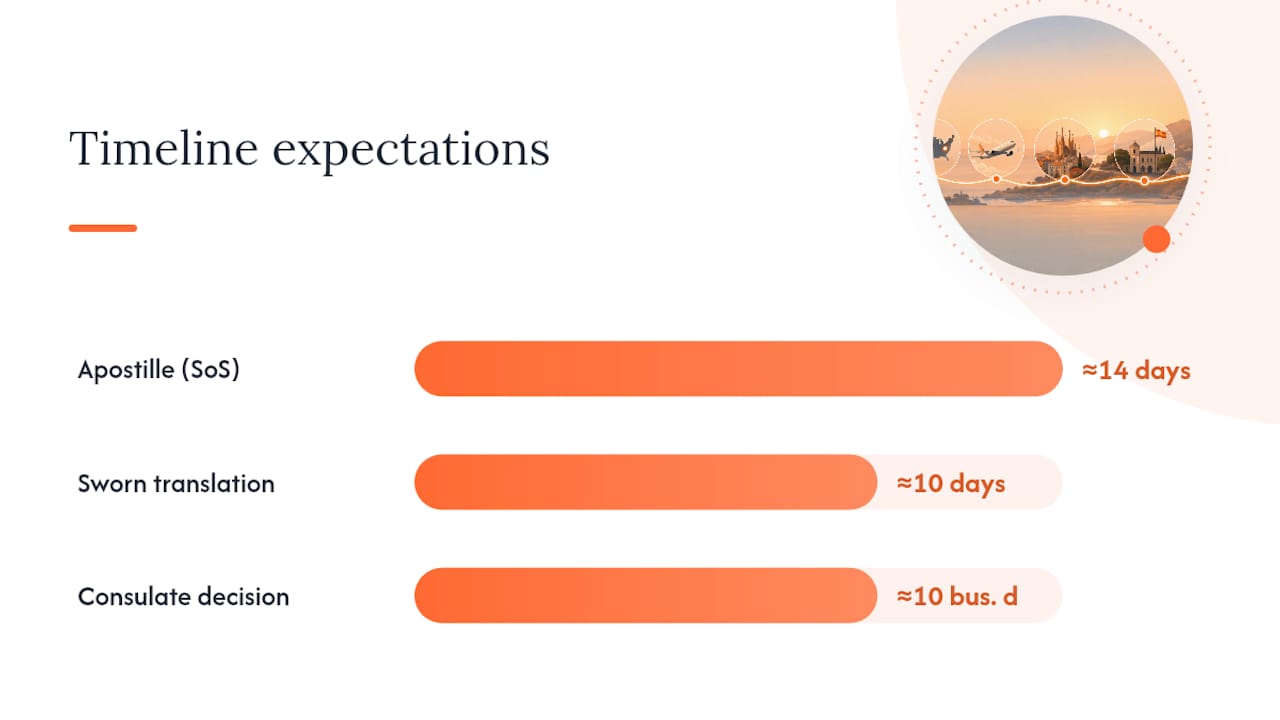
Timeline expectations matter too. Apostilles from a Secretary of State can take anywhere from a few days to several weeks. Sworn translations typically add another week or two, depending on document volume. Once your file is complete, consulates generally aim to decide within about 10 business days of submission, though that clock resets if they request additional documents or schedule an interview.
Before you submit, run through this list:
- Employer letter signed on letterhead, with explicit remote-work consent language.
- Company name matches exactly across the letter, registry extract, and application form.
- Registry certificate apostilled and translated into Spanish.
- Bank statements are official PDFs, not screenshots, covering the required period.
- Salary figures in the letter match the bank statement deposits.
- Responsible declaration addresses social security status clearly.
- All translations completed by a recognized sworn translator.
- Visa application form filled out and cross-checked against the letter’s dates.
- Proof of accommodation in Spain included and consistent with your stated address.
- Documents ordered logically: application form first, then identity, then employment, then financial, then accommodation.
Pro Tip: Put your Spanish translations directly behind their English originals rather than grouping all translations at the back of the file. Reviewers move faster when they don’t have to flip between two separate stacks.
Let Digital Nomad in Spain Handle the Paperwork for You
Getting every clause, apostille, and bank PDF right on your own is doable, but it eats hours you’d rather spend planning your move. A full-service visa consultancy can build the entire application package for you: eligibility checks, drafting and reviewing employer letters, coordinating apostilles and sworn translations, submitting the application, following up with the consulate, and handling post-approval steps like your TIE card and tax registration once you land.
The service reports a high success rate across applicants from many countries, with processing generally faster than typical self-filed applications, largely because documents arrive at the consulate already formatted the way officers expect. If you’re weighing the Digital Nomad Visa against the Non‑Lucrative Visa, start with the eligibility checker to see which path fits your situation, or go straight to booking a consultation to get your employer letter and supporting documents reviewed before you file.
Why Consulates Insist on This Exact Paperwork Order
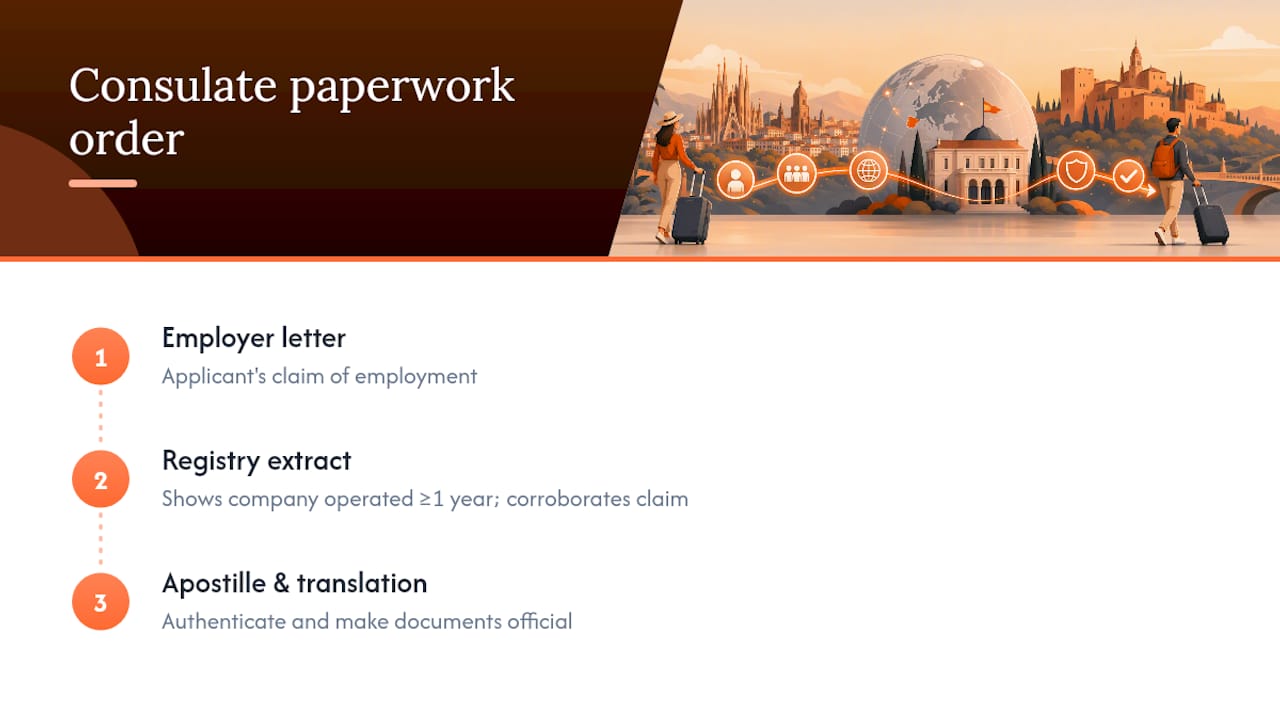
The specific sequence, letter first, registry proof second, apostille and translation third, isn’t bureaucratic decoration. It exists because consular officers need to verify a claim against something outside the applicant’s own word, and a registry extract showing a company has operated for a year or more is the cleanest way to do that. An employer letter with no corroborating registry document reads, to an officer, like a favor from a friend rather than proof of a real job.
The frustrating part is how often good applicants get flagged for sloppy presentation rather than a real eligibility gap. A mismatched company name, a screenshot where a PDF was expected, an apostille attached to the wrong page. None of that reflects whether someone deserves the visa. It reflects whether the paperwork was assembled by someone who’s done this before. That’s the entire case for using a service like Digital Nomad in Spain instead of assembling this from scratch: not because the rules are secret, but because the margin for a small formatting error is thinner than most applicants expect.
— Joshua
Where to Verify These Requirements Yourself
Check your specific consular district’s page on exteriores.gob.es for document lists that vary by jurisdiction. The ONE Platform covers national procedures, and SpainNonLucrativeVisa.com breaks down current financial thresholds and bank-statement formatting.
Sources
- Digital Nomad Visa (Consulate page)
- Application for the Digital Nomad Visa | Plataforma One
- Spain NLV Income Requirements 2026: €28,800/Yr + IPREM €600/Month
FAQ
Does the employer letter need to be notarized?
Notarization requirements vary by document and by U.S. state, but the registry extract and certificate of incorporation typically need an apostille rather than a notary stamp, while the employer letter itself is usually accepted with a company signature and letterhead.
Can a freelancer submit an employer letter without a traditional employer?
Yes. Freelancers substitute a client confirmation letter or a summary of active contracts and invoices covering a similar period, showing consistent income from clients based outside Spain.
Is the employer letter enough to prove income for the Non‑Lucrative Visa?
No. The Non‑Lucrative Visa relies primarily on 12 months of bank statements or passive-income documentation, since there’s no employment relationship behind the application.
How long does the whole document process usually take?
Between apostille processing, sworn translation, and gathering bank statements, most applicants need several weeks of preparation before submission, and the consulate then typically decides within about 10 business days of receiving a complete file.
What’s the biggest reason employer letters get rejected?
Missing explicit consent for remote work from Spain, or a company name that doesn’t match the registry extract exactly, are the two most common triggers for a request for additional documents.