Prove remote income with an income mapping packet and five core documents. A visa agnostic checklist shows what consulates actually want and how to avoid...
Income Mapping: 5 Docs Freelancers Use to Win a Digital Nomad Visa

Most digital nomad visa programs boil down to five document types: a valid passport, proof of recurring foreign-source income, evidence of remote client relationships (contracts or letters), international health insurance, and a clean criminal background check. Consulates typically want 6 to 24 months of income history, though exact thresholds vary by country. Groups like Migrationpolicy track this shift closely, and firms like Digital Nomad in Spain build entire application packages around exactly this evidence set.
TL;DR:
- Most visa programs require 6 to 24 months of consistent income proof, with longer lookback periods favoring official tax documents over recent bank statements.
- Combining invoices, bank statements, and platform reports into a clear, cross-referenced income mapping sheet greatly improves the legitimacy of your application.
- Validating your remote work through client contracts or attestations that specify foreign clients and remote work details is essential for proving the work arrangement.
- Health insurance and background checks take weeks to process; starting early on these civil documents is critical to avoid delays or rejection.
- Income thresholds vary significantly, from as low as $1,500 per month in some programs to over $4,000 in higher-cost destinations; always verify specific consulate requirements before applying.
Table of Contents
- The Freelancer Proof Digital Nomad Checklist You Can Save
- How Do You Prove Freelance Income for a Visa Application?
- What Proves You Actually Work Remotely for Foreign Clients?
- Insurance, Background Checks, and Passport Rules That Trip People Up
- Why Do Visa Income Thresholds Vary So Much by Country?
- When Should You Submit, and What Gets Applications Rejected?
- How Digital Nomad in Spain Turns This Checklist Into an Approved Visa
- Do You Need a Reliable Internet Setup Before You Apply?
- An Honest Take on What Actually Moves the Needle
- Ready to Turn This Checklist Into a Submitted Application?
- Where to Verify Country-Specific Visa Rules
- Sources
- FAQ
The Freelancer Proof Digital Nomad Checklist You Can Save
Think of your application packet as a legal argument. Every document either backs up your claim (“I earn enough, remotely, legitimately”) or it doesn’t belong in the file. Here’s the working checklist that covers what nearly every program asks for, drawn from patterns across dozens of remote-work visa programs:
- Valid passport with at least 6 to 12 months of validity beyond your planned stay (some countries want longer)
- Passport-style photos meeting the destination country’s exact size and background specs
- Criminal background check, usually from your country of citizenship and any country you’ve lived in recently
- International health insurance certificate showing coverage in the destination country
- Proof of income: bank statements, invoices, and tax returns spanning the required lookback window
- Client contracts or statements of work showing the remote, foreign-source nature of your income
- Proof of accommodation in the destination (sometimes required, sometimes optional)
Save everything as PDF. Consulates almost universally prefer PDF over Word documents or image files, and many explicitly reject JPEG screenshots of bank apps. Name your files in a way a stranger could sort them blind: “01_Passport.pdf,” “02_CriminalRecord.pdf,” “03_Invoices_JanJune.pdf.” When a country requires notarized copies, get them notarized before you scan, not after.
Some items are genuinely optional depending on the program: proof of accommodation, a return flight itinerary, or a local bank account. Others are non-negotiable everywhere: the passport, the background check, and income proof. If something on this list feels like it doesn’t apply to your situation (say, you’re between contracts right now), don’t leave a blank space in your file. Add a short letter explaining the gap and how you’re covering it.
Pro Tip: Build your document folder in the exact order the consulate lists requirements, not the order you happen to collect them. Reviewers move faster through a packet that mirrors their own checklist.
How Do You Prove Freelance Income for a Visa Application?
Income proof is where most applications fall apart, not because freelancers don’t earn enough, but because their paperwork doesn’t tell a coherent story. Immigration reviewers aren’t accountants. They want to glance at a stack of documents and see, without effort, that money came in regularly from real clients.
Four document types typically satisfy income requirements, each with real tradeoffs:
- Bank statements show the money actually landed, but by themselves they don’t explain where it came from.
- Invoices explain the source of each payment, but alone they don’t prove the client actually paid.
- Tax returns carry the most institutional weight since a government already reviewed them, but they lag behind your current earnings by up to a year.
- Platform payment reports (Stripe, PayPal, Upwork) add a timestamped third-party record that’s hard to dispute.
None of these documents works well in isolation. The fix is combining them into a chain reviewers can follow start to finish.
Most programs ask for 6 to 24 months of consistent income evidence, and the exact window shapes which documents matter most. A six-month window favors recent bank statements and invoices. A 24-month window makes tax returns nearly mandatory, since no consulate wants to comb through two years of monthly statements.
The number that matters: Immigration reviewers consistently flag unexplained deposits and screenshot-only evidence as red flags, while files where every deposit traces back to an invoice move through review faster.
Here’s the mapping workflow that actually works, and it’s simpler than it sounds:
- Pull every invoice you sent during the lookback period and number them sequentially.
- Match each invoice to its payment confirmation, whether that’s a PayPal receipt, a Stripe payout notice, or a wire transfer confirmation.
- Match each payment confirmation to the corresponding line item on your bank statement.
- Build a single spreadsheet with four columns: invoice number, client name, payment date, and bank deposit date.
That last step, the income mapping sheet, is the single highest-leverage document in your entire packet. It’s not officially required anywhere, but it’s one of the clearest signals of legitimacy a reviewer will see, because it does their cross-referencing work for them. A three-column table with fifteen rows can save a reviewer from making an assumption you don’t want them making.
If your income fluctuates month to month, which is normal for freelancers, don’t try to hide the variation. Show a 12-month average and let your tax return back it up. Consulates generally understand that freelance income isn’t a biweekly paycheck; what they can’t tolerate is income they can’t verify at all.
What Proves You Actually Work Remotely for Foreign Clients?
Income documents prove money came in. They don’t prove the work behind it is remote, ongoing, or tied to clients outside your destination country, which is the actual legal question most digital nomad visas are asking. That takes a separate evidence layer.
-
Client contracts or statements of work. Every contract you submit should specify the client’s country, the scope of work, the payment terms, and the contract dates. A contract missing the client’s location is nearly useless for this purpose, since the whole point is proving your income is foreign-source.
-
Client attestation letters. A short letter on the client’s letterhead works better than any contract clause. It should state how long you’ve worked together, what you do, that the work is performed remotely, and roughly what you’re paid. Keep it under half a page. Reviewers read dozens of these and reward brevity.
-
Recurring invoice history and project timelines. A single invoice looks like a one-off gig. Twelve invoices spanning a year, each referencing the same client and project code, look like a working relationship. If you juggle multiple clients, a simple project timeline showing overlapping engagements adds credibility that no single document can.
-
Platform records and portfolio snapshots. Upwork earnings summaries, Stripe payout histories, or a dated screenshot of your live portfolio site all add corroborating detail. None of these should be your primary evidence, but stacked alongside contracts, they round out the picture.
Some consulates get specific about what counts as proof of profession. Italy’s guidance for its remote-worker visa, for instance, lists tax returns, invoices, or professional association membership as acceptable evidence of experience, which is a narrower ask than most countries make. Read the exact wording on your target country’s consulate page before assembling anything.
One question that comes up constantly: does registering a sole proprietorship or a DBA help? Usually not for the visa itself, unless the destination country’s law explicitly requires a formal business entity. It adds value mainly for tax organization and for clients who want an invoice from a registered business name. If your target country’s visa page doesn’t mention entity structure, skip the extra paperwork and put that energy into your income mapping sheet instead.
Insurance, Background Checks, and Passport Rules That Trip People Up
These civil documents feel like paperwork errands, but they’re where timelines slip the most, mostly because they take weeks to process and nobody starts them early enough.
Health insurance. Most programs distinguish between short-term travel medical insurance and a full international health plan. A travel medical policy might cover emergencies for a few months; a full international plan covers ongoing care for the visa’s entire duration. Standard U.S. domestic health plans almost never qualify without an add-on international rider, so check that specifically before assuming your existing coverage works.
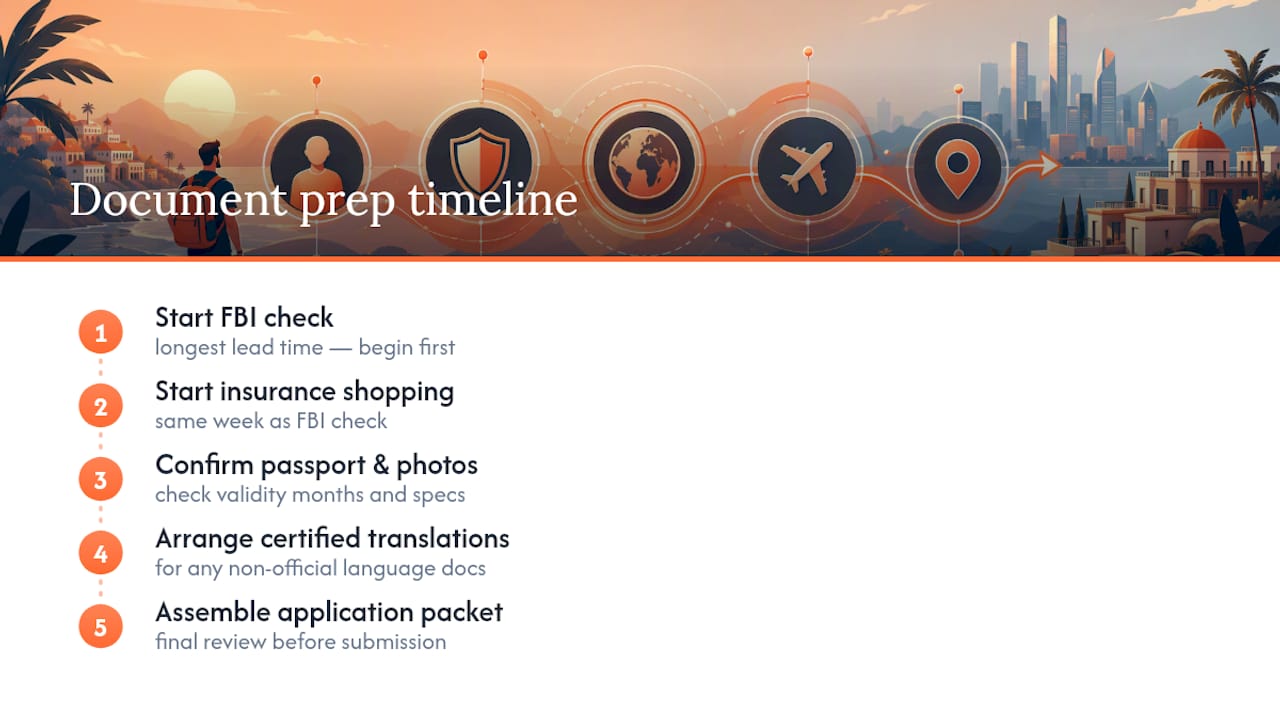
Criminal background checks. In the U.S., that means an FBI background check, which currently takes several weeks to process by mail and faster through an approved channeler. Many destination countries then require that check to carry an apostille, a form of international certification, before it’s valid abroad. Start this document first; it has the longest lead time of anything on your list.
Passport and photos. Check validity rules early. Some countries want six months of remaining validity past your visa’s expiration; others want twelve. Photo specs (background color, size in millimeters, head positioning) vary by country and a rejected photo can bounce your whole submission back.
Certified translations. If any document isn’t in the destination country’s official language, expect a request for a certified translation, not a casual one you did yourself.
Pro Tip: Order your FBI background check and start your international insurance shopping in the same week you decide to apply. Both have processing lags that quietly eat your timeline while you’re busy chasing invoices.
Why Do Visa Income Thresholds Vary So Much by Country?
Reading five different countries’ visa pages back to back feels like reading five different languages, even though they’re all in English. One says “€2,646 per month.” Another says “$50,000 annually.” A third just says “sufficient means” with no number attached. Over 50 countries now run some version of a remote-work visa, and there’s no shared formula behind any of it.
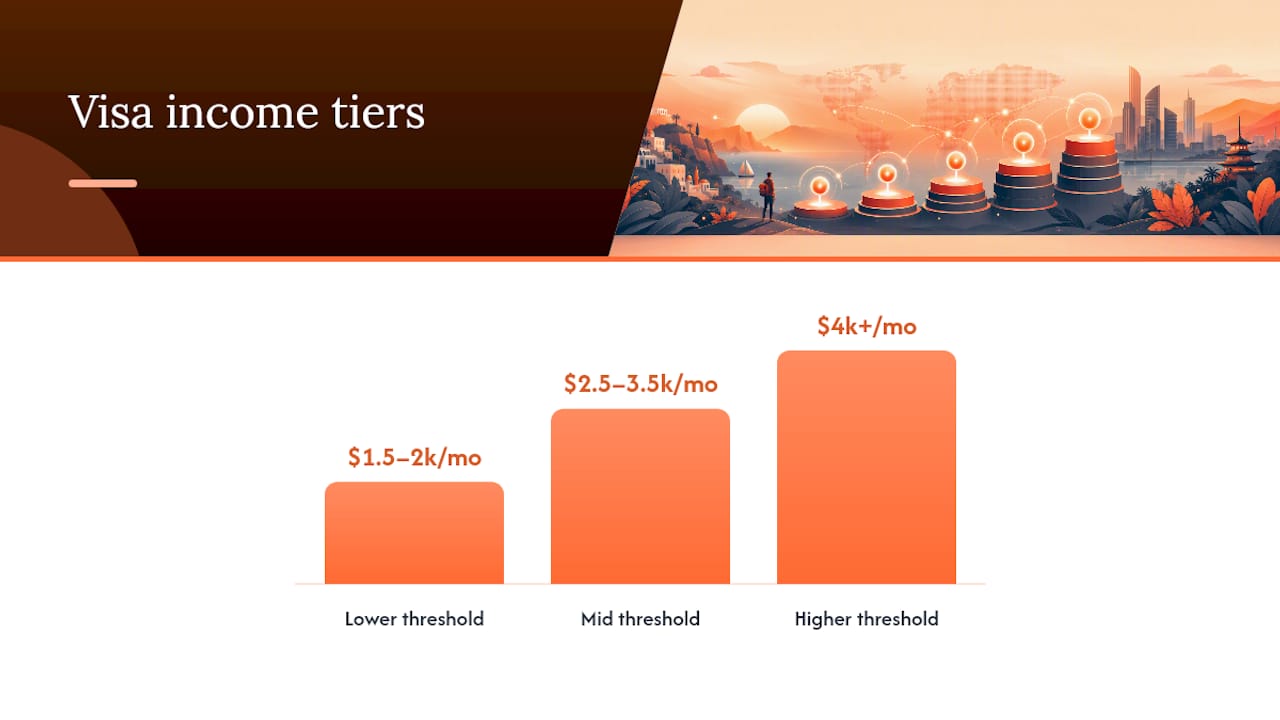
Rough tiers you’ll encounter across current programs:
- Lower-threshold programs, often in Eastern Europe or parts of Latin America, sometimes accept the equivalent of $1,500 to $2,000 in monthly income.
- Mid-threshold programs, common across much of Western Europe, tend to land somewhere in the $2,500 to $3,500 monthly range.
- Higher-threshold programs, frequently in wealthier destinations with a higher cost of living, can require $4,000 or more per month, sometimes stated as a lump annual figure instead.
The wording matters as much as the number. A country that lists an annual figure is usually fine with income that fluctuates month to month, as long as the yearly total clears the bar. A country that lists a monthly figure often wants to see that number, or close to it, in each of your last several bank statements. Take a $60,000 annual freelance income: divided evenly, that’s $5,000 a month, but freelance income never arrives evenly. If a consulate is checking monthly figures, average your trailing 12 months rather than looking at any single month in isolation, and say so explicitly in your cover letter.
Lookback windows shift by program too, from as short as six months to as long as two years, and a longer window generally means the consulate cares more about consistency than about your absolute current earnings.
When a country’s page uses vague language like “sufficient means” or “adequate financial resources” with no hard number, don’t guess. Some programs will accept substitute documents, like a letter from an accountant summarizing your finances, in place of raw bank statements. Others won’t budge. Spain’s program, for example, spells out specific income documentation requirements that differ meaningfully from neighboring countries’ rules, which is exactly the kind of detail worth confirming directly with the consulate or with someone who works these applications regularly.
When Should You Submit, and What Gets Applications Rejected?
Timing mistakes and evidence mistakes cause most of the delays freelancers run into, and both are avoidable with a little sequencing.
Start your background check and insurance shopping first, since those carry the longest lead times. Give yourself 8 to 12 weeks before your target submission date for a straightforward file, longer if any document needs an apostille or a certified translation. Processing times after submission then vary widely by country, from a few weeks to several months, so build in buffer on both ends.
Three mistakes come up over and over in rejected files:
- Unexplained deposits. A large, unlabeled bank deposit with no invoice behind it reads as suspicious even when it’s perfectly legitimate money. Fix it by adding a one-line note in your income mapping sheet explaining the source.
- Screenshots instead of official statements. A phone screenshot of a banking app doesn’t carry the same weight as an official downloaded or bank-issued statement. Reviewers treat screenshots as a weaker form of evidence than formal statements, even when the numbers match.
- Mismatched names or dates. A contract dated after your claimed start date, or a client name spelled differently across three documents, creates doubt that’s entirely avoidable with a careful proofread.
Package your final submission in this order: a cover letter summarizing who you are and what’s attached, a numbered document index, then the documents themselves grouped by category, with certified translations and notarized copies placed directly behind their English originals.
Pro Tip: Print one full physical copy of your packet even if the application is submitted online. Consulates occasionally ask for an in-person copy during an interview, and scrambling to reprint at that stage costs you time you don’t have.
How Digital Nomad in Spain Turns This Checklist Into an Approved Visa
Everything above is the general playbook. Applying it to one specific country’s exact wording, translation rules, and consulate quirks is where most freelancers get stuck, and where Digital Nomad in Spain’s work actually starts.
The service runs an eligibility check first, so you know before spending a dollar whether your income and documentation realistically clear Spain’s bar. From there, the team handles document preparation, certified translations, full application assembly, and consulate follow-up, then continues supporting clients after approval with TIE card registration and initial tax setup.
If your income is straightforward, your paperwork is clean, and you have months of runway before your move, a well-organized DIY packet using the checklist above can absolutely work. If your income mixes several clients, your timeline is tight, or Spain’s specific wording has you second-guessing which documents actually qualify, professional review closes that gap fast.
Do You Need a Reliable Internet Setup Before You Apply?
Most digital nomad visa applications don’t ask for proof of your internet connection or workspace, but skipping this step anyway is a mistake that catches up with freelancers fast once they land.
Research your destination’s connectivity before booking anything long-term. Coworking spaces in nomad-heavy cities (Lisbon, Chiang Mai, Mexico City, most of Spain’s major cities) typically publish their download and upload speeds, and a quick search or a message to current members beats guessing. If you’re working with clients on tight deadlines or handling video calls, treat sub-25 Mbps download speeds as a red flag, not a minor inconvenience.
A dual-connection strategy protects you better than any single provider. Pair a fixed apartment connection with a mobile hotspot on a different carrier network, so an outage on one doesn’t take down your entire workday. Many nomads also carry a portable router that accepts a local SIM, which pays for itself the first time a landlord’s WiFi goes down mid-deadline.
For workspace, resist the instinct to work exclusively from cafes. They’re fine for a few hours, but unreliable power outlets and inconsistent noise levels wear on productivity over weeks. A short-term coworking membership, often available on a monthly basis without a long-term lease, gives you a stable desk, faster WiFi, and often a community of other remote workers who already know the local quirks worth knowing.
An Honest Take on What Actually Moves the Needle
Most digital nomad visa advice obsesses over which documents to collect. That’s the easy part. The real skill is presentation: making a reviewer’s job effortless by showing, not asserting, that your money is real and your work is remote.
Conventional advice treats every document as equally important. It isn’t. An income mapping sheet that ties invoice numbers to bank deposits does more work than three extra reference letters, because it removes the guesswork a reviewer would otherwise have to do themselves. Spend your prep time there before you spend it hunting for one more supporting document.
The DIY versus professional-help question isn’t about how organized you are. It’s about how much your income story deviates from a clean, single-client monthly paycheck. If you juggle five clients across three currencies, get help. If Digital Nomad in Spain’s kind of consulate-specific knowledge saves you one rejection cycle, it paid for itself in the weeks it saved.
— Joshua
Ready to Turn This Checklist Into a Submitted Application?
Assembling this packet alone is doable, but consulate-specific formatting rules, translation requirements, and Spain’s particular income wording trip up even well-prepared freelancers. Digital Nomad in Spain built its entire service around closing that exact gap: eligibility screening before you commit, full document preparation and certified translation, application submission, and consulate follow-up until you have an answer.
The standard package starts with an eligibility check so you know your realistic odds before paying for anything further, and pricing is laid out upfront rather than buried in a call. After that, expect a structured document review, a translation and notarization pass on anything that needs it, and submission handling that removes the guesswork about formatting or missing paperwork. If you’re ready to see where you stand, start with the eligibility checker or review the full Digital Nomad Visa service details to see exactly what’s included.
Where to Verify Country-Specific Visa Rules
Treat every source in this article as a starting point, not a final answer, since consulate requirements change without much notice. Migrationpolicy.org offers solid comparative context across the growing field of remote-work visa programs. For Spain specifically, Digital Nomad in Spain’s visa requirements guide and tax guide walk through current documentation and tax rules in detail. Always confirm final requirements on your target country’s official consulate page before submitting anything.
Sources
- The future of remote work, digital nomads, and implications for immigration systems - Migration Policy Institute
- How to Actually Make a Living Freelancing Abroad - CLIMB
- UAE Digital Nomad Visa Checklist: Documents, Income Proof and Red Flags
FAQ
What Qualifies Someone as a Digital Nomad?
A digital nomad is generally someone who earns income remotely, usually from clients or an employer outside their current country, while living abroad temporarily or long-term. Most visa programs define it more narrowly, requiring proof that your income source is foreign and your work doesn’t require a local employer.
Is Freelancing Still a Viable Path to Working Abroad in 2026?
Freelancing remains a solid path to living abroad, especially with over 50 countries now offering dedicated remote-work visa pathways. Success depends less on the freelance model itself and more on documenting income clearly enough to satisfy consulate reviewers.
Do I Need an LLC or Business Registration as a Freelancer?
Not usually, unless your target country’s visa program explicitly requires a registered business entity. Most programs care more about proof of consistent, verifiable income than about your legal business structure.
Do Consulates Verify Freelance Work and Income Claims?
Yes. Reviewers commonly cross-check invoices against bank deposits and contracts, and unexplained deposits or screenshot-only evidence are treated as red flags that can trigger further scrutiny or rejection.
How Far Back Do Income Documents Need to Go?
Most programs request 6 to 24 months of income history, though the exact window depends on the specific country’s visa program. Longer windows generally emphasize consistency over your most recent earnings.