
Discover essential health insurance for non lucrative visa Spain. Get 100% coverage, no deductibles, and consulate requirements covered.
Health Insurance for Non-Lucrative Visa Spain: 2026 Guide

You need a one-year private health insurance policy from an insurer authorized to operate in Spain, covering 100% of SNS-equivalent services with zero copayments, zero deductibles, no waiting periods, and repatriation coverage — plus a Spanish-language certificate to hand the consulate. That’s the whole requirement in one sentence. Everything below is about making sure your policy actually meets it.
Must-haves every consulate checks:
- One-year minimum coverage, paid in full upfront
- Insurer registered with Spain’s DGSFP (the national insurance regulator)
- Zero copayments and zero deductibles — no exceptions
- No waiting periods (carencias) that overlap your visa start date
- Repatriation of remains coverage
- Coverage comparable to Spain’s National Health System (SNS): inpatient, outpatient, emergency, diagnostics
Pro Tip: Before you buy, look up your insurer on the DGSFP registry and request a visa-specific certificado de seguro in Spanish that states exact coverage dates and confirms full-year payment. Get it as a PDF before your consulate appointment.
Table of Contents
- What does the consulate actually require for NLV health insurance?
- Which policy features should you confirm before you buy?
- How do U.S. applicants buy a compliant policy from abroad?
- What does NLV health insurance typically cost?
- Which documents go into your visa application packet?
- What mistakes cause NLV insurance rejections?
- How does a visa consultancy reduce your rejection risk?
- Key Takeaways
- Why documentation beats price every time
- Digitalnomadinspain handles the insurance verification for you
- Useful sources
- FAQ
What does the consulate actually require for NLV health insurance?
The official consulate language is precise: private health insurance from an insurer authorized to operate in Spain, covering all risks covered by Spain’s public health system, with no deductible, no copayment, no waiting periods, and covering the full period of stay. The New York consulate adds that coverage must be unlimited with no co-payment or deductible, and requires both original and copy of the certificate.

Consulates are not uniform in how strictly they enforce these rules. The Los Angeles consulate, along with several others, has been reported to require exact Spanish wording on the certificate and may reject policies with any ambiguous repatriation language. Some consulates ask for an apostille or sworn translation; others accept a clean Spanish PDF.
| Requirement | What consulates check | Enforcement level |
|---|---|---|
| Insurer DGSFP authorization | Registration code on certificate | Strict — verified against registry |
| Zero copayment / zero deductible | Explicit wording in certificate | Strict — any copay clause disqualifies |
| No waiting periods | Carencia-free from policy start date | Strict at most consulates |
| Repatriation coverage | Named in policy and certificate | Moderate — wording must be unambiguous |
| SNS-equivalent scope | Inpatient, outpatient, emergency, diagnostics | Moderate — broad coverage assumed if DGSFP-registered |
| Spanish-language certificate | Certificate language | Varies — required at stricter consulates |
| One-year term, paid upfront | Proof of payment for full year | Strict |
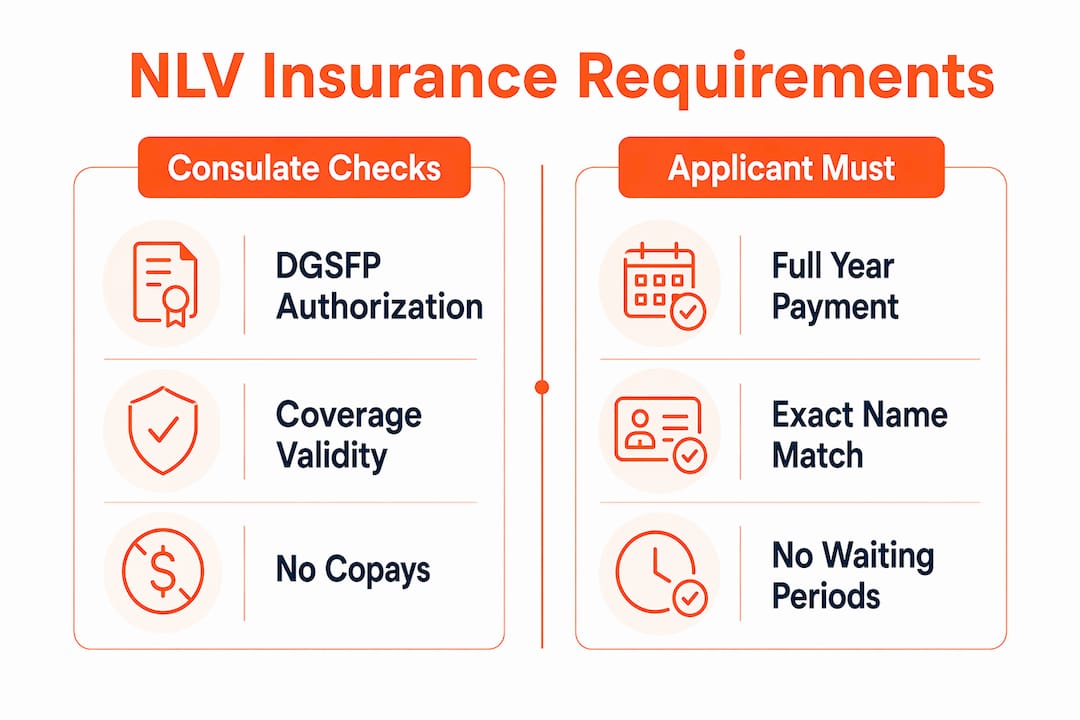
Always check your specific consulate’s page for additional requirements. The rules above are the baseline; individual consulates can and do add steps.
Which policy features should you confirm before you buy?
The gap between a policy that looks compliant and one that is compliant usually comes down to a handful of clauses buried in the fine print.
Clause checks — read these line by line:
- Explicit “no copayment” / “sin copago” wording in the policy document itself, not just the marketing brochure
- Zero deductible — any amount, even €5, disqualifies the policy
- No annual or per-claim caps on covered services
- No carencia (waiting periods) from the policy start date, or a clear statement that carencia does not apply to the visa period
- Repatriation of remains explicitly named as a covered benefit
- Pandemic/epidemic coverage if your consulate has requested it
- Full SNS-equivalent scope: inpatient hospitalization, outpatient consultations, emergency care, diagnostic tests, maternity, and mental health
Documentation checks — what the certificate must show:
- Your full legal name exactly as it appears on your passport
- Policy start and end dates matching your intended visa period
- Insurer’s DGSFP registration code
- Insurer contact details (address, phone, email)
- Statement of no copayment and no deductible
- Proof of full-year premium payment attached or referenced
A note on pre-existing conditions: Spanish insurers commonly apply carencia periods of 6–12 months for pre-existing conditions. Many consulates accept this if the carencia is clearly documented and does not affect emergency coverage from day one. Strict consulates, however, prefer day-one coverage with no carencia at all. If you have serious pre-existing conditions and are applying through a strict consulate, international senior plans with day-one coverage are often the safer choice despite higher premiums.
Pro Tip: Ask your insurer to send you their visa certificate template before you pay. Confirm it includes all the required fields, then save the final PDF immediately after purchase. Consulates have rejected screenshots and online policy summaries — only an official PDF certificate counts.
How do U.S. applicants buy a compliant policy from abroad?
Buying Spanish health insurance from the U.S. is straightforward if you follow the steps in order. The mistakes happen when applicants skip the verification steps and go straight to payment.
- Confirm your visa route first. Use the eligibility checker to verify the Non-Lucrative Visa is the right path before spending money on insurance.
- Gather your documents. You’ll need your passport details, date of birth, and a basic medical history summary (relevant for underwriting and pre-existing condition disclosure).
- Check DGSFP registration. Before requesting any quote, look up the insurer at the DGSFP registry. If they’re not listed, stop there.
- Request a visa-specific quote. Tell the insurer explicitly that you need a Non-Lucrative Visa-compliant policy with zero copay, zero deductible, no waiting periods, and repatriation. Ask them to confirm these terms in writing.
- Review the certificate template. Before paying, ask for a sample certificado de seguro and verify every field listed in the documentation checklist above.
- Pay the full-year premium. Pay in one transaction and request a payment receipt that references the policy number and coverage period.
- Obtain your documents. Collect the policy PDF, the Spanish-language certificate, and the payment receipt. If your consulate requires an apostille or sworn translation, arrange that now.
Where to buy from the U.S.:
- Spanish insurers that accept non-residents: Sanitas and Adeslas are the most commonly used for NLV applicants and issue visa certificates quickly
- International expat insurers with DGSFP-authorized Spanish channels
- Visa consultancies like Digitalnomadinspain that verify insurer compliance and handle certificate formatting on your behalf
Documents to collect at purchase:
- Full policy PDF in Spanish (or bilingual)
- Certificado de seguro in Spanish with all required fields
- Payment receipt for the full annual premium
- Insurer’s DGSFP registration code (confirm it matches the registry)
What does NLV health insurance typically cost?
Premium ranges vary significantly by age and whether you need day-one pre-existing condition coverage. The table below reflects typical industry ranges for basic NLV-compliant plans.

| Age band | Typical monthly range | Notes |
|---|---|---|
| Under 40 | €39–€55/month | Lowest risk tier; most plans issue same-day |
| 40–55 | €55–€100/month | Moderate underwriting; carencia common for pre-existing |
| 56–65 | €100–€150/month | Higher underwriting scrutiny; day-one coverage costs more |
| 65+ | €150–€400+/month | International senior plans often needed; day-one coverage adds significant cost |
All premiums must be paid for the full year upfront. That means a 45-year-old applicant should budget roughly €660–€1,200 for the year before any other application costs. For a full picture of what the NLV application costs in total, the 2026 NLV budget guide breaks down every line item.
Certificate issuance is fast with the right insurer. Sanitas and similar Spanish insurers typically issue the certificado de seguro quickly after payment, often within a couple of days. Brokers or international plans can take longer. If your consulate appointment is within a week, go directly to a Spanish insurer rather than routing through a broker.
Plan for extra time if your consulate requires an apostille or sworn translation of the certificate. That process alone can add several business days depending on your state.
Which documents go into your visa application packet?
The consulate wants a specific set of insurer documents, and missing even one can result in an immediate rejection. Keep this list next to your application checklist.
- Certificado de seguro in Spanish: Must show your full legal name, policy number, coverage start and end dates, insurer name, DGSFP registration code, and explicit statement of no copayment and no deductible
- Proof of full-year payment: Bank receipt or insurer-issued payment confirmation referencing the policy number and coverage period
- Full policy document (PDF): The complete policy wording, not a summary or welcome letter
- Insurer contact details: Address, phone number, and email on the certificate or a separate insurer letterhead
- Translation or apostille (if required): Check your specific consulate page — some require a sworn Spanish translation even if the certificate is already in Spanish, or an apostille on the insurer’s document
Two formatting mistakes cause the most rejections: a name on the certificate that doesn’t exactly match the passport (even a middle name discrepancy), and submitting an online policy summary or screenshot instead of the official PDF. Insurers will reissue corrected certificates, but that takes time you may not have before your appointment.
What mistakes cause NLV insurance rejections?
The most common rejection isn’t a wrong insurer. It’s a policy that looks fine on the surface but contains a small clause the consulate flags immediately.
Top applicant errors:
- Submitting travel insurance, which is rejected because of time limits, exclusions, and coverage caps that don’t meet SNS-equivalent standards
- Buying a policy with any copay — even a €3 per-visit fee disqualifies the plan
- Accepting a policy with waiting periods that start on the same date as the visa
- Not verifying DGSFP registration before purchase
- Submitting an English-only certificate when the consulate requires Spanish
- Sending a policy summary instead of the full official PDF
Red-flag policy features to reject immediately:
- Per-visit copayment or percentage coinsurance
- Annual coverage cap (e.g., €50,000 maximum)
- Ambiguous repatriation wording (“may cover” instead of “covers”)
- Insurer not found in the DGSFP registry
- Waiting periods for any condition from the policy start date
Visa consultancies consistently report that hidden cost-sharing clauses are the single most common cause of NLV insurance rejections. A policy that saves you €20/month but contains a €10 copay clause will cost you the visa.
Pro Tip: When comparing plans, open the full policy PDF and search for the words “copago,” “franquicia,” “carencia,” and “límite.” If any of those appear without a clear “no” or “zero” in front of them, ask the insurer to clarify in writing before you pay.
How does a visa consultancy reduce your rejection risk?
Digitalnomadinspain reports a high success rate across clients from many countries, and processes applications notably faster than typical self-applicants. Those numbers come from one specific practice: catching compliance problems before the consulate does.
The consultancy’s insurance verification process covers DGSFP registration checks, line-by-line policy wording review, and certificate formatting against the specific requirements of your consulate. That last point matters more than most applicants realize. The Los Angeles consulate has different documentation expectations than the New York consulate, and a certificate that passes one may be questioned at the other.
A visa-specific certificate in Spanish that includes the insurer’s DGSFP code and exact coverage dates materially reduces consulate queries and speeds processing. Getting that certificate right before submission is the single highest-leverage step in the insurance process.
For applicants with pre-existing conditions or those applying through stricter consulates, the consultancy also identifies which insurers offer day-one coverage without carencia — a detail that’s easy to miss when comparing plans independently. The full NLV application guide covers every document in the packet, not just insurance.
Key Takeaways
A compliant NLV health insurance policy requires zero copayments, zero deductibles, no waiting periods, DGSFP-registered insurer, and a Spanish-language certificate with exact dates and proof of full-year payment.
| Point | Details |
|---|---|
| Verify DGSFP registration | Check your insurer at the DGSFP registry before paying any premium. |
| Confirm zero cost-sharing | The policy must explicitly state no copayment and no deductible in the certificate. |
| Get a Spanish certificate | Request the certificado de seguro in Spanish with your name, dates, and DGSFP code. |
| Pay one year upfront | Budget a monthly premium that varies significantly depending on your age; pay in full and save the payment receipt. |
| Digitalnomadinspain | Verifies insurer compliance, formats consulate-specific certificates, and manages submission with a 98% success rate. |
Why documentation beats price every time
Most applicants approach NLV insurance as a cost problem. Find the cheapest compliant plan, pay for a year, move on. That framing is understandable — you’re already spending thousands on the application — but it’s the wrong lens for year one.
The consulate doesn’t see your premium. It sees your certificate. A €39/month plan with a clean, DGSFP-verified certificate and explicit no-copay wording will sail through. A €55/month plan with ambiguous repatriation language or a €5 per-visit fee will get flagged, and you’ll be back at square one with a delayed appointment and a refund dispute with the insurer.
After year one, the calculus changes. Once you have continuous residency, empadronamiento, and your TIE card, you may qualify for the convenio especial — Spain’s public pay-in system that costs roughly €60/month for applicants under 65 and €157/month for those 65 and older, with full SNS access and no pre-existing exclusions. That’s the long game. For year one, the only question worth optimizing is: will the consulate accept this certificate?
Digitalnomadinspain handles the insurance verification for you
Sorting through DGSFP registries, policy PDFs, and consulate-specific certificate formats takes hours — and one missed clause costs you the visa. Digitalnomadinspain offers a faster path: eligibility check, insurer verification, document preparation, and consulate submission support, all in one package with a 98% approval rate.
The service covers the insurance piece specifically: confirming your insurer is DGSFP-registered, reviewing policy wording for hidden copay or carencia clauses, and formatting your certificado de seguro to match your consulate’s exact requirements. For families relocating with children, that documentation extends to dependents too — a detail that catches many self-applicants off guard. Families moving to Spain with school-age children may also find SchoolFinder Spain useful for planning the next step after the visa is approved.
Ready to stop second-guessing your policy wording? Start your NLV application with Digitalnomadinspain and get a compliance-verified insurance recommendation as part of the process.
Useful sources
- Spain Ministry of Foreign Affairs — Non-Lucrative Visa (New York Consulate): Official document checklist including insurance requirements
- Spain Ministry of Foreign Affairs — Non-Lucrative Visa (Los Angeles Consulate): Consulate-specific requirements and variations
- DGSFP — General Directorate for Insurance and Pension Funds: Official registry to verify insurer authorization in Spain
- Convenio especial — Ministry of Health (Spain): Public pay-in system available after one year of residency
- Sanitas expat/residency plans: Spanish insurer with NLV-oriented plans and quick certificate issuance
- Caser Expat Insurance — NLV guidance: Documented guidance on typical policy issues for NLV applicants
Check your specific consulate’s page directly before submitting — requirements for apostilles, translations, and certificate formatting vary by location and can change without notice.
FAQ
How much does NLV health insurance cost in Spain?
Typical monthly premiums range from roughly €39–€55 for applicants under 40, up to €150–€400+ for those over 65 or those needing day-one pre-existing condition coverage. All premiums must be paid for the full year upfront.
What is the best health insurance for expats in Spain?
Sanitas is one of the most commonly used options for NLV applicants because it is DGSFP-registered, offers visa-oriented residency plans, and issues certificates quickly. Caser Expat Insurance also publishes specific NLV guidance. For applicants who want compliance verified before purchase, Digitalnomadinspain reviews insurer certificates as part of its visa service.
Does travel insurance qualify for Spain’s Non-Lucrative Visa?
No. Travel insurance is rejected because it carries time limits, coverage caps, and exclusions that don’t meet SNS-equivalent standards. Only long-term private policies from DGSFP-authorized Spanish insurers qualify.
What are the benefits of Spain’s Non-Lucrative Visa?
The Non-Lucrative Visa grants legal residency in Spain for one year, renewable for two-year periods, without requiring employment in Spain. It allows access to Spain’s infrastructure, banking, and public services, and after one year of continuous residency, eligible holders can apply for the convenio especial for lower-cost public health coverage.
Can I buy NLV health insurance from the U.S. before moving?
Yes. Several Spanish insurers, including Sanitas, accept non-resident applicants and issue certificates remotely. The process is fully online: get a quote, confirm the policy terms, pay the annual premium, and receive your Spanish-language certificate by email, typically within a couple of days.