
Discover how to get an NIE in Spain with our 2026 step-by-step guide. Learn the required documents and application process for smooth transactions.
The NIE, or Número de Identificación de Extranjero, is Spain’s official foreigner identification number, and no foreigner can legally buy property, open a bank account, or pay taxes without one. Whether you are a remote worker, retiree, or digital nomad planning a move to Spain, understanding how to get an NIE in Spain is the single most important administrative task you will face. The Spanish Directorate-General for the Police and the AEAT tax authority both rely on this number to identify you across every official transaction. This guide covers the full 2026 process, from required documents to applying inside Spain or from abroad.
What documents do you need for a NIE application in Spain?
The standard NIE application requires four core items: a completed EX-15 form, your original passport plus a photocopy, proof of fee payment via form 790 (code 012), and a justification document. That justification document is the piece most applicants underestimate.
Spain’s immigration offices do not issue NIE numbers on request alone. You must prove a legitimate reason for needing one. Accepted justification documents include:
- A signed property purchase contract or reservation agreement
- A job offer letter or employment contract from a Spanish employer
- A business registration document or company formation certificate
- A university enrollment letter from a Spanish institution
- A healthcare or insurance contract tied to Spanish residency
The administrative fee ranges from approximately €9.84 to €12.00, paid via form 790 (code 012). You pay this fee at a Spanish bank before your appointment, then bring the stamped receipt as proof. Some offices also request two passport photos sized 32x26 mm, so carry them regardless of whether your local office lists them as mandatory.
If someone else is applying on your behalf, you need a notarized power of attorney document. This is common for property buyers who are still abroad when the purchase process begins.
Pro Tip: Download the EX-15 form directly from the Spanish Ministry of Interior website and fill it out digitally before printing. Handwritten forms with corrections or smudged ink are frequently rejected at the front desk, costing you weeks.
How to apply for a NIE in Spain: step-by-step process
Applying inside Spain is the most direct route. The process runs through either a National Police station (Comisaría de Policía) with a foreigners’ unit or a dedicated immigration office (Oficina de Extranjería), depending on your province.
-
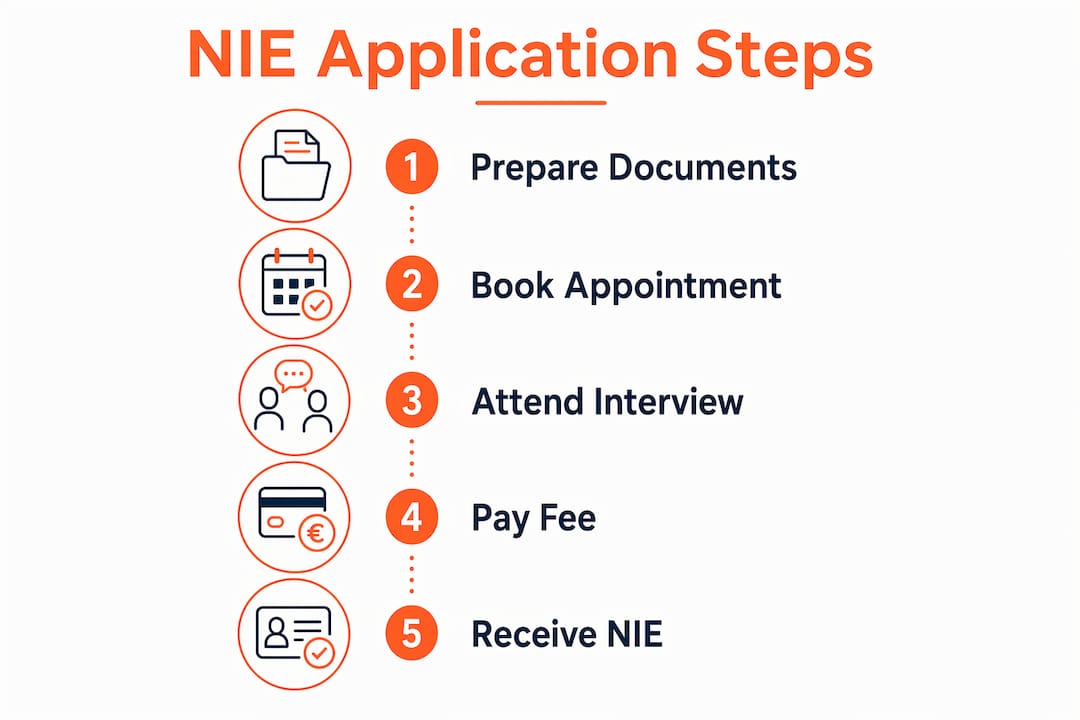
Book your appointment online. Use the Spanish government’s cita previa system at sede.administracionespublicas.gob.es. Select “Policía Nacional” and then “Certificados UE” for EU citizens or “Asignación de NIE” for non-EU applicants. Wait times vary by city, often stretching several weeks in Madrid and Barcelona. Book the moment you know your travel dates.
-
Pay the fee before your appointment. Take form 790 (code 012) to any Spanish bank branch and pay the fee in person. The bank stamps the form as proof of payment. Keep the original stamped copy.
-
Organize your documents the night before. Bring your original passport, a full photocopy of every page, the completed EX-15 form, the stamped 790 form, your justification document, and two passport photos. Place everything in a clear folder in the order listed.
-
Attend your appointment. Arrive 10 minutes early. The officer reviews your documents, may ask basic questions about your reason for being in Spain, and either processes the application on the spot or gives you a receipt for collection.
-
Collect your NIE certificate. The NIE is typically issued within two weeks after the appointment, though some offices provide it the same day. Others require a return visit. You receive a white A4 certificate printed with your NIE number. This is your official NIE document.
Pro Tip: Check the specific police station’s website for your province before your appointment. Some offices in Andalusia and Valencia post updated document checklists that differ from the national template. Showing up with the wrong checklist is the most avoidable delay in the entire process.
Once you have your NIE, the next logical step for many relocators is securing a TIE residency card, which formalizes your legal status in Spain beyond the NIE certificate itself.

How to apply for a NIE from abroad through a consulate
Applying from outside Spain is possible through Spanish consulates, and it is the right choice if you cannot travel to Spain before your legal transaction requires the number.
The consular process works as follows:
- Contact the Spanish consulate in your country and book an appointment through their specific scheduling system. Each consulate operates independently, so the booking method varies.
- Submit the EX-15 form, a valid passport, proof of fee payment, and your justification document at the appointment.
- The consulate forwards your application to Spain’s Ministry of Interior for final processing.
Consular processing takes 4–8 weeks, and fees vary by country. Budget extra time if your transaction has a fixed closing date.
The alternative to attending in person is using an authorized legal representative in Spain. A Spanish lawyer with a notarized power of attorney can apply on your behalf at a local police station. This route is especially common among property buyers completing purchases remotely.
Key facts about the representative route:
- Lawyer fees typically range from €150 to €350, plus official fees and any translation costs
- The process usually takes 2–3 weeks from the date the lawyer submits the application
- The power of attorney must be notarized and, in most cases, apostilled if signed outside Spain
One critical limitation applies to both routes: a NIE obtained abroad does not grant residency rights in Spain. It is purely an identification number. If you plan to stay longer than 90 days or work legally in Spain, you will need a separate visa or residency permit. Digital nomads, for example, should look into the Digital Nomad Visa requirements alongside their NIE application.
What are the most common NIE application mistakes?
Most NIE rejections and delays trace back to a small set of predictable errors. Knowing them in advance saves you weeks of rescheduling.
- Wrong box on form 790. Ticking the EU/non-EU status incorrectly on the 790 fee form is the single most common processing error. EU and non-EU applicants pay through different codes, and the wrong selection invalidates your payment proof.
- Weak justification documents. A vague letter of intent does not satisfy the requirement. You need a signed, dated document that clearly ties you to a specific legal or economic activity in Spain.
- Ignoring local procedural differences. Each province and police station operates with a degree of autonomy. What works in Málaga may not work in Bilbao. Always verify requirements directly with the office handling your application.
- Incomplete passport copies. Some offices require copies of every passport page, including blank ones. Bringing only the photo page is a common shortcut that triggers rejection.
- Missing appointment confirmation. Print your cita previa confirmation and bring it physically. Some offices do not accept digital versions on a phone screen.
Applying for a NIE without verifying your specific office’s current requirements is the fastest way to lose your appointment slot and wait another month for the next available date. Thirty minutes of research before you go saves weeks of frustration after.
Pro Tip: If your application is rejected or delayed, request a written explanation from the officer. This document tells you exactly what to fix and gives you grounds to escalate if the rejection was procedural rather than substantive.
For applicants opening a Spanish bank account as part of their relocation, note that most banks require the NIE before they can complete account registration. Sequence your applications accordingly.
Key Takeaways
Applying for a NIE in Spain requires the right documents, a booked appointment, and a clear justification for why you need the number.
| Point | Details |
|---|---|
| NIE is mandatory for legal activity | Without a NIE, property purchases, bank accounts, and tax filings cannot proceed in Spain. |
| Four core documents required | Bring the EX-15 form, passport with copy, stamped 790 fee form, and a justification document. |
| Book appointments early | Wait times in cities like Madrid and Barcelona often stretch several weeks. |
| Local rules vary by province | Always verify document requirements with your specific police station before attending. |
| NIE does not equal residency | A NIE obtained abroad or inside Spain is an ID number only, not a residency permit. |
The part of this process nobody warns you about
Most guides tell you what to bring. Few tell you what actually goes wrong, and why it goes wrong for smart, prepared people.
The NIE system in Spain is decentralized in a way that genuinely surprises applicants from countries with unified national processes. I have seen people arrive with a perfectly prepared folder, only to be turned away because the specific office they visited had updated its checklist two weeks prior and the national government website had not caught up. That is not an edge case. That is Tuesday in Spanish bureaucracy.
The provinces that cause the most friction are the most popular ones: Madrid, Barcelona, Málaga, and Alicante. These offices handle enormous volumes of applications from foreign buyers, retirees, and remote workers. Appointment slots disappear within minutes of release. If you miss a slot, you may wait four to six weeks for the next one.
My strongest advice is this: treat the NIE application as a project, not a form. Give it a dedicated folder, a checklist specific to your province, and a buffer of at least three weeks before any transaction that depends on the number. Retirees buying property and digital nomads setting up Spanish tax residency both underestimate how tightly the NIE timeline connects to everything else. Get the number before you need it, not the week you need it.
Staying current on policy changes matters too. Spain updated several procedural details in 2025 and early 2026, including fee adjustments and form revisions. If you are relying on a guide written before 2025, verify every detail against the current AEAT and Ministry of Interior portals before your appointment.
— Joshua
How Digitalnomadinspain can help with your NIE and visa process
Applying for a NIE while managing a relocation, a property purchase, or a visa application at the same time is genuinely complex. Digitalnomadinspain works with remote workers, retirees, and freelancers from over 50 countries to handle exactly this kind of layered paperwork.

The team at Digitalnomadinspain offers document preparation, appointment guidance, and end-to-end support for both NIE applications and the visas that follow. Their Digital Nomad Visa service is built specifically for remote workers who need NIE support alongside their visa filing. For retirees, the Non-Lucrative Visa guidance covers the full residency pathway. If you want to know which route fits your situation, book a consultation and get a clear answer before you start filling out forms.
FAQ
What is a NIE number in Spain?
The NIE (Número de Identificación de Extranjero) is Spain’s official identification number for foreigners. It is required for all legal and financial activities, including property purchases, employment, and tax filings.
How long does it take to get a NIE in Spain?
The NIE is typically issued within two weeks of your appointment, though some offices issue it the same day and others require a return visit to collect the certificate.
Can I apply for a NIE without being in Spain?
Yes. You can apply through a Spanish consulate in your home country, which takes 4–8 weeks, or through a Spanish lawyer with a notarized power of attorney acting on your behalf inside Spain.
Does a NIE give me the right to live in Spain?
No. A NIE is an identification number only. It does not grant residency rights in Spain. You need a separate visa or residency permit to live or work legally in the country.
What is the fee for a NIE application in Spain?
The NIE application fee ranges from approximately €9.84 to €12.00, paid via form 790 (code 012) at a Spanish bank before your appointment.