
Discover how to secure a long term visa Spain for living, working, or studying. Unlock your dreams of staying longer than 90 days!
What is a long-term visa for Spain, and do you need one?
Yes, you can stay in Spain longer than 90 days. But you need the right visa before you arrive. The standard Schengen allowance gives non-EU nationals 90 days within any 180-day period. Once you cross that threshold, you’re in illegal stay territory unless you hold a national long-stay visa, officially called a Type D visa.
A Type D visa is Spain’s authorization for non-EU nationals who plan to live, work, study, or retire in the country for more than 90 days. It’s not the same as a tourist visa or a short-stay Schengen permit. It’s a separate category issued by Spanish consulates, and it’s the entry point to legal residency.
Who actually needs one? Any U.S. citizen planning to:
- Retire or live off passive income in Spain without working locally
- Work remotely for a non-Spanish employer as a digital nomad
- Study at a Spanish university or language school for more than 90 days
- Start a business or operate as a self-employed entrepreneur
- Work for a Spanish company as a highly qualified professional
- Join a family member who already holds Spanish residency
The visa itself is stamped in your passport and gives you a window to enter Spain. Once you arrive, the real residency document you need is the Foreigner Identity Card, known as the TIE (“Tarjeta de Identificación de Extranjeros”). The TIE card is what legally confirms your residence in Spain for stays beyond six months.
Types of long-term visas available to U.S. nationals in 2026
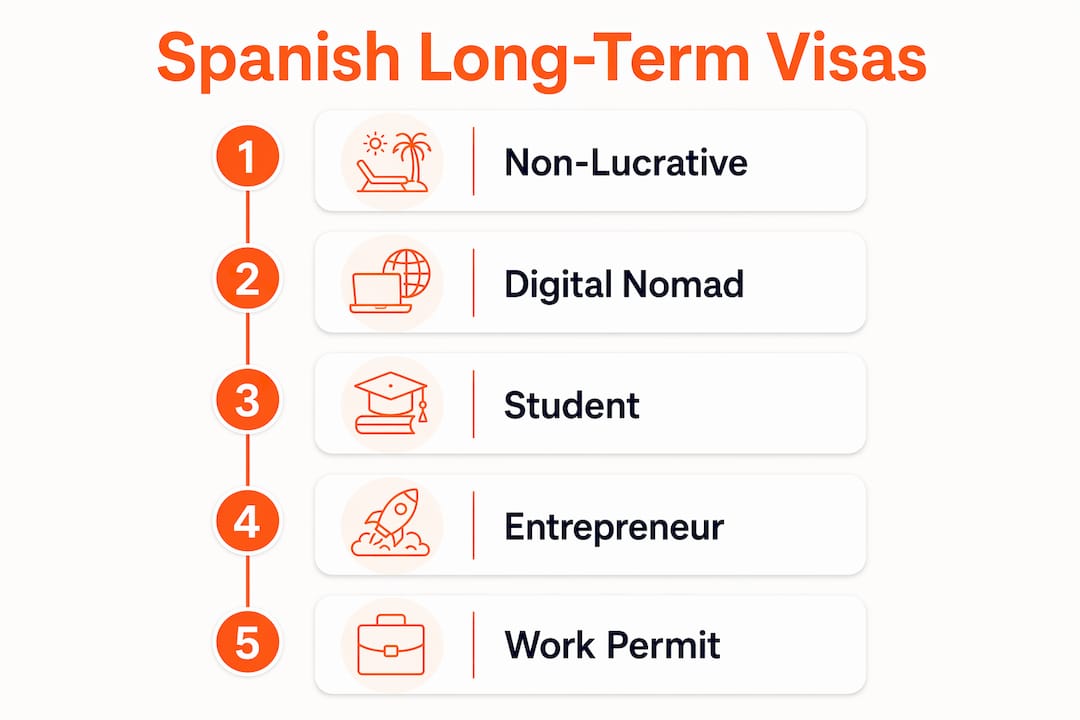
Spain offers several distinct visa categories under the Type D umbrella. Each one targets a different lifestyle or professional situation, and the requirements vary considerably between them.
1. Non-Lucrative Visa (NLV)
The Non-Lucrative Visa is the go-to option for retirees, people living off investments, and anyone with passive income who doesn’t plan to work in Spain. It explicitly prohibits any paid activity, including remote work for foreign employers. The Non-Lucrative Visa is valid for one year initially and renewable for two-year periods after that.
2. Digital Nomad Visa
Spain’s Digital Nomad Visa, introduced under the Startup Act, allows remote workers and freelancers to live in Spain while working for clients or employers outside Spain. Unlike the NLV, it permits professional activity. It’s specifically designed for people whose income comes from international sources, and it opens the door to Spain’s special expat tax regime (Beckham Law).

3. Student Visa
For anyone enrolled in a Spanish university, language school, or accredited training program lasting more than 90 days. Student visas are slightly more flexible than other categories: applicants can sometimes apply from within Spain before their course begins, which differs from most other long-stay visas that require applying from your home country.
4. Entrepreneur Visa
Aimed at founders and self-employed professionals who want to launch a business in Spain. Applicants must present a viable business plan and demonstrate that the project has economic value for Spain. This visa falls under the Entrepreneur’s Law and can lead to a residence permit once the business is operational.
5. Highly Qualified Work Permit (EU Blue Card)
For professionals with a university degree or equivalent qualification who have a job offer from a Spanish company paying above a set salary threshold. The EU Blue Card is Spain’s mechanism for attracting skilled workers in fields like technology, engineering, and medicine. It comes with a work permit built in, so there’s no separate authorization needed.
What are the requirements for Spain’s long-term visas?
The documents and financial thresholds differ by visa type, but several requirements apply across all categories.
Universal requirements for all long-stay visa applicants:
- Valid U.S. passport with at least two blank pages and valid for the full duration of the intended stay
- FBI background check (apostilled through the U.S. Department of State)
- Proof of health insurance covering Spain with no copays and no deductibles
- Proof of accommodation in Spain (rental contract, property deed, or letter of invitation)
- Completed application forms EX-01 and 790-052
- Proof of legal U.S. residency for non-U.S. citizens (Green Card or valid long-term U.S. visa)
Financial thresholds by visa type:
The Non-Lucrative Visa has the most clearly defined financial floor. Applicants must prove financial means equivalent to 400% of Spain’s IPREM for the main applicant, plus 100% of IPREM for each dependent family member. In 2026, that means the minimum financial means for a Non-Lucrative Visa are set at 400% of the annual IPREM (with IPREM at approximately €600 per month), plus 100% of IPREM per dependent, calculated annually (consulates require proof of annual resources, not just monthly).
| Visa Type | Financial Requirement | Work Permitted | Initial Validity |
|---|---|---|---|
| Non-Lucrative Visa | 400% of annual IPREM for main applicant, plus 100% per dependent | No | 1 year |
| Digital Nomad Visa | Proof of remote income (threshold applies) | Yes (foreign clients) | 1 year |
| Student Visa | Proof of monthly subsistence funds | No (limited hours) | Course duration |
| Entrepreneur Visa | Viable business plan + capital | Yes (own business) | 1 year |
| Highly Qualified Work Permit | Job offer above salary threshold | Yes (employer) | 1–2 years |
Pro Tip: Get your FBI background check apostilled early. The apostille process through the U.S. Department of State adds time, and the background check itself must be recent, typically issued within the last three to six months before your application date.
The NLV cost breakdown covers both the visa fee and the residency permit fee, which are two separate payments. Both are non-refundable, so accuracy on your forms matters before you pay.
How to apply for a long-term visa from the U.S.: step by step
The application process runs through Spanish consulates in the U.S. or their designated processing centers. The single most important rule: you must apply at the consulate that covers your state of residence, not whichever one is most convenient.
Step 1: Confirm your consulate jurisdiction
Each Spanish consulate in the U.S. covers specific states. Applicants living in Washington D.C., Maryland, Virginia, West Virginia, or North Carolina must submit through BLS International at the Washington D.C. center. Applicants in New York, Connecticut, New Jersey, Pennsylvania, or Delaware apply through the New York Consulate. Applying at the wrong office is grounds for immediate rejection.
Step 2: Gather and authenticate your documents
Collect every required document, get foreign-language documents translated by a certified translator, and apostille any U.S.-issued documents (criminal record, birth certificate if needed). Health insurance must meet Spain’s specific coverage standards, not just any international policy.

Step 3: Complete forms EX-01 and 790-052
Form EX-01 is the residence authorization application. Form 790-052 is the fee payment form for the initial temporary residence permit. On the 790-052, select the correct box for “initial temporary residence” and include your exact address in Spain. An incomplete or incorrect address on this form can delay your entire application.
Step 4: Book your appointment and submit in person
All long-stay visa applications require an in-person appointment. You cannot mail your application. At the Washington D.C. BLS center, appointments are requested by email. Bring originals and copies of every document. The consulate will return a sealed copy of your EX-01 and your 790-052 receipt after submission.
Step 5: Wait for the decision
Processing times vary by consulate and visa type. The Washington consulate typically takes 1–3 months, though this can stretch during peak periods. You can track your application status online using the code provided at submission.
Step 6: Enter Spain within the visa validity window
Once approved, your visa is stamped in your passport. The Non-Lucrative Visa from the Washington consulate is valid for one year from issuance. You must enter Spain before it expires. Waiting too long and missing the entry window means starting the entire process over.
Step 7: Apply for your TIE within 30 days of arrival
This step is where many applicants stumble. The visa in your passport is not your residency document. Within one month of entering Spain, you must apply for the TIE at the local Foreign Nationals’ Office (Oficina de Extranjeros) or a designated National Police Station. The TIE appointment requires fingerprinting and biometric data collection.
| Milestone | Typical Timeline |
|---|---|
| Document gathering and apostille | 4 weeks |
| Consulate appointment wait | 2–6 weeks |
| Consulate processing | 4 weeks |
| Visa issuance to entry in Spain | Up to 1 year (visa validity) |
| TIE application after arrival | Within 30 days (mandatory) |
| TIE card issuance | 4 weeks after appointment |
How to renew your visa and convert it to permanent residency
The long-stay visa is the starting point, not the finish line. Spain’s residency system has a clear progression, and understanding it helps you plan years ahead.
Year 1: Initial residence permit
Your first TIE is valid for one year, matching your initial visa. Before it expires, you apply to renew your residence authorization. For the Non-Lucrative Visa, renewal is for two years. You must still meet the financial requirements and maintain health insurance coverage.
Years 2–5: Temporary residence renewals
After the first renewal, you continue renewing your temporary residence in two-year blocks. During this period, you must spend the majority of your time in Spain. Prolonged absences, typically more than six months in a year, can interrupt your residency continuity and reset the clock toward permanent residency.
Year 5: Long-term or permanent residency
After five continuous years of legal residence in Spain, you become eligible to apply for long-term residency (residencia de larga duración) or the EU long-term residence permit. This status is significantly more stable: it doesn’t require the same income proofs, it’s renewable every five years, and it gives you broader rights to work and move within the EU.
Year 10: Spanish citizenship
Ten years of legal residence opens the path to Spanish citizenship, reduced to two years for nationals of certain Latin American countries and the Philippines. Citizenship requires passing a Spanish language test (DELE A2 minimum) and a civics exam (CCSE), along with demonstrating integration into Spanish society.
One important distinction: switching visa categories mid-residency is possible but requires careful timing. A digital nomad who later gets hired by a Spanish company can convert to a work permit without leaving Spain, provided the application is filed before the current authorization expires. Consulting a citizenship and residency specialist before making that switch can prevent gaps in legal status.
Expert insights: what U.S. applicants get wrong and how to avoid it
The biggest misconception among first-time applicants is treating the visa stamp as the final goal. It isn’t. The visa gets you into Spain. The TIE is what keeps you there legally. Missing the 30-day TIE deadline after arrival is the single most common mistake, and it creates real complications for your residency status.
Common reasons for visa rejection:
- Applying at the wrong consulate for your state of residence
- Submitting health insurance that has copays, deductibles, or excludes repatriation
- Providing bank statements that don’t clearly show consistent, stable income
- Missing the apostille on U.S.-issued documents
- Incorrect or incomplete address on form 790-052
- Affidavit not translated into Spanish or not notarized
Pro Tip: Book your TIE appointment before you even board the plane to Spain. Appointment slots at the Oficina de Extranjeros fill up fast in major cities like Madrid and Barcelona. If you wait until you arrive to start looking, you may struggle to get a slot within the 30-day window.
Consulate jurisdiction enforcement is strict and non-negotiable. Applying at the correct consular office for your state of residence drastically reduces rejection risk. Some applicants assume they can choose the consulate with the shortest wait times. They can’t.
The stamped copies of EX-01 and 790-052 that the consulate returns to you are not just receipts. They serve as proof of your pending legal application status while you wait for your TIE to be issued. Keep them safe. If you’re stopped by police during that window, those documents demonstrate you’re in the process of legalizing your stay.
Digitalnomadinspain works with applicants from over 50 countries and maintains a 98% approval rate by catching these errors before they reach the consulate. The team handles document preparation, translation, and consulate follow-up, and typically moves applications through the process 30% faster than self-applicants. If you want to check whether you qualify before committing to the full process, the eligibility checker takes about two minutes.
How Digitalnomadinspain can help you get it right the first time

Getting a long-term visa for Spain approved on the first attempt comes down to preparation. The paperwork is manageable, but the margin for error is thin: a wrong box checked on form 790-052, a health insurance policy with a €50 copay, or an apostille that’s three months too old can send your application back to square one.
Digitalnomadinspain offers full-service support for the Digital Nomad Visa and the Non-Lucrative Visa, covering everything from eligibility assessment and document preparation to consulate submission and post-arrival TIE support. If you’re not sure which visa fits your situation, book a consultation and get a straight answer from someone who has done this hundreds of times.
Key Takeaways
Spain’s long-term visa system rewards preparation: applicants who understand the TIE requirement, meet IPREM-based financial thresholds, and apply at the correct consulate jurisdiction consistently achieve approval on the first attempt.
| Point | Details |
|---|---|
| Type D visa is the gateway | Non-EU nationals need a national long-stay visa for any stay in Spain exceeding 90 days. |
| TIE within 30 days is mandatory | The visa stamp is only an entry permit; the TIE card must be applied for within one month of arrival. |
| Financial floor for the NLV | The Non-Lucrative Visa requires proof of 400% of IPREM for the main applicant, plus 100% per dependent. |
| Consulate jurisdiction is strict | You must apply at the consulate covering your U.S. state of residence; applying elsewhere causes rejection. |
| Five years leads to permanent residency | Continuous legal residence for five years makes you eligible for long-term or permanent residency status. |