
Explore the pros and cons of madrid vs barcelona living. Discover which city suits your budget, lifestyle, and remote work needs!
Madrid vs Barcelona Living: Guide for Expats & Nomads

TL;DR:
- Madrid offers lower housing costs and more time for visa processes, making it ideal for budget-focused remote workers and retirees. Barcelona provides a vibrant lifestyle with beach access and a faster housing market, suited for digital nomads seeking a Mediterranean environment. Both cities support visa applications, but acting quickly in Barcelona is crucial due to its competitive rental market.
Madrid wins on budget and space. Barcelona wins on Mediterranean lifestyle and compactness. Neither is universally better — the right answer depends on what you’re actually optimizing for when comparing Madrid vs Barcelona living.
- Budget-focused remote workers and retirees: Madrid. Numbeo’s city comparison shows Barcelona rents running about 22% higher for a one-bedroom in the center, and Madrid’s larger footprint means more outer-zone options at lower price points.
- Lifestyle-first digital nomads: Barcelona. Beach access, a compact walkable grid, and a thriving international tech scene (especially the 22@ district) justify the premium for many.
TL;DR by profile:
- Digital nomads: Barcelona for the international scene and beach proximity; Madrid for lower rent and a bigger home-office footprint.
- Freelancers: Madrid for cost flexibility; Barcelona if your clients or sector cluster there.
- Remote employees: Madrid for space and affordability; Barcelona if your employer has an office there.
- Retirees: Madrid for quieter outer districts and lower costs; Barcelona for walkability and the Mediterranean climate.
Table of Contents
- How do Madrid and Barcelona compare across key living factors?
- What does housing actually cost in each city?
- What are the visa and admin steps after you pick a city?
- What does daily life actually feel like in each city?
- Which city fits your profile best?
- How do you decide and take action right now?
- Key Takeaways
- The factor most people underestimate
- Digitalnomadinspain takes the complexity out of your Spain visa
- Useful sources
- FAQ
How do Madrid and Barcelona compare across key living factors?
| Dimension | Madrid | Barcelona |
|---|---|---|
| Best for | Budget-conscious nomads, retirees, families | Lifestyle-first nomads, beach lovers, tech freelancers |
| 1BR center rent | ~€895/month | ~€1,089/month |
| Groceries & utilities | Slightly lower | ~4–6% higher |
| Housing competition | Moderate; more outer-zone inventory | High; listings move in hours |
| Visa fit | Both visas available; more budget room for financial proof | Both visas available; higher cost baseline |
| Healthcare | Excellent public system; register via empadronamiento | Same public system; private options widely used |
| Climate | Hot summers (38°C+); mild winters | Mild year-round; humid summers |
| Metro network | ~294 km; monthly pass — | ~116 km; monthly pass — |
| Airport | Barajas (MAD): major intercontinental hub | El Prat (BCN): strong European connections |
| Expat community | Large, diverse, Latin American-heavy | International, English-friendly, tech-leaning |
| Coworking & Wi-Fi | Dense citywide; fiber widely available | Dense in Eixample and Poblenou; fiber standard |
| Nightlife/daytime balance | Late-night cosmopolitan culture | Daytime outdoor-focused; earlier evenings |
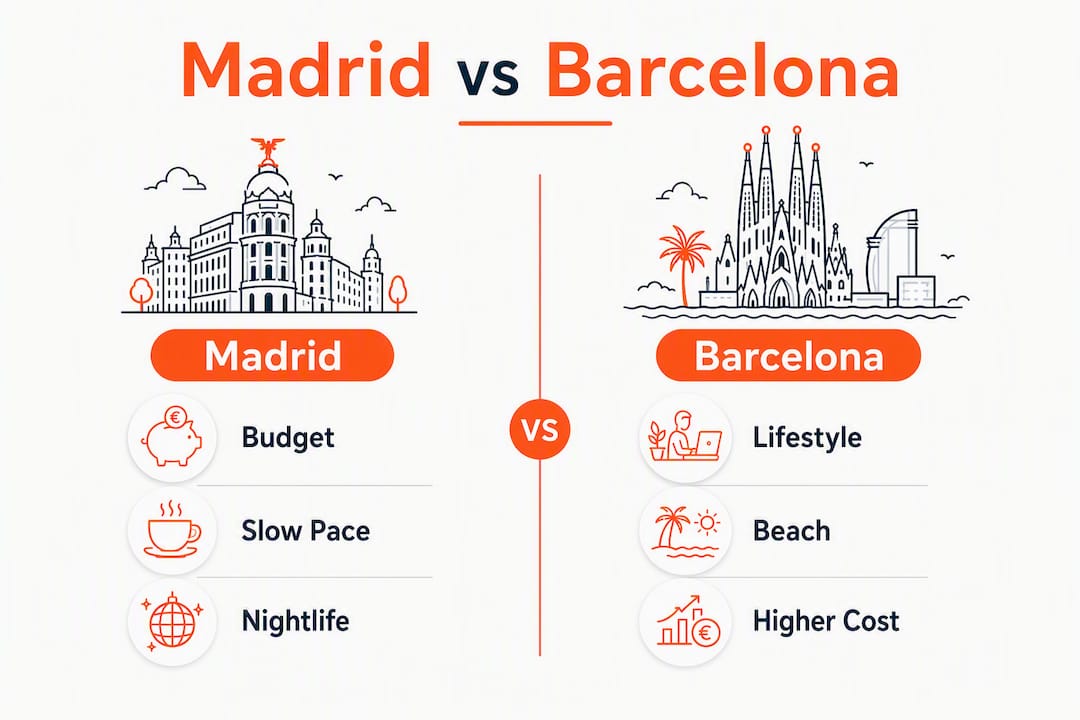
Barcelona receives a substantially higher number of annual tourists than Madrid, which compresses Barcelona’s long-term rental supply and drives its housing premium.
What does housing actually cost in each city?
The rent gap between the two cities is real but not catastrophic. One dataset puts a one-bedroom in the center at roughly €895 in Madrid and €1,089 in Barcelona. Step outside the center and Madrid’s advantage grows: its larger geographic area means you can find a spacious apartment in Carabanchel or Vallecas for well under €800, with a 20-minute metro ride to the core. Barcelona’s geographic ceiling (the sea to the east, mountains to the north) limits that escape valve.
Barcelona’s market also moves faster. Premium central listings in Eixample or Gràcia can be gone within a day of posting. Madrid listings in comparable districts typically allow a few days of consideration.
Neighborhood guide by profile:
- Remote workers/freelancers: Barcelona’s Eixample and Poblenou for coworking density; Madrid’s Malasaña or Lavapiés for creative energy at lower cost.
- Retirees: Barcelona’s Sarrià-Sant Gervasi for quiet streets and green space; Madrid’s Salamanca or Chamberí for walkability and safety.
- Budget-conscious: Madrid’s outer zones (Carabanchel, Vallecas) or Barcelona’s Nou Barris — though Barcelona’s budget options are fewer and farther from the center.
| Cost item | Madrid | Barcelona |
|---|---|---|
| 1BR center rent | ~€895/month | ~€1,089/month |
| Utilities (basic) | Moderate | ~4–6% higher |
| Groceries | Baseline | Slightly higher |
Pro Tip: In Barcelona, have your rental documents ready before you start viewing: passport copy, three months of bank statements, proof of income, and a reference letter. Landlords in high-demand districts expect same-day decisions.
What are the visa and admin steps after you pick a city?
Both the Digital Nomad Visa and the Non-Lucrative Visa are available regardless of which city you choose. City choice affects your financial evidence more than your visa category.
Digital Nomad Visa: Requires proof of remote employment or freelance income (typically 200% of Spain’s minimum wage), a clean criminal record, private health insurance, and accommodation proof. Barcelona’s higher rents mean your bank statements need to show a comfortable buffer above the minimum threshold.
Non-Lucrative Visa: Requires passive or investment income sufficient to support yourself without working in Spain. The Non-Lucrative Visa cost guide covers current financial thresholds in detail.
Post-arrival admin checklist:
- Register at your local town hall (empadronamiento) within 30 days of arrival — this is the foundation for everything else.
- Apply for your NIE (foreigner identification number) at the nearest National Police station or through a gestor.
- Register for public healthcare at your local health center using your empadronamiento certificate, or activate private coverage if your visa requires it.
- Open a Spanish bank account (Sabadell, BBVA, and CaixaBank all have English-language onboarding for non-residents).
- Apply for your TIE (residence card) within 30 days of visa activation.
Typical visa-related costs:
Digitalnomadinspain carries a 98% success rate across clients from over 50 countries and processes applications roughly 30% faster than self-applicants — a meaningful difference when Barcelona rental listings won’t wait for a slow consulate timeline.
What does daily life actually feel like in each city?
Madrid runs late. Dinner at 10 PM is normal, bars fill after midnight, and the city’s social rhythm rewards night owls. The metro covers 294 km of track, so getting across the city is rarely a problem. Barajas airport connects to most major US cities with direct flights, which matters if you’re a remote worker who travels back frequently.

Barcelona’s pace is earlier and more outdoor-focused. The beach is 20 minutes from most central neighborhoods by metro or bike. The compact grid means many residents walk everywhere. El Prat airport has strong European connections, though fewer direct transatlantic routes than Barajas.
For remote workers specifically:
- Fiber internet is standard in both cities; expect 300–600 Mbps in most apartments.
- Coworking spaces are dense in Barcelona’s Poblenou (22@ district) and Madrid’s Chamberí and Malasaña.
- English-speaking meetups and nomad communities are active in both cities, though Barcelona’s international tech scene skews younger and more startup-oriented.
- Madrid’s broader corporate market offers more in-person networking opportunities across industries.
Which city fits your profile best?
- Digital nomad: Barcelona if you want beach access and a startup-adjacent community. Madrid if you need a larger apartment for a home office without paying a premium.
- Freelancer: Madrid for cost headroom; Barcelona if your sector (tech, design, tourism) concentrates there.
- Remote employee: Madrid for space and affordability; Barcelona if your company has a local presence.
- Retiree: Madrid’s Salamanca district for safety and walkability; Barcelona’s Sarrià-Sant Gervasi for a quieter Mediterranean feel.
- Family: Madrid for lower international school costs (childcare and school fees can run 20–30% higher in Barcelona) and more apartment space per euro.
60-second decision rule: If housing budget is your primary constraint, pick Madrid. If daily lifestyle quality (beach, walkability, Mediterranean climate) outweighs the cost difference, pick Barcelona.
How do you decide and take action right now?
8-question decision checklist:
- Can you tolerate summers above 38°C without beach access? (Yes = Madrid; No = Barcelona)
- Is your monthly housing budget under €900 for a one-bedroom? (Yes = Madrid)
- Do you need beach access within 30 minutes? (Yes = Barcelona)
- Is your work sector concentrated in tech or design? (Yes = Barcelona’s 22@)
- Do you need a dedicated home office room without paying a premium? (Yes = Madrid)
- Are you applying for a Non-Lucrative Visa with a fixed passive income? (Yes = Madrid for lower cost baseline)
- Do you travel internationally more than once a month? (Yes = consider Barajas hub access)
- Is an English-speaking expat community a daily priority? (Both qualify; Barcelona skews more international)
3-step action plan:
- Run your visa eligibility check and confirm which visa category fits your income structure.
- Shortlist two neighborhoods in your chosen city and set Idealista or Fotocasa alerts for listings now — don’t wait until documents are ready.
- Book a scouting trip or engage application support so your visa timeline and housing search run in parallel.
Pro Tip: Start your housing deposit savings before your visa is approved. Barcelona landlords won’t hold a unit while you wait for consulate processing. Having two months’ deposit liquid and ready is the difference between landing your first-choice apartment and settling for your third.
Key Takeaways
Madrid is the stronger choice for budget-conscious remote workers and retirees, while Barcelona suits lifestyle-first digital nomads willing to pay a roughly 22% rental premium for Mediterranean access and compactness.
| Point | Details |
|---|---|
| Rent gap is real | Barcelona center rents average €1,089/month compared to €895/month in Madrid (about 21.6% higher); outer zones widen that gap further. |
| Barcelona moves fast | Premium listings in Eixample or Gràcia can disappear within a day — have documents ready. |
| Both cities support visas | Digital Nomad and Non-Lucrative Visas are available in either city; financial proof thresholds are the same. |
| Family costs diverge | Childcare and international school fees run 20–30% higher in Barcelona than Madrid. |
| Digitalnomadinspain | Offers end-to-end visa support with a 98% success rate, processing applications ~30% faster than self-applicants. |
The factor most people underestimate
The Madrid vs Barcelona debate gets framed as beach versus boulevard, but the real decision axis is speed. Not the speed of the cities themselves — the speed at which you need to be ready to act.
Barcelona’s housing market doesn’t care about your visa timeline. A landlord in Eixample with three qualified applicants in front of them will not wait while your consulate appointment is six weeks out. The applicants who land the apartments they actually want are the ones who have their financial documentation clean, their deposit liquid, and their visa process far enough along that they can sign a lease with confidence.
Madrid gives you more time. The market is competitive but not frantic in the same way. That breathing room matters enormously for first-time relocators who are managing a visa application, a job transition, and an international move simultaneously.
The practical implication: if you’re leaning toward Barcelona, start your visa process earlier than you think you need to. If you’re leaning toward Madrid, you have slightly more flexibility — but don’t mistake that for permission to be slow.
Digitalnomadinspain takes the complexity out of your Spain visa
Choosing between Madrid and Barcelona is the interesting part. The visa paperwork is not. Digitalnomadinspain handles the full application process for both the Digital Nomad Visa and the Non-Lucrative Visa — document preparation, certified translations, consulate follow-up, and after-approval support including TIE card registration and tax setup.
The 98% success rate comes from knowing exactly what Spanish consulates want to see, and the 30% faster processing means your visa timeline doesn’t cost you the apartment you found. Whether you’re heading to Madrid’s Malasaña or Barcelona’s Eixample, the next step is the same: confirm your eligibility, get your documents in order, and move fast.
Check your visa eligibility now, or review the full Digital Nomad Visa service to see exactly what’s included.
Useful sources
- Numbeo: Madrid vs Barcelona cost comparison — item-level price data including groceries, transport, and utilities.
- MetroVersus: Barcelona vs Madrid 2026 — metro network sizes, transport pass prices, and livability indices.
- Idealista: Best neighborhoods in Barcelona 2026 — neighborhood profiles by expat segment.
- Digitalnomadinspain: Spain Digital Nomad Visa requirements — full document checklist and income thresholds.
- Digitalnomadinspain: Non-Lucrative Visa cost guide — financial proof requirements and fee breakdown.
FAQ
Is Madrid or Barcelona cheaper to live in?
Madrid is consistently cheaper. Center one-bedroom rents average €895/month in Madrid versus €1,089/month in Barcelona, and groceries and utilities run about 4–6% lower in Madrid as well.
Which city is better for digital nomads applying for Spain’s Digital Nomad Visa?
Both cities qualify, but Madrid offers more housing flexibility and lower costs, which makes meeting the financial proof requirements more comfortable. Barcelona suits nomads whose work or network is concentrated in the tech and design sectors.
How long does it take to settle in after arriving in Spain?
Plan for 4–8 weeks to complete empadronamiento, NIE/TIE registration, healthcare enrollment, and bank account setup. Barcelona’s faster rental market means housing should be secured before or immediately upon arrival.
What are the best neighborhoods in Barcelona for expats?
Eixample and Gràcia suit young professionals and digital nomads; Sarrià-Sant Gervasi works well for retirees and families; Poblenou attracts tech freelancers near the 22@ district.
Can Digitalnomadinspain help with both the Digital Nomad Visa and the Non-Lucrative Visa?
Yes. Digitalnomadinspain provides end-to-end support for both visa types, including document preparation, translations, consulate follow-up, and post-approval TIE and tax registration, with a reported 98% success rate.