
Craft a compelling motivation letter for your Spain visa. Learn essential tips to ensure your application stands out and gets approved.
Motivation Letter for Spain Visa: U.S. Applicant Guide

TL;DR:
- Your Spain visa motivation letter must prove your purpose, funding, accommodation, and return intent with supporting documents. A clear, one-page letter aligned with specific files helps consular officers verify claims and avoid delays. Digitalnomadinspain offers full-service support to ensure accuracy and success.
Your Spain visa motivation letter has one job: prove to a consular officer that your purpose, funding, accommodation, and intent to return are all real, consistent, and backed by named documents. Keep it to one page, write it in Spanish or attach a sworn translation, and make sure every claim you write points to a specific file in your application package.
Table of Contents
- Why consular officers actually care about your motivation letter
- What your motivation letter must prove for a Spain visa
- How to structure your letter paragraph by paragraph
- A short sample motivation letter you can use as a blueprint
- Language, translation, and length rules
- Common mistakes that delay or derail applications
- Document checklist: mapping each letter claim to its file
- Timeline and cost guidance for U.S. applicants
- When does hiring a visa consultancy actually make sense?
- Key Takeaways
- The letter is a reconciliation tool, not a formality
- Digitalnomadinspain handles the letter and everything around it
- Authoritative resources to verify before you submit
- FAQ
Why consular officers actually care about your motivation letter
Consular officers treat the motivation letter as a roadmap for the file. When the letter is clear, they can move through the application quickly. When it is vague or contradicts a document, they stop and request more evidence, which can push your timeline back by weeks.
Three things the letter changes in practice:
- Clarifies purpose. It tells the officer immediately which visa category fits and why, so they are not guessing from scattered documents.
- Reconciles documents. A letter that names each attachment lets the officer verify claims without hunting through the file.
- Shows return intent. Concrete anchors like employment leave approval or property ownership signal that the trip is genuinely temporary.
Pro Tip: Open with a single sentence that states your name, visa type, intended dates, and funding source. A busy officer who reads only that sentence should already understand the core of your application.
What your motivation letter must prove for a Spain visa
The minimum claims a Spain visa cover letter must establish are: purpose of stay, intended duration, funding model, accommodation, health insurance, ties to your home country, and legal compliance with Spanish residency rules.
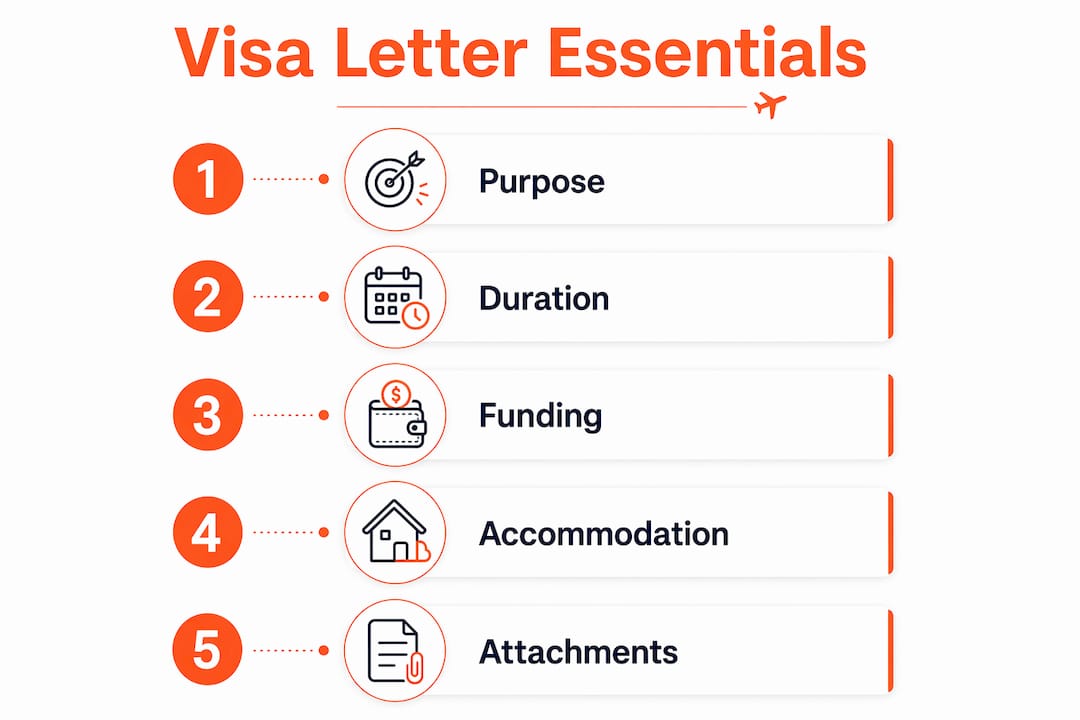
Each claim needs a matching document. Here is the pairing:
| Claim | Supporting document |
|---|---|
| Purpose of stay | Remote work contract / passive income statements / retirement income proof |
| Intended duration | Intended entry and exit dates stated in the letter |
| Funding | 3 months of bank statements, employer contract, or sponsor affidavit |
| Accommodation | Signed lease, property deed, or hotel booking |
| Health insurance | Policy certificate covering Spain, minimum €30,000 coverage |
| Return intent | Employment letter, property deed, family ties declaration |
| Legal compliance | Statement of no criminal record / background check |
Never assert a fact your documents cannot support. If your bank statements show a sponsor contributing funds, say so explicitly rather than claiming full self-funding.

How to structure your letter paragraph by paragraph
The letter should follow a clean four-to-six paragraph structure. Here is a numbered template you can copy into your draft:
-
Opening (30–40 words). State your full name, nationality, visa type, and dates. Example: “I, [Full Name], a U.S. citizen, respectfully submit this letter in support of my application for Spain’s Digital Nomad Visa / Non-Lucrative Visa for a period commencing [date].”
-
Purpose of stay (40–60 words). Explain why you are relocating. For a Digital Nomad visa, name your remote employer or clients and confirm income is sourced outside Spain. For a Non-Lucrative visa, confirm you will not work in Spain and that income is passive. Reference the attached employment contract or income statements.
-
Funding (40–50 words). State your funding model clearly: self-funded, employer-funded, or sponsor-funded. Avoid vague phrases like “I have sufficient funds.” Write: “My stay is self-funded. See attachment: bank_statement_Q1_2026.pdf, which shows monthly income exceeding the IPREM threshold.”
-
Accommodation (30–40 words). Confirm where you will live and for how long. Reference the lease or property deed by file name. If moving with family, note that here and reference the international school enrollment or search process if applicable.
-
Return ties / intent (30–40 words). Name the concrete anchor that brings you back: ongoing U.S. business obligations, property ownership, family ties, or approved leave. Support each with a named document.
-
Closing (20–30 words). Restate the visa type, confirm you will comply with all Spanish laws, thank the officer, and list enclosures.
Total target: 200–300 words. Use 12-point Times New Roman or Arial, 1-inch margins, and date the letter in DD/MM/YYYY format.
A short sample motivation letter you can use as a blueprint
The sample below fits a Digital Nomad visa application. For a Non-Lucrative visa, replace paragraphs 2 and 3 with passive income details and remove any reference to remote work arrangements.
Carta de Motivación — Solicitud de Visado de Nómada Digital
Estimado/a Señor/a Oficial Consular,
I, Jane Smith, a U.S. citizen (Passport No. XXXXXXXX), respectfully apply for Spain’s Digital Nomad Visa for a period of 12 months commencing January 1, 2027. (Maps to: passport copy, visa application form)
I work remotely as a software engineer for Acme Corp., a U.S.-registered company. All income is sourced from outside Spain. (Maps to: employment contract, last 3 months’ payslips — see attachment: acme_contract_2026.pdf)
My stay is self-funded. Monthly net income exceeds the applicable IPREM threshold. (Maps to: bank_statement_Oct_2026.pdf, bank_statement_Nov_2026.pdf, bank_statement_Dec_2026.pdf)
I have secured accommodation in Barcelona for the initial 12-month period. (Maps to: lease_agreement_barcelona.pdf)
I hold comprehensive health insurance valid in Spain with coverage of €30,000. (Maps to: insurance_certificate_2026.pdf)
I intend to return to the United States upon visa expiry. I maintain property ownership and ongoing client contracts in the U.S. (Maps to: property_deed.pdf, client_contracts.pdf)
Enclosures: visa application form, passport, employment contract, 3 months’ bank statements, lease agreement, health insurance certificate, background check, property deed.
Respectfully, Jane Smith | jane.smith@email.com | +1 (555) 000-0000 | Date: 01/01/2027
Sworn translation note: If you write the letter in English, attach a sworn (certified) Spanish translation immediately after the original. Place the translation on a separate page with the translator’s credentials and stamp.
Language, translation, and length rules
The letter should be in Spanish or accompanied by a sworn translation. One page is the standard; two pages is the absolute maximum for complex cases such as family applications or multi-income structures.
Dos and don’ts:
- Use a certified sworn translator, not a bilingual friend or a machine translation app.
- Place the sworn translation on a separate page, immediately after the original.
- Sign the letter by hand. Digital signatures are not universally accepted at Spanish consulates.
- Date the letter in DD/MM/YYYY format to match Spanish consular conventions.
- Include your full name, passport number, phone number, and email at the top.
Common mistakes that delay or derail applications
The most damaging errors are contradictions between the letter and the evidence, generic copy-paste templates, and overstated financial claims. Consular officers catch these quickly, and the result is either a request for additional evidence or an outright rejection.
Watch for these specific red flags:
- Funding contradiction. Claiming self-funding while bank statements show a sponsor. The fix: explain the funding split explicitly and attach a sponsor affidavit.
- Generic template language. Phrases like “I am a law-abiding citizen” with no document support read as filler to a trained officer.
- Overstated income. Claiming income well above what statements show. Officers compare figures.
- Missing return anchor. Stating you will return without naming a specific obligation or document.
- Wrong visa framing. A Non-Lucrative applicant who mentions freelance work in the letter signals ineligibility for that visa category.
If your application is denied, a visa refusal guide can help you identify the specific gap and correct it before reapplying.
Document checklist: mapping each letter claim to its file
Every sentence in the letter that makes a factual claim should reference a named attachment. This table gives you the exact pairing and a sample reference line.
| Letter claim | Required document | Sample reference line |
|---|---|---|
| Remote income / employment | Employment contract + payslips | “See attachment: acme_contract_2026.pdf” |
| Passive income (NLV) | Pension statements / investment income | “See attachment: pension_statement_Q4_2026.pdf” |
| Bank balance / funds | 3 months’ bank statements | “See attachment: bank_statement_Oct_2026.pdf” |
| Accommodation | Signed lease or property deed | “See attachment: lease_barcelona_2026.pdf” |
| Health insurance | Policy certificate | “See attachment: insurance_cert_2026.pdf” |
| Return intent | Employment letter / property deed | “See attachment: property_deed_US.pdf” |
| Sponsor funding | Notarized sponsor affidavit | “See attachment: sponsor_affidavit_2026.pdf” |
Official Schengen visa checklists from the Spanish Ministry of Foreign Affairs confirm that a cover letter explaining the purpose of the visit belongs in the file alongside these supporting records.
Timeline and cost guidance for U.S. applicants
Preparation typically takes 1–4 weeks, depending on how quickly you gather documents and arrange sworn translations. Consulate appointments at major U.S. cities (New York, Los Angeles, Miami, Chicago, Houston) can book out 4–8 weeks in advance. Final decisions generally arrive 4–12 weeks after the appointment, with the Digital Nomad visa process often running faster than the Non-Lucrative visa.
Typical cost categories for U.S. applicants:
| Cost item | Notes |
|---|---|
| Consulate visa fee | Required; check the current fee on your local consulate’s page |
| Sworn translation (per document) | Required for non-Spanish documents |
| Notarization / apostille | Required for background checks and civil documents |
| Health insurance | Required; minimum €30,000 coverage |
| Courier / document shipping | Optional but common for remote applicants |
| Consultancy fee | Optional; see the Non-Lucrative visa cost guide for budget ranges |
Always verify current fees and appointment availability directly on your local Spanish consulate’s website, as these change without notice.
When does hiring a visa consultancy actually make sense?
Hire professional help when your documents have inconsistencies, you need sworn translations coordinated across multiple files, or you want to reduce the time between preparation and decision. The triggers that most often push applicants toward a consultancy: mixed funding sources, self-employment income that requires extra documentation, or a previous visa refusal.
A full-service package from a consultancy like Digitalnomadinspain typically covers eligibility assessment, document checklist, sworn translations, a tailored motivation letter, consulate submission, and follow-up on requests for additional evidence. Digitalnomadinspain reports a 98% success rate and processing times typically 30% faster than self-applicants, which reflects the value of having someone who knows exactly what each consulate expects.
The Digital Nomad visa requirements page and the Non-Lucrative visa service page both include eligibility checks as a starting point. If you are unsure whether your income profile qualifies, that is the right first step before investing in document preparation.
Key Takeaways
A consulate-ready Spain visa motivation letter maps every claim to a named document, stays on one page, and is written in Spanish or accompanied by a sworn translation.
| Point | Details |
|---|---|
| One-page rule | Keep the letter to one page; two pages maximum for complex family or multi-income cases. |
| Spanish or sworn translation | Write in Spanish or attach a certified sworn translation on a separate page. |
| Map claims to documents | Every factual claim must reference a named attachment file in the letter. |
| Avoid contradictions | Funding, income, and return-intent claims must match what the documents actually show. |
| Digitalnomadinspain | Offers end-to-end support with a 98% success rate and 30% faster processing for U.S. applicants. |
The letter is a reconciliation tool, not a formality
Most applicants treat the motivation letter as a box to check. That is the wrong frame. The letter is the only place in the entire application where you can preemptively explain anything that looks inconsistent. A gap between your bank balance and your stated income, a sponsor relationship that is not obvious from the documents, a multi-country itinerary that needs destination logic explained: all of these are problems that a well-written letter can neutralize before an officer even notices them.
What I see most often is applicants who write the letter last, after the documents are assembled, and treat it as a summary. The better approach is to write the letter first, as a diagnostic. Draft the claims you want to make, then check whether your documents actually support each one. That sequence catches contradictions before they reach the consulate.
Generic templates are the other consistent failure point. A letter that reads like it was written for anyone reads to an officer like it was written for no one. Personalization is not about adding emotion. It is about naming your specific employer, your specific lease address, your specific bank, your specific return obligation. Those details are what make the file coherent.
Digitalnomadinspain handles the letter and everything around it
Drafting a strong motivation letter is one piece of a larger application puzzle. Digitalnomadinspain’s full-service packages for the Digital Nomad Visa and Non-Lucrative Visa cover the whole picture: eligibility check, document preparation, sworn translations, a personalized motivation letter tailored to your visa type and income structure, consulate submission, and follow-up through to approval.
For U.S. applicants, the difference between a clean first submission and a request for additional evidence often comes down to whether the letter and documents tell the same story. With a 98% success rate across clients from over 50 countries, Digitalnomadinspain’s team knows what each consulate needs to see. Start with the eligibility checker to confirm your visa category, then book a consultation to get your documents and letter built correctly from the start.
Authoritative resources to verify before you submit
Requirements and appointment systems vary by consulate. Always check your local Spanish consulate or embassy page before finalizing your application.
| Resource | What to verify there |
|---|---|
| Spanish Ministry of Foreign Affairs — Schengen visas | Official document checklist and cover letter requirement |
| Spain Non-Lucrative Visa 2026 guide | Visa-specific income thresholds and documentary requirements |
| Spain Digital Nomad Visa: Complete 2026 Guide | Remote work income proofs and application steps |
| Your local Spanish consulate website | Current fees, appointment availability, and local checklist |
Items to recheck at the consulate before submitting: current visa fee, appointment booking system, whether sworn translations must be from a Spain-approved translator, and any consulate-specific cover letter format requirements.
FAQ
Does a Spain visa motivation letter need to be in Spanish?
The letter should be in Spanish or accompanied by a sworn (certified) translation. One page is the standard length, with two pages accepted only in complex cases.
What is the difference between a Digital Nomad and Non-Lucrative visa motivation letter?
A Digital Nomad letter emphasizes remote income sources and tax compliance plans; a Non-Lucrative letter must confirm passive income sufficiency and explicitly state no intention to work in Spain.
How do I reference documents inside the motivation letter?
Name each attachment directly in the relevant sentence, for example: “See attachment: bank_statement_Oct_2026.pdf.” Concrete attachment references reduce the time an officer spends locating evidence.
What happens if my letter contradicts my bank statements?
Contradictions between the letter and supporting documents are one of the most common triggers for additional evidence requests or rejection. If a sponsor contributes funds, state that explicitly in the letter and attach a notarized sponsor affidavit.
Can Digitalnomadinspain write the motivation letter for me?
Yes. Digitalnomadinspain’s full-service packages include a personalized motivation letter tailored to your visa type, income structure, and supporting documents, along with sworn translations and consulate submission.