
Learn how to transition from Spain's Non-Lucrative Visa to the Digital Nomad Visa. Discover your income eligibility and benefits today!
Non‑Lucrative to Digital Nomad: How to Choose or Switch

If you earn ongoing income from remote work or freelance clients, Spain’s Digital Nomad Visa (DNV) is the right route. If you live on pensions, investments, or savings and won’t work while in Spain, the Non‑Lucrative Visa (NLV) is the correct one. That single distinction between active and passive income decides the whole question, and it’s also the reason so many applicants end up filing for the wrong visa.
Switching from NLV to DNV is allowed, but it isn’t automatic. You have to actually meet DNV’s income and documentation standards, then follow either an in-country change of status or a fresh consulate filing.
- Confirm which category your income falls into before you file anything.
- Gather employment contracts, client invoices, or 12 months of bank statements as proof.
- Run your numbers through an eligibility check before committing to a route.
Quick benchmark: the DNV requires roughly €2,763 per month in 2026, while the NLV requires about €28,800 in savings per year for the main applicant, calculated at 400% of Spain’s IPREM index.
Key Takeaways
The right visa comes down to one test: active foreign income means the Digital Nomad Visa, passive savings or pensions mean the Non‑Lucrative Visa, and switching between them is possible but requires meeting DNV’s documentation standard.
| Point | Details |
|---|---|
| Apply the income test first | Active earned income points to the DNV; passive savings or pensions point to the NLV. |
| Know the thresholds | DNV needs about €2,763 per month; NLV needs about €28,800 per year in savings. |
| Switching is possible, not automatic | Moving from NLV to DNV requires UGE change of status or a fresh consulate filing with full income proof. |
| Tax election depends on visa | Only DNV holders with qualifying employment income can typically elect the 24% Beckham Law rate. |
| Get professional help for mixed income | Digitalnomadinspain reports a very high success rate and processing times faster than self-filed applications. |
This article is general information, not a substitute for advice from a qualified lawyer. Consult a qualified legal professional about your own circumstances before acting on anything here.
Table of Contents
- Non-Lucrative Visa vs Digital Nomad Visa: What Actually Changes
- How Do You Switch From NLV to DNV?
- What Documents Do You Need for Each Visa?
- How Does Each Visa Affect Your Taxes?
- How Do Renewals Count Toward Permanent Residency?
- What Mistakes Cause Rejections or Penalties?
- How Digitalnomadinspain Helps You Choose or Switch
- Why the “Just Pick One” Advice Gets This Wrong
- Get Expert Help Switching or Choosing Your Visa
- Sources
- FAQ
Non-Lucrative Visa vs Digital Nomad Visa: What Actually Changes
The two visas solve different problems, and mixing them up is the single most common filing mistake. Here’s where they diverge in ways that matter for your application.
Work rights. The DNV lets you keep working for foreign employers or clients remotely, with up to 20% of your income allowed from Spanish sources. The NLV is built around not working in Spain at all. Since 2023 there’s a narrow carve-out for limited remote activity, but it was never designed to cover someone running an active freelance business.
Income thresholds. DNV applicants show ongoing earned income near €2,763 per month. NLV applicants show a lump sum, roughly €28,800 saved for the year, with no requirement that the money keeps flowing in.
Application channel and timing. DNV applications can go through Spain’s Unidad de Grandes Empresas (UGE), a fast-track unit that often clears cases in weeks rather than months, or through a consulate abroad. NLV applications almost always go through a consulate, and those tend to run longer.
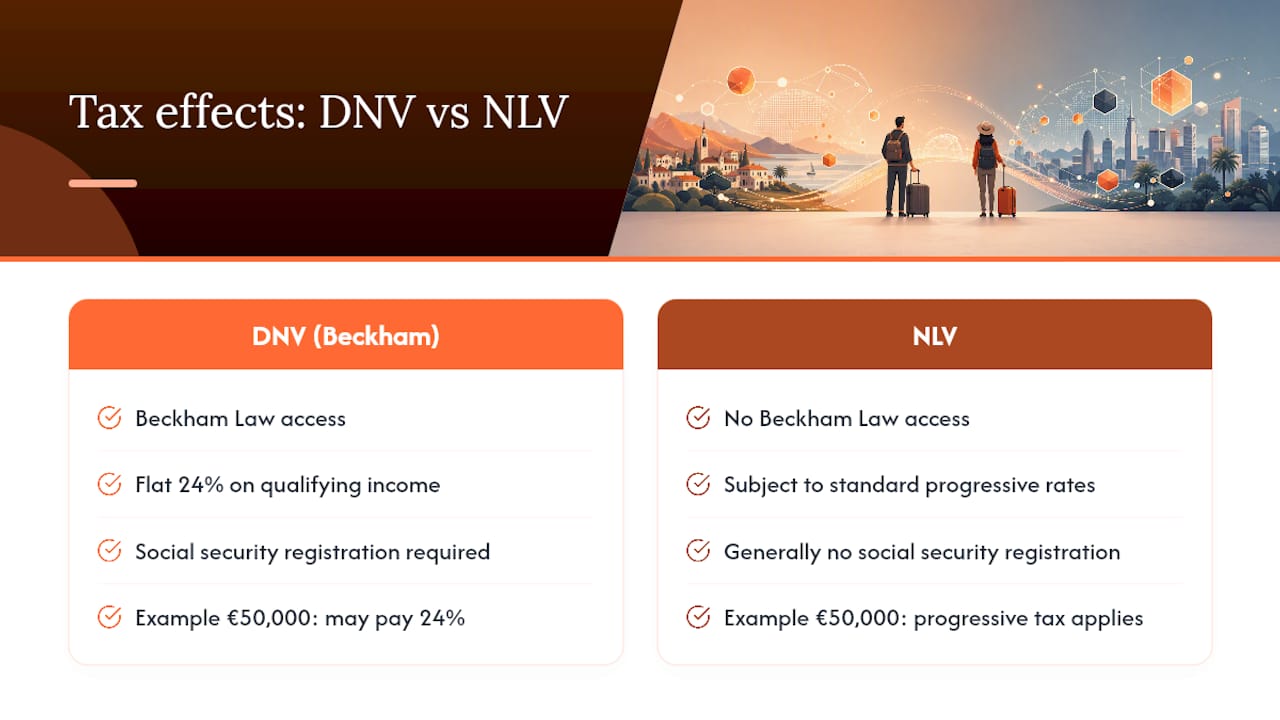
Tax election. Only DNV holders with qualifying employment income can typically opt into the Beckham Law flat 24% rate. NLV holders aren’t working, so they don’t qualify.
- DNV: active income, work rights, faster UGE option, Beckham Law eligible.
- NLV: passive funds, no work rights (narrow exception), consulate-only, standard tax rates.
Spain’s thresholds also sit inside a broader landscape. Some countries set minimal or no income floor for remote-worker visas, while others demand far more than Spain does. That context matters if you’re comparing Spain against a shortlist of destinations, not just deciding between two Spanish visas.
How Do You Switch From NLV to DNV?
Two administrative paths exist, and picking the right one saves months.
- In-country change of status through the UGE. If you’re already a legal resident in Spain on an NLV and can document qualifying active income, you may be able to modify your status without leaving the country. This route tends to move faster because the UGE processes DNV filings on an accelerated track.
- Fresh consulate application. If your NLV is expiring, or your income history doesn’t yet meet DNV standards, you may need to exit the NLV process and apply for the DNV through a Spanish consulate in your home country instead.
Either path requires solid proof: a signed employment contract, invoices from foreign clients, or 12 months of bank statements showing consistent income. Documents originating outside Spain typically need certified translation and legalization before submission.
The most common bottleneck isn’t the paperwork itself. It’s proving the income is sustained, not a one-time transfer, and getting social security registration sorted before the appointment deadline.

Pro Tip: Start your bank statement trail at least three months before you plan to file. A single large deposit looks like a gift; a steady pattern looks like income.
If your income mixes freelance work with a pension, or you’re unsure which document set satisfies UGE reviewers, get a professional to check your file before submission rather than after a rejection.
What Documents Do You Need for Each Visa?
Evidence has to match the income type you’re claiming, and reviewers check for consistency, not just volume.
For the DNV, expect to submit an employment contract or freelance client agreements, invoices covering recent months, and proof the work relationship predates your application by at least three months. You’ll need to show that no more than 20% of your income comes from Spanish clients.
For the NLV, you’ll submit bank statements, pension award letters, or investment account statements showing the required funds, calculated against the IPREM-based threshold.
Both visas require:
- Private health insurance with no copays, meeting Spanish regulatory standards.
- A criminal background check from your home country, apostilled or legalized.
- Certified Spanish translations for any document not originally in Spanish.
- Proof of accommodation in Spain.
Organize these into a single file before your consulate or UGE appointment. Missing translations or expired police certificates are the top reason applications bounce back for resubmission.
How Does Each Visa Affect Your Taxes?
Spend more than 183 days in Spain in a calendar year and you become a Spanish tax resident, regardless of which visa got you there. That triggers worldwide income reporting, not just Spanish-source income.
This is where the visa choice has real financial teeth. DNV holders with qualifying employment income can often elect the Beckham Law regime: a flat 24% rate on qualifying employment income up to certain caps, for up to five years, available to people who weren’t Spanish tax residents in the prior five years. NLV holders can’t use it, since the regime is built around active employment income they don’t have.
For employed or self-employed DNV holders, Spanish social security registration is also part of the deal, either through a bilateral agreement with your home country or direct enrollment. NLV holders generally don’t register at all, since they aren’t working.
Picture two people with identical €50,000 incomes: one on DNV with Beckham Law, one on NLV without a work option. The DNV holder’s flat rate can leave meaningfully more net income than standard progressive rates would. That gap is the whole reason so many remote workers push to qualify for DNV specifically, and it’s worth running the actual tax comparison before assuming either path is cheaper.
How Do Renewals Count Toward Permanent Residency?
Both visas typically run on initial terms with renewal cycles afterward, and UGE processing tends to move faster at renewal than consulate routes do.
- Continuous legal residence on either visa counts toward Spain’s five-year permanent residency threshold.
- Long gaps outside Spain, or lapses between renewal filings, can break that continuity and reset the clock.
- Dependents are generally covered under the primary applicant’s visa, though their own work rights depend on which visa the family is attached to.
- Plan renewal filings at least two months ahead of expiration, and revisit your visa choice at each renewal if your income situation has changed.
What Mistakes Cause Rejections or Penalties?
Misclassifying income is the single biggest cause of rejection, and it’s consistently flagged in legal and immigration commentary as the top failure point. Other frequent errors:
- Leaning on the NLV’s narrow remote-work exception as if it were a full DNV.
- Submitting untranslated or unlegalized documents.
- Registering for social security late, which can jeopardize renewal.
These mistakes can mean outright rejection, denied renewals, or retroactive tax exposure. A conservative, well-documented income classification, checked against current rules before you file, avoids most of this.
How Digitalnomadinspain Helps You Choose or Switch
Digitalnomadinspain handles the parts of this process that trip people up most: eligibility screening, document preparation, certified translation, filing with the consulate or UGE, TIE follow-up after approval, and tax-registration support once you land.
A paid package makes the most sense when your income mixes sources (freelance plus a pension, for instance), when you’re filing for a family, or when your timeline is tight and a rejection would cost you months you don’t have.
“Choosing the wrong visa for your income mix is the leading cause of rejections and renewal problems,” according to immigration analysis on the NLV versus DNV decision.
Start with the eligibility checker or go straight to booking a consultation if your case involves mixed income or a short deadline.
Why the “Just Pick One” Advice Gets This Wrong
Most guides treat this as a simple menu choice: pick the visa with the lower bar and move on. That advice ignores the fact that the wrong choice doesn’t just cost you a rejected application. It costs you a wasted tax year, a broken residency timeline, or a Beckham Law window you can never reopen once it closes.
The overlooked piece is timing your decision around your five-year non-residency window for Beckham Law eligibility, not around which visa feels easier to qualify for today. Someone with a modest freelance income who forces themselves onto an NLV, just to dodge the DNV’s income proof requirements, gives up a real tax advantage for no lasting benefit.
My honest read: the income test matters more than people admit, and switching later is harder than getting the classification right from the start. If your income is even partly active, don’t default to NLV because it looks simpler on paper. Run the numbers, check the eligibility rule against your actual finances, and file for the visa that matches reality, not convenience.
Get Expert Help Switching or Choosing Your Visa
Filing this yourself means chasing UGE requirements, translation rules, and IPREM thresholds on your own, with no second check before submission.
That speed comes from catching the errors, like a missing certified translation or an income mix that doesn’t clearly fit either visa category, before a caseworker does. If your income situation is anything but simple, or your timeline is tight, that difference is worth more than the fee.
Start with the Digital Nomad Visa service page to see what’s included, or book a consultation to get a straight answer on which visa fits your situation and what switching would take.
Sources
Before you file, read the primary breakdowns rather than relying on secondhand summaries. Start with the comparison on DNV versus NLV requirements for 2026, then review Digitalnomadinspain’s Digital Nomad Visa requirements guide and Non-Lucrative Visa application guide. Talk to a tax advisor about your specific situation before filing.
- Digital Nomad vs Non-Lucrative Visa Spain 2026 — Vamos Spanish
- Spain Non-Lucrative Visa or Digital Nomad Visa: Which Should You Choose? — Immigration Start Guide
- Best digital nomad visas for the low income requirement — Deel
FAQ
What Is the Easiest Digital Nomad Job to Get for Visa Purposes?
Freelance contract work and remote employee positions with an existing foreign employer are usually the easiest to document, since they produce the invoices or signed contracts that DNV reviewers expect to see.
What Happens After 5 Years on a Non-Lucrative Visa?
Continuous legal residence on the NLV counts toward Spain’s five-year permanent residency threshold, provided you haven’t broken continuity with long absences or lapsed renewals.
Do Digital Nomads Still Have to Pay Taxes?
Yes. Spending more than 183 days in Spain in a calendar year makes you a Spanish tax resident with worldwide income reporting obligations, regardless of which visa you hold.
Which Country Is Easiest to Get a Digital Nomad Visa For?
Minimum income requirements vary widely by country, with some destinations setting very low or no floor while others require several thousand dollars a month, so “easiest” depends heavily on your income level and target country.
Can Digitalnomadinspain Help Me Switch From NLV to DNV?
Yes. Digitalnomadinspain handles eligibility screening, document preparation, and filing for both the UGE change-of-status route and consulate applications, which is where most self-filed switches run into trouble.