
Discover the income requirements for Spain's non-lucrative visa in 2026. Learn how to calculate your funds based on the latest IPREM.
Spain Non-Lucrative Visa Income Requirements: 2026 U.S. Guide

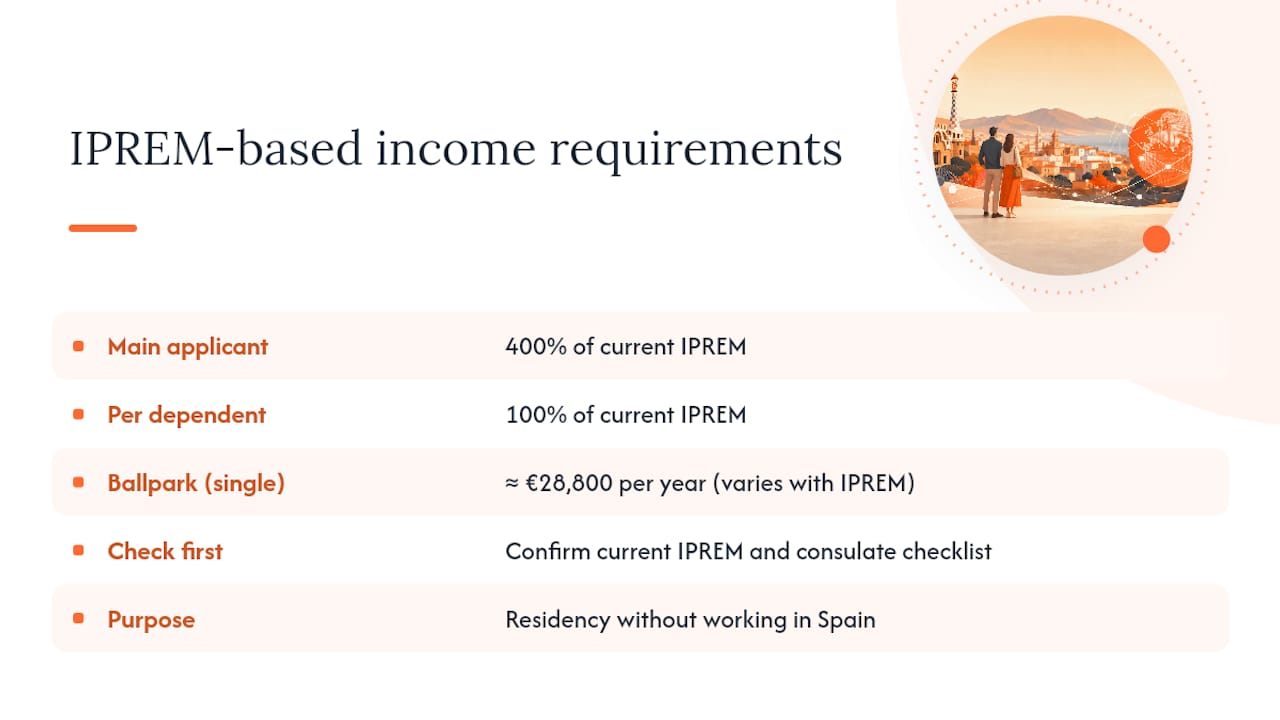
Spain’s non-lucrative visa requires you to show minimum funds equal to 400% of Spain’s IPREM for the main applicant, plus 100% of the IPREM for each dependent you bring. This corresponds to a minimum amount defined as a multiple of Spain’s current IPREM; applicants should check the latest IPREM figure to calculate their required funds accordingly. Before you do anything else, pull up the current IPREM figure from Spain’s official sources and navigate to the U.S. consulate page covering your state, because consulates in Los Angeles, New York, Miami, and Chicago each publish their own document checklists with minor variations.
Quick orientation: Practical guides commonly reference approximately €28,800 per year as the single-applicant ballpark, but that figure moves with each IPREM update. Always verify the current IPREM before calculating your required amount.
The non-lucrative visa (visado de residencia no lucrativa) is Spain’s residency route for people who can support themselves without working in Spain. It is not the same as the Digital Nomad Visa, which is a separate pathway designed for remote workers who keep earning from foreign clients or employers. If you plan to keep your remote job while living in Spain, the Digital Nomad Visa is the correct route. The non-lucrative visa is built for retirees, passive-income holders, and anyone living off savings, pensions, dividends, or rental income.
Key Takeaways
| Point | Details |
|---|---|
| Core income threshold | 400% of Spain’s annual IPREM for the main applicant; add 100% per dependent. |
| Single-applicant ballpark | Approximately €28,800/year based on a €7,200 IPREM; verify the current IPREM before applying. |
| Apostille is mandatory | FBI criminal record certificate must carry a U.S. Department of State Hague Apostille before submission. |
| Work is prohibited | The non-lucrative visa bars all gainful activity in Spain, including teleworking for a foreign employer. |
| Digitalnomadinspain support | Digitalnomadinspain offers end-to-end document preparation and consulate support with a high reported success rate. |
Table of Contents
- How Spain calculates the non-lucrative visa income requirement
- What documents you need to submit from the U.S.
- How to apply from the United States: consulate steps and timelines
- Renewal timing, tax residency, and the work prohibition
- Sample calculations and a pre-submission checklist
- Common reasons for refusal and how to fix them
- What applicants actually experience: a practical perspective
- Ready to move forward with your non-lucrative visa application?
- Sources
- FAQ
How Spain calculates the non-lucrative visa income requirement
The formula is straightforward once you know what IPREM stands for. IPREM (Indicador Público de Renta de Efectos Múltiples, or Public Multiple Effects Income Indicator) is Spain’s official benchmark figure used to set income thresholds across social programs and visa categories. The consulate instruction text is explicit: the main applicant must demonstrate funds equal to 400% of the annual IPREM, and each dependent adds another 100%.
The exact euro amount depends on the current IPREM value, which applicants should verify from official sources before applying.
These are annual minimums. Consulates typically want to see that you can sustain this level of income or savings on an ongoing basis, not just that you had a good month before applying.
Recurring vs. one-off funds
Consulates consistently prioritize documentation showing recurring or guaranteed income over a single large deposit. If your main proof is a savings account, officers will look for a stable balance over time, not a recent transfer. A large lump-sum deposit made shortly before your application raises questions about source of funds and sustainability.

If your wealth is primarily in investments or real estate rather than a flowing income stream, back your bank statements with a certified letter from your financial institution confirming the nature and liquidity of your assets. An investment account statement showing $500,000 in an S&P 500 index fund is more persuasive when paired with a letter from your broker on official letterhead.
Pro Tip: Consulates look at the pattern, not just the balance. Three to six months of consistent bank statements showing deposits that match your stated income source (pension, dividends, rent) is far more convincing than a single statement with a high balance.
What documents you need to submit from the U.S.
Getting the document list right before your appointment is where most U.S. applicants either save or lose weeks. The Manchester consulate page confirms the same requirements that U.S. consulates apply: foreign documents must be apostilled and translated into Spanish where applicable.
Required forms and identification
- EX-01 form: The official Spanish national visa application form for non-lucrative residency. Download it from the consulate website covering your state of residence.
- National visa application form: The standard Schengen/national visa application, completed in full.
- Valid U.S. passport: Must be valid for at least one year beyond your intended stay, with at least two blank pages.
- Two recent passport-style photos: White background, taken within the last six months, meeting Spanish consulate specifications.
Proof of financial means
- Bank statements from the past three to six months (originals and copies), showing account holder name, account number, and consistent balance
- Pension award letter or Social Security benefit statement (dated within the past three months)
- Annuity or insurance contract showing guaranteed income
- Brokerage or investment account statements (dated within the past three months)
- For rental income: signed lease agreements plus corresponding bank deposit records
Criminal record certificate
A U.S. federal background check from the FBI is required, covering the past five years. This document must carry a Hague Apostille from the U.S. Department of State’s Office of Authentications. Processing the FBI check and then obtaining the apostille takes four to eight weeks combined, so start this early. Some consulates also accept state-level criminal record checks apostilled by the relevant state authority, but confirm this with your specific consulate before relying on a state check alone.
Medical certificate
A physician-signed certificate confirming you do not have any disease with serious public health implications, as defined by the 2005 International Health Regulations. The certificate must be recent (typically within three months of your application date) and may need to be translated into Spanish.
Private health insurance
Spain’s non-lucrative visa requires private health insurance with full coverage in Spain for the entire duration of your stay. Consulates check for several specific features:
- Coverage in Spain (not just emergency coverage)
- Repatriation coverage
- No copays or deductibles that would effectively exclude routine care
- No exclusion for pre-existing conditions (some consulates flag policies with broad exclusions)
- Issued by a company authorized to operate in Spain
You cannot use U.S. Medicare, Medicaid, or any public health program to satisfy this requirement.
Document validity at a glance: Bank statements and financial letters must generally be dated within three months of your application. The FBI criminal record certificate is valid for three to six months depending on the consulate, so time your apostille request accordingly. The medical certificate is typically valid for three months. Health insurance must cover the full initial visa period (usually one year).
| Document | How recent it must be |
|---|---|
| Bank statements | Within 3 months |
| Pension / annuity letter | Within 3 months |
| Investment account statement | Within 3 months |
| FBI criminal record + apostille | Within 3–6 months (verify with your consulate) |
| Medical certificate | Within 3 months |
| Health insurance policy | Must cover full visa duration |
| Passport | Valid 1+ year beyond intended stay |
How to apply from the United States: consulate steps and timelines
Step-by-step application process
- Determine your consulate jurisdiction. Spanish consulates in the U.S. serve specific states. The Consulate General of Spain in Los Angeles, for example, covers California, Nevada, Arizona, Hawaii, and several other western states. Check the exteriores.gob.es directory to confirm which consulate covers your state of residence.
- Gather and apostille your documents. Complete the FBI background check, obtain the Hague Apostille from the U.S. Department of State, and arrange certified Spanish translations for all documents not already in Spanish.
- Book your appointment. Several Spanish consulates in the U.S. use BLS International as their consular application center for appointment scheduling and document submission. Check your consulate’s website to confirm whether BLS handles appointments in your jurisdiction or whether you book directly with the consulate.
- Attend your in-person appointment. Non-lucrative visa applications require in-person submission. Bring originals and copies of every document. Biometrics (fingerprints and photograph) are collected at this appointment.
- Pay the visa fee. The fee is paid using Form 790 (Tasa 052), Spain’s official fee payment form. The exact amount varies; verify the current fee on your consulate’s page before your appointment. Fees are typically paid by money order or cashier’s check made out to the consulate.
- Wait for processing. Leave your passport with the consulate. Processing times vary by consulate and season.
- Collect your visa and travel. Once approved, you collect your passport with the visa stamp. You must enter Spain within the visa’s validity window, typically 90 days from issuance.
What to bring on appointment day
- Originals and copies of every document on the checklist
- Completed EX-01 and national visa application forms
- Apostilled FBI background check with certified Spanish translation
- Apostilled medical certificate (if required by your consulate) with certified translation
- Private health insurance policy documents
- Proof of financial means (bank statements, pension letters, investment statements)
- Passport photos
- Visa fee payment (Form 790, paid in advance or at the consulate per local instructions)
Processing times and realistic lead time
Processing times at U.S. consulates typically run four to twelve weeks, though some consulates have processed applications in as few as three weeks during quieter periods. Summer and the holiday season (November through January) tend to bring longer waits. Budget at least three months of total preparation time from the moment you start gathering documents, and apply no later than four to five months before your intended move date.
Renewal timing, tax residency, and the work prohibition
Initial validity and renewal pattern
The non-lucrative visa is issued as a one-year initial residency permit. After that first year, you can renew for two-year periods. After five years of continuous legal residency, you become eligible to apply for long-term residency. Renew at least 60 days before your current permit expires; late renewals create gaps in your legal status.
At renewal, you must again demonstrate sufficient financial means at the current IPREM threshold, show continued private health insurance coverage, and confirm you have not engaged in gainful employment in Spain.
The work prohibition: what it actually covers
Official consulate language is clear: the non-lucrative visa does not authorize the holder to carry out any profit-making or professional activity in Spain. This includes teleworking for a foreign employer. Applicants who plan to keep earning from remote work should apply for the Digital Nomad Visa instead, which is specifically designed for that situation and carries different tax treatment.
This distinction matters more than many applicants realize. Some people assume that working for a U.S. company from a Spanish apartment is invisible to Spanish authorities. It is not, particularly after you become a tax resident. If you are on a non-lucrative visa and you continue earning employment income, you are in violation of your visa conditions.
Tax residency and the 183-day rule
Spend more than 183 days in Spain in a calendar year and you become a Spanish tax resident, which means Spain taxes your worldwide income. Tax guidance consistently flags this as the most underestimated consequence of the non-lucrative visa. Before you cross that threshold, consult a Spanish tax professional who understands both U.S. and Spanish tax obligations, including the U.S.-Spain tax treaty and FBAR reporting requirements for U.S. citizens abroad.
Renewal checklist
- Updated bank statements and financial proof at the current IPREM threshold
- Renewed private health insurance policy covering the next permit period
- Proof of continued residence in Spain (rental contract, utility bills, or empadronamiento certificate)
- Confirmation of no gainful employment (some consulates request a sworn statement)
- Completed renewal application forms submitted to the relevant Spanish immigration office (Extranjería)
Sample calculations and a pre-submission checklist
The table below uses a sample IPREM of €7,200 per year. Verify the current IPREM before calculating your own required amount, as it is updated periodically by the Spanish government.
*USD conversions are approximate and based on a EUR/USD rate near 1.09. Exchange rates fluctuate; always confirm the current rate and present your funds in euros when communicating with the consulate.
Pre-submission checklist
Work through this list before booking your consulate appointment. A missing apostille or an expired bank statement is the most common reason for delays.
- [ ] FBI background check ordered and apostille obtained from the U.S. Department of State
- [ ] Certified Spanish translation of criminal record certificate
- [ ] Bank statements covering the past three to six months, showing a balance or income stream meeting the IPREM threshold
- [ ] Pension, annuity, or Social Security letter dated within three months
- [ ] Investment or brokerage account statement dated within three months
- [ ] Private health insurance policy with full Spain coverage, repatriation, and no public health exclusions
- [ ] Medical certificate signed by a licensed physician, dated within three months
- [ ] EX-01 form completed and signed
- [ ] National visa application form completed
- [ ] Two passport photos meeting Spanish specifications
- [ ] Passport valid for at least one year beyond intended stay
- [ ] Visa fee payment prepared (Form 790)
- [ ] Copies of all originals (consulates typically require one set of copies alongside originals)
Digitalnomadinspain’s visa services include document preparation and apostille coordination, which reduces the back-and-forth that typically extends preparation time for U.S. applicants.
Common reasons for refusal and how to fix them
Most non-lucrative visa refusals come down to a handful of preventable documentation problems.
- Insufficient documented funds. The balance is there, but the statements do not show it consistently over time. Fix: submit three to six months of statements, not just the most recent one. If your balance spiked recently, include a letter from your bank or financial advisor explaining the source.
- Missing or invalid apostille. The FBI background check arrives without an apostille, or the apostille is from a state authority when a federal apostille is required. Fix: submit your FBI check to the U.S. Department of State’s Office of Authentications for the Hague Apostille. Allow four to six weeks.
- Unclear source of funds. Large deposits with no explanation. Fix: include a certified letter from your financial institution, a pension award letter, or a signed lease agreement that ties the deposits to a named income source.
- Health insurance gaps. The policy covers emergencies only, excludes pre-existing conditions broadly, or does not include repatriation. Fix: purchase a policy specifically marketed for Spanish visa applicants and confirm in writing with the insurer that the policy meets Spanish consulate requirements.
- Wrong or incomplete application forms. Using an outdated version of the EX-01 or leaving fields blank. Fix: download the current form directly from your consulate’s website on the day you complete it, and have a second person review every field before signing.
- Translations not certified. Documents translated by a bilingual friend rather than a certified or sworn translator. Fix: use a translator certified by the American Translators Association (ATA) or a sworn translator recognized by the Spanish consulate.
Pro Tip: Organize your application package in the exact order the consulate checklist specifies, with a cover sheet listing each document. Consular officers process dozens of applications per day; a clearly organized file gets reviewed faster and signals that the applicant is thorough.
For a detailed breakdown of what to do if your application is refused, the non-lucrative visa denial guide covers the most common fix strategies and appeal options.
What applicants actually experience: a practical perspective
The income threshold is rarely the real obstacle for U.S. applicants who have done their homework. What slows most applications down is the apostille chain: the FBI check takes time, the U.S. Department of State adds more time, and then the certified translation adds another layer. Applicants who start this process two months before their intended appointment date almost always hit a wall.
The other pattern worth flagging is working-age applicants who underestimate the notarized affidavit requirement. If you are under 65 and not drawing a pension, several U.S. consulates will ask you to prove you are not planning to work in Spain. A notarized statement promising not to engage in gainful activity, combined with documentation of your passive income sources, addresses this directly.
Professional document preparation through a service like Digitalnomadinspain tends to cut the back-and-forth significantly.
Ready to move forward with your non-lucrative visa application?
Calculating your required income is step one. Getting every document apostilled, translated, and organized to consulate standards is where most U.S. applicants spend the most time and make the most mistakes.

Digitalnomadinspain handles the full document preparation process for U.S. applicants: from eligibility checks and financial threshold calculations to apostille coordination, certified translations, consulate appointment support, and renewal follow-up.
This is a paid service and not a requirement for applying. You can apply directly through your consulate without professional help. But if you want to avoid the most common refusal reasons and move through the process without rebuilding your file from scratch, check your eligibility or review the non-lucrative visa package to see what the service covers.
Sources
Before you apply, verify the current IPREM and consulate-specific requirements directly from official sources. Requirements and fees change, and your consulate’s page is the authoritative version.
This article is general information, not a substitute for advice from a qualified lawyer. Consult a qualified legal professional about your own circumstances before acting on anything here.
FAQ
How much money do I need in the bank for a non-lucrative visa in Spain?
Using a €7,200 IPREM, that is approximately €28,800 per year for a single applicant.
Do you pay tax in Spain if you have a non-lucrative visa?
Once you spend more than 183 days in Spain in a calendar year, you become a Spanish tax resident and owe tax on your worldwide income. Consult a tax professional before crossing that threshold, particularly if you have U.S. income or retirement accounts.
Is it hard to get a non-lucrative visa for Spain?
The visa is achievable for applicants who meet the financial threshold and submit complete, correctly apostilled documents. Most refusals stem from documentation errors rather than insufficient funds, which is why organized preparation matters.
What is the minimum salary for a non-lucrative visa in Spain?
The non-lucrative visa does not require a salary.