Learn how to apply for Spain's Non-Lucrative Visa from New York, and enjoy a life of residency in Spain without the need to work.
Spain’s Non-Lucrative Visa: New York Applicant Guide
Yes, you can apply for Spain’s Non-Lucrative Visa (NLV) from New York. If you live in New York, New Jersey, Connecticut, Pennsylvania, or Delaware, the Consulate General of Spain in New York is your filing office. The NLV is Spain’s residency visa for retirees, passive-income earners, and financially independent people who want to live in Spain without working there. Here are your three immediate next steps:
- Verify your residency falls within the New York consular district (NY, NJ, CT, PA, or DE) using a current government-issued photo ID showing your address.
- Start gathering high-priority documents now: your FBI Identity History Summary Check, medical certificate, and proof of financial means take the most lead time.
- Request an appointment by emailing the Consulate directly at cog.nuevayork.visnac@maec.es with your applicant details.
Pro Tip: The Consulate does not use an online booking portal for NLV appointments. Email is the only channel, so send a complete, organized request the first time.
Key Takeaways
Applying for Spain’s Non-Lucrative Visa from New York requires verified residency in the consular district, a compliant document packet, and an email-based appointment with the Consulate General of Spain in New York at cog.nuevayork.visnac@maec.es.
| Point | Details |
|---|---|
| Consular jurisdiction | The New York Consulate covers NY, NJ, CT, PA, and DE; verify your state before booking. |
| Apostilles and translations | Start 6–8 weeks early; the FBI criminal record and medical certificate are the longest-lead items. |
| Health insurance compliance | Policy must be DGSFP-authorized, with no copayments, no waiting periods, and NLV-specific wording. |
| Processing timeline | Typical processing runs 4–12 weeks; do not book international travel until your passport is returned. |
| Digitalnomadinspain | Offers full-service NLV support for New York applicants, with a high success rate and faster processing times. |
Table of Contents
- Who can apply for the non-lucrative visa in New York?
- What documents do you need for the New York NLV application?
- Which U.S. documents need an apostille or sworn translation?
- How do you book and submit your application at the New York Consulate?
- What forms and fees do you need to complete?
- How long does the New York NLV application take to process?
- What does the Non-Lucrative Visa allow, and what happens after you arrive?
- When does hiring a visa service actually make sense?
- One thing most New York applicants underestimate
- Digitalnomadinspain makes the New York NLV process straightforward
- Sources
- FAQ
Who can apply for the non-lucrative visa in New York?
The New York Consulate’s jurisdiction covers five states: New York, New Jersey, Connecticut, Pennsylvania, and Delaware. If you live in any of those states, this is your consulate. If you live elsewhere in the U.S., you must apply at the consulate with jurisdiction over your state of residence, not the one closest to you geographically.
To prove you live within the district, the Consulate requires a current, government-issued photo ID that shows your address. A driver’s license from one of the five covered states is the most common document used. An address alone on a utility bill is not sufficient on its own.
The NLV is designed for:
- Retirees living on pension or retirement income
- Passive-income earners (dividends, rental income, investments)
- Financially independent individuals who do not need to work
Family members can apply together in the same appointment. Each family member needs their own complete document set, but you can include all applicants in a single booking email. Dependents (spouse, minor children) are eligible to join the primary applicant under the same visa category.
Pro Tip: Check your ID’s expiration date before booking. The Consulate will not accept an expired ID as proof of residency, and replacing a driver’s license can take weeks.
What documents do you need for the New York NLV application?
The Consulate requires originals and copies of every document. Bring one original and at least one clean photocopy of each item, organized in the same order for each applicant. Presenting a disorganized packet is one of the fastest ways to slow down your appointment.
Applicant identity
- Passport: Original plus two copies of the photo page. Must be valid for at least one year beyond your intended stay.
- Passport-size photos: Two recent color photos on a white background, meeting Schengen photo standards.
- Proof of residency: Current government-issued photo ID (driver’s license) showing your address in the consular district.
Criminal record
- FBI Identity History Summary Check: This is the required federal criminal record certificate for U.S. applicants. Request it through the FBI’s identity history summary service. The document must be apostilled and accompanied by a certified Spanish translation. Most consulates require it to be issued within the last 90 days.
Health documentation
- Medical certificate: Issued by a licensed physician, confirming you have no contagious diseases that pose a public health risk. Must be apostilled and translated into Spanish. Typically valid for 90 days from the date of issue.
- Health insurance: A Spanish-licensed policy (authorized by Spain’s DGSFP) with no copayments, no waiting periods, and full annual coverage. The policy wording must reference the Non-Lucrative Visa. This is the single most commonly flagged document at the New York Consulate. A standard U.S. travel insurance policy will not pass.
Financial proof
- Bank statements: Typically the last three to six months, showing consistent passive income or savings. The financial threshold is linked to Spain’s IPREM (Public Income Multiple Effect Reference Indicator). Aggregated applicant guides commonly report a requirement of 400% of the annual IPREM for the main applicant, plus 100% per additional family member. Always verify the current IPREM figure before submission, as it is updated periodically.
- Pension or income documentation: Award letters, dividend statements, or rental income records that demonstrate ongoing passive income.
Spain-arrival paperwork
- Accommodation evidence: A property deed, rental contract, or a letter of invitation (carta de invitación) from a Spanish resident confirming where you will live.
- Completed Form EX-01: The official non-lucrative residence form, completed in Spanish. Bring two copies.
- Form 790-052: The consular fee payment form, completed with box 2.1 checked. Two copies required.
Common rejection reasons at the New York Consulate
- Health insurance that does not meet DGSFP authorization or includes copayments
- Criminal record certificate older than 90 days or missing apostille
- Medical certificate missing apostille or certified translation
- Financial proof that does not clearly demonstrate passive income (a large lump sum without income context is often insufficient)
- Missing or incorrect accommodation evidence
Pro Tip: Print your document packets in the exact order listed on the Consulate’s checklist. Consular officers process dozens of files per day. A clearly labeled, ordered packet moves faster.
Which U.S. documents need an apostille or sworn translation?
The Hague Apostille Convention covers both the U.S. and Spain, so U.S. documents destined for Spanish consular use need an apostille rather than full diplomatic legalization. The U.S. Department of State explains the process: for state-issued documents (birth certificates, marriage certificates, medical certificates), you obtain the apostille from the Secretary of State’s office in the state where the document was issued. For federal documents like the FBI Identity History Summary Check, the apostille comes from the U.S. Department of State in Washington, D.C.
Documents that typically require an apostille:
- FBI Identity History Summary Check (federal apostille)
- Medical certificate (state apostille, from the state where the doctor is licensed)
- Birth certificates (if required for family applications)
- Marriage certificates (for spousal dependents)
Documents that generally do not require an apostille:
- Bank statements and financial records
- Pension award letters
- Health insurance policy documents
Every apostilled document in English must also have a certified Spanish translation (traducción jurada). This is a translation prepared by a sworn translator recognized by the Spanish authorities, not a standard commercial translation. The translator signs and stamps the document, and that stamp is what the Consulate accepts.
The validity window matters. The FBI criminal record and medical certificate are most commonly required to be issued within 90 days of your appointment date. Plan backward from your target appointment date when ordering these documents.
Pro Tip: Start the apostille and translation process at least 6–8 weeks before your target appointment. The FBI Identity History Summary Check alone can take several weeks, and the federal apostille adds more time on top of that. This is consistently the longest lead item in the entire application.
How do you book and submit your application at the New York Consulate?
The New York Consulate does not use an online booking system for NLV appointments. The process is email-based, and the steps below reflect the procedure the Consulate uses.
- Prepare your complete document packet before emailing. The Consulate expects you to be ready to attend an appointment shortly after it is scheduled.
- Send one email to cog.nuevayork.visnac@maec.es with the following information for each applicant: full legal name, date of birth, passport number, and the visa type requested (Non-Lucrative Residence Visa). If applying as a family, include all applicants’ details in a single email.
- Wait for the Consulate’s reply confirming your appointment date and time. The reply will typically include an application code or receipt reference. Keep this.
- Attend your appointment in person. Bring your complete document packet: originals followed by copies, signed forms, and proof of fee payment. The Consulate will review your documents at the counter.
- Submit your passport. The Consulate retains your passport during processing. Do not plan international travel while your application is pending.
- Track your application through the MAEC consular portal, where the Consulate issues application receipts and status updates using your application code.
What to include in your booking email: Full name, date of birth, and passport number for each applicant; the visa type (Non-Lucrative Residence Visa); your contact phone number; and a brief note if you are applying as a family unit. A clear, complete first email avoids back-and-forth delays that can push your appointment date back by weeks.
You can also submit through BLS International’s Spain Visa Application Centre in New York, which handles document collection and forwards files to the Consulate. BLS provides practical guidance on appointment preparation and the national visa application process. Check their current instructions, as procedures and service fees are updated periodically.
Pro Tip: When booking a family application, include every applicant’s details in one email. Sending separate emails for each family member often results in separate appointment slots, which complicates the submission.
What forms and fees do you need to complete?
Three forms are required for the NLV application at the New York Consulate:
- Form EX-01: The official Spanish residence application form for non-lucrative residency. Download the PDF from the Spanish Ministry portal. Complete it in Spanish and bring two copies.
- National visa application form: A standard consular visa application form, available from the Consulate or BLS. Complete and sign it.
- Form 790-052: The consular fee payment form. Check box 2.1 for the non-lucrative residence visa. Bring two completed copies.
The consular fee is paid in connection with Form 790-052. Payment methods and the current fee amount should be confirmed directly with the Consulate or BLS before your appointment, as accepted payment methods and amounts can change. The fee is denominated in euros, converted to U.S. dollars at the applicable rate. Keep both a digital and printed copy of your payment receipt. The Consulate will not process your application without proof of fee payment, and a missing receipt on the day of your appointment means a wasted trip.
Statistic note: The consular fee for a long-stay national visa is set by Spanish regulation. Always verify the current amount at the Consulate’s official page or with BLS before your appointment, as the rate is subject to periodic adjustment.
Pro Tip: Download Form 790-052 from the official source and complete it before your appointment. Do not rely on filling it out at the Consulate window. Bring two signed copies along with your payment receipt.
For a full breakdown of what the NLV application costs beyond the consular fee, including apostille fees, translation costs, and insurance, the NLV cost guide covers the full budget picture.
How long does the New York NLV application take to process?
Processing times at the New York Consulate vary. Applicant reports suggest processing typically runs from several weeks to a few months. Seasonal volume, particularly in spring and summer when relocation demand peaks, can push timelines toward the longer end.
Your passport stays with the Consulate from the moment you submit until the visa is issued or refused. The visa is stamped directly into your passport, so you cannot travel internationally during that window.
Common causes of delay:
- Missing or expired apostille on the FBI criminal record or medical certificate
- Health insurance that does not meet DGSFP authorization requirements
- Incomplete financial evidence (bank statements that show a balance but not a clear income source)
- High application volume during peak seasons (March through August)
- Requests for additional documentation after initial review
Once the visa is approved, the Consulate will notify you to collect your passport. You can pick it up in person or arrange courier return. The visa validity period begins from the date of issue, not the date you enter Spain, so plan your travel accordingly.
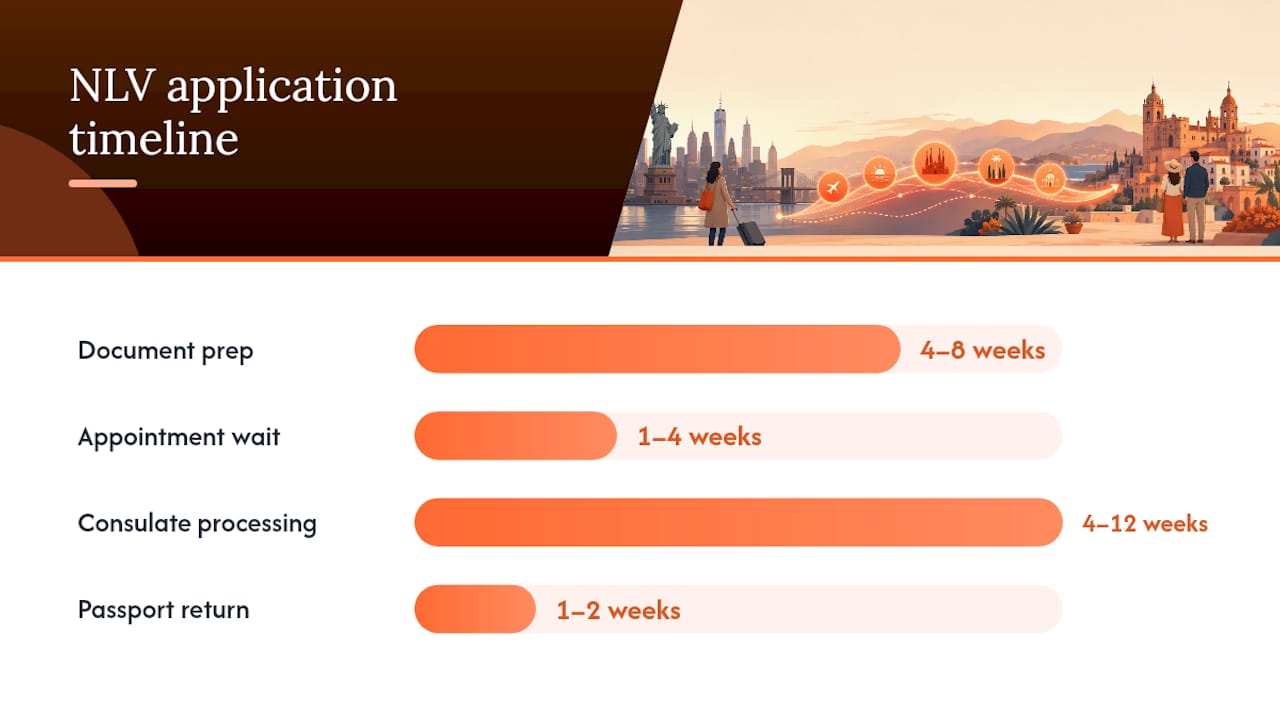
| Stage | Typical Timeframe |
|---|---|
| Document preparation (apostilles, translations) | 4–8 weeks |
| Appointment wait time | 1–4 weeks |
| Consulate processing | 4–12 weeks |
| Passport return after approval | 1–2 weeks |
Pro Tip: Build at least a 2–3 month buffer between your target submission date and any planned move to Spain. Booking flights or signing a long-term lease before your visa is in hand is a costly mistake.
What does the Non-Lucrative Visa allow, and what happens after you arrive?
The NLV grants you the right to reside in Spain without engaging in any gainful employment or professional activity. That includes both local employment and teleworking for a foreign employer. If you plan to work remotely from Spain for clients or an employer outside Spain, the NLV is the wrong visa. Spain’s Digital Nomad Visa is designed for that situation.
What the NLV allows:
- Living in Spain as a legal resident
- Enrolling dependents (spouse, minor children) under the same visa category
- Accessing Spain’s public services as a registered resident
- Renewing residency annually (and eventually applying for long-term residency)
What the NLV does not allow:
- Working for a Spanish employer
- Teleworking for a non-Spanish employer or clients
- Starting a business or freelancing in Spain
After you arrive in Spain, you have a short window to complete several registration steps:
- Apply for your TIE (Tarjeta de Identidad de Extranjero) within 30 days of arrival. This is your physical residence card and the document you will use for most official purposes in Spain. Apply at the local Oficina de Extranjería.
- Register on the padrón municipal at your local town hall (Ayuntamiento). This is Spain’s municipal census and is required for many local services.
- Register with the Spanish health system if applicable, or confirm your private insurance coverage continues to meet residency requirements.
If you spend more than 183 days in Spain in a calendar year, you become a Spanish tax resident. That has real implications for how your worldwide income is taxed. Consult a tax advisor who knows both U.S. and Spanish tax law before you move, not after.
Pro Tip: If you plan to split time between the U.S. and Spain, get a tax advisor involved early. The 183-day rule is straightforward, but the interaction between U.S. tax obligations and Spanish residency rules is not.
When does hiring a visa service actually make sense?
A straightforward NLV application from a single applicant with clean financials and a simple income profile is manageable as a DIY project, provided you are organized and have time to research each requirement carefully. The Consulate’s official checklist is public, the forms are downloadable, and the appointment process is email-based.
Professional help tends to pay for itself in three situations: complex financial profiles (multiple income sources, investment portfolios, or self-employment income that needs to be presented as passive), family applications with multiple document sets, and tight timelines where a single rejected document could cost months.
Digitalnomadinspain offers end-to-end support for New York applicants applying for the Non-Lucrative Visa, including:
- Eligibility assessment before you spend money on documents
- Document checklist tailored to your specific financial profile
- Apostille and certified translation coordination
- Form completion (EX-01, 790-052, national visa form)
- Appointment scheduling and submission follow-up
- Post-arrival support: TIE application, padrón registration, tax registration guidance
These are client-supplied figures. What they reflect in practice is that an experienced team knows which insurance policies the New York Consulate accepts, how to present financial evidence for non-standard income profiles, and how to avoid the document errors that cause the most common delays.
You do not need to hire anyone to apply. The Consulate accepts direct applications. But if your financial situation is anything other than a straightforward pension or savings account, or if you are applying as a family, a professional review of your document packet before submission is worth considering.
Pro Tip: Even if you plan to file yourself, an eligibility check with a visa service costs far less than a rejected application and a second round of apostilles.
One thing most New York applicants underestimate
The paperwork for Spain’s Non-Lucrative Visa looks manageable on paper. A checklist of ten or twelve items, a couple of forms, an email to book an appointment. Most applicants who run into trouble do not fail on the big items. They fail on the details that nobody warns them about until the Consulate flags them.

Health insurance is the clearest example. The requirement is not just “health insurance.” It is a Spanish-licensed policy, authorized by Spain’s DGSFP, with no copayments, no waiting periods, full annual coverage paid upfront, and policy language that explicitly references the Non-Lucrative Visa. A policy that covers everything medically but uses the wrong wording gets rejected. That rejection costs you weeks, sometimes months, because you then need to source a compliant policy, get the documentation in order, and rebook.
The same logic applies to the financial proof. The IPREM-linked threshold is a floor, not a target. Showing a bank balance that technically clears the number is not the same as demonstrating stable passive income. Consular officers are looking for evidence that you will not need to work in Spain, and a lump sum without a clear income source behind it raises questions.
The applicants who move through the New York Consulate process fastest are not the ones with the most money or the most documents. They are the ones who read the requirements precisely, sourced compliant products, and submitted a clean packet the first time. That is a preparation problem, not a qualification problem.
Digitalnomadinspain makes the New York NLV process straightforward
Getting the Non-Lucrative Visa right the first time means no rebooking, no second round of apostilles, and no months of uncertainty while your passport sits at the Consulate. Digitalnomadinspain handles the full application process for New York applicants: document preparation, apostille and translation coordination, compliant health insurance guidance, form completion, appointment scheduling, and post-arrival support including your TIE and tax registration.
Hiring is optional. You can apply directly. But if you want a professional review of your packet before you submit, or you would rather hand the process to someone who has done it hundreds of times, check your eligibility and get a clear picture of what your application needs before you spend a dollar on documents.
Sources
Always verify the current document checklist and fee amounts directly on the Consulate’s official page before your appointment, as requirements are updated periodically.
This article is general information, not a substitute for advice from a qualified lawyer. Consult a qualified legal professional about your own circumstances before acting on anything here.
FAQ
Can I get a non-lucrative visa for Spain from New York City?
Yes. If you live in New York, New Jersey, Connecticut, Pennsylvania, or Delaware, the Consulate General of Spain in New York is your filing office. Email cog.nuevayork.visnac@maec.es to request an appointment.
How much money do you need for a non-lucrative visa?
The financial threshold is linked to Spain’s IPREM. Applicant guides commonly report a requirement of 400% of the annual IPREM for the main applicant, plus 100% per additional family member. Verify the current IPREM figure before submission, as it is updated periodically.
How long does a non-lucrative visa take to process?
Processing at the New York Consulate typically runs 4–12 weeks from the date of submission. Seasonal volume and incomplete documents are the most common causes of delays at the longer end of that range.
Do I pay taxes with a non-lucrative visa?
The visa itself does not determine your tax status. If you spend more than 183 days in Spain in a calendar year, you become a Spanish tax resident and are taxed on your worldwide income. Consult a tax advisor familiar with both U.S. and Spanish tax law before you move.
Can I telework on a non-lucrative visa?
No. The NLV prohibits all gainful employment, including teleworking for a foreign employer. If you plan to work remotely from Spain, Spain’s Digital Nomad Visa is the appropriate visa category.