
Discover how to successfully renew your non-lucrative visa in Spain with updated requirements and essential tips for a smooth process.
Renewing Your Non-Lucrative Visa in Spain: What Changed

Yes, you can renew your non-lucrative visa in Spain, and most applicants who kept their status clean the first time around get approved again without drama. To start your file, you need four things in hand: a valid TIE and passport, uninterrupted private health insurance that meets Spanish standards, and financial proof covering the full two-year renewal period, not just one year like your original application.
- Current TIE card and passport with at least a few months of validity remaining
- Private health insurance with no co-payments, active continuously since your last renewal
- Bank statements or income documentation covering two years of financial means
- Evidence you’ve actually lived in Spain (padrón certificate, utility bills, local bank activity)
You can file starting about two months before your TIE expires, with a grace window afterward if you miss the deadline.
Pro Tip: Book your Extranjería appointment the day your 60-day window opens. Provincial offices in Madrid and Barcelona fill up fast, and a late appointment can push you dangerously close to the grace period cutoff.
Key Takeaways
Renewing a Spanish non-lucrative visa successfully depends on filing within the 60-day window, proving two years of financial means, and keeping insurance and residence evidence continuous.
| Point | Details |
|---|---|
| File within the window | Submit 60 days before TIE expiry; the 90-day grace period exists but adds risk. |
| Prove two years of funds | Renewal financial proof must cover the full two-year authorization, not just one year. |
| Keep insurance unbroken | Any lapse in private, co-payment-free health insurance can trigger extra document requests. |
| Document your presence | Padrón registration, utility bills, and bank activity all support your residence evidence. |
| Five years unlocks more | Continuous residence for five years removes the income requirement via long-term residency. |
| Get professional backup | Digitalnomadinspain’s non-lucrative visa service handles document prep, appointments, and TIE follow-up for complex or time-sensitive files. |
This article is general information, not a substitute for advice from a qualified lawyer. Consult a qualified legal professional about your own circumstances before acting on anything here.
Table of Contents
- When to Apply for Your Non Lucrative Visa Renewal
- What Are the Requirements for Non-Lucrative Visa Renewal?
- Non-Lucrative Visa Renewal Documents Checklist
- How Do You Submit a Non Lucrative Visa Renewal Application?
- What Happens After Your Renewal Is Approved
- How Long Does Non-Lucrative Visa Renewal Take?
- Common Mistakes That Delay or Deny NLV Renewals
- What Happens After 5 Years on a Non-Lucrative Visa?
- When Should You Hire Help for Your NLV Renewal?
- Get Renewal Support From Digitalnomadinspain
- Sources
- FAQ
When to Apply for Your Non Lucrative Visa Renewal
The official window opens 60 days before your TIE card expires and stays open for up to 90 days after expiry, though filing late adds risk and, in some provinces, extra scrutiny. This same 60-day-before structure applies across Spain’s residence schemes, including the digital nomad visa renewal process, so if you know someone on that visa, the timing logic transfers directly.
Appointment availability is the real bottleneck, not the paperwork. Some provinces book out Extranjería slots six to eight weeks in advance. Opening your window on day 60 without an appointment already secured is a mistake.
Here’s what a realistic timeline looks like for a TIE expiring on June 15:
- April 16: Window opens; submit online or book your in-person appointment immediately
- Late April to May: Attend appointment, submit documents, receive your resguardo (proof of filing)
- June 15 onward: Your resguardo keeps you legally resident while the decision is pending, even past the expiry date
Filing before expiry, rather than during the grace period, keeps your paper trail clean and avoids any argument later about continuous residence.
What Are the Requirements for Non-Lucrative Visa Renewal?
Extranjería runs four checks on every renewal file: money, insurance, presence, and identity documents. Miss one, and you’re looking at a request for more paperwork at best, a denial at worst.
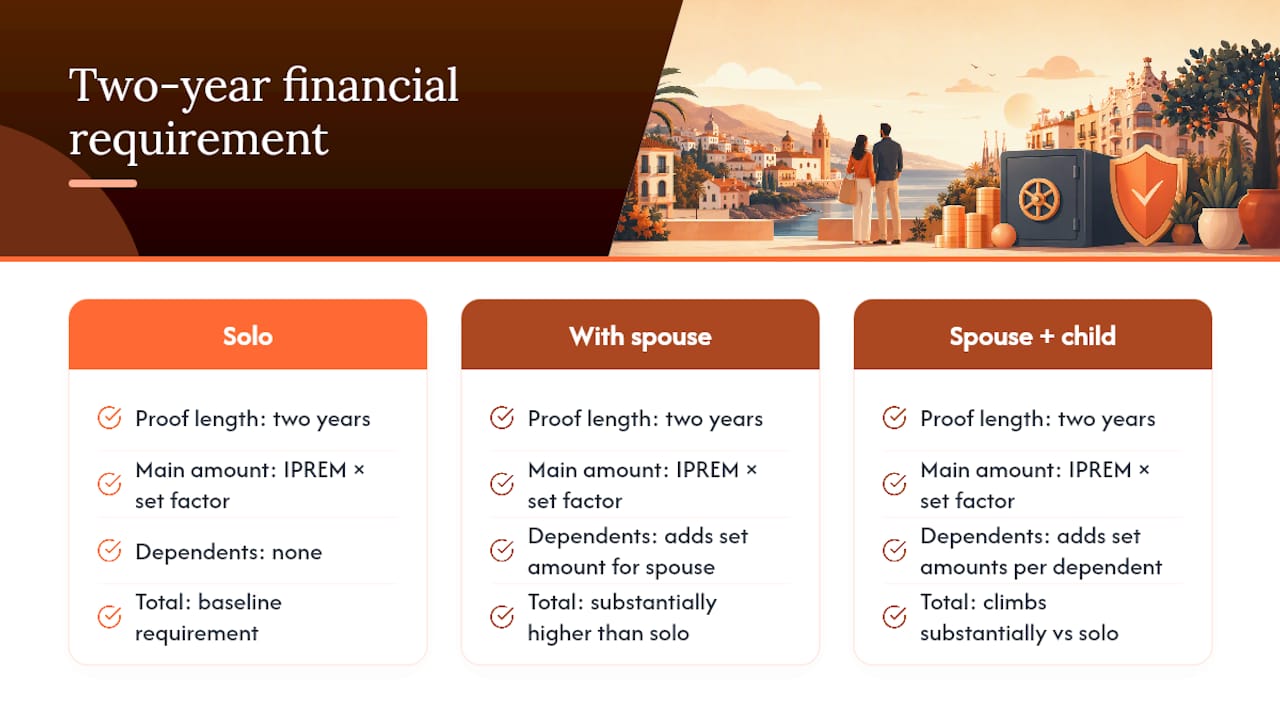
Financial means now require proof covering two full years, not the single year you needed initially. The calculation multiplies the public income indicator (IPREM) by a set factor for the main applicant, with additional amounts stacked on for each dependent. If you’re renewing with a spouse and one child, your required total climbs substantially compared to a solo applicant, so run the math before you assume last year’s savings statement will still clear the bar.
Health insurance must be private, Spanish-compliant, and free of co-payments, and it needs to have run continuously since your last approval. A one-month lapse, even an accidental one caused by a policy renewal mix-up, is the kind of thing that triggers a supplemental document request.
Residence evidence matters more than it used to. Officials look at your padrón registration, utility bills in your name, and bank account activity to confirm you actually live where you say you do. A recent court decision has pushed back against denying renewals purely because someone spent more than 183 days abroad in a given year, but that ruling doesn’t erase the need for solid habitual-residence evidence. It just means the 183-day count isn’t an automatic disqualifier on its own.
Identity documents are the simplest piece: a passport with valid pages remaining, your current TIE, and a Spanish criminal record check run internally.
Pro Tip: If your income comes from a mix of pension payments, rental income, and investment dividends, gather a separate proof document for each stream rather than one combined statement. Reviewers move faster when income sources are labeled, not merged.
Non-Lucrative Visa Renewal Documents Checklist
Assembling the full file up front is the single best way to avoid a supplemental document request that can add weeks to your case. Here’s what goes in the folder:
- Completed EX-01 form (the standard residence authorization renewal form)
- Full passport copy, including any pages with prior Spanish stamps or visas
- Current TIE card, front and back
- Padrón certificate (empadronamiento), issued recently, not from years ago
- Private health insurance certificate showing continuous coverage with no co-payments
- Bank statements covering the full two-year proof period
- Income documentation: pension letters, investment statements, rental contracts, whichever applies
- Recent passport-style photos
- Proof of tasa payment (the government fee receipts)
Most in-Spain renewals don’t require apostilles on documents you already used in your original application, since those were verified once already. New documents, like a fresh pension letter, generally just need to be current and legible rather than officially translated, unless the specific office asks.
For bank statements, six months to a year of recent activity is typical, layered on top of the older statements that cover the earlier part of your two-year window. Names need to match exactly across every document. A missing middle initial on one bank statement has derailed more than one otherwise solid file.
If you’re renewing with dependents, each family member needs their own passport copy, TIE, and health insurance certificate, and the financial threshold rises per person. A spouse and two kids means four sets of identity documents stacked on top of one shared financial proof package.
Digitalnomadinspain’s detailed NLV overview includes a fuller breakdown of document formatting if you want to cross-check your file before submitting.
How Do You Submit a Non Lucrative Visa Renewal Application?
The process runs in four stages, and where you file (online versus in person) changes how each stage feels.
- Prepare documents and pay the tasa. You’ll typically pay Tasa 790-052 for the residence authorization renewal itself, and Tasa 790-012 separately for the new TIE card issuance. Combined, government fees usually land somewhere in the €38 to €44 range, though insurance and any professional help cost extra on top.
- Request your appointment. You can book directly at your local Extranjería office, or increasingly, submit through the electronic headquarters (sede electrónica), which Spain’s residence authorities are pushing more applicants toward. The electronic route skips the in-person wait but demands your documents be scanned and formatted correctly the first time.
- Attend the appointment or complete e-submission. Officials check your originals, confirm your documents match your uploads, and issue a resguardo, your temporary proof that the application is active.
- Respond fast to any request for more information. If Extranjería asks for a supplemental document, you usually get a short window, often 10 business days, to respond. Missing it can mean starting over.
Provincial variation is real. Madrid and Barcelona see heavier caseloads and longer appointment queues than smaller provinces, so applicants there benefit most from filing through the sede electrónica early or bringing in a local gestor or immigration lawyer to navigate office-specific quirks.
Budget beyond the government tasas for:
- Private health insurance renewal or upgrade
- Certified translations, if any foreign documents are required
- A gestor or lawyer’s fee, if you choose professional help
What Happens After Your Renewal Is Approved
Approval doesn’t hand you a card on the spot. Once Extranjería approves your renewal, your new TIE is typically ready for collection at a designated police station within a few weeks, and the consular guidance on telework visas outlines similar TIE issuance mechanics that apply broadly across Spain’s residence categories.
Bring your resguardo, passport, and the fee receipt for the TIE tasa when you go to collect it. Until your new card is in hand, your resguardo remains your legal proof of status, so don’t let it expire or misplace it.
Once you have the new TIE, a few small tasks close the loop:
- Confirm your padrón registration is still current at your address
- Verify your health insurance policy dates align with your new authorization period
- Update any bank or tax records that reference your old TIE number
Keep a photo of your new TIE and insurance certificate on your phone. It sounds minor, but it saves you scrambling if a landlord or bank asks for proof mid-transaction.
How Long Does Non-Lucrative Visa Renewal Take?
Processing time typically runs one to three months, though the exact wait depends heavily on which province handles your file. High-volume offices in Madrid and Barcelona tend to sit at the longer end of that range, while smaller provincial offices sometimes clear renewals in a matter of weeks.
Your resguardo protects you the entire time you’re waiting, meaning you remain legally resident even if your old TIE’s expiry date passes before a decision comes through. That said, a decision that drags well past three months without update is worth following up on, particularly if you have upcoming travel plans that require a valid card.
You can check status through the sede electrónica portal, by calling your provincial Extranjería office directly, or through the appointment system if you booked one initially.
Pro Tip: If your case sits unresolved past the typical window and you have a genuine travel deadline, that’s the moment to bring in a lawyer or immigration consultant who can escalate directly with the provincial office rather than waiting in a general phone queue.
Common Mistakes That Delay or Deny NLV Renewals
Most refusals trace back to a handful of avoidable errors. Insufficient financial proof for the full two-year window tops the list, usually because applicants assume last year’s numbers still apply. Insurance gaps come second, often from a policy lapsing between renewal dates without the applicant noticing. Expired passport pages, a missing padrón certificate, and blowing past the deadline to respond to a supplemental document request round out the usual suspects.
If you catch a gap late, a sworn statement explaining a short insurance lapse, paired with proof the gap has since been closed, can sometimes bridge the issue. Additional bank evidence covering a shortfall works the same way.
- Double-check every document shows consistent name spelling and current dates
- Never submit expired originals, even if a copy looks fine
- If your renewal was previously denied for a fixable reason, address that specific gap head-on this time
Pro Tip: Booking your Extranjería appointment at the last minute inside the 60-day window is the single most common cause of missed deadlines. Book the day the window opens.
What Happens After 5 Years on a Non-Lucrative Visa?
Five years of continuous legal residence opens the door to long-term residency, known as the tarjeta de larga duración. This is the real payoff for sticking with the annual and biennial renewal cycle.
- The income requirement disappears entirely at this stage
- Work rights open up, letting you take local employment without a separate authorization
- Continuous residence is judged the same way it is at renewal: padrón history, tax filings, and time actually spent in Spain all factor into your claim
Courts have already pushed back on overly rigid interpretations of time-abroad rules at the renewal stage, and that same flexibility tends to carry through when applicants build their long-term residency case.
When Should You Hire Help for Your NLV Renewal?
Some renewals are straightforward. Others aren’t, and it’s worth being honest about which category you fall into before you start. Complex income sources spread across pensions, rental properties, and investments, a TIE expiring in a province known for backlogs, an insurance gap you’re not sure how to explain, or a prior refusal are all solid reasons to bring in professional support rather than gamble on a DIY file.
Digitalnomadinspain’s non-lucrative visa service covers the pieces that trip people up most: an eligibility check before you file, document preparation and translations, appointment booking, follow-up on any supplemental requests, and support through TIE collection once you’re approved.
- Eligibility review that flags financial or insurance gaps before submission
- Document preparation that matches formatting expectations for your specific province
- Ongoing follow-up so a request for more information doesn’t sit unanswered past the deadline
Pro Tip: A targeted review of your file before submission catches the small inconsistencies, mismatched names, outdated statements, thin insurance proof, that otherwise turn into a formal request for additional documents weeks later.
A pragmatic note from the publisher
Most failed renewals I’ve seen trace back to one small, fixable thing: someone assumed their original approval meant the second round would be identical, and it isn’t. One applicant nearly missed the two-year financial threshold because they used their first-year numbers out of habit. Keep insurance and padrón registration continuous, always. It’s the cheapest insurance against a denial you’ll ever buy.
Get Renewal Support From Digitalnomadinspain
Digitalnomadinspain is the difference between guessing whether your two-year financial proof clears the bar and knowing it does before you ever sit down at Extranjería. Instead of piecing together document formats from forum posts, you get a service built specifically around Spain’s non-lucrative visa renewal rules.
The support covers three things that matter most at renewal: document preparation tailored to your income mix, appointment scheduling in provinces where slots vanish fast, and follow-up if Extranjería requests anything extra after submission. Clients working with Digitalnomadinspain also get help through TIE collection, so the process doesn’t stall right at the finish line.
If you’re unsure whether your current savings or income documentation meets the two-year threshold, start with the eligibility checker or head straight to the non-lucrative visa service page to book a consultation before your filing window opens.
Sources
- Telework (Digital nomad) Visa - Consular Section
- Application for the Digital Nomad Visa | Plataforma One
- Spain Digital Nomad Visa Renewal 2026: New Income Rules
FAQ
How Many Times Can You Renew a Non-Lucrative Visa in Spain?
There’s no fixed cap. You can keep renewing every two years as long as you continue meeting the financial, insurance, and residence requirements, and after five continuous years you become eligible for long-term residency instead.
What Happens After 5 Years on a Non-Lucrative Visa?
You can apply for the tarjeta de larga duración, which removes the income requirement entirely and opens up work rights you didn’t have on the standard NLV.
What Are the Requirements for the Non-Lucrative Visa Renewal?
You need continuous private health insurance, financial proof covering two full years, evidence of actual residence in Spain like padrón registration and utility bills, and a valid passport and TIE.
Is It Hard to Get a Non-Lucrative Visa Renewal for Spain?
Renewal is generally more predictable than the initial application if you’ve kept your insurance continuous and your finances documented, though gaps in either one are the most common cause of delays. Working with a service like Digitalnomadinspain can help catch those gaps before submission.
When Should I Submit My Non-Lucrative Visa Renewal?
File starting 60 days before your current TIE expires. A 90-day grace period exists after expiry, but filing early keeps your resguardo and legal status uninterrupted.