
Had your non lucrative visa Spain denied? Discover fixable reasons and take action fast to appeal or reapply with confidence.
Spain Non-Lucrative Visa Denied? Here’s How to Fix It

TL;DR:
- Most non-lucrative visa denials from Spanish consulates are repairable by correcting specific documentary issues. Acting promptly within the appeal window and thoroughly fixing the reasons listed can help applicants reapply successfully.
Most non-lucrative visa (NLV) denials from Spanish consulates are fixable. The majority trace back to documentary problems: insufficient financial proof, a non-compliant health insurance policy, missing apostilles, or a sworn translation that wasn’t sworn. Those are correctable. What you do in the next 24–48 hours determines whether you appeal, reapply fast, or need a lawyer.
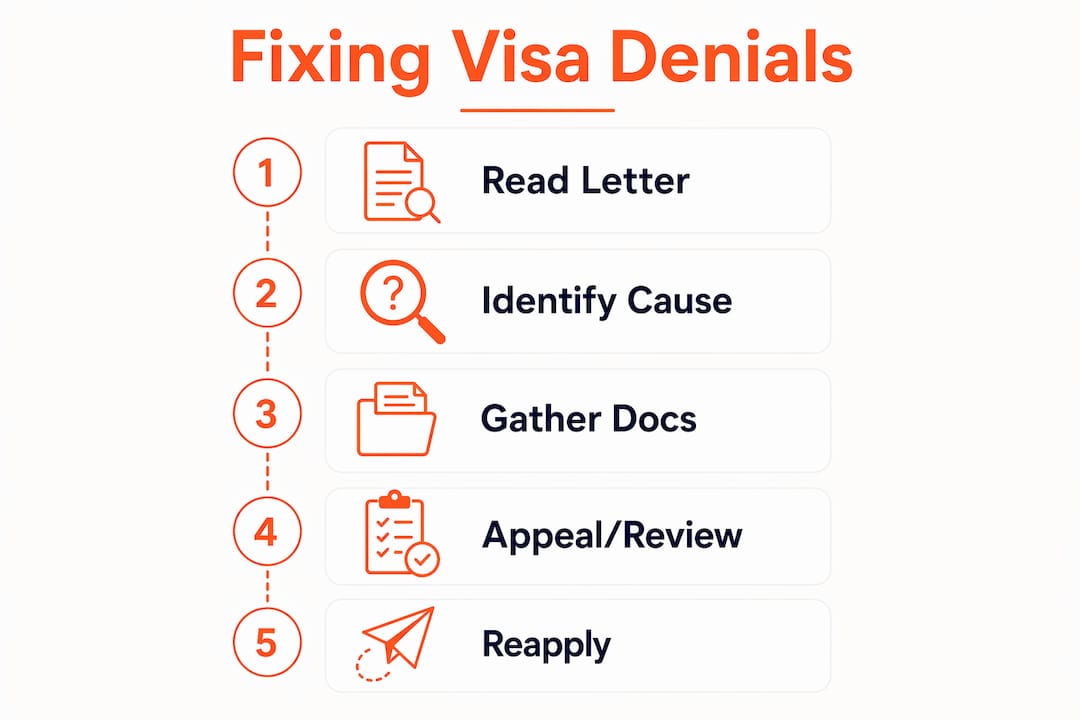
Your immediate priority: Find the resolución denegatoria (the official denial letter), read the paragraph that states the legal grounds, and write down the appeal deadline. For an administrative appeal (recurso de reposición), you typically have one calendar month from the date of official notification. That clock is already running.
Once you have the denial text in front of you, triage your situation into one of three paths:
- Path A: The denial cites a missing or incorrect document. Gather the corrected materials and reapply. This is the fastest route for most applicants.
- Path B: The denial cites a procedural or technical error that the consulate made. File a recurso de reposición within one month.
- Path C: The denial cites substantive ineligibility (criminal record issues, clear intent to work, profile mismatch). Get an immigration lawyer involved before doing anything else.
If the letter is vague or uses boilerplate language, call the consulate for clarification and simultaneously send the denial text to a qualified immigration consultant for an intake review. Denials have become more frequent since 2020 as consulates apply tighter scrutiny to NLV profiles, so acting quickly and correctly matters more than acting fast and sloppily.
Table of Contents
- Why your non-lucrative visa Spain denial happened and how to fix each cause
- How to read your resolución denegatoria and find what matters
- Your legal options after denial: appeal, judicial review, or reapply
- The document checklist to fix before you reapply
- What timelines and costs look like for U.S. applicants
- When hiring a consultant or immigration lawyer actually changes the outcome
- Key Takeaways
- What the denial patterns actually tell you
- Digitalnomadinspain can rebuild your NLV application after a denial
- Useful resources for denied NLV applicants
- FAQ
Why your non-lucrative visa Spain denial happened and how to fix each cause
The denial letter names the reason. Here is what each common reason actually means and what to do about it.
Insufficient financial means
Spain’s consulates use an IPREM-based calculation to judge whether you can support yourself without working. Specialist guidance commonly cites approximately €28,800 per year for the main applicant as the IPREM-derived baseline, plus roughly €7,200 per year for each dependent. Confirm the current figures with your specific consulate before reapplying, as IPREM adjusts annually.

The fix is rarely just having enough money. It’s proving it convincingly. Investment account statements without a notarized translation, balances that fluctuate sharply month to month, or income that looks temporary rather than ongoing all trigger rejections. Submit 3–6 months of bank statements, a letter from your financial institution confirming account ownership, and clear documentation of passive income sources (rental income, dividends, pension payments). Multiple income streams, each documented separately, reduce the consulate’s discretion to reject.
Pro Tip: Present each income source as its own mini-dossier: account statements + source documentation + sworn translation. Consular officers reviewing a well-organized packet are less likely to exercise discretionary rejection than those confronted with a stack of mixed, untranslated documents.
Non-compliant health insurance
Private health insurance for an NLV must provide full coverage across Spain, with no copayments and no waiting periods. Travel insurance doesn’t qualify. U.S.-based plans don’t qualify. Policies with deductibles are routinely rejected. The insurer must be authorized to operate in Spain.

The fix: obtain a policy that explicitly states no copayments, no waiting periods, and nationwide Spain coverage, then request a confirmation letter from the insurer on company letterhead. Some consulates want to see the full policy document; others accept the certificate. Bring both. For a practical comparison of compliant providers, the international health insurance guide from Digitalnomadinspain covers what to look for in a qualifying policy.
Missing apostilles and sworn translations
Every foreign document in your application needs a Hague Apostille and a sworn translation (traducción jurada) into Spanish. A regular translation, even a professional one, does not satisfy this requirement. The translator must be a traductor jurado certified by Spain’s Ministry of Foreign Affairs.
Common pitfalls: apostilles that expired before submission, translations that omit the translator’s official stamp, and documents translated into Spanish but not apostilled in the country of origin. Fix these before reapplying, not after.
Criminal record issues
Your criminal background check must cover every country where you have lived for more than six months in the last five years. Each certificate needs its own apostille and sworn translation. An expired apostille, a missing jurisdiction, or even a minor undisclosed conviction produces a denial. If your record includes anything beyond a clean certificate, get an immigration lawyer to assess the impact before reapplying.
Passport validity and medical certificate errors
Most consulates expect your passport to remain valid well beyond the visa period requested. Check the specific validity requirement with your consulate. The medical certificate must be recent (typically within three months of submission), signed by a licensed physician, and use the exact wording Spanish consulates require, including a reference to the WHO International Health Regulations. Generic language or a missing IHR reference is a common, easily corrected denial ground.
Evidence suggesting intent to work
Consulates actively scan for telework signals: LinkedIn profiles listing an active employer, freelance contracts, invoices, or social media identifying you as a digital nomad. If any of these appear in your application or are publicly visible, the consulate may deny on the spot. The fix before reapplying is to remove or contextualize those items and, if you are genuinely a remote worker, consider whether the Digital Nomad Visa is actually the better fit for your situation.
Wrong consulate or missed appointment
Consular jurisdiction is determined by your legal state of residence in the U.S. Filing at the wrong consulate is an automatic administrative rejection. Verify which consulate has jurisdiction over your address before refiling.
Missing accommodation proof or prior immigration violations
Acceptable proof of a Spanish address includes a rental contract, a property deed, a hotel reservation for the initial period, or a notarized invitation letter from a Spanish resident. Prior overstays or immigration violations in Spain or the Schengen Area add a layer of scrutiny that almost always requires legal review before reapplying.
How to read your resolución denegatoria and find what matters
The denial letter is your roadmap. Don’t skim it.
Start with the paragraph that states the legal grounds for denial. Copy it word for word. That paragraph determines your appeal strategy. Immediately below or at the end of the letter, look for the section titled something like “recursos” or “pie de recurso.” This section lists your appeal rights and the deadlines: typically one month for the recurso de reposición and two months for the recurso contencioso-administrativo (judicial appeal).
Write down four pieces of information from the letter: the date of official notification, the consulate’s file or reference number, the specific article or clause cited as the denial ground (if present), and the names of any documents explicitly called out as missing or deficient. These four items are what a lawyer or consultant needs to assess your case quickly.
If the letter is vague, uses boilerplate language, or simply says “insufficient documentation” without specifying what was missing, that vagueness is itself a legal issue. In that case, contact the consulate in writing to request clarification, and simultaneously send a scanned copy of the letter to an immigration professional. Vague denials are sometimes challengeable on procedural grounds.
What to send to a lawyer or consultant for an intake review:
- Scanned resolución denegatoria (full letter, all pages)
- Complete copy of the application you submitted
- Passport copy
- Bank statements and financial documentation submitted
- Health insurance certificate and policy
- All translations and apostilles included in the original application
The faster you get this package together, the more options you have before the appeal window closes.
Your legal options after denial: appeal, judicial review, or reapply
Three paths exist. The right one depends entirely on why the visa was denied.
Administrative appeal (recurso de reposición)
File within one calendar month of the denial notification, directly with the consulate that issued the denial. The appeal must identify the resolution being challenged (date, reference number, applicant identity), state the legal and factual grounds for the appeal addressing each denial reason, and include corrected or new evidence that responds directly to those reasons. No lawyer is legally required, though many applicants hire one for stronger argumentation.
The consulate has three months to respond. If three months pass with no answer, the appeal is deemed implicitly denied by silencio negativo, which opens the door to a judicial appeal. The recurso de reposición works best when the denial was based on a fixable documentary issue. It works poorly when the denial was discretionary or based on profile concerns.
Judicial appeal (recurso contencioso-administrativo)
File within two months of an explicit denial of the reposición, or two months from the silencio negativo date. This requires both a Spanish lawyer (abogado) and a court representative (procurador). Timelines run from six to eighteen months depending on court workload. Costs are higher than an administrative appeal.
One important precedent: the Spanish Supreme Court judgment of March 22, 2012 (recurso de casación 299/2010) held that the NLV requires only that the applicant not work in Spain, not that they perform no work at all. If your denial cited remote work or telework, this doctrine is relevant ammunition in a judicial appeal.
Reapply with a corrected dossier
For most documentary denials, this is the fastest and cheapest route. There is no mandatory waiting period between a denial and a new application. The key is addressing every point named in the denial letter before submitting again. A reapplication that fixes only the explicitly named issue while leaving other weaknesses in place often produces a second denial.
| Factor | Administrative Appeal | Judicial Appeal | Reapply |
|---|---|---|---|
| Deadline | 1 month from denial | 2 months from denial or silencio | No mandatory wait |
| Cost | Low to moderate | High | Moderate (document costs) |
| Timeline | 3+ months for response | 6–18 months | Consulate processing time |
| Lawyer required | No (recommended) | Yes | No (recommended for complex cases) |
| Best for | Procedural/documentary errors | Substantive legal grounds | Most documentary denials |
| Success likelihood | Moderate | Depends on legal grounds | High when all issues fixed |
Decision rule: If the denial letter says “missing document” or “insufficient evidence,” reapply. If it cites substantive ineligibility or you have a criminal record issue, get a lawyer and consider the judicial route. If the denial seems procedurally wrong, file the reposición while simultaneously preparing a corrected reapplication as a backup; for more cross-border relocation insights, see the Essential Guide for Spanish Citizens Moving From Spain to Ireland.
The document checklist to fix before you reapply
Work through this list against the specific items named in your denial letter.
Financial evidence
Calculate your required annual income using the IPREM-derived baseline (approximately €28,800 per year for the main applicant, plus roughly €7,200 per year for each dependent, per specialist guidance; confirm current figures with your consulate). Document every passive income stream separately: bank statements for the most recent 3–6 months, brokerage statements, rental income records, pension award letters, or dividend documentation. Each source needs a sworn translation. The full NLV requirements guide from Digitalnomadinspain covers acceptable documentation formats in detail.
Health insurance
Obtain a policy with no copayments, no waiting periods, and full Spain coverage from an insurer authorized to operate in Spain. Request both the insurance certificate and the full policy document. Attach a cover letter from the insurer confirming the policy meets Spanish NLV requirements.
Apostilles and sworn translations
Every foreign-issued document needs a Hague Apostille from the issuing country and a sworn translation by a traductor jurado certified by Spain’s Ministry of Foreign Affairs. Find certified translators through the Spanish Ministry of Foreign Affairs’ official registry. Check apostille issue dates: some consulates treat apostilles older than six months as expired.
Criminal record certificates
Cover every country where you lived for more than six months in the last five years. Each certificate needs its own apostille and sworn translation. FBI Identity History Summary checks are the standard U.S. federal criminal record document; state-level certificates may also be required depending on your consulate’s instructions.
Passport and medical certificate
Confirm minimum passport validity with your specific consulate. The medical certificate must be dated within three months of submission, signed by a licensed physician, and reference the WHO International Health Regulations explicitly. Use a physician familiar with Spanish consular requirements or ask your consultant for the exact required wording.
Proof of accommodation
Acceptable formats include a signed rental contract, a property deed, a hotel reservation covering the initial arrival period, or a notarized invitation letter from a Spanish resident. The address must be in Spain and the document must show your name.
| Document | Common Error | Fix | Acceptance-Ready Format |
|---|---|---|---|
| Bank statements | Fluctuating balances, no translation | 3–6 months statements + sworn translation | Certified bank letter + statements + jurada translation |
| Health insurance | Copayments, travel policy, no Spain coverage | Replace with NLV-compliant policy | Certificate + full policy + insurer confirmation letter |
| Criminal record | Missing jurisdiction, expired apostille | Cover all countries >6 months, fresh apostille | FBI check + state check + apostille + sworn translation |
| Medical certificate | Generic wording, no IHR reference | New certificate with IHR language | Physician-signed, dated within 3 months, translated |
| Passport | Insufficient remaining validity | Renew before applying | Valid well beyond visa period |
| Accommodation proof | No name on document, unnotarized | Rental contract or notarized invitation | Signed contract or notarized letter with applicant’s name |
Pro Tip: Attach a short cover letter to your reapplication that explicitly maps each corrected document to the denial reason it addresses. Consular officers process high volumes; a one-page summary that says “Denial cited insufficient financial proof — see Tab 2, updated bank statements with sworn translation” materially speeds review.
What timelines and costs look like for U.S. applicants
Consulate processing times for a new NLV application from a U.S. consulate typically run several months, and second applications generally track the same timeline as first-time submissions. There is no expedited lane for reapplications.
For an administrative appeal (recurso de reposición), the consulate has three months to respond explicitly. If it doesn’t, silencio negativo applies and the judicial appeal window opens. In practice, many reposición filings take the full three months or longer before producing a response.
A judicial appeal before the Tribunal Superior de Justicia de Madrid runs six to eighteen months from filing to resolution, depending on court workload. That is a long time to wait if your goal is to move to Spain.
Cost ranges to budget (U.S. applicants):
- Sworn translations: typically $50–$150 per document, depending on length and language pair
- Apostille fees: vary by state and document type; FBI apostille processing adds additional time and cost
- NLV-compliant health insurance: annual premiums vary by age and provider; request quotes from multiple insurers
- Immigration consultant package (full reapplication support): varies by firm and scope; Digitalnomadinspain’s service packages cover document preparation, translations, and consulate follow-up
- Lawyer fees for a judicial appeal: significantly higher than consultant fees; get a written scope and fee estimate before engaging
For a detailed breakdown of NLV application costs, the 2026 NLV budget guide covers the full fee picture for U.S. applicants.
Realistic timeline if reapplying: Allow several months from the date you submit a corrected application to a decision. The fastest path to a green light is a clean, over-documented reapplication, not an appeal.
Translation and apostille fees are one-time costs. Health insurance premiums are recurring. Consultant or lawyer fees are one-time per engagement, though a judicial appeal may involve additional billing as the case progresses.
When hiring a consultant or immigration lawyer actually changes the outcome
Not every denial needs professional help. A straightforward documentary fix, where the denial letter is specific and the corrected documents are easy to obtain, is something many applicants handle on their own. But several situations reliably benefit from professional involvement.
Hire a professional when:
- Your denial cites criminal record issues or a prior immigration violation
- The denial letter is vague or uses legal language you cannot parse
- Your financial evidence is complex (multiple income streams, foreign accounts, business ownership)
- You are working against a tight appeal deadline and cannot afford a second denial
- A previous reapplication was also denied
A visa consultant handles the documentary side: reviewing your denial letter, identifying every gap, correcting apostilles and translations, sourcing compliant insurance, drafting the cover letter, and submitting the application. A lawyer is required for judicial appeals and for cases where substantive legal rights are at stake in court.
Digitalnomadinspain handles both the appeal and reapplication tracks. The firm’s intake process starts with a review of your denial letter and original application, produces a document correction checklist, and moves through submission and consulate follow-up. Digitalnomadinspain reports a 98% success rate across its NLV clients and processing times typically 30% faster than self-applicants, which reflects the value of submitting a complete, correctly formatted package the first time through.
For an intake review, prepare your scanned denial letter, original application documents, and financial statements. Turnaround on initial feedback is typically fast, and the firm works with clients from over 50 countries.
Key Takeaways
A denied Spain non-lucrative visa is almost always recoverable, but only if you act within the appeal window and fix every issue the denial letter names before resubmitting.
| Point | Details |
|---|---|
| Read the denial letter first | Copy the legal grounds and the appeal deadline from the resolución denegatoria before doing anything else. |
| One-month appeal window | The recurso de reposición must be filed within one calendar month of official notification. |
| Reapply beats appeal for most cases | Documentary denials are faster and cheaper to fix by reapplying with corrected documents than by filing an appeal. |
| Financial proof requires documentation | IPREM-derived thresholds (approximately €28,800 per year for the main applicant, plus roughly €7,200 per year for each dependent) must be backed by sworn translations and 3–6 months of statements. |
| Digitalnomadinspain for complex cases | The firm handles denial-letter review, document correction, appeal drafting, and full reapplication support with a reported 98% success rate. |
What the denial patterns actually tell you
Most people who get a Spain non-lucrative visa denial read the letter, feel frustrated, and immediately start gathering documents. That instinct is right, but the execution is where things go wrong the second time.
The pattern Digitalnomadinspain sees repeatedly is applicants who fix the explicitly named issue and resubmit without addressing the underlying weaknesses the consulate didn’t bother to spell out. A denial for “insufficient financial means” often masks a secondary problem: the income documentation was there, but the translations weren’t sworn, or the bank statements showed a large recent deposit that looked like a one-time transfer rather than ongoing passive income. Fix the letter’s stated reason and ignore the rest, and the second denial arrives faster than the first.
The other pattern worth naming: applicants who spend months pursuing a judicial appeal when a clean reapplication would have resolved the issue in the same timeframe at a fraction of the cost. Judicial appeals make sense when the denial is legally wrong on its face, particularly for remote-work denials where the 2012 Supreme Court doctrine applies. For a missing apostille? Reapply.
What actually works is treating the denial letter as a complete audit of your application, not just a list of named defects. Over-document everything, get sworn translations on every foreign document, and attach a cover letter that walks the consulate officer through exactly what was fixed and where to find it. That approach, combined with a compliant health insurance policy and clean financial documentation, is what moves applications from denial to approval.
Digitalnomadinspain can rebuild your NLV application after a denial
A denied application with a one-month appeal window and a stack of documents to correct is exactly the situation Digitalnomadinspain was built for. The firm’s denied-application service starts with a full review of your resolución denegatoria and original submission, identifies every gap (not just the ones the letter names), and produces a corrected document package with proper apostilles, sworn translations, and a compliant health insurance pre-approval.

From there, Digitalnomadinspain handles consulate follow-up, tracks your application status, and supports post-approval steps including TIE card registration and tax setup. The 98% success rate and processing times 30% faster than self-applicants reflect what a complete, professionally prepared package does for your odds. If your denial suggests the NLV isn’t the right fit, the team can also assess whether the Digital Nomad Visa is a better match for your situation.
Book an intake review at digitalnomadinspain.com/services/non-lucrative-visa. Bring your denial letter and original application documents. Initial feedback typically comes back quickly, and the team works with U.S. applicants across all consular jurisdictions.
Useful resources for denied NLV applicants
| Resource | What it contains | Why it’s useful |
|---|---|---|
| Spanish Consulate Washington NLV page | Official NLV requirements, jurisdiction rules, and document lists for U.S. applicants | Primary source for consulate-specific requirements and filing jurisdiction |
| Economic means guidance (Ottawa consulate) | Official IPREM-based financial thresholds and calculation structure | Authoritative source for financial means requirements |
| Investor Visa application (Spain) | Requirements and thresholds for Spain’s investor visa | Alternative visa route for applicants whose denial shows NLV ineligibility |
| Digitalnomadinspain NLV service page | End-to-end NLV support, document preparation, and post-approval assistance | Primary resource for professional help with a denied or reapplied NLV |
| NLV eligibility checker | Self-assessment tool to check NLV eligibility before paying for services | Useful first step before booking a paid intake review |
FAQ
How hard is it to get a Spain non-lucrative visa?
The NLV has become more competitive since 2020 as consulates apply tighter scrutiny, but most denials stem from correctable documentary issues rather than fundamental ineligibility. A complete, correctly apostilled and translated application with compliant health insurance significantly improves approval odds.
How much money do I need in the bank for a Spain non-lucrative visa?
Specialist guidance commonly cites approximately €28,800 per year for the main applicant as the IPREM-derived baseline, plus roughly €7,200 per year for each dependent. Confirm the current figures with your specific consulate before applying, as IPREM adjusts annually.
How long can you be outside Spain on a non-lucrative visa?
NLV holders can visit other Schengen and EU countries, but standard Schengen mobility rules apply: generally 3 months in every 6-month period in non-Spain Schengen territory. Extended absences from Spain can also affect visa renewal.
How long does it take to get a Spain non-lucrative visa?
Consulate processing times vary by location and application volume, typically running several months from submission to decision. Second applications after a denial generally follow the same timeline. Working with a consultant like Digitalnomadinspain, which reports processing times 30% faster than self-applicants, can reduce that window.
Can I reapply immediately after a non-lucrative visa denial?
Yes. There is no mandatory waiting period between a denial and a new application. The critical requirement is that you fully address every issue named in the denial letter before resubmitting, since a second denial on the same grounds is common when applicants fix only the explicitly stated problem.