
Discover how to obtain a permanent residence card Spain. Learn eligibility requirements and benefits to live and work in Spain indefinitely.
Spain’s permanent residence card is the official document that grants non-EU nationals the right to live and work in Spain indefinitely, without the restrictions tied to temporary permits. Known formally as the Long-Term Residence Permit and issued as a TIE card (Tarjeta de Identidad de Extranjero), it is governed by EU Directive 2003/109/EC, Ley Orgánica 4/2000, and Real Decreto 557/2011. The eligibility threshold is five years of continuous lawful residence in Spain. Remote workers, retirees, and digital nomads who have built their lives here are the primary candidates for this status.
What are the eligibility requirements for the permanent residence card in Spain?
Non-EU nationals qualify after five years of continuous lawful residence under any valid permit type. That includes the Non-Lucrative Visa, the Digital Nomad Visa, a work permit, or a student visa. The five years must be uninterrupted, which means you need to track your time outside Spain carefully.
Spain’s immigration rules allow absences of up to six months per year and no more than ten months total across the five-year period. Exceeding those limits can reset your clock. Short trips for tourism or family visits are fine, but extended stays abroad require documentation to prove they were exceptional circumstances.
Financial requirements are tied to Spain’s IPREM index. In 2026, you must show approximately €600 per month for yourself, plus 50% of the IPREM for each additional family member included in the application. This is not a savings balance requirement. Spain wants proof of regular, stable income, whether from employment, freelance work, pension, or passive sources.

Integration requirements add another layer. Applicants must demonstrate A2-level Spanish language skills and pass the CCSE civic knowledge test administered by the Instituto Cervantes. Some applicants are exempt, including those under 18, those over 65, and individuals with certified health conditions that prevent participation.
Pro Tip: If you hold an EU Blue Card, you may qualify for an accelerated path to long-term residence after just 33 months of residence across EU member states, with at least 18 months in Spain.
Criminal record requirements apply in both Spain and your country of origin. You must provide certificates showing no convictions for offenses that carry a sentence of more than one year under Spanish law.
How do you apply for the permanent residence card step by step?
The application goes through your local Oficina de Extranjería, the immigration office in your province. You submit Form EX-11, which is the official application form for long-term residence. Appointments often require booking months in advance, so plan well ahead of your five-year anniversary date.
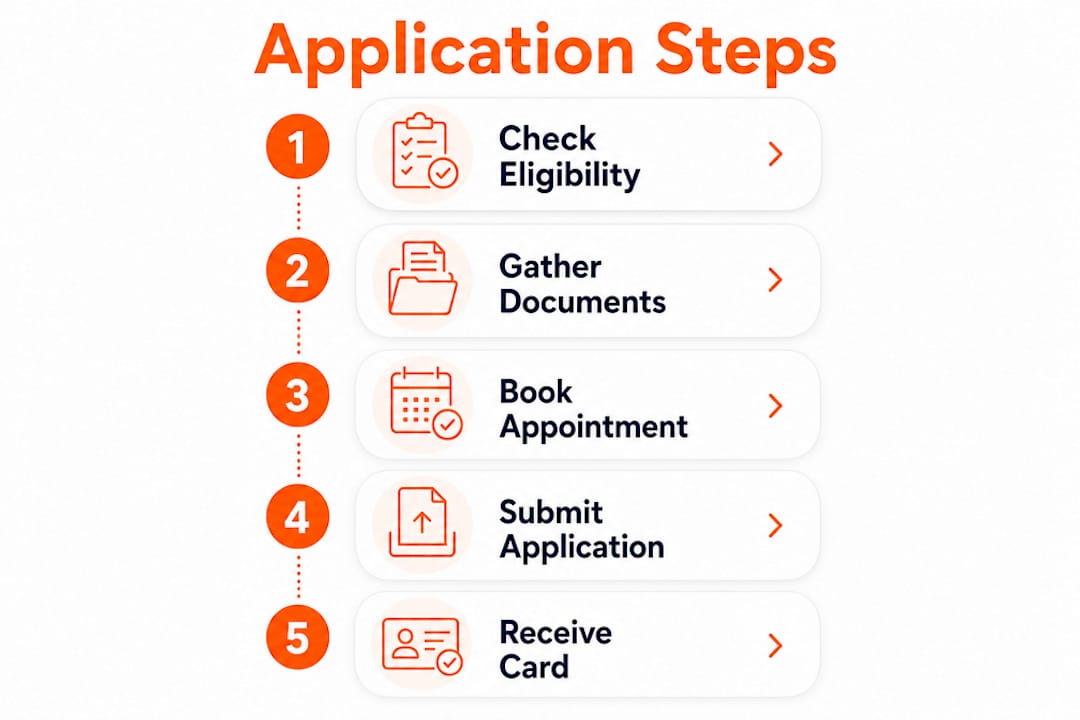
The step-by-step process works like this:
- Gather your documents. Collect your valid passport, current TIE card, empadronamiento certificate (proof of municipal registration), criminal records from Spain and your home country, proof of income, and health insurance documentation if applicable.
- Get documents certified. Foreign criminal records need an apostille stamp and a sworn translation into Spanish. Do not skip this step. Uncertified documents are grounds for immediate rejection.
- Pay the application fee. The TIE card application fee is approximately €73 using model 790 code 052. Pay at a bank before your appointment and bring the stamped receipt.
- Attend your appointment. Submit Form EX-11 and all supporting documents at the Oficina de Extranjería. The officer will review your file and may ask clarifying questions.
- Wait for a decision. Processing can take up to three months. If no official response arrives within that window, administrative silence applies and the application is considered approved by default.
- Attend fingerprinting and collect your TIE. Once approved, you will receive a notification to attend a fingerprinting appointment. Your permanent residence TIE card is then issued and collected in person.
Pro Tip: Book your Oficina de Extranjería appointment before you hit the five-year mark. Processing delays are common, and you want your application submitted while your current permit is still valid.
If your application is rejected, you have the right to appeal through administrative and judicial channels. Document every step of your application process in case you need to build a case.
What documents do you need for the permanent residence card application?
Documentation is where most applications succeed or fail. The required documents fall into several categories, and each one has specific certification rules.
Core documents required:
- Valid passport (original and photocopy of all pages)
- Current TIE card (original and photocopy)
- Empadronamiento certificate, issued within the last three months
- Criminal record certificate from Spain (Certificado de Antecedentes Penales)
- Criminal record certificate from your country of origin, with apostille and sworn Spanish translation
- Proof of income (tax returns, payslips, bank statements, or pension documentation)
- Health insurance proof if you are not covered by Social Security through employment
- CCSE test certificate or equivalent language certification
The CCSE test covers Spanish constitutional values, history, and civic knowledge. It is administered by the Instituto Cervantes at testing centers across Spain. The DELE A2 certificate or an official language school diploma at A2 level or above satisfies the language requirement separately from the CCSE.
Exemptions from integration testing apply to refugees, stateless persons, and applicants who can prove a physical or mental condition that prevents participation. Children under 18 and adults over 65 are also exempt.
| Document | Certification required |
|---|---|
| Foreign criminal record | Apostille + sworn Spanish translation |
| Empadronamiento certificate | Issued within 3 months of application |
| Proof of income | Official documents; bank statements accepted |
| Health insurance | Required for non-workers; exempt if Social Security enrolled |
| CCSE and language certificate | Original certificate from Instituto Cervantes or equivalent |
Common pitfalls: Expired empadronamiento certificates are rejected outright. Foreign documents without apostilles are not accepted. Translations must be done by a sworn translator recognized in Spain, not a general translation service.
What rights do you get after obtaining the permanent residence card?
The permanent residence card grants indefinite rights to work, study, and access healthcare in Spain under conditions similar to Spanish nationals. You no longer need to renew your work authorization or prove income levels every one or two years. That alone removes a significant administrative burden.
The physical TIE card must be renewed every five years, but the underlying residence status is indefinite. Think of it like renewing a driver’s license. The card expires, but your right to drive does not.
Absence rules still apply after you receive permanent status. Staying outside Spain for more than six months in a single year can trigger a review of your status. An absence of more than 12 consecutive months can result in loss of the permit entirely, unless you have documented exceptional circumstances such as serious illness or military service.
Permanent residence does not equal Spanish citizenship. You cannot vote in national elections, hold a Spanish passport, or access certain public sector jobs reserved for citizens. However, permanent residence counts toward the ten-year residency requirement for naturalization, and some nationalities from Latin America, the Philippines, Equatorial Guinea, and Andorra qualify for citizenship after just two years of legal residence.
Key differences at a glance:
- Temporary permit: renewed every 1–2 years, income checks required each cycle
- Permanent residence: indefinite status, card renewed every 5 years, no income threshold after approval
- Spanish citizenship: full political rights, passport access, requires separate naturalization application
Tax status does not change automatically with permanent residence. If you have been a Spanish tax resident throughout your five years, your obligations remain the same. If you were a non-resident for tax purposes, permanent residence may trigger tax residency depending on your physical presence pattern going forward.
Key Takeaways
Spain’s permanent residence card grants indefinite rights to live and work after five years of continuous lawful residence, but meeting the time requirement alone is not enough to guarantee approval.
| Point | Details |
|---|---|
| Five-year eligibility threshold | Any valid permit type counts, but absences must stay within 6 months per year. |
| Financial proof required | Show approximately €600/month income in 2026, tied to the IPREM index. |
| Integration tests are mandatory | Pass the CCSE civic test and demonstrate A2 Spanish unless exempt by age or health. |
| Application fee and timeline | Pay approximately €73 and expect up to 3 months processing at the Oficina de Extranjería. |
| Status is indefinite, card is not | Renew the physical TIE card every 5 years; the underlying residence right does not expire. |
What I’ve learned after watching hundreds of applicants go through this process
The single biggest mistake I see is treating the five-year mark as a finish line. Applicants assume that because they have held a valid permit for five years, approval is automatic. It is not. Immigration offices audit actual physical presence, and they are getting stricter every year. Padrón records, employment history, social security contributions, and even utility bills all get scrutinized.
The people who sail through this process are the ones who treated their documentation like a running file from day one. They kept every empadronamiento renewal, every tax return, every Social Security contribution record. When the time came to apply, they had a clean, organized paper trail that left no room for doubt.
I also see applicants underestimate the integration requirements. The CCSE test is not difficult, but it does require preparation. The Instituto Cervantes publishes official study materials. Spending two or three weeks with those materials is enough for most people. Skipping that preparation and hoping for the best is a gamble that costs months of delay.
For remote workers and digital nomads, the Digital Nomad Visa is increasingly the starting point for this path. Five years on that visa, with proper documentation throughout, puts you in a strong position for permanent status. The key is treating every year of your temporary permit as preparation for the permanent application.
My honest advice: get professional help, especially if your situation involves multiple countries, gaps in employment, or complex income sources. The cost of a rejected application, in time, stress, and reapplication fees, far exceeds the cost of getting it right the first time.
— Joshua
How Digitalnomadinspain can help with your application
Applying for long-term residence in Spain involves layers of documentation, strict deadlines, and integration requirements that catch many applicants off guard. Digitalnomadinspain has guided clients from over 50 countries through this process, with a 98% success rate and processing times that run 30% faster than self-applicants typically achieve.
Whether you are starting with the Digital Nomad Visa or building toward permanent status from a Non-Lucrative Visa, the team at Digitalnomadinspain handles document preparation, appointment coordination, and personalized guidance at every stage. Check your eligibility and get a clear picture of your path forward with a free eligibility check before you commit to a route.
FAQ
What is the permanent residence card in Spain?
Spain’s permanent residence card is a TIE card issued to non-EU nationals after five years of continuous lawful residence, granting indefinite rights to live and work in the country without renewing a temporary permit.
How long does it take to get permanent residency in Spain?
Processing takes up to three months at the local Oficina de Extranjería. If no decision arrives within three months, administrative silence rules apply and the application is considered approved.
Does permanent residence in Spain lead to citizenship?
Permanent residence counts toward the ten-year residency requirement for Spanish naturalization. Nationals from certain countries, including Latin American nations and the Philippines, qualify for citizenship after just two years of legal residence.
Can I lose my permanent residence status in Spain?
Yes. Absences exceeding six months in a single year or more than 12 consecutive months abroad can result in loss of status, unless you document exceptional circumstances such as serious illness or military service.
What is the difference between the TIE card and permanent residence status?
The TIE card is the physical document and must be renewed every five years. The permanent residence status itself is indefinite and does not expire as long as you maintain your presence and comply with absence rules.