Avoid five consular rejections: which national certificate to request, whether you need a federal or state apostille, and the correct order for sworn...
Internationals: Avoid 5 Consular Rejections on Spain Police Clearance
Spain requires a national or federal criminal record certificate, never a local or state-level police report, and it must clear three steps before a consulate will accept it: issuance by the correct national authority, an apostille, and a sworn Spanish translation. Americans need the FBI Identity History Summary. Applicants from the UK, Canada, and Australia use ACRO, the RCMP, and the AFP instead. Skip any of these steps and the consulate sends the file back.
TL;DR:
- Applicants from the US must obtain the FBI Identity History Summary, request a federal apostille, and secure a sworn Spanish translation for a valid police clearance.
- Certificates from other countries require verification of the issuing authority, appropriate legalization (apostille or embassy approval), and translation after legalization.
- Most consulates consider certificates valid for 90 days, so timing and sequence—obtaining, apostilling, then translating—are critical to avoid rejection.
- Mistakes like submitting local police reports, mixing apostille levels, or translating before legalization often cause application rejections.
- Using specialized services can help coordinate the process, prevent errors, and reduce overall processing time from months to weeks.
Table of Contents
- What Counts as a Valid Police Clearance for Spain
- Getting the Right Certificate by Country
- Apostille and Sworn Translation: Getting the Order Right
- Timing Rules and the Mistakes That Get Applications Rejected
- Your Pre-Appointment Checklist and Timeline
- Why Sequencing Trips Up Even Careful Applicants
- How Digitalnomadinspain Handles the Document Side for You
- Where to Confirm the Rules for Your Case
- Sources
- FAQ
What Counts as a Valid Police Clearance for Spain
A police clearance for a Spain visa has to come from a national or federal law enforcement authority. That’s the single rule that trips up more applicants than any other requirement on the checklist. A county sheriff’s letter, a city police department report, or a state-level background check will not satisfy the consular section’s criteria, no matter how official it looks.
Once you have the right certificate, two more things stand between you and an accepted application:
- The apostille. This is the Hague Convention’s international authentication seal, and it has to be issued by the authority that matches the document’s level. A federal document needs a federal apostille; a state-issued document needs that state’s apostille. Mixing the two is one of the most common rejection triggers.
- The sworn translation. Spain requires a certified translation by a traductor jurado recognized by the Spanish Ministry of Foreign Affairs, and it has to happen after the apostille, not before.
- The validity window. Most Spanish consulates treat these certificates as valid for 90 days from the issue date, though a handful allow up to six months in specific circumstances. Always confirm the exact window with your assigned consulate before you build your timeline around it.
Every consulate publishes its own checklist, and small variations exist between jurisdictions. Treat the general rules here as your baseline, then verify specifics against your consulate’s own page before you submit anything.
Getting the Right Certificate by Country
The issuing authority changes depending on where you’ve lived, and this is where most delays start. Here’s how the process breaks down for the countries that come up most often.
- United States. You need the FBI Identity History Summary, a fingerprint-based national check, not a state police report. You can request it directly from the FBI by mail, which typically takes several weeks, or go through an FBI-approved channeler that processes fingerprints electronically and often returns results in days rather than weeks. Once issued, the document needs a federal apostille from the U.S. Department of State, not a state secretary of state’s office, since the FBI is a federal agency.
- United Kingdom. The ACRO Police Certificate is the document Spain expects, not a DBS check, which is designed for UK employment screening rather than international use. After ACRO issues the certificate, it needs legalization through the Foreign, Commonwealth & Development Office (FCDO) before it can be translated and submitted.
- Canada. Spain requires an RCMP-certified, fingerprint-based criminal record check, which you request through an accredited fingerprinting agency rather than your local police station. Once issued, the certificate goes through Canada’s federal legalization process before translation.
- Australia. The AFP National Police Check is the accepted route, and you should request it specifically for immigration or visa purposes so the certificate reflects the correct use case. Legalization follows the same apostille logic as other countries before the sworn translation stage.
- Any other country. Identify the national police or justice ministry that issues federal-level certificates, confirm whether fingerprinting is required, and check whether that country is a Hague Apostille Convention member. Non-member countries require legalization through the Spanish embassy instead of an apostille, which adds time.
Pro Tip: If you’ve lived in more than one country for over six months in the last five years, you’ll likely need a certificate from each one. Start the slowest country’s process first and let the faster ones catch up.
Apostille and Sworn Translation: Getting the Order Right
The apostille authenticates the signature of the official who issued your criminal record certificate. It does not certify the content of the document itself, which is why the apostille has to come from an authority that matches the issuing agency’s level. A federal document like the FBI Identity History Summary needs a federal apostille from the U.S. Department of State. A state-issued document, by contrast, gets its apostille from that state’s secretary of state office. Confusing the two levels is a rejection waiting to happen.
Translation comes after legalization, never before. A sworn Spanish translator, or traductor jurado, recognized by Spain’s Ministry of Foreign Affairs has to translate both the certificate and the apostille language itself, since some consulates require the apostille text translated too.
A few things that make this stage smoother:
- Request expedited apostille processing when your appointment date is close. Standard state department processing can take weeks; expedited options often cut that to days.
- Ship original documents with tracked, signature-required courier service. Losing an original apostilled certificate means restarting the entire chain.
- Confirm your sworn translator’s credentials are recognized specifically by Spain, since not every certified translator qualifies.
Pro Tip: Order two or three certified copies of the translated package before your appointment. Consulates sometimes keep originals, and you don’t want to be stuck without a backup.
Timing Rules and the Mistakes That Get Applications Rejected
Most consulates count a certificate’s validity from about three months after issue, though some allow a longer validity period in limited cases. Plan backward from your appointment date using the 90-day rule as your default, since assuming the longer window and guessing wrong means starting over.
The rejection patterns show up again and again across consulates:
- Submitting a state or local police report instead of the national-level certificate.
- Getting a state apostille on a federal document, or vice versa.
- Translating the certificate before it’s apostilled, which invalidates the translation.
- Letting the 90-day window lapse before the appointment.
- Damaging or losing the original apostilled document during transit.
If your appointment date is fixed and time is tight, an FBI-approved channeler paired with an expedited apostille courier can compress a process that normally takes months into a few weeks.
Your Pre-Appointment Checklist and Timeline
Work through these steps in order, and don’t skip ahead to translation before legalization is finished:
- Request your national certificate (FBI, ACRO, RCMP, AFP, or your country’s equivalent).
- Receive the original document, checking it for accuracy before moving forward.
- Send it for apostille through the correct federal or state authority.
- Get a sworn Spanish translation of the certificate and apostille.
- Assemble originals, translations, and copies into your appointment kit.
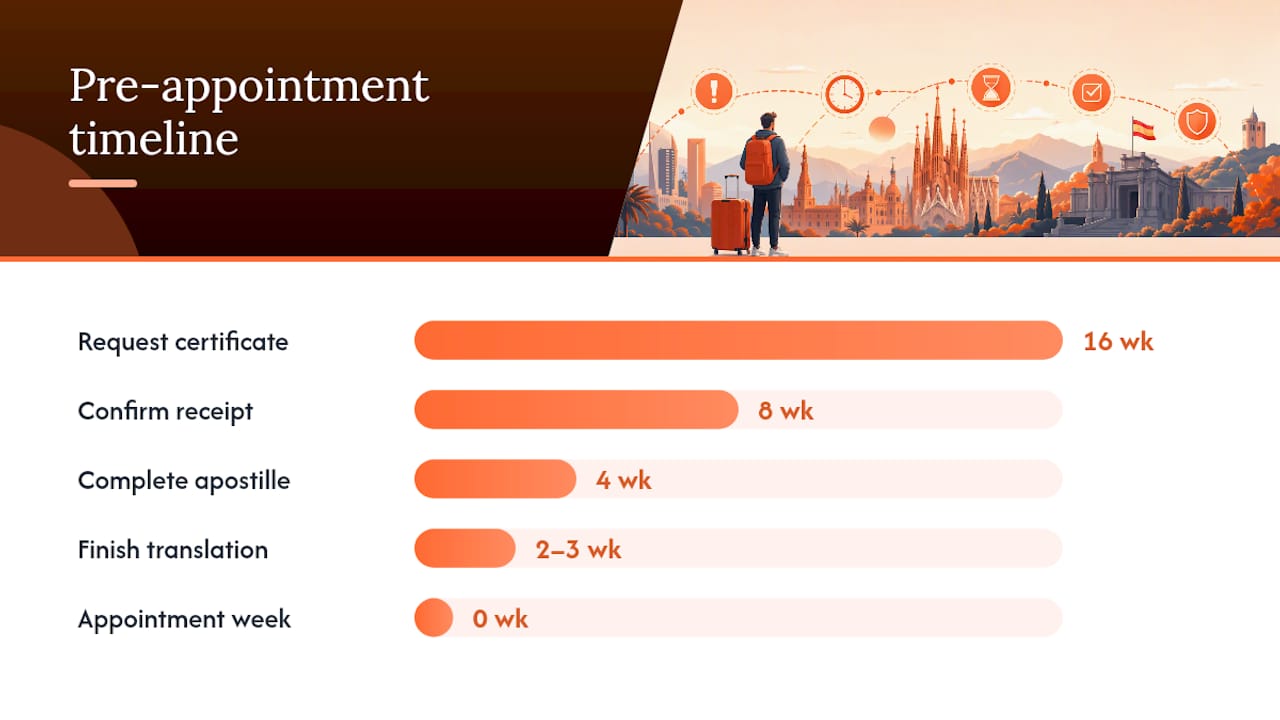
A workable timeline looks like this: request the certificate 16 weeks before your appointment, confirm receipt by week 8, complete the apostille by week 4, finish translation by week 2 to 3, then spend appointment week organizing and double-checking your file. Applicants who use channelers and expedited apostille services can often compress this into 6 to 8 weeks total.
Bring both originals and copies of every document, label each with the country it came from, and keep the translation stapled directly behind its corresponding original. Consulate officers move faster through organized files, and that reduces the odds of extra questions on appointment day.
Why Sequencing Trips Up Even Careful Applicants
Most rejected files aren’t missing documents. They’re documents completed in the wrong order, usually a translation done before the apostille, or a state apostille stamped on a federal certificate. Channelers and expedited apostille couriers solve the timing half of the problem, but they don’t fix a sequencing mistake once it’s made. Readers dealing with more than one country’s paperwork run into this most often, since each certificate follows its own clock. The guides on apostilling an FBI report and building a full visa document checklist go deeper into each stage than space allows here.
— Joshua
How Digitalnomadinspain Handles the Document Side for You
Every mistake covered above, the wrong apostille level, a translation done too early, an expired certificate, comes from managing too many moving pieces without a clear map. A service provider can handle the document coordination directly: sourcing the correct national certificate, managing federal versus state apostille routing, and arranging sworn translations that meet consulate standards.

That speed comes directly from knowing which apostille authority applies to which document and catching sequencing errors before they reach a consulate. If you’re preparing a Digital Nomad Visa application and want the police clearance handled correctly the first time, consult An American’s guide to moving to Spain: visas and life to get your document checklist reviewed before you submit anything.
Where to Confirm the Rules for Your Case
Consulate requirements shift by jurisdiction, so verify specifics before you submit:
- Your assigned Spanish consulate’s consular services page for exact validity windows and document lists.
- The FBI’s Identity History Summary page for current request methods and processing times.
- Country-specific guidance like Canada’s police certificate instructions for Spain if applying from outside the U.S.
This article is general information, not a substitute for advice from a qualified lawyer. Consult a qualified legal professional about your own circumstances before acting on anything here.
Sources
- Employee Visa - Consular Section
- FBI identity history summary checks
- How to get a Police Certificate – Spain (including the …)
- How to obtain a Spanish police clearance certificate
- How to Get an FBI Background Check Apostille for a Spain Visa And Why Most Applicants Get It Wrong
FAQ
How do I get a police clearance certificate for Spain?
Request the national-level certificate from your country’s federal authority (FBI, ACRO, RCMP, or AFP), get it apostilled at the matching federal or state level, then have it translated by a sworn Spanish translator before your consulate appointment.
Does the Spain visa require a criminal record check?
Yes, nearly every Spain visa category requires an apostilled, translated national criminal record certificate covering every country where you’ve lived more than six months in the past five years.
What is the fastest way to get a police clearance certificate?
Using an FBI-approved channeler for fingerprint processing combined with an expedited apostille courier service can cut total processing time from several months to a few weeks in many cases.
Is an FBI background check required for Spanish visas?
Yes, if you’ve lived in the United States, the FBI Identity History Summary is the only accepted document; state or local police reports are not valid substitutes.
Can Digitalnomadinspain help with the apostille and translation process?
Some visa application support services coordinate the entire document chain, from requesting the correct national certificate through apostille routing and sworn translation.