2026 checklist for US applicants: what to show for Spain visas, including €1,089.90 at the border, €600/month for students, €28,800/year for non...
€28,800 a Year or €122.10/day: Spain Visa Proof for US Applicants 2026
Spain sets three different financial bars depending on why you’re crossing the border. For a short stay, border officers want to see €122.10 per day with a minimum of about €1,089.90 on hand, in cash, on a card with a matching statement, or in a bank book. Student visas require 100% of the IPREM, roughly €600 a month, backed by stamped bank statements or a sponsor letter. The Non-Lucrative Visa demands 400% of IPREM, €28,800 a year for the main applicant, ideally shown through documented passive income rather than a single deposit.
TL;DR:
- Showing a consistent bank balance over several months is crucial, as consulates prefer documented recurrent income or savings over large, recent deposits.
- Proper proof includes original, stamped bank certificates or statements with signatures, avoiding online printouts or unverified images.
- For student visas, applicants must demonstrate funds equal to 100% of the IPREM, roughly €600 monthly, with support documents like bank statements or sponsorship letters.
- The Non-Lucrative Visa requires proof of at least €28,800 annual income through recurring income sources or accumulated savings.
- Preparing all documents with sworn translations, apostilles, and duplicates at least three to four weeks in advance helps prevent common mistakes that can derail visa approval.
Table of Contents
- How Much Money Do You Need for a Spain Visa at the Border?
- What Financial Proof Does a Spain Student Visa Require?
- How Much Money Do You Need for a Non-Lucrative or Residency Visa?
- What Document Formats Do Spanish Consulates Actually Accept?
- How Do You Avoid “Window Dressing” With Bank Statements?
- What Should You Bring to Your Consulate Appointment?
- What I’ve Seen Go Wrong With Financial Proof
- How Digitalnomadinspain Helps You Get Your Documents Consulate-Ready
- Sources
- FAQ
How Much Money Do You Need for a Spain Visa at the Border?
Border checks for short tourist or business trips run on a simple formula: €122.10 per person per day, with a hard floor of roughly €1,089.90 no matter how short the trip. A nine day visit does not require more than the floor, but a three week stay pushes the total well past it. This threshold traces back to the Schengen Borders Code, which gives officers legal grounds to check your finances at any external border, not just at the consulate stage.
Officers generally accept a narrow set of proofs:
- Cash in hand, though carrying large sums is rarely advisable
- Traveler’s checks
- A credit card paired with a recent, stamped bank statement
- An up to date bank book showing available balance
Skip the printout of an online-only bank portal screen. It rarely satisfies an officer who wants something that looks bank-issued. Bring a currency-conversion printout if your funds sit in dollars, proof of prepaid accommodation, and, if a company is footing the bill, a signed sponsor letter on letterhead.
What Financial Proof Does a Spain Student Visa Require?
Student visa applicants need to show funds equal to 100% of the IPREM, Spain’s official reference index used to calculate minimum income thresholds across dozens of government programs. In 2026 that works out to about €600 a month, or roughly €7,200 for a full year, though consulates typically prorate the figure to the length of the study program. For a US applicant converting from dollars, use your bank’s official exchange rate on the statement date rather than a rough online estimate. Consulates want the math to trace cleanly.
Acceptable documentation includes:
- Three recent, bank-stamped statements in the student’s name
- A university guarantee or financial support letter
- A notarized parental affidavit of support, paired with the parents’ own stamped statements
One detail trips up a lot of applicants: if tuition or housing is already paid in full, some consulates reduce the monthly amount you need to show. A prepaid dorm contract or a scholarship award letter can shrink the required balance considerably, so gather that paperwork before you calculate what else you need in the bank.
How Much Money Do You Need for a Non-Lucrative or Residency Visa?
The Non-Lucrative Visa sits in a different category entirely. It requires 400% of the IPREM, which comes out to €28,800 a year, or €2,400 a month, for the main applicant in 2026. A couple with one child would need to show roughly €43,200 for the year once you add up the main applicant plus two dependents.
Consulates accept several forms of proof here, but not all of them carry equal weight:
- Pension award letters showing a recurring monthly payment
- Brokerage or investment account statements documenting regular dividend payouts
- Rental income evidence, typically lease agreements plus deposit records
- Twelve months of bank statements showing the required balance sustained over time
Consular officers consistently favor documented, recurring income over a lump sum sitting in checking. A pension check that lands every month tells a cleaner story than a $30,000 transfer that appeared six weeks before your appointment. If savings are your only option, spread the proof across a full year of statements rather than a single snapshot, and expect follow-up questions if a large deposit shows up with no clear origin.
What Document Formats Do Spanish Consulates Actually Accept?
Format mistakes sink more applications than insufficient funds do. Consulates and border officials work from a short list of what they consider legitimate.
- Originals over copies. Bring the original bank certificate or statement, plus a photocopy for the file. A photo of a screen almost never counts.
- Bank stamps and signatures. A proper bank certificate carries a wet stamp or an authorized signature, the account holder’s name, the current balance, and often an average balance over a set period. Some banks now issue PDFs with a verification code instead of a physical stamp, and most consulates accept those as long as the code is checkable.
- Sworn translations. Any document not in Spanish needs a certified or sworn translation. A friend who speaks Spanish translating your bank letter will not satisfy a consular officer.
- Apostilles for foreign public documents. Notarized affidavits, marriage certificates, and similar records from the US typically need an apostille before a Spanish consulate will consider them valid.
The Ministry’s electronic office lists appointment procedures and document rules by consulate, and it’s worth checking your specific location before you finalize your folder, since some consulates ask for extra copies or specific translation formats.
How Do You Avoid “Window Dressing” With Bank Statements?
Consulates look for stability, not just a big number on a given day. A certificate of average balance that shows your balance held steady over several months carries more weight than a screenshot from yesterday. Most officers want to see three to twelve months of consistent history, and a sudden six-figure deposit two weeks before your appointment tends to invite questions rather than confidence.
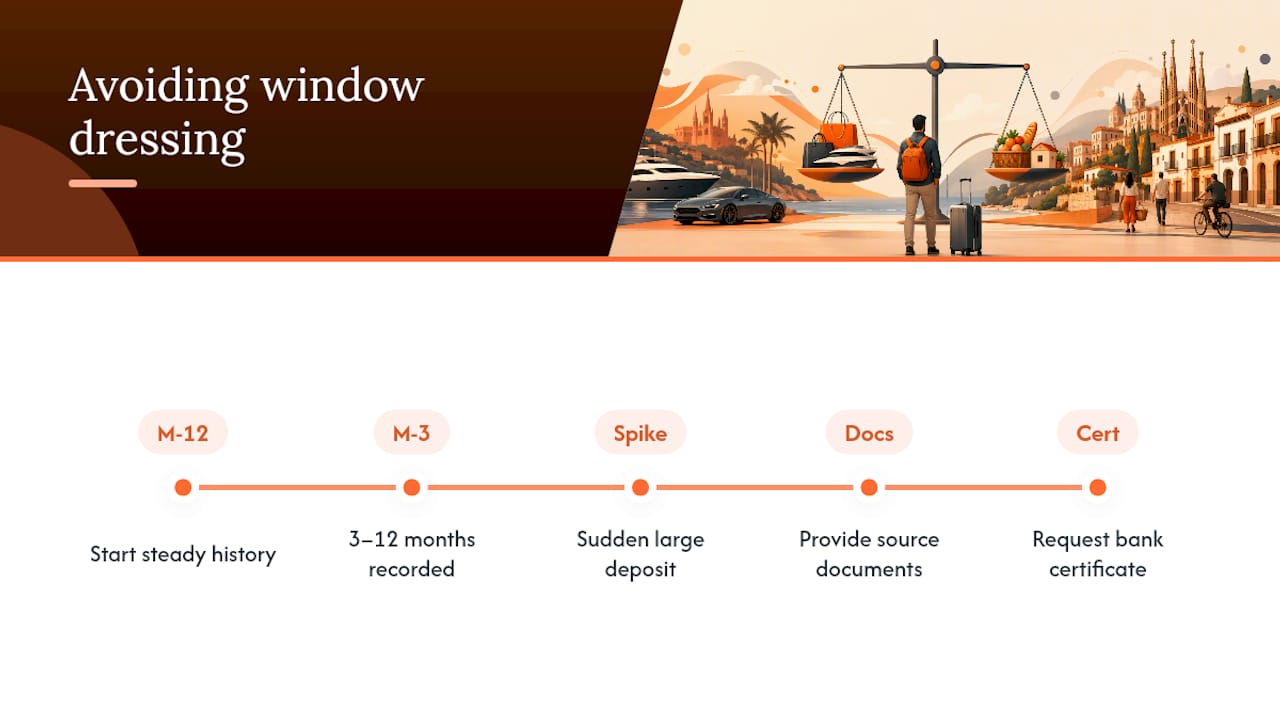
If a recent transfer is unavoidable, document where it came from. A sale deed from a property sale, inheritance paperwork, or a settlement letter all help explain a spike that would otherwise look like it was staged for the application.
Retirement accounts complicate things further. A 401(k) or IRA balance doesn’t behave like a checking account, so ask your plan administrator for a written statement confirming ownership and, where relevant, your ability to access the funds. Online-only banks present a similar wrinkle: since there’s no branch to stamp anything, request a formal certificate letter instead. Most major US online banks will issue one if you call and ask specifically for a “certificate of account ownership and balance.”
Pro Tip: Request your bank certificate at least three weeks before your consulate appointment. Some banks take ten business days just to process the request, and you’ll still need time to get it translated and, if required, apostilled.
What Should You Bring to Your Consulate Appointment?
Pack in duplicate: an original plus a copy of everything.
- Stamped bank statements or certificates, translated if not in Spanish
- Sponsor or scholarship letters, notarized where applicable
- Proof of prepaid accommodation or lease agreements
- A currency-conversion printout showing the exchange rate used
- Apostilled affidavits, if a parent or sponsor is involved
Request bank certificates and apostilles at least three to four weeks ahead of your appointment date. Keep a digital backup of every document in a cloud folder, and label files by category so you’re not digging through your phone at the consulate window.
What I’ve Seen Go Wrong With Financial Proof
A common reason for visa issues is presenting the required funds with improper documentation—unstamped printouts, untranslated statements, or unexplained large deposits—rather than the amount itself. Careful preparation catches these before a consulate does. Digitalnomadinspain has guided applicants through this exact documentation process, and a structured document review tends to catch formatting problems long before an appointment date.
— Joshua
How Digitalnomadinspain Helps You Get Your Documents Consulate-Ready
Assembling proof of funds that a consulate will actually accept is tedious work, and a single missing stamp or unsworn translation can cost you your appointment slot. Visa consultancy services can review your bank statements and certificates against current consulate requirements before submission, coordinate sworn translations and apostille requests, and follow up directly with the consulate on your behalf.

That kind of document-by-document review matters most for the Non-Lucrative Visa, where consulates scrutinize passive income documentation closely, and for the Digital Nomad Visa, where income proof and bank formatting rules differ from the Non-Lucrative track. If you’re weighing Spain against other residency options, this global remote worker visa comparison is worth a look before you commit. When you’re ready to find out where you stand, run through the eligibility checker and book a consultation to get your specific document list.
This article is general information, not a substitute for advice from a qualified lawyer. Consult a qualified legal professional about your own circumstances before acting on anything here.
Sources
- Conditions for entry into Spain — Consulate of Spain in New York
- Spain Proof of Funds 2026: Entry rules HR teams must know — Jobbatical
FAQ
How much bank balance is required for a Spain visa?
It depends on the visa: short stays need a minimum of roughly €1,089.90, student visas need roughly €600 a month (100% IPREM), and the Non-Lucrative Visa requires €28,800 a year (400% IPREM) for the main applicant.
Is a 3-month bank statement enough for a Schengen visa?
Many consulates accept three months of stamped statements for short-stay Schengen applications, but Non-Lucrative and residency visas often expect six to twelve months to show sustained, consistent balances.
How much money do I need for a Spain visa?
The amount scales with the visa type: about €122.10 per day at the border for short stays, roughly €600 a month for students, and €28,800 a year for Non-Lucrative applicants, plus €7,200 per dependent.
How much bank balance should I show for a Schengen visa?
Show at least the minimum absolute threshold of roughly €1,089.90, or €122.10 per day multiplied by your planned length of stay, whichever is higher.