Learn what documents are needed to prove your relationship for a Spain visa. Ensure a smooth application process with our expert guide.
Proof of Relationship for a Spain Visa: U.S. Applicant Guide
For a Spain Digital Nomad or Non-Lucrative Visa, the proof of relationship your consulate expects comes down to two routes: a civil-registry marriage or registered-partnership certificate (apostilled and sworn-translated into Spanish), or a documented evidence bundle proving at least 12 continuous months of cohabitation for unregistered partners. Foreign documents without an apostille or a sworn Spanish translation are routinely rejected, regardless of how authentic they are.
Core documents consulates expect:
- Official marriage certificate or civil-partnership registration certificate
- Apostille (or consular legalization) on every foreign civil-status document
- Sworn Spanish translation by a traductor jurado (sworn translator)
- Originals plus one copy of each document
- Valid passports for all family members being included
- Proof of cohabitation (joint lease, joint bank statements, shared utility bills) for unregistered partners
Document-age rules vary by consulate. The Spanish Consulate in Los Angeles specifies that civil-status certificates must be recently issued; many posts treat six months as the cutoff. Always confirm with the specific consulate processing your file.
Key Takeaways
Choosing the correct relationship route and certifying every foreign document with an apostille and a sworn Spanish translation are the two factors that most determine whether a Spain visa family application succeeds or stalls.
| Point | Details |
|---|---|
| Choose the right route | Marriage/registered partnership and unregistered cohabitation are separate routes; never mix evidence types. |
| Apostille every foreign document | All foreign civil-status documents must be apostilled or legalized before a Spanish consulate will accept them. |
| Use a sworn translator | Only a certified traductor jurado produces translations Spanish consulates accept; U.S. notarized translations are not equivalent. |
| Meet the financial add-ons | Adding a spouse requires €810/month above the main applicant’s €2,160 base; each dependent adds —. |
| Digitalnomadinspain | Offers end-to-end document preparation and translation coordination with a 98% success rate for Digital Nomad and Non-Lucrative Visa applicants. |
This article is general information, not a substitute for advice from a qualified lawyer. Consult a qualified legal professional about your own circumstances before acting on anything here.
Table of Contents
- What documents prove your relationship, by status type?
- How do you apostille documents and get a sworn Spanish translation?
- How do you build a convincing evidence bundle for unregistered partners?
- How does adding family members change your financial requirements?
- What do consular officers look for, and what gets applications rejected?
- Your consulate-ready checklist and preparation timeline
- Digitalnomadinspain takes the document stress off your plate
- What the team at Digitalnomadinspain fixes most often
- Sources
- FAQ
What documents prove your relationship, by status type?
Married spouses
Your primary document is an official marriage certificate from the civil registry where the marriage was recorded. If you married in Spain, request the certificate from the Spanish Civil Registry. For U.S.-issued certificates, obtain a certified copy from the county or state that issued it, then get an apostille from the relevant Secretary of State’s office. The Spanish Embassy in Dublin confirms that foreign civil-status documents must be apostilled or legalized and accompanied by an official sworn translation into Spanish.
If either spouse was previously married, add the final divorce decree or certificate of dissolution. Spanish consular guidance is explicit: marriage and an analogous (unregistered) relationship are incompatible routes, and only one spouse may be included unless prior marriages were legally dissolved.
Registered partners
Provide the registration certificate from the public registry where the civil partnership was recorded. This document also needs an apostille and a sworn Spanish translation. Plataforma ONE confirms that relationships registered in a public registry qualify as analogous to marriage under the Digital Nomad Visa provisions.
Unregistered (stable) partners
The bar is higher here. Consulates expect a cumulative paper trail proving at least 12 continuous months of shared residence. Accepted evidence includes joint lease agreements, joint bank account statements, shared utility bills showing both names at the same address, joint property deeds, and jointly addressed official correspondence such as tax documents or government letters. A child together is an accepted exception to the 12-month rule.
Minors and dependent adults
Birth certificates are required for all minor children, apostilled and sworn-translated. When one parent is not present on the application, a notarized parental consent form or consular certification is typically required. For dependent adults, an affidavit of dependency supported by financial documentation is standard.
Pro Tip: Order a freshly issued copy of every civil-status document rather than using an old certified copy you have on file. Many consulates reject documents older than six months, and a stale certificate is one of the most avoidable rejection triggers.
How do you apostille documents and get a sworn Spanish translation?
Foreign civil-status documents need two certifications before a Spanish consulate will accept them: an apostille (or consular legalization) and a sworn Spanish translation. Both are mandatory, and skipping either one is grounds for rejection.
Step-by-step for U.S. applicants:
- Obtain a certified copy from the issuing authority (county clerk, state vital records office, or federal agency).
- Get an apostille from the Secretary of State in the state that issued the document. Most states offer mail-in processing; some offer expedited in-person service. Processing times range from a few days to several weeks depending on the state, so build in buffer time.
- Hire a sworn translator (traductor jurado). Spain’s Ministry of Foreign Affairs maintains a register of sworn translators certified to produce translations accepted by Spanish authorities. Many work remotely and accept scanned documents. Turnaround is typically 3–7 business days.
- Confirm the translation format. A sworn translation must include the translator’s stamp, signature, and certification statement. A notarized translation from a U.S. notary is not the same thing and will not be accepted.
Pro Tip: Keep a master folder with the original, the apostilled copy, and the sworn translation for each document. Label each set clearly. Consular officers review stacks of paperwork fast, and a disorganized bundle creates delays even when every document is technically correct.
How do you build a convincing evidence bundle for unregistered partners?
Consulates expect a cumulative paper trail that proves at least 12 continuous months of cohabitation, unless you have a child together. A single document rarely suffices. The goal is to show consistent, overlapping evidence across time.
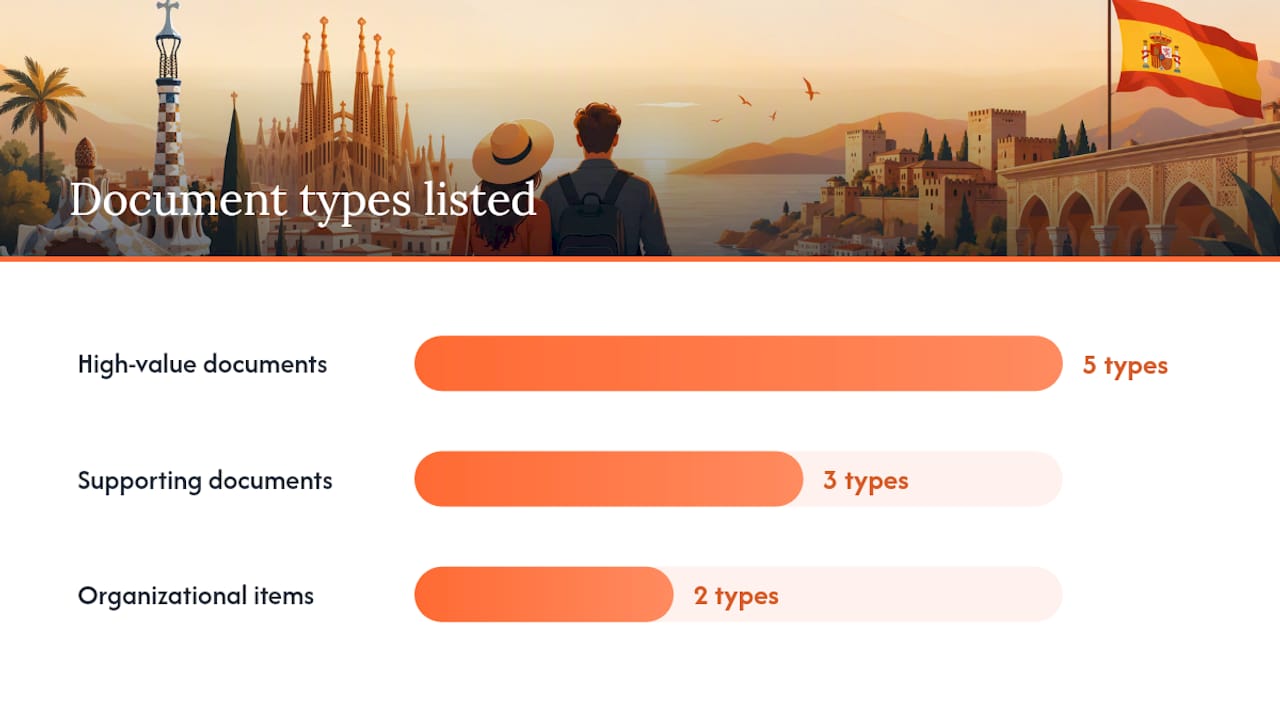
High-value items (lead with these):
- Joint lease or mortgage documents showing both names and the shared address
- Joint bank account statements spanning 12 or more months
- Shared utility bills (electricity, gas, internet) showing both names at the same address
- Joint insurance policies (health, renters, auto)
- Jointly addressed official correspondence: tax returns, government letters, voter registration
Useful supporting items:
- Sworn affidavits from third parties (landlord, employer, mutual friends) who can attest to the shared residence
- Dated travel records showing joint travel history
- Evidence of shared financial commitments (joint subscriptions, shared loan documents)
Gaps in the timeline are not automatically fatal, but unexplained gaps raise flags. A brief cover letter addressing a temporary separation (work travel, family emergency) with supporting evidence keeps the record clean.
Pro Tip: Create a simple index page for the bundle: list each document, its date, and what it proves. Number the documents to match the index. Consular officers move faster through organized submissions, and a clear index signals that the applicant understands what is being asked.
How does adding family members change your financial requirements?
Adding a spouse, partner, or dependents raises the monthly income threshold you must document. Official Digital Nomad Visa guidance sets the main applicant’s requirement at 200% of the Spanish minimum wage, with per-family-member add-ons calculated as a percentage of that base.
Example calculation (based on official guidance figures):
Figures sourced from the Spanish Embassy in Nicosia’s Digital Nomad Visa guidance document.
Acceptable financial proof includes:
- Bank statements covering the past 6–12 months
- Employment contracts or payslips
- Pension statements or passive income documentation
- Invoices and client contracts (for freelancers)
- Proof of liquid assets or investment accounts
Financial documents issued abroad may also need apostilles and sworn translations, depending on the consulate. Confirm this with your specific post before submitting.
Pro Tip: Freelancers with variable income should include a short cover letter explaining income patterns and seasonal fluctuations. A 12-month bank history that shows consistent deposits, even if the amounts vary, is far more persuasive than three months of high earnings with no context.
What do consular officers look for, and what gets applications rejected?
Consular officers evaluate relationship evidence for three things: authenticity, continuity, and consistency. A document that is authentic but outdated, or a bundle that is internally inconsistent, raises the same red flag as a missing document.
Common rejection triggers:
- Civil-status documents older than six months at the time of submission
- Missing apostille or legalization on foreign-issued documents
- Translations not produced by a certified traductor jurado
- Missing divorce decree when either applicant was previously married
- Insufficient cohabitation evidence for unregistered partners (a single utility bill is not enough)
- Poorly organized bundles with no index, making review difficult
Critical warning: Marriage and an analogous (unregistered) relationship are treated as incompatible routes under Spanish immigration rules. Choose the correct route for your situation and submit only the documents that match it. Mixing a marriage certificate with cohabitation evidence as though they are interchangeable will not strengthen your application. It will confuse the record and may trigger a request for clarification or an outright refusal.
If your application is questioned or initially refused on relationship grounds, respond with a formal written rebuttal that addresses each specific concern, adds any missing documentation, and includes a cover letter summarizing the corrected evidence. Consulates generally allow applicants to supplement a file before a final decision.
Your consulate-ready checklist and preparation timeline
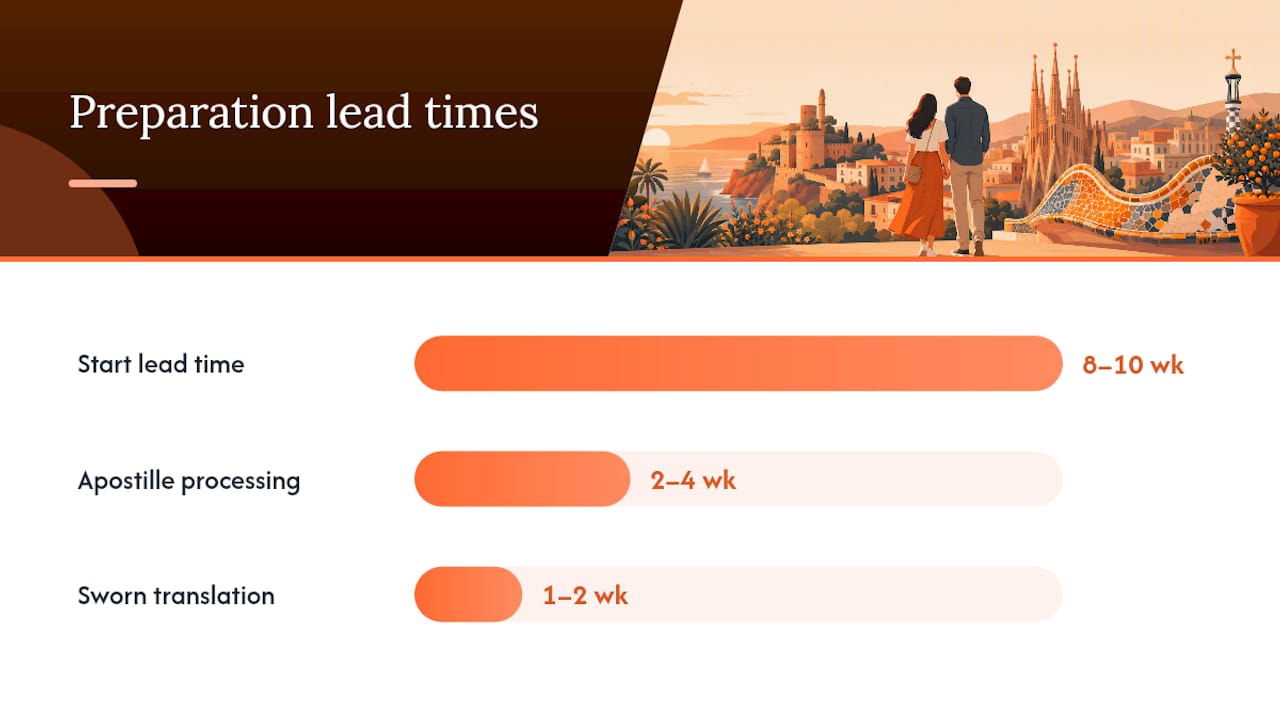
Lead time matters. Apostilles and sworn translations both take time, and consulate appointments in major U.S. cities book weeks or months out. Start at least 8–10 weeks before your target appointment date.
Step-by-step preparation order:
- Identify all family members to be included and confirm their relationship-document requirements with your specific consulate.
- Order certified copies of all civil-status documents (marriage certificate, birth certificates, partnership registration).
- Submit documents for apostille via the relevant Secretary of State’s office. Allow 2–4 weeks for standard processing.
- Send apostilled documents to a certified traductor jurado for sworn Spanish translation. Allow 1–2 weeks.
- Assemble the full bundle: originals, apostilled copies, sworn translations, financial proof, passports, passport photos, and completed application forms.
- Prepare a cover letter and document index.
- Book your consulate appointment. For the Digital Nomad Visa application process, appointments at U.S. consulates often require advance scheduling.
Bring to your appointment:
- Originals and one copy of every document
- Sworn Spanish translations for all foreign-issued documents
- Completed visa application forms
- Passport photos meeting Spanish consulate specifications
- Proof of financial resources (bank statements, contracts, payslips)
- Relationship-specific documents (marriage certificate or cohabitation bundle)
- Payment for consular fees (confirm accepted payment methods in advance)
Keep a complete digital backup (PDF) of every document in the bundle. If a consultant reviews your file before submission, digital copies make that review faster and cheaper.
The Spanish Consulate in Los Angeles and other U.S. posts publish their own checklists. Download the checklist from your specific consulate and cross-reference it against this guide before you submit.
Digitalnomadinspain takes the document stress off your plate
Getting the relationship evidence right is the part of a Spain visa application that trips up even well-prepared applicants. A missing apostille, a translation from the wrong type of translator, or a cohabitation bundle that covers 11 months instead of 12 can mean a refusal and a months-long delay.
Digitalnomadinspain handles the full document chain for Digital Nomad and Non-Lucrative Visa applicants: reviewing your relationship evidence, coordinating sworn translations with certified traductores jurados, guiding you through the apostille process, and preparing a consulate-ready bundle before your appointment. The firm’s visa services cover clients from more than 50 countries, with a 98% client success rate and processing times that run roughly 30% faster than self-filed applications.
If you are adding a spouse, partner, or dependents to your application, the document requirements multiply fast. A Digital Nomad Visa consultation or Non-Lucrative Visa review session gives you a clear document list, flags any gaps before submission, and keeps your application on track. Start with an eligibility check to confirm your route, then book a document review.
What the team at Digitalnomadinspain fixes most often
The errors that actually sink relationship-document files
The most common fix the Digitalnomadinspain team makes is replacing a notarized U.S. translation with a proper sworn translation from a certified traductor jurado. Applicants frequently assume a U.S. notary stamp is equivalent. It is not, and Spanish consulates will not accept it.
The second most frequent correction is adding a missing apostille to a document the applicant believed was already “certified.” A county clerk’s certified copy is not apostilled. Those are two separate steps, and conflating them is a reliable path to rejection.
For unregistered partners, the most common gap is a cohabitation bundle that covers 10 or 11 months rather than the required 12. A few additional bank statements or a backdated utility bill in the file often closes that gap cleanly.
Digitalnomadinspain’s document preparation service catches these errors before the consulate does.
Sources
- Non‑Lucrative residence visa — Spanish Consulate in Los Angeles
- Application for the Digital Nomad Visa — Plataforma ONE
FAQ
What is the main proof of relationship for a Spain visa?
An official marriage or civil-partnership certificate, apostilled and sworn-translated into Spanish, is the primary document. Unregistered partners must submit a cohabitation evidence bundle covering at least 12 continuous months.
Do U.S. marriage certificates need an apostille for a Spain visa?
Yes. Any U.S.-issued civil-status document must be apostilled by the Secretary of State in the issuing state before a Spanish consulate will accept it.
Can unmarried partners qualify as family members on a Spain Digital Nomad Visa?
Yes, if they can prove at least 12 continuous months of shared residence through joint leases, bank statements, utility bills, and similar documents, or if they have a child together.
How much extra income do you need to add a spouse to a Spain visa?
Official Digital Nomad Visa guidance sets the add-on at €810 per month for a spouse, on top of the main applicant’s base requirement of €2,160 per month.
Can Digitalnomadinspain help with relationship document preparation?
Yes. Digitalnomadinspain coordinates the full document chain, including sworn translation and apostille guidance, for Digital Nomad and Non-Lucrative Visa applicants adding a spouse, partner, or dependents.