
Build a consulate ready pack for Spain's visa: match contracts, payslips and bank traces, fix the 12 vs 14 pay error, and know when to hire help.
Avoid the 12 vs 14 Pay Error: Remote Income Verification in Spain

Spain’s telework visa requires annual income of roughly €34,188 for the main applicant, tied to 200% of the national minimum wage for 2026. Officers want three evidence types together: a remote-work contract or employer letter, payslips or invoices, and bank statements that trace those payments landing in your account. Get those three aligned, and most of the paperwork battle is already won. If your case involves multiple income sources, freelance work, or numbers close to the threshold, verify your calculation and consider professional review before you submit.
TL;DR:
- Applicants must demonstrate an annual income of about €34,188 for 2026, verified through aligned contracts, payslips or invoices, and matching bank statements.
- Income calculations should focus on total annual figures or accurate 14-payment equivalent amounts, especially when salary is split into 14 payments per year.
- Supporting documents must establish a clear, traceable money trail from contracts or invoices to bank deposits, with translations and apostilles as needed.
- For freelancers, multi-year tax returns, regular client contracts, and a detailed bank history are crucial to prove stability and ongoing income.
- Using third-party services can help organize and verify evidence, especially for complex income sources or documents involving foreign currency or non-standard payment arrangements.
Table of Contents
- How Do You Calculate Spain’s Remote Income Verification Requirement?
- What Documents Prove Your Income for a Spain Visa Application?
- What Should an Employer Remote-Work Letter Say?
- How Do Freelancers Prove Stable Income for a Digital Nomad Visa?
- How Do You Build a Complete Evidence Pack Without Errors?
- Should You Apply Through the Consulate or the UGE in Spain?
- When Should You Hire Help With Your Income Verification?
- How Do You Prove Your Remote Income Is Stable, Not Just Sufficient?
- How Do You Verify Income From Multiple Clients or Job Types?
- Can You Use Cryptocurrency or Non-Traditional Income for Your Visa?
- Do You Need Apostilles and Translations for Every Document?
- Is the Income Requirement Different for Other Spain Residency Permits?
- What Patterns Actually Cause Rejections?
- Get Help Preparing Your Spain Visa Income Evidence
- Sources
- FAQ
How Do You Calculate Spain’s Remote Income Verification Requirement?
The number that matters is annual, not monthly. Spain’s telework visa sets the minimum at 200% of the annual Salario Mínimo Interprofesional (SMI), which lands at approximately €34,188 for the main applicant in 2026. That figure is set by royal decree and published in the Boletín Oficial del Estado, and it’s the one figure consulates and the UGE actually check against your file.
Here’s where applicants trip up. Spanish salaries are traditionally split into 14 payments a year (12 regular months plus two extra payments, common in Spanish employment contracts). Foreign applicants sometimes take their monthly salary, multiply by 12, and assume they’re covered, when their employer actually pays on a 14-payment schedule that produces a different monthly figure. Practitioner guides flag this as a recurring cause of rejection: applicants present a monthly number using the wrong pay-period basis, and the total comes in below the binding annual threshold even though their real annual income clears it.
The safest move is to skip the monthly math entirely and lead with the annual total. If you do want to show a monthly breakdown for clarity, present it two ways so there’s no ambiguity:
- Annual total: the one figure that legally matters, roughly €34,188 for 2026.
- 12-month average: annual total divided by 12, useful if your income arrives in a standard monthly salary.
- 14-payment equivalent: annual total divided by 14, relevant only if your employer’s contract genuinely pays in 14 installments.
Label whichever breakdown you include so a reviewer never has to guess which pay structure you’re using.
Family members change the math further. Bringing a spouse or partner typically adds an increment based on a percentage of the SMI, with additional increments for each dependent. If you’re applying with dependents, calculate the full household figure before you assemble documents. Applying alone with income just above the solo threshold, then adding a spouse later, is a different filing than applying together from the start, and the income evidence needs to reflect whichever scenario you’re actually in.
What Documents Prove Your Income for a Spain Visa Application?
Consulates and the UGE publish checklists, but the underlying logic is simple: every document has to point back to the same number, and every number has to trace to a real bank transaction. Here’s the priority order that gets files approved without extra requests for information.
- Employment contract or freelance client agreements. State your role, start date, and salary or fee structure in writing. For employees, this should match your employer letter. For freelancers, recent signed contracts with named clients carry more weight than verbal arrangements.
- Payslips or invoices covering the past three to six months, minimum. Payslips need employer name, tax ID, gross and net pay, and pay date. Invoices need your business details, the client’s identifying information, invoice number, date, amount, and payment terms.
- Bank statements showing those exact payments landing in your account. This is the step people skip, and it’s the one that convinces a reviewer the paper trail is real rather than assembled for the application. Amounts and dates on statements need to match payslips or invoices line by line.
- Tax returns or an official tax certificate, where you’ve filed them. Spain’s Agencia Tributaria issues an IRPF certificate summarizing declared income, and it’s strong supporting evidence if you’ve already filed in your home country or in Spain.
- Savings statements, useful as a buffer if your income sits close to the threshold or fluctuates month to month, but not a substitute for documented income.
If your income isn’t in euros, expect banks and reviewers to apply a currency lens. Mortgage lenders working with foreign income in Spain commonly discount non-euro earnings by 10 to 20 percent to account for exchange-rate risk, and while that’s a lending practice rather than an official visa rule, it signals how conservatively Spanish institutions treat foreign currency. Convert your figures at a documented exchange rate and note the conversion source on your summary sheet.
On formatting: submit certified copies where the consulate specifies them, not just scans. Any document not originally in Spanish generally needs an official translation, and some consulates require sworn translations rather than standard ones. Check your specific consulate’s page before you pay for translation work you didn’t need.
Pro Tip: Build your evidence pack in the same order the checklist above lists it. Reviewers process hundreds of files. A pack that mirrors their own checklist gets through faster than one organized around your logic instead of theirs.
What Should an Employer Remote-Work Letter Say?
A generic “this person works for us” letter is close to worthless for this application. UGE guidance and consulate checklists want a letter that does real work, and the details matter more than the letterhead.
A strong letter includes:
- Your job title, start date, and a description of your actual responsibilities.
- Explicit authorization to work remotely from Spain, not just general remote-work language.
- Salary stated in euros, even if you’re paid in another currency, with the conversion basis noted.
- The company’s legal name, registration number, and country of incorporation.
- Confirmation of how long the company has operated and, ideally, a note on the length of your employment relationship.
Letters that convert salary to euros and explicitly authorize remote work from Spain get accepted more reliably than letters that just confirm employment in general terms. That single sentence about remote authorization is often the difference between a smooth review and a request for clarification.
Social security is the other piece employed applicants get wrong. If your employer already covers you under a certificate of coverage from a country with a bilateral agreement with Spain, that certificate can substitute for Spanish registration during your stay. Where no such agreement exists, you or your employer may need to register with Spanish social security instead. Confirm which category applies to your home country before you assume either path is automatic.
Common employer-side snags: HR departments that won’t put remote authorization in writing, letters printed without company letterhead or a signatory’s title, and salary figures quoted in a currency with no euro conversion. Fix these before submission by giving HR a short template of exactly what the consulate wants. Most companies will comply once they see the specific language required.
How Do Freelancers Prove Stable Income for a Digital Nomad Visa?
Self-employed applicants face a harder proof problem: there’s no employer vouching for continuity, so every document has to do that work itself. The core evidence set includes signed client contracts, invoices with full identifying details, proof of RETA registration where your home country requires it, and tax filings covering as much history as you can produce.
- Invoices and contracts: recent, dated, and matched to named clients rather than vague freelance platforms.
- RETA registration or its home-country equivalent: proof you’re operating as a legitimate registered freelancer, not working informally.
- Tax returns: ideally two years, since banks and reviewers both favor multi-year continuity over a single strong quarter.
- Bank statements matching invoice payments: the same traceability principle that applies to employees applies doubly to freelancers, since there’s no payroll system backing you up.
Variable income is the freelancer’s biggest headache. If your monthly totals swing widely, don’t try to average away the swings. Show a recent signed contract that projects forward income, back it with a multi-year tax history that demonstrates the pattern isn’t new, and use savings as a visible buffer for the gaps. Reviewers care less about a perfectly smooth income line than about seeing that you’ve sustained yourself this way before and have a documented reason to expect it to continue.
If part of your work is for Spanish clients, pay attention to the source-of-income rule: the visa is built around non-Spanish income, so keeping the large majority of your billing tied to clients outside Spain protects your eligibility. If you’re uncertain how your specific client mix reads, that’s a case worth reviewing with someone who checks these files regularly rather than guessing.
Pro Tip: Keep a running expense and invoice log rather than reconstructing one at application time. A tax-ready record system, like the one bookkeeping guides for freelancers recommend, turns a two-week scramble into a ten-minute export.
How Do You Build a Complete Evidence Pack Without Errors?
Assembling the file is where good documents either come together into a coherent story or turn into a stack a reviewer has to reconstruct themselves. Build it in this order.
- Cover letter and contents list. One page stating who you are, what visa you’re applying for, and a numbered list of every document included, in the order it appears.
- Income summary sheet. State the annual figure, the calculation method, and reference each supporting document by number.
- Grouped evidence. Contract or employer letter first, then payslips or invoices in date order, then bank statements, then tax records.
- Traceability table. A one-page table listing each payslip or invoice, its date and amount, the matching bank transaction date and reference, and a short confirmation note. This single page does more to convince a reviewer than any cover letter, because it shows the money trail rather than describing it.
- Translations and certifications, attached directly behind the documents they translate.
The mistakes that sink applications are almost always the same three: presenting a monthly figure calculated on the wrong pay-period basis (the 12 versus 14 confusion covered earlier), submitting payslips or invoices with no matching bank statement, and relying on a generic employer letter that never explicitly authorizes remote work. Every one of these is fixable before submission if you catch it. None of them are fixable gracefully after a consulate has already flagged your file.
Pro Tip: Print your traceability table and physically check off each row against the bank statement before you submit. If a row doesn’t reconcile in five minutes, a reviewer won’t find it convincing either.
Should You Apply Through the Consulate or the UGE in Spain?
You have two routes, and they’re not interchangeable conveniences. The consulate route means applying from your home country before you travel, typically resulting in an initial visa valid for up to one year. The UGE route (Unidad de Grandes Empresas) means applying from inside Spain, usually on a tourist stay, and typically produces a residence permit valid for up to three years initially.
- Consulate route: apply from your home country; expect several weeks to a few months of processing depending on the consulate; original documents and apostilles are typically required before you travel.
- UGE route: apply after entering Spain; often processed faster once submitted, sometimes within weeks; still requires apostilled and translated originals, but you can gather some documents once you’re already local.
- Criminal record certificates: these have validity windows and apostille timing that vary by country, so start them early regardless of which route you choose, since they often become the bottleneck.
Which route fits depends on your situation. If you want to lock in a longer initial permit and can wait out consulate processing from home, the consulate route often makes sense. If you’re already able to spend time in Spain on a tourist stay and want faster turnaround once your file is ready, the UGE route tends to suit better. Neither route changes the income evidence required. It changes where you assemble it and how long you’ll wait to find out if it worked.
When Should You Hire Help With Your Income Verification?
Some files are simple: one employer, one steady salary, income comfortably above the threshold. Others aren’t. If you’re a company director rather than an employee, your income mixes salary and freelance work, your total sits close to €34,188, or your social security situation involves a country without a clear bilateral arrangement with Spain, that’s usually when paid help earns its cost.
A consultant handling your application typically covers:
- An eligibility check before you spend money on translations or apostilles you might not need.
- Document preparation, including the income summary and traceability table reviewers actually want to see.
- Certified translations and formatting to consulate or UGE specifications.
- Submission and follow-up communication with the consulate or UGE.
- Post-approval steps, including TIE card processing and initial tax registration in Spain.
For a straightforward single-employer case, that support may be overkill. For anything with moving parts, it’s the difference between a clean first submission and a round of clarification requests that costs you months.
How Do You Prove Your Remote Income Is Stable, Not Just Sufficient?
Meeting the threshold once isn’t the same as proving you’ll keep meeting it. Reviewers are implicitly asking whether your income is a snapshot or a pattern, and the strongest files answer that with history rather than assurance.
For employees, this usually means payslips covering at least three to six months, ideally longer, alongside an employer letter that references how long you’ve held the role rather than just your current salary. A one-month-old job offer paired with a single payslip reads very differently than a two-year employment history with consistent pay.
For freelancers, continuity is harder to show and more important to establish. Multi-year tax returns are the strongest signal, because they demonstrate income across periods you couldn’t have staged for the application. Layer in a mix of ongoing client contracts (not just one-off projects) and a bank statement history that shows deposits arriving on a recognizable cadence, even if the amounts vary.
If you’ve had a recent gap, income dip, or client change, don’t hide it. Address it directly in your cover letter with a sentence explaining the transition and point to the contract or client relationship that replaced the lost income. Reviewers who see an unexplained dip assume the worst. Reviewers who see a dip explained with a signed replacement contract usually move on without flagging it.
How Do You Verify Income From Multiple Clients or Job Types?
Plenty of applicants aren’t single-employer cases. You might combine a part-time contract role with freelance clients, or run two separate freelance income streams in different currencies. The verification principle doesn’t change: every stream needs its own paper trail, and all of them need to add up to the same annual total on your summary sheet.
Build a simple table listing each income source, the client or employer name, the contract type, and the average monthly or annual contribution. Then attach the supporting documents for each stream separately, grouped by source rather than mixed together chronologically. A reviewer trying to verify €34,188 in income from four different clients needs to see each client’s contribution clearly labeled, not a single stack of invoices they have to sort themselves.
Bank statements become more important here, not less. When income arrives from multiple sources, the bank trace is what proves the streams are real and independent rather than one client’s payment split across invoices to look like several. If you’re paid in different currencies from different clients, convert each stream separately and note the exchange rate and date used for each, since combining currencies before conversion tends to produce numbers a reviewer can’t easily check.
One caution: if one income stream is significantly smaller or newer than the others, don’t let it carry disproportionate weight in your total. Reviewers tend to trust income that’s been arriving consistently over income that just started, so lead your evidence pack with your most established source.
Can You Use Cryptocurrency or Non-Traditional Income for Your Visa?
Income paid in cryptocurrency or through non-traditional payment platforms creates a documentation problem, because the core requirement, a clear bank trace showing traceable payments, wasn’t designed with crypto in mind. That doesn’t mean crypto income disqualifies you. It means you need extra steps to translate it into evidence a consulate or UGE officer can actually verify.
The safest approach is converting crypto earnings to euros or your home currency through a regulated exchange and routing the converted funds into a traditional bank account before you apply. That creates a bank statement entry a reviewer recognizes, backed by exchange records showing the conversion date, rate, and amount. Relying solely on a blockchain wallet address or exchange dashboard as proof of income is far weaker, since it doesn’t map cleanly to the payslip-to-bank-trace model reviewers are trained to check.
If your employer or clients pay you in crypto as standard practice, get a written statement from them confirming the payment arrangement and the agreed value in euros or dollars at time of payment. Pair that with your own conversion records. Tax filings help enormously here too. If you’ve declared crypto income on a tax return in your home country, that filing gives your income an official paper trail independent of the blockchain itself.
Given how unevenly consulates may treat non-traditional income, this is a case where getting a second opinion before you submit is worth the time, rather than finding out after a rejection that your evidence didn’t translate the way you expected.
Do You Need Apostilles and Translations for Every Document?
Most foreign documents submitted for a Spain telework visa need two things: an apostille (or legalization, depending on your country) confirming the document is genuine, and a certified translation into Spanish if the original isn’t already in that language. Not every document needs both, so it’s worth sorting your pack before you spend money on either step.
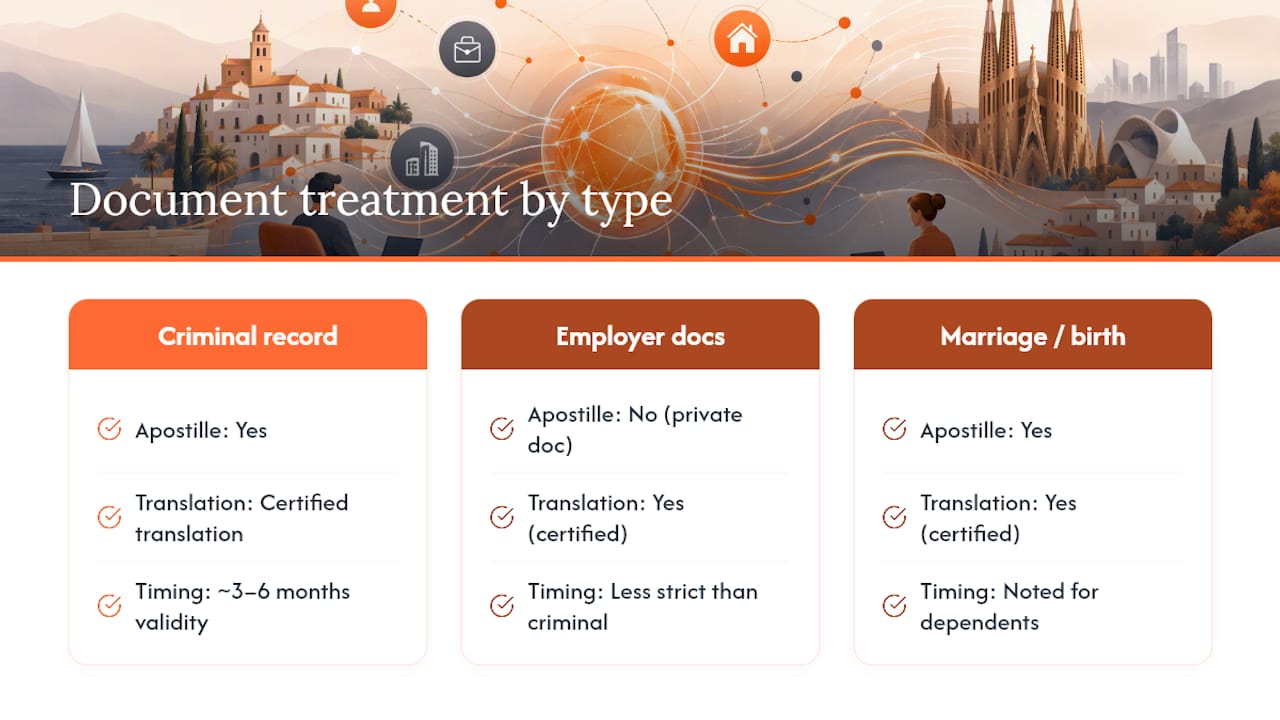
Criminal record certificates almost always need apostilling, and they typically carry a short validity window, often around three to six months depending on the consulate, so timing matters more here than for most other documents. Employer letters and payslips generally need translation but not apostilling, since they’re private company documents rather than government-issued ones. Marriage or birth certificates for dependents usually need both an apostille and a translation.
Translations should be done by a certified or sworn translator recognized for official use. Some consulates accept translations from any certified translator in your home country. Others require a Spanish sworn translator (traductor jurado) specifically. This detail varies enough by consulate that it’s worth confirming directly rather than assuming your home country’s certification will transfer automatically.
Keep translated documents physically attached behind their originals in your evidence pack, in the same order as your contents list. A reviewer flipping through a file where every original has its translation immediately behind it moves through your application faster than one where translations are grouped separately at the back.
Is the Income Requirement Different for Other Spain Residency Permits?
The €34,188 annual figure is specific to the telework, or digital nomad, visa. Other Spanish residency permits use different income logic entirely, and conflating them is a common source of confusion for applicants researching online.
The Non-Lucrative Visa, aimed at people living off savings, investments, or passive income rather than active remote work, uses a separate calculation also tied to the SMI but structured around demonstrating sufficient means without any employment or freelance income at all. Applicants on this route generally cannot work remotely for a foreign employer like telework visa holders can. The two permits solve different problems: one is built for people actively earning through remote work, and the other for people who do not need to work at all during their stay. Comparing costs and requirements side by side is worth doing before you pick a lane, since budget planning differs meaningfully between the two.
Standard work visas, by contrast, require a Spanish employer sponsor and a job offer inside Spain, which makes them irrelevant for most remote workers reading this article. If your income comes from outside Spain and you want to keep working for that foreign employer or those foreign clients while living in Spain, the telework visa is built specifically for your situation. If your goal is retirement or living off assets with no active income at all, the Non-Lucrative Visa is the closer fit.
What Patterns Actually Cause Rejections?
The failures I see repeated most often aren’t exotic. They’re a generic employer letter that never says “remote work authorized,” an income total calculated on the wrong pay-period basis, and payslips with no bank statement behind them to prove the money actually moved.
Fix them in this order: get the employer letter language right first, since it’s the cheapest fix and the one HR departments resist most if you wait until the last minute. Then build your bank-trace mapping table. Then handle translations and apostilles last, once you know exactly which documents made the final cut.
If you do just one thing after reading this: open a spreadsheet today, list every income document you have, and check whether each one has a matching bank entry. Most gaps show up in that first hour, long before a consulate finds them for you.
— Joshua
Get Help Preparing Your Spain Visa Income Evidence
Building a traceability table, converting employer letters into the exact language UGE wants, and chasing apostilles across time zones is a lot to manage alongside an actual relocation. Digitalnomadinspain is the alternative to piecing this together alone: instead of guessing whether your bank trace matches consulate expectations, you get a document review built around exactly the checklist covered here.

The service covers eligibility checks, full document preparation, certified translations, application submission, consulate or UGE follow-up, and support after approval, including TIE card processing and initial tax registration. That end-to-end coverage supports a high success rate and faster processing times compared to self-filed applications. If your income sits close to the threshold, comes from multiple sources, or involves freelance and employment income mixed together, that’s exactly the kind of file where a second set of eyes can help avoid a rejection.
Start with the eligibility checker or book a consultation through the Digital Nomad Visa service page to walk through your specific income situation before you submit anything.
Sources
Confirm details with your consulate’s telework visa page, the UGE procedure page, and the Agencia Tributaria for tax certificates. For complex cases, a licensed immigration professional should review your file.
- How to Find a Remote Job That Qualifies for Spain’s Digital Nomad Visa
- Residence Application for Digital Nomads | Plataforma One
- Tax Agency: 3.3.1. Information available
FAQ
What Are the Requirements for Working Remotely in Spain?
You need a foreign employer or clients based outside Spain, a remote-work authorization letter, and annual income of roughly €34,188 for the main applicant, backed by payslips or invoices and matching bank statements.
Is $42,000 a Good Salary for Spain’s Digital Nomad Visa?
Converted to euros, income above the roughly €34,188 annual threshold typically meets the requirement, though the exact margin depends on the exchange rate at the time you apply, so calculate it in euros before assuming you’re comfortably above the line.
How Much Income Do I Need for Spain’s Digital Nomad Visa?
The binding figure is 200% of the annual SMI, approximately €34,188 for 2026 for a single applicant, with additional increments for a spouse and dependents according to official guidelines.
What Are the Requirements for Spain’s Non-Lucrative Visa?
The Non-Lucrative Visa requires proof of sufficient passive income or savings without any active work, using a different calculation from the telework visa; compare both routes on the Non-Lucrative Visa service page before choosing.
What Documents Prove Remote Income for a Spain Visa?
The core set is an employer letter or client contracts, recent payslips or invoices, and bank statements showing those exact payments, supplemented by tax returns or an official tax certificate where available.