
Discover the Spain digital nomad visa cost in 2026. Get insights on official fees, budget breakdowns, and tips to save money.
Spain Digital Nomad Visa Cost in 2026: Full Budget Guide

TL;DR:
- The Spain Digital Nomad Visa costs €73.26 in official fees, with total expenses often reaching €1,000 to €2,500 for DIY applicants. The minimum income requirement for 2026 is €2,849 monthly, proving consistent earnings through bank statements or contracts. Applying correctly involves careful budgeting for documents, translations, apostilles, and health insurance to avoid costly delays or rejections.
The official government application fee for Spain’s Digital Nomad Visa is €73.26 per applicant (Tasa 790-038), and you must show monthly income of at least €2,849 — that’s 200% of Spain’s current minimum wage (SMI). Those two numbers are the floor. The overall cost to get approved typically includes additional expenses beyond official fees, varying widely based on service choices. Neither figure includes your first month’s rent deposit, which often requires multiple months’ rent upfront depending on your rental agreement.
Here’s what’s in this guide:
- The exact official fees and how to pay them
- A line-item budget for every cost between now and your TIE card
- How the income test changes with dependents
- When each payment hits and how to avoid cash-flow surprises
- Where to cut costs — and where cutting costs backfires
For the full application process, see Digitalnomadinspain’s complete 2026 guide.
Table of Contents
- What does the Spain digital nomad visa cost in official fees?
- Every other cost you need to budget before you submit
- How the income requirement works and what changes with dependents
- When each payment hits during the application process
- How to lower your total costs — and the shortcuts that backfire
- How the budget ranges in this guide were calculated
- Key Takeaways
- Why professional help often costs less than it looks
- Digitalnomadinspain handles the paperwork so you don’t pay twice
- Useful sources
- FAQ
What does the Spain digital nomad visa cost in official fees?
Two government fees are non-negotiable. Everything else in your budget is variable.
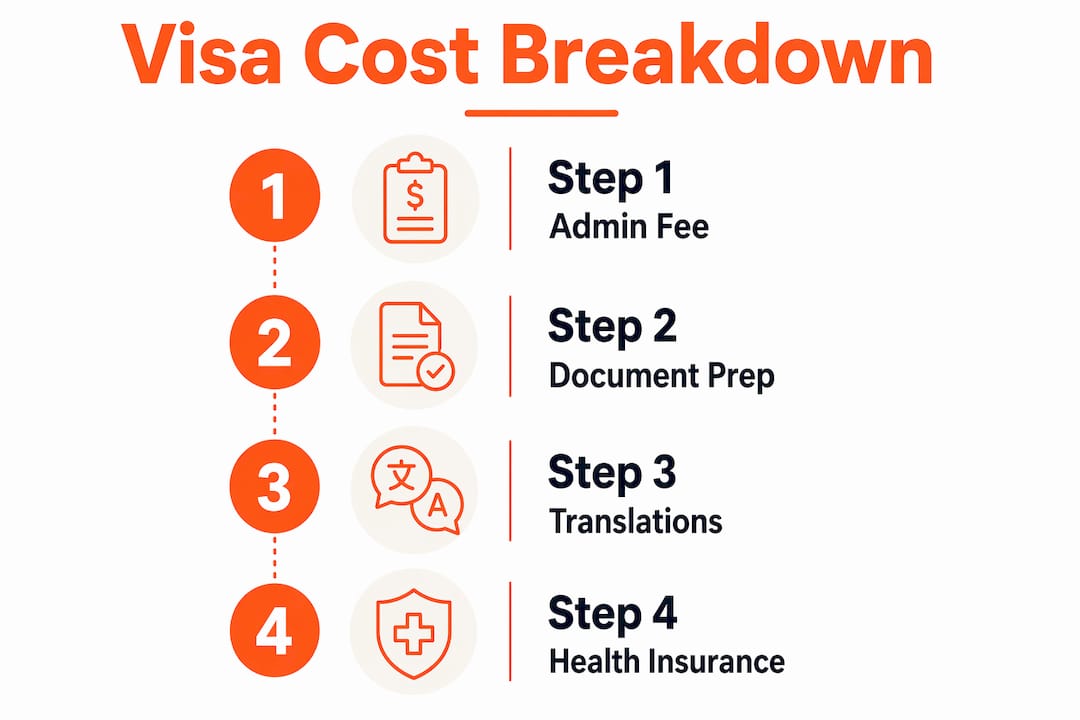
Tasa 790-038 is the primary administrative fee: €73.26 per applicant in 2026. You pay this before submitting your application, and the receipt must be included in your application package. No receipt, no application. The Spanish government’s Plataforma One confirms that Form 790-038 must be completed, downloaded, and paid — either in cash at a bank branch, at an ATM, or via bank account using a digital certificate or Cl@ve Pin.
Tasa 790-012 covers the TIE (Tarjeta de Identidad de Extranjero) residence card you collect after arriving in Spain. That fee typically runs €16–€22.
Consular visa fee is separate and varies by nationality and consulate. If you’re a U.S. citizen applying at a Spanish consulate in the United States, the consular fee schedule sets the 2026 rate at $190 for American passport holders. Fees are revised quarterly based on exchange rates and are non-refundable even if your application is denied.
- Tasa 790-038: €73.26 (paid before submission)
- TIE card fee (Tasa 790-012): €16–€22 (paid on arrival in Spain)
- U.S. consular visa fee: $190 (2026 rate, non-refundable)
- Other nationalities: $106–$3,020 depending on reciprocity agreements
Pro Tip: Download the fee form directly from your specific consulate’s page, not a generic government portal. Some consulates require separate payment slips; submitting the wrong receipt format is one of the most common reasons applications get returned before review.
Every other cost you need to budget before you submit
The government fees are the smallest line items. Here’s where the real money goes.

Apostilles and legalization authenticate your documents for use in Spain. Costs vary by country of origin: typically €10–€80 per document. A U.S. FBI background check, for example, requires a federal apostille — that’s a separate step from the state-level apostille on your state criminal record. Budget for both.
Sworn translations are required for any document not in Spanish. Translators certified by the Spanish Ministry of Foreign Affairs charge €30–€80 per page. A multi-page criminal record or employment contract can easily run €150–€300 in translation fees alone. Documents that need re-translation after errors compound fast.
Criminal record check from the FBI costs $18 through the official channel, but the full process (identity history summary, apostille, certified translation) typically runs $100–$200 total when you add up all steps.
Health insurance is mandatory and must provide full coverage in Spain with no copays. Expect to pay €50–€150 per month for a compliant policy. Annual premiums for a single applicant generally run €600–€1,800. Policies that look cheap often exclude pre-existing conditions or have coverage gaps that disqualify you — check that the insurer explicitly covers Spain with no territorial exclusions.
Optional but common costs:
- Immigration lawyer or gestor (document audit only): €200–€500
- Full-service consultancy package: €800–€2,000+
- Appointment scheduling service: €50–€200
- Courier fees (sending documents to consulate): €30–€80
- Travel to consulate (if not local): varies widely
- Notarization of supporting documents: €20–€60 per document
Choosing a city wisely also affects your ongoing budget; travel and city-cost context for nomads can help you pick the most affordable destination. Living costs in Valencia or Málaga can run 30–40% lower than Madrid or Barcelona, which matters when you’re planning your first year’s cash flow.
| Cost Item | Low Estimate | High Estimate | Notes |
|---|---|---|---|
| Tasa 790-038 | €73.26 | €73.26 | Fixed; paid before submission |
| U.S. consular fee | $190 | $190 | Non-refundable; 2026 rate |
| TIE card (Tasa 790-012) | €16 | €22 | Paid on arrival |
| Apostilles | €30 | €80 | 3–4 documents typical |
| Sworn translations | €90 | €400 | Per-page; multi-page docs add up |
| Criminal record (full process) | $100 | $200 | FBI check + apostille + translation |
| Health insurance (year 1) | €600 | €1,800 | Must be fully compliant |
| Gestor / lawyer (audit only) | €200 | €500 | Optional but often worth it |
| Full-service consultancy | €800 | €2,000 | Replaces most DIY line items |
| Courier / travel | €30 | €200 | Depends on consulate location |

Pro Tip: Health insurance is the line item applicants most often underestimate. A policy that’s €20/month cheaper but excludes maternity, mental health, or pre-existing conditions may not satisfy the consulate’s coverage requirements — and you won’t find out until your application is returned.
How the income requirement works and what changes with dependents
The €2,849/month threshold for a single applicant is the 2026 figure, calculated as 200% of Spain’s SMI. You don’t deposit this money anywhere — you prove you earn it consistently, typically through six months of bank statements, payslips, contracts, or invoices.
Here’s how the math changes when you bring family:
- Solo applicant: €2,849/month (200% of SMI)
- Applicant + one dependent: add 75% of SMI ≈ €888/month → €3,737/month total
- Applicant + two dependents: add another 25% of SMI ≈ €296/month → €4,033/month total
- Each additional dependent beyond two: add 25% of SMI per person
Acceptable proof of income includes:
- Employment contract plus recent payslips (last 3–6 months)
- Client contracts and invoices for freelancers
- Bank statements showing consistent deposits
- Tax returns for the prior year (supporting document, not standalone proof)
The SMI-linked structure creates a renewal risk that most guides gloss over. Spain has raised the SMI multiple times in recent years, and the threshold rises with it. If your income is right at the minimum when you apply, you could fall short at renewal two or three years later. Build a buffer of at least 20–25% above the headline figure.
When each payment hits during the application process
Cash flow matters as much as the total budget. Here’s the sequence:
- Document preparation phase (weeks 1–8): apostilles, translations, criminal record checks, health insurance purchase. This is where most of the variable costs land — and where delays are most common.
- Fee payment (before submission): pay Tasa 790-038 and obtain the Complete Reference Number (NRC). No NRC, no application submission.
- Consulate appointment and submission: pay the consular visa fee ($190 for U.S. citizens) at the appointment. Fees are non-refundable.
- Consulate decision (typically 10–45 business days): no payment due, but you must collect the visa within one month of notification or it’s canceled.
- Arrival in Spain (within the visa validity window): register your address (empadronamiento), then apply for your TIE card.
- TIE card collection: pay Tasa 790-012 (€16–€22) and attend a biometrics appointment.
Documents commonly required at submission that drive front-loaded costs:
- Apostilled criminal record (federal and state)
- Certified Spanish translations of all foreign-language documents
- Proof of health insurance (policy document, not just a quote)
- Proof of employment or client contracts
- Bank statements (typically 3–6 months)
- Tasa 790-038 payment receipt
For a detailed walkthrough of the U.S.-specific process, Digitalnomadinspain’s guide for U.S. applicants covers consulate-by-consulate differences.
How to lower your total costs — and the shortcuts that backfire
Where you can genuinely save:
- Bundle apostilles. If you need multiple documents apostilled, some states process them in batches. Sending four documents together is cheaper than four separate trips or mailings.
- Use accredited translators, not the cheapest option. The Spanish Ministry of Foreign Affairs maintains a list of certified translators. Using an uncertified translator means the consulate rejects the translation — and you pay again.
- Choose health insurance carefully. Policies from providers that explicitly serve expats and digital nomads in Spain tend to have cleaner documentation for consulates. The cheapest policy that passes the coverage test beats an expensive one that doesn’t.
- Consider a document audit instead of a full package. For straightforward single applicants, hiring a gestor to review your documents once (€200–€500) often catches errors before submission without the cost of a full-service package.
- City choice cuts ongoing costs. Nomada’s city tracker shows meaningful differences between Spanish cities — a factor worth considering when you’re planning your first year’s budget.
Shortcuts that raise your total cost:
- Skipping the apostille on any document. Consulates return incomplete applications, and you restart the clock.
- Submitting bank statements that show irregular deposits. Freelancers with lumpy income need to aggregate and annotate — a gestor can help frame this correctly.
- Buying the cheapest health insurance without checking the coverage terms. A rejected policy means buying a second one.
- Ignoring the Beckham Law. Higher earners who qualify for Spain’s special tax regime pay a flat 24% on qualifying income up to €600,000 for a limited period. That’s a material ongoing saving that should factor into your total cost calculation.
Pro Tip: The single most expensive mistake applicants make is underestimating translation costs. Criminal records and employment contracts often run 4–8 pages each. At €30–€80 per page, a single multi-page document can cost more than the entire government fee.
How the budget ranges in this guide were calculated
The figures in this article draw from official Spanish government sources, consular fee schedules, and commonly reported costs from immigration specialists.
Sources for headline figures:
- Tasa 790-038 (€73.26): Spanish National Police official fee page
- U.S. consular fee ($190): Spanish Consulate Washington D.C. fee schedule, effective January 1, 2026
- Monthly income threshold (€2,849): Spanish Government SMI announcement and YouResidency’s 2026 update
- Apostille and translation ranges (€10–€80 and €30–€80/page): Immigration Start Guide itemized cost data
- TIE card fee (€16–€22): Tasa 790-012 official schedule
Assumptions behind the DIY vs. full-service ranges:
| Scenario | Documents | Dependents | Total Estimate |
|---|---|---|---|
| DIY, single applicant | 3–4 apostilled docs | None | €1,000–€2,500 |
| Full-service, single applicant | 3–4 apostilled docs | None | €800–€2,000+ |
| Full-service, applicant + family | 3–4 apostilled docs | 1–2 | €800–€2,000+ |
Known variables to adjust for your situation:
- Your consulate’s specific payment method and currency conversion rate (fees are revised quarterly)
- State-level apostille fees (vary by U.S. state)
- Number of pages in your criminal record and employment documents
- Whether your health insurer provides a consulate-ready certificate or requires additional documentation
- Local notarization requirements for supporting documents
Always verify current fees directly on your consulate’s page before payment. The Spanish Consulate Washington D.C. page is the authoritative source for U.S.-based applicants.
Key Takeaways
The Spain Digital Nomad Visa costs €73.26 in official fees plus $190 at the U.S. consulate, but realistic total spend runs €1,000–€2,500 DIY or €2,000–€4,000 with professional support.
| Point | Details |
|---|---|
| Official application fee | Tasa 790-038 is €73.26 per applicant; payment receipt is mandatory in your application package. |
| 2026 income threshold | You must show €2,849/month as a solo applicant (200% of SMI); each dependent adds €888/month for the first and €296/month for each additional dependent. |
| Realistic total budget | DIY applicants typically spend €1,000–€2,500; full-service support runs €2,000–€4,000. |
| Top three cost items | Health insurance (€600–€1,800/year), sworn translations (€30–€80/page), and apostilles (€10–€80 each) drive most of the variable spend. |
| Digitalnomadinspain | Offers end-to-end visa support with a reported 98% success rate, covering document prep, fee checks, translations, and TIE follow-up. |
Why professional help often costs less than it looks
Here’s the honest version of the DIY vs. paid-help debate: the government fee is €73.26. The real cost of getting it wrong is a rejected application, a second round of apostilles and translations, and another consulate appointment — easily €500–€1,000 in wasted spend, plus months of delay.
For a single applicant with a clean employment history, a straightforward income stream, and no dependents, a document audit from a gestor (€200–€500) is usually enough. You handle the legwork; they catch the errors before submission. That’s the sweet spot where professional help pays for itself without the full-service price tag.
The calculus shifts for families, freelancers with irregular income, or anyone applying from a country with complex apostille requirements. In those cases, a full-service package isn’t a luxury — it’s insurance against a much larger cost. The same logic applies to timing: hiring help early in the document prep phase, before you’ve paid for translations that turn out to be wrong, is cheaper than hiring help to fix a problem after submission.
One thing most cost guides miss entirely: the Beckham Law. If you’re earning above €60,000–€70,000 annually and you qualify, the flat 24% tax rate on Spanish-source income can save you more in year one than the entire cost of your visa application. That’s not a visa cost — it’s a visa benefit that changes the math on whether Spain is worth it financially.
Digitalnomadinspain handles the paperwork so you don’t pay twice
Getting the Spain Digital Nomad Visa right the first time is cheaper than getting it wrong. Digitalnomadinspain’s full-service packages cover eligibility checks, document preparation, sworn translations, fee verification, consulate appointment coordination, and TIE card follow-up after you arrive — everything that turns a stack of requirements into a submitted application.

The 98% approval rate comes from catching the errors that cause rejections: the wrong apostille format, the health insurance policy that doesn’t meet consulate standards, the bank statement that needs annotation. For U.S.-based applicants, the team knows which consulates require separate payment slips and which accept consolidated receipts — details that aren’t obvious from the official pages.
If you’re not sure whether you qualify, start with the free eligibility check before committing to anything. For applicants ready to move forward, the Digital Nomad Visa service page outlines what’s included at each stage and what the process looks like from document prep through your first TIE card appointment.
Useful sources
Before you pay any fee or submit any document, verify current figures directly from official sources:
- Tasa 790-038 official fee page: Spanish National Police — Extranjería fees
- Residence application procedure (in-country): Plataforma One — Digital Nomad residence
- Visa application procedure (from abroad): Plataforma One — Digital Nomad visa
- U.S. consular fee schedule and visa instructions: Spanish Consulate Washington D.C. — Telework Visa
- SMI and income threshold updates: La Moncloa — Spain minimum wage news
- TIE card form: Ministerio de Inclusión — TIE form
- All Spanish consulates and embassies: Exteriores.gob.es — consulate directory
Consular fees are revised quarterly. Always check your specific consulate’s page — not a third-party summary — before your appointment.
FAQ
What is the official fee for the Spain Digital Nomad Visa?
The government application fee (Tasa 790-038) is €73.26 per applicant in 2026, paid before submission. U.S. citizens also pay a separate consular visa fee of $190 at their appointment.
What is the minimum income for Spain’s digital nomad visa in 2026?
Single applicants must show €2,849 per month, equal to 200% of Spain’s SMI. Each accompanying family member adds €888/month for the first dependent and €296/month for each additional dependent.
How hard is it to get a digital nomad visa in Spain?
The application is document-heavy but straightforward if your income is consistent and your paperwork is complete. The most common rejection triggers are missing apostilles, non-compliant health insurance, and incomplete proof of income, all of which are avoidable with preparation.
Can a U.S. citizen just move to Spain without a visa?
U.S. citizens can visit Spain visa-free for up to 90 days. For longer stays and the right to work remotely, you need the Digital Nomad Visa, which requires meeting the income threshold and submitting a full application package through a Spanish consulate.
What is the 3-year digital nomad visa in Spain?
Spain’s Digital Nomad Visa grants an initial residence permit of up to three years (or shorter if your employment contract is shorter). It’s renewable, and holders can apply for long-term residency after five continuous years in Spain.
This article is general information, not legal or immigration advice. Fees, income thresholds, and consular requirements change. Verify current figures with the official Spanish government sources listed above or a qualified immigration professional before submitting your application.