Discover how Filipinos can apply for the Spain digital nomad visa from the US. Learn key requirements and steps to make your move!
Spain Digital Nomad Visa for Filipinos: How to Apply from the US
TL;DR:
- Filipino remote workers can qualify for Spain’s Digital Nomad Visa by meeting income and employment criteria. The visa allows long-term residence and offers a pathway to naturalization after two years. Proper document preparation, including apostilles and explicit employer authorization, is essential for success.
Filipino remote workers and freelancers can qualify for Spain’s Digital Nomad Visa (DNV). The core requirements: you must earn at least €2,160 per month, work remotely for a company based outside Spain, and hold a Foreigner Identity Number (NIE) before your consulate appointment. If you’re applying from the United States, your first move is confirming which Spanish consulate covers your state, then booking through BLS International.
Key facts before you dive in:
- Minimum income: at least €2,160 per month for a solo applicant
- NIE required: Obtain it before your consulate appointment or risk rejection
- Employer tenure: Your foreign employer must have been operating for a continuous period proven by official documents
- Where to apply from the US: In person at a BLS Spain Visa Application Center, by appointment only
- Expert support: Digitalnomadinspain offers end-to-end application help with a claimed 98% success rate
Pro Tip: Don’t book your consulate appointment until your NIE is in hand. Many applications stall at this exact step.
Table of Contents
- What does Spain’s digital nomad visa actually allow you to do?
- Are you eligible? A checklist for Filipino applicants
- How much income do you need to show, and what counts as proof?
- What documents do you need before your appointment?
- How do you apply step by step from the United States?
- What happens after your visa is approved?
- Common reasons applications fail and how to avoid them
- Digitalnomadinspain makes the application process manageable
- Key Takeaways
- What the DNV pathway really means for Filipinos
- Official resources and further reading
- FAQ
What does Spain’s digital nomad visa actually allow you to do?
Spain’s Digital Nomad Visa is a national residence permit created under Spain’s Startup Law. It lets non-EEA nationals live in Spain while working remotely for employers or clients based outside the country. That’s the core of it.
Two common points of confusion worth clearing up. A standard Schengen short-stay visa lets you visit Spain for up to 90 days in any 180-day period, but you cannot work under it. The Non-Lucrative Visa (NLV) allows residency but prohibits active employment entirely. The DNV sits in a different category: it’s designed specifically for remote workers who earn income from foreign sources. For Filipinos who want to live in Spain without giving up their remote careers, it’s the right instrument.
Are you eligible? A checklist for Filipino applicants
Filipino nationals are non-EEA citizens, so you meet the nationality requirement automatically. Beyond that, here’s what the Spanish Consulate in Manila’s guidance requires:
- Employment or freelance relationship with a company based outside Spain (employed or self-employed both qualify)
- Company operational history: Your employer or client company must have been operating for at least one year, proven by a business registry certificate
- Income floor: At least €2,160/month (more on the exact calculation below)
- Professional experience: Three years in your field, or a relevant university degree as a substitute
- Health insurance: Private coverage valid in Spain for the full visa period
- Clean criminal record: NBI clearance from the Philippines (or equivalent from any country where you’ve lived in the past five years)
- NIE: Obtained before your appointment
If you’re applying from the United States: Your consulate jurisdiction depends on your state of residence. Filipinos living in Washington D.C., Maryland, Virginia, West Virginia, or North Carolina apply through the Spanish Consulate in Washington D.C., which uses BLS International as its visa application center. Other states fall under different consular districts — check the Spanish Ministry of Foreign Affairs website to confirm yours before booking anything.
Self-employed Filipinos face one extra hurdle. Because the Philippines does not issue A1 social security portability certificates, you’ll likely need to register with RETA (Spain’s Special Regime for Self-Employed Workers) or provide equivalent documentation. Build that into your timeline.

How much income do you need to show, and what counts as proof?
The official solvency floor is €2,160 per month for a solo applicant. Add €810 for your first dependent and €540 for each additional dependent.
Quick calculation example:
- Solo applicant: €2,160/month
- Applicant + spouse: €2,160 + €810 = €2,970/month
- Applicant + spouse + one child: €2,970 + €540 = €3,510/month
Income threshold: €2,160/month is the minimum monthly income required for a solo Filipino applicant under Spain’s Digital Nomad Visa program, as stated in official consulate guidance.
Which documents actually prove this? Consulates typically want:
- Apostilled payslips covering at least three consecutive months
- Bank statements showing consistent deposits that match your declared income
- Audited income statements for self-employed applicants
- An employment contract or service agreement that specifies your monthly compensation
Label every source of income clearly. If you receive payments from multiple clients, list each one with corresponding bank entries. Consulate reviewers are looking for consistency, not just a single high-income month.
Pro Tip: Show three months of income that comfortably exceeds the minimum, not just meets it. A buffer of 20–30% above the floor signals financial stability and reduces the chance of a solvency-related rejection.
What documents do you need before your appointment?
| Document | Apostille Required | Translation Required | Notes |
|---|---|---|---|
| National visa application form | No | N/A | Download from consulate website |
| Valid passport | No | No | Must have valid passport |
| NIE (Foreigner Identity Number) | No | No | Must be obtained before appointment |
| Form 790 (code 052) | No | No | Tax fee form; pay before appointment |
| Medical certificate | Yes (if issued in PH) | Yes (Spanish-accredited) | Must confirm no contagious diseases |
| NBI clearance | Yes (DFA apostille) | Yes (Spanish-accredited) | Covers past 5 years of residence |
| Private health insurance | No | Yes (if not in Spanish/English) | Must cover full visa period in Spain |
| Proof of employment/contract | Yes (if issued in PH) | Yes (Spanish-accredited) | Includes employer permission letter |
| Company registry certificate | Yes (if issued in PH) | Yes (Spanish-accredited) | Proves 1+ year of company operation |
| Degree or professional experience proof | Yes (if issued in PH) | Yes (Spanish-accredited) | Degree substitutes for 3 yrs experience |
All documents issued in the Philippines must be authenticated via DFA apostille and translated by a Spanish-accredited translator. Documents issued in the United States follow U.S. apostille procedures instead.
What your employer permission letter must say:
- Your full name and job title
- A clear statement that your role is inherently remote
- Explicit confirmation that the employer has no objection to you working from Spain
- Your monthly salary or compensation
- The company’s official letterhead, signature, and date
Vague letters that simply confirm employment without addressing remote work from Spain are one of the most common rejection triggers. The consulate needs to see explicit permission, not just proof of a job.
Pro Tip: Prepare a single consolidated packet: apostilled originals on top, certified translations behind each one, and an index cover sheet listing every document. Consulate reviewers move faster through organized submissions, and it signals you know what you’re doing.
How do you apply step by step from the United States?
-
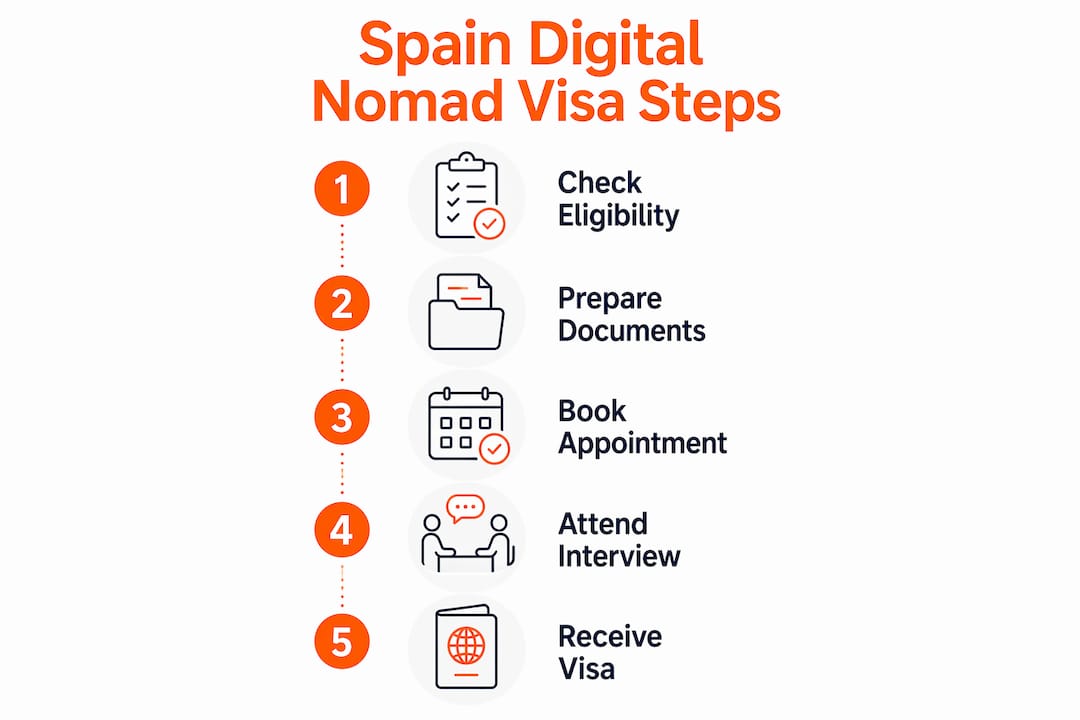
Confirm your consulate jurisdiction. Find which Spanish consulate covers your U.S. state of residence. This determines where you submit your application.
-
Obtain your NIE. Apply for your Foreigner Identity Number through the Spanish consulate. This is a separate administrative step from the visa application itself. Do not skip it or assume it can be handled later.
-
Prepare and apostille your documents. Gather everything on the checklist above. Philippine-issued documents go through the DFA for apostille; U.S.-issued documents go through the relevant U.S. state authority. Send documents to a Spanish-accredited translator once apostilled.
-
Pay form 790 (code 052). Download the form from the consulate website, fill it out, and pay the visa fee before your appointment. Bring the payment receipt.
-
Book your appointment through BLS International. The Spanish Consulate in Washington D.C. routes long-term national visa appointments through BLS. Note that short-term Schengen and long-term national visa appointments are listed separately on the BLS portal — make sure you select the correct category.
-
Attend your appointment in person. Every applicant must appear in person. Bring originals and copies of every document. BLS staff will forward your complete file to the consulate.
-
Wait for the decision. Processing typically runs 15–45 calendar days, though complex cases can take longer. Track your application status through BLS.
-
Collect your passport and travel to Spain. Once approved, your visa is stamped in your passport. You must enter Spain within the validity window printed on the visa.
Agency vs. self-apply: Self-applying works well if your employment situation is straightforward — salaried, single employer, clean documents. If you’re self-employed, have multiple income sources, or your company’s activity is hard to document clearly, professional help cuts the risk of a rejection that resets your timeline entirely. The Spain digital nomad visa process guide from Digitalnomadinspain walks through the U.S.-specific workflow in detail.
What happens after your visa is approved?
Arrival checklist:
- Enter Spain within the visa validity window; present your visa at border control
- Within 30 days of arrival, book your TIE (Tarjeta de Identidad de Extranjero) appointment at the nearest Extranjería office
- Register on the padrón (municipal register) at your local town hall — you’ll need this for the TIE and for accessing local services
- Open a Spanish bank account (padrón certificate and NIE/TIE typically required)
- Confirm your private health insurance is active and covers Spain
Renewal timeline:
- Initial DNV validity: one year
- First renewal: up to three additional years (apply before your current authorization expires)
- Second renewal: up to two more years
- After five years of continuous legal residence: you can apply for long-term EU residency
Filipino-specific citizenship note: Under Spanish nationality law, Filipino nationals may be eligible for naturalization after just two years of legal residence, compared to the standard ten years for most nationalities. This is one of the most significant long-term advantages of the DNV pathway for Filipinos. Conditions apply and legal advice is recommended before relying on this route.
Tax residency warning: If you spend more than 183 days in Spain in a calendar year, you become a Spanish tax resident. That changes your filing obligations significantly. Get a tax advisor before you hit that threshold. The Spain digital nomad visa tax guide from Digitalnomadinspain covers the key obligations in plain language.
This article is general information, not legal or tax advice. Confirm current requirements with the Spanish consulate or a qualified immigration professional for your specific situation.
Common reasons applications fail and how to avoid them
The same mistakes show up repeatedly in rejected Filipino applications:
- Missing NIE. Submitting without it is an automatic problem. Treat the NIE as a prerequisite, not a parallel task.
- Un-apostilled documents. A Philippine NBI clearance or birth certificate without a DFA apostille will not be accepted. Budget 2–4 weeks for DFA processing.
- Vague employer letters. Letters that confirm employment but don’t explicitly authorize remote work from Spain are consistently flagged. Use the outline in the documents section above.
- Insufficient company history proof. A company registry certificate that doesn’t clearly show at least one year of operation leaves a gap the consulate will question.
- Self-employed RETA gap. Freelancers who don’t address the RETA registration requirement upfront often face delays or requests for additional documentation.
Practical fixes:
- For company registry certificates: request an official extract from your employer’s country of incorporation, apostilled and translated.
- For NBI clearance: apply through the NBI’s online portal well in advance. DFA apostille adds processing time on top of that.
- For employer letters: have your HR or legal team review the letter against the checklist above before signing.
Community tip: Spain has a Filipino community estimated at over 200,000, with active networks in Madrid, Barcelona, and the Canary Islands. Filipino churches and InterNations groups are practical sources for finding Spanish-accredited translators, short-term housing references, and advice on local registration deadlines that official consulate pages don’t cover.
Digitalnomadinspain makes the application process manageable
Getting the DNV right the first time matters. A rejection doesn’t just cost you the application fee — it resets your timeline by months.
Digitalnomadinspain handles the full application cycle for Filipino remote workers: eligibility assessment, document preparation (including apostille coordination and translation management), employer letter review, consulate appointment booking, and post-approval support for your TIE card and tax registration setup. The team claims a 98% success rate across clients from more than 50 countries, with processing times running roughly 30% faster than self-applicants typically achieve.
The service is especially useful for self-employed Filipinos navigating RETA requirements, applicants with multiple income sources, or anyone working against a tight relocation deadline. Check your eligibility and get a personalized document checklist through the eligibility checker, or browse the full visa services overview to find the right support package.
Key Takeaways
Spain’s Digital Nomad Visa is fully accessible to Filipino remote workers who meet the income, employment, and documentation requirements — and the two-year naturalization pathway makes it one of the strongest long-term residency options available to Filipino nationals.
| Point | Details |
|---|---|
| Income floor | Solo applicants must show at least €2,160/month; add €810 for the first dependent and €540 for each additional dependent. |
| NIE is non-negotiable | Secure your Foreigner Identity Number before booking your consulate appointment. |
| Apostille everything from the Philippines | DFA apostille plus Spanish-accredited translation is required for all Philippine-issued documents. |
| Self-employed applicants need RETA | Without an A1 certificate, Filipino freelancers must register with Spain’s RETA before applying. |
| Digitalnomadinspain | Offers end-to-end DNV support with a claimed 98% success rate and an eligibility checker to start. |
What the DNV pathway really means for Filipinos
Most guides treat the Spain Digital Nomad Visa as a generic remote-work permit. For Filipino applicants specifically, it’s something more interesting than that.
The two-year naturalization route is the detail most people gloss over. For the majority of nationalities, Spanish citizenship requires ten years of continuous legal residence. Filipinos qualify after two. That means a Filipino remote worker who secures the DNV today and renews it consistently could realistically hold a Spanish (and therefore EU) passport within a few years. That’s a different calculation than the one most digital nomad visa guides are built around.
The apostille and translation burden is real, but it’s manageable with the right sequencing. The mistake most applicants make is treating document preparation as something to handle in the final two weeks before their appointment. DFA apostille processing, accredited translation, and NIE acquisition each take time on their own. Stack them sequentially and you’re looking at six to eight weeks of lead time before you even book the BLS appointment. Start earlier than you think you need to.
The employer letter is the other underestimated variable. Consulate reviewers are specifically looking for explicit authorization to work from Spain, not just proof of employment. A letter that doesn’t say “remote work from Spain is authorized” in plain terms is a letter that creates problems. That single sentence is worth more than a dozen supporting documents.
Official resources and further reading
Official sources:
- Spanish Consulate in Manila — Digital Nomad Visa guidance (PDF): The primary official document for Filipino applicants; includes the full document checklist and income requirements.
- ONE.gob.es — Digital Nomad Visa application procedure: Spain’s official government portal for the DNV application process, including self-employed requirements.
- Spanish Consulate in Washington D.C. — Visa services: Consulate jurisdiction details and BLS appointment booking for U.S.-based applicants.
- DFA Philippines — Apostille services: Visit the DFA website (dfa.gov.ph) for current apostille procedures and processing times for Philippine-issued documents.
- BLS International — Spain visa appointments: Book long-term national visa appointments through the BLS portal for your consulate district.
Digitalnomadinspain resources:
- Complete DNV requirements guide: Detailed breakdown of documentation and eligibility criteria.
- DNV process guide for U.S. applicants: Step-by-step workflow for applicants applying from the United States.
- Eligibility checker: Quick self-assessment tool to confirm whether you qualify before starting document preparation.
FAQ
Can Filipino citizens apply for Spain’s digital nomad visa?
Yes. Filipino nationals qualify as non-EEA citizens and are eligible for the DNV provided they meet the income, employment, and documentation requirements set by the Spanish consulate.
Is it difficult to get Spain’s digital nomad visa as a Filipino?
The process is document-intensive but straightforward if you prepare early. The most common obstacles are missing NIE, un-apostilled Philippine documents, and employer letters that don’t explicitly authorize remote work from Spain.
Can Filipinos work legally in Spain?
Under a standard tourist or Schengen visa, no. The Digital Nomad Visa is the correct authorization for remote workers; it grants legal residency and the right to work remotely for non-Spanish employers.
How long can Filipinos stay in Spain on the digital nomad visa?
The initial DNV is valid for one year. It can be renewed for up to three additional years, then again for up to two more, giving a potential total of six years before transitioning to long-term EU residency status.
Can Filipinos get Spanish citizenship through the digital nomad visa?
Potentially yes. Filipino nationals may qualify for Spanish naturalization after two years of legal residence, compared to ten years for most other nationalities. Strict residency continuity and legal conditions apply; consult an immigration lawyer before relying on this pathway.