
Discover how to qualify for the Spain digital nomad visa for Indians. Work remotely in Spain while enjoying vibrant culture and lifestyle!
Who qualifies for Spain’s digital nomad visa as an Indian applicant?
Indian remote workers and freelancers can legally live and work in Spain under the Digital Nomad Visa, formally established under Spain’s Startup Law (Law 28/2022). The core requirement is straightforward: you must work remotely for a company or clients based outside Spain, and your income must reach at least 200% of Spain’s monthly minimum wage, which adjusts annually, as determined by the current Salario Mínimo Interprofesional (SMI).
Beyond income, here is what Indian applicants specifically need to meet:
- Non-EU citizenship: Indians qualify as non-EU nationals.
- Professional background: Either a degree from a recognized university or business school, or at least 3 years of verifiable experience in your current field.
- Prior work relationship: At least 3 months of employment or freelance engagement with a foreign company before applying.
- Clean criminal record: No convictions in Spain or in any country where you have lived during the past two years.
- Health insurance: Private coverage from an insurer authorized to operate in Spain.
- Work scope: At least 80% of your professional activity must be for companies or clients outside Spain. Spanish client income is capped at 20% of total earnings.
The visa grants initial residence for up to one year when applied from outside Spain, with a path to renew up to five years total. You can also bring your spouse, dependent children, and dependent parents under family reunification provisions, though each additional family member triggers extra income requirements based on proportions of the SMI for each additional family member.
Table of Contents
- What documents and steps does the application process involve?
- How long does the visa last, and what rights does it give you?
- What challenges do Indian applicants commonly face, and how do you avoid them?
- How Digitalnomadinspain makes the process easier for Indian applicants
- What does the timeline from application to approval look like?
- What does the visa actually cost?
- What happens after your visa is approved?
- What are the tax obligations for Indian digital nomads in Spain?
- Key Takeaways
- Digitalnomadinspain handles the hard parts so you can focus on the move
What documents and steps does the application process involve?
Getting the paperwork right is where most Indian applicants either succeed or stumble. The Spanish Consulate in Mumbai (and New Delhi) has specific requirements that go beyond what other nationalities face, largely because Indian-issued documents require a formal apostille chain.
Core documents you will need:
- Valid passport (minimum one year of remaining validity, two blank pages, issued within the last 10 years)
- Completed national visa application form, signed by the applicant
- NIE number certificate (Foreign Identification Number — you apply for this simultaneously with the visa)
- Proof of income: bank statements, employment contract, or commercial freelance contracts
- Certificate from your employer confirming at least 3 months of remote work authorization, or freelance contracts showing the same
- University degree or professional certificate confirming 3+ years of relevant experience
- Indian Police Clearance Certificate (PCC), apostilled by the Ministry of External Affairs (MEA)
- Private health insurance policy valid in Spain
- Responsible declaration committing to comply with Spanish social security obligations before starting work
- Proof of social security registration (or a portability certificate if an India-Spain social security agreement applies)
Step-by-step process:
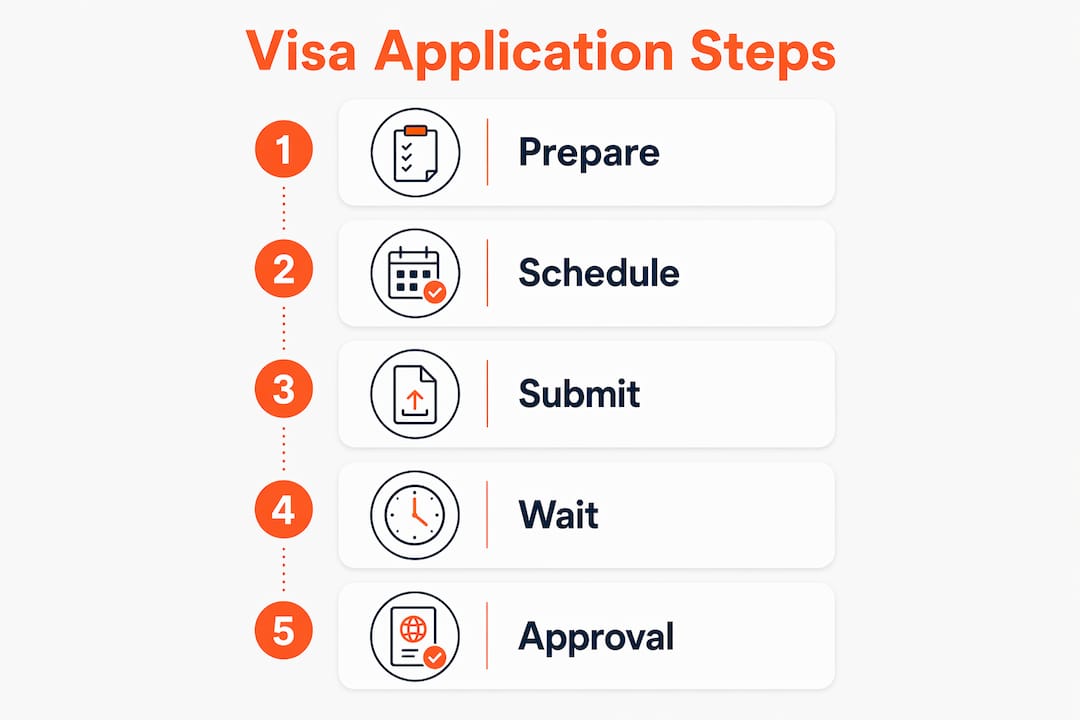
- Gather all documents and get Indian-issued ones apostilled through the MEA.
- Have non-English/non-Spanish documents sworn-translated by a certified translator.
- Apply for your NIE number at the consulate.
- Schedule a consulate appointment — book early, as slots fill weeks out.
- Pay the visa fee, which is officially around €75.
- Submit originals and copies in person; attend the interview.
- Collect your visa within one month of notification.
Pro Tip: Book your consulate appointment the moment your documents are ready. Slots at the Mumbai and New Delhi consulates are limited, and a two-to-three week wait is common. Missing the collection window after approval means your visa is canceled.
How long does the visa last, and what rights does it give you?
The initial visa runs for up to one year when you apply from India. Once you are in Spain, you can apply for a residence authorization directly, which may be granted for three years. After that, renewals extend your stay in two-year increments, up to five years of total legal residence.
A few practical points worth knowing:
- Schengen travel: The visa doubles as a Schengen residence permit, so you can travel freely across the 27 Schengen member states without additional visas.
- No local employment: You cannot take a job with a Spanish employer. Freelancers can work with Spanish clients, but that work cannot exceed 20% of total income.
- Healthcare access: Legal residents can access Spain’s public health system after registering (empadronamiento) at your local town hall.
- Family reunification: Your spouse, minor children, and financially dependent parents can join you. Each family member needs their own application, and your income must cover the additional SMI thresholds.
- Path to permanent residency: After five continuous years of legal residence, you can apply for long-term EU residency status.
One thing many guides skip: the visa itself serves as proof of legal residency for up to a year. You are not required to obtain a Tarjeta de Identidad de Extranjero (TIE residence card) immediately, though applying for one voluntarily makes daily life in Spain considerably easier for banking, renting an apartment, and dealing with local bureaucracy.
What challenges do Indian applicants commonly face, and how do you avoid them?
The apostille requirement trips up more Indian applicants than any other single issue. Failing to properly apostille Indian documents — particularly the Police Clearance Certificate — is cited as a leading cause of consulate rejection for Indian nationals.
The PCC must come from your Regional Passport Office, then be apostilled by the Indian Ministry of External Affairs. A standard police verification certificate from a local station does not meet the requirement, no matter how official it looks.
Other frequent pitfalls:
- Insufficient income proof: Bank statements that show irregular deposits or gaps raise red flags. Consulates want to see consistent, documented income at or above the SMI threshold.
- Missing the responsible declaration: This document, confirming your commitment to Spanish social security compliance before starting work, is required for approval but frequently overlooked by first-time applicants.
- Misreading the 20% rule: Some freelancers assume they can freely work with Spanish clients up to 20% of their time. The restriction is on income, not hours — and exceeding it can jeopardize your visa status.
- Outdated passport: Passports issued more than 10 years ago are not accepted, and the passport must have at least one year of remaining validity at the time of application.
Proactive scheduling and professional help with paperwork measurably improve approval efficiency for Indian remote workers. Getting a second set of eyes on your document package before submission is not overcaution — it is the difference between a clean approval and a resubmission months later.
How Digitalnomadinspain makes the process easier for Indian applicants
Navigating Spain’s immigration system from India involves coordinating apostilles, sworn translations, consulate appointments, and social security declarations across two countries. Digitalnomadinspain handles that coordination end-to-end.
The service starts with a personalized eligibility assessment that accounts specifically for Indian documentation norms, including the MEA apostille chain and the Regional Passport Office PCC requirement. From there, the team prepares your full document package, arranges certified translations, and verifies that every item meets the 2026 consulate standards before submission.
Key advantages for Indian clients:
- a high approval rate across clients from over 50 countries, built on deep familiarity with Spain’s immigration law under Law 28/2022.
- processing up to a third faster compared to self-applicants, driven by knowing exactly which documents consulates scrutinize and how to present them.
- Consulate appointment support: The team guides you through scheduling at Mumbai or New Delhi and prepares you for the interview.
- Post-approval support: After you land in Spain, Digitalnomadinspain helps with TIE card applications, empadronamiento registration, and tax registration setup.
For Indian freelancers juggling client work across time zones, handing off the visa paperwork to specialists who have done it hundreds of times is a practical decision, not a luxury.
What does the timeline from application to approval look like?
Plan for several weeks to a few months from document gathering to visa collection, with phases including document gathering and apostille, sworn translations, NIE application and consulate appointment, consulate review, and visa collection, each with variable durations depending on circumstances

The apostille step is the most unpredictable. The MEA processes applications through its RPO offices, and turnaround can stretch if you apply during peak periods. Submitting your PCC apostille request as early as possible in the process protects the rest of your timeline. Once the consulate has your complete file, the review period is typically 4–6 weeks, though complex cases can run longer.
Pro Tip: Apply for your NIE number at the same time as you submit your visa application — the consulate processes both together, and waiting to apply for the NIE separately adds unnecessary weeks to your timeline.
What does the visa actually cost?
The visa fee itself is around €75, paid at an approved financial institution before your consulate appointment. That is the official government fee. The total cost of obtaining the visa, however, is higher once you account for the full process.
Realistic cost breakdown:
| Item | Approximate Cost |
|---|---|
| Visa application fee | ~€75 (~₹7,000) |
| Apostille fees (MEA, per document) | ₹50–₹100 per document |
| Sworn translation (per document) | €50–€100 per document |
| Private health insurance (annual) | — |
| Professional consultancy (optional) | Varies by provider |
| TIE card application (post-arrival) | — |
Health insurance costs vary widely depending on your age, coverage level, and provider; basic compliant policies for younger healthy applicants are on the lower end of the price range, with comprehensive coverage costing more. Check the Spanish Directorate-General of Insurance and Pension Funds (DGSFP) registry to confirm your insurer is authorized to operate in Spain before purchasing.
What happens after your visa is approved?
Approval is not the finish line. Several steps follow before you are fully settled and legally compliant in Spain.
Within the first month of arrival:
- Empadronamiento: Register at your local town hall (Ayuntamiento) to get your certificate of municipal registration. This is required for almost everything that follows, including healthcare access and school enrollment for children.
- TIE card (optional but practical): Apply at the Oficina de Extranjería or the nearest National Police station. The TIE card is a physical ID card that proves your residency status and makes banking and renting far simpler.
- Spanish social security registration: If you have not already done this through your employer, complete your RETA registration (for self-employed workers) or confirm your employer’s registration with the Spanish Social Security system.
- Bank account: Most Spanish banks require your NIE and empadronamiento certificate. Opening an account early simplifies paying rent, utilities, and local expenses.
The Spain digital nomad lifestyle involves more administrative setup than most people expect in the first few weeks, but the process is well-documented and manageable with the right preparation.
What are the tax obligations for Indian digital nomads in Spain?
Tax residency is where many Indian remote workers get caught off guard. If you spend more than 183 days in Spain in a calendar year, you become a Spanish tax resident and must file an annual income tax return (IRPF) on your worldwide income.
Spain’s standard income tax rates are progressive, ranging from 19% to 47% depending on your income band. However, the Beckham Law (Régimen Especial para Trabajadores Desplazados) offers a significant alternative: qualifying digital nomads can elect to be taxed as non-residents for up to six years, paying a flat 24% rate on Spanish-sourced income up to €600,000, rather than the progressive resident rates on worldwide income.
Key tax points for Indian applicants:
- India-Spain Double Taxation Avoidance Agreement (DTAA): India and Spain have a tax treaty that prevents you from being taxed twice on the same income. You will need to obtain a Tax Residency Certificate from India’s income tax authorities if you plan to claim treaty benefits.
- Beckham Law election: Must be requested within six months of registering with Spanish Social Security. Missing this window means you cannot apply retroactively.
- Modelo 030: File this form with the Spanish tax authority (Agencia Tributaria) to register as a taxpayer when you arrive.
- Annual filing: Spanish tax returns (Modelo 100 for residents, Modelo 210 for non-residents) are due between April and June for the prior year’s income.
The interaction between Indian and Spanish tax obligations is genuinely complex, and the Beckham Law election in particular has strict timing requirements. Getting tax advice from a Spanish gestor or tax advisor in your first month of arrival is worth the cost.
Key Takeaways
Spain’s Digital Nomad Visa gives Indian remote workers a clear, legal path to five years of residence, provided the income threshold, apostille requirements, and work-scope rules are met from the start.
| Point | Details |
|---|---|
| Income threshold | You must earn at least 200% of Spain’s monthly minimum wage; family members require additional proof per dependent. |
| Apostille is non-negotiable | Your Indian PCC must come from the Regional Passport Office and be apostilled by the MEA — a standard police check is rejected. |
| Work scope restriction | At least 80% of your income must come from outside Spain; Spanish clients are capped at 20% of total earnings. |
| Beckham Law timing | Elect the 24% flat-tax regime within six months of Social Security registration — the window cannot be reopened. |
| Digitalnomadinspain | Offers end-to-end application support with a 98% approval rate, covering documents, apostille verification, and post-arrival registration. |
Digitalnomadinspain handles the hard parts so you can focus on the move
Getting the Spain Digital Nomad Visa right as an Indian applicant means coordinating apostilles across two government ministries, preparing sworn translations, navigating consulate appointment systems, and submitting a document package that leaves no room for error. Digitalnomadinspain does all of that for you.

The team’s full-service visa support covers eligibility assessment, document preparation, translation, apostille verification, consulate guidance, and post-approval setup including TIE cards and tax registration. The 98% approval rate across clients from more than 50 countries reflects a process built specifically around what consulates actually require, not what generic guides suggest. Processing typically runs 30% faster than self-applicants manage on their own.
If you are not yet sure whether you qualify, start with a free eligibility check before committing to the full process. For those ready to move forward, the visa services page outlines exactly what is included and how to get started.