Discover how the digital nomad visa Spain for US citizens lets you work remotely in Spain. Learn requirements, application tips, and tax info.
Spain’s Digital Nomad Visa is defined as a legal residency permit that allows U.S. citizens to live in Spain while working remotely for non-Spanish employers or clients. Introduced under Spain’s Startup Act in 2023, it fills a gap that previously left remote workers in a legal gray zone. The digital nomad visa Spain for US citizens requires a minimum monthly income of approximately €2,849, an FBI background check with apostille, and proof of a university degree or at least three years of professional experience. This guide covers every requirement, both application routes, and the tax rules you need to know before you move.
What are the Spain Digital Nomad Visa eligibility criteria for U.S. citizens?
The income threshold is the first filter most applicants face. The 2026 minimum income requirement is 200% of Spain’s minimum interprofessional wage, which works out to roughly €2,849 per month for the main applicant. That number rises if you bring family: add 75% of the minimum wage per adult dependent and 25% per minor. Three months of bank statements or payroll records showing stable, recurring deposits are required to prove it.
One critical point many applicants miss: savings do not count. Spain’s visa requires ongoing monthly income, not a lump sum in a bank account. A freelancer with €50,000 saved but no active contracts will be rejected. Your income must be demonstrably current and recurring.
The professional qualifications requirement is equally firm. You must show either a university degree, a professional certification, or at least three years of verifiable experience in your field. Freelancers must also prove that 80% or more of their income comes from non-Spanish clients or employers.

The background check requirement is one of the most time-consuming parts of the application. U.S. citizens must submit an FBI Identity History Summary check covering all countries where they have lived during the past five years. The FBI check must be apostilled by the U.S. Department of State. No state or local background checks are accepted by Spanish authorities. If you lived in another country during that period, you need a criminal record certificate from that country as well, translated and legalized.
The remaining core requirements are:
- Private health insurance covering all risks with zero co-payments, from a Spanish-licensed provider, for the full visa duration
- Proof of remote work authorization from your employer, confirming you are permitted to work from abroad
- Employer tenure of at least three months with your current foreign employer, or active freelance contracts if self-employed
- Accommodation proof showing where you will live in Spain (a rental contract or property deed)
Pro Tip: Start the FBI check process at least three months before you plan to apply. Processing and apostille together can take six to ten weeks, and it is the single most common cause of application delays.
How do you apply for the Spain Digital Nomad Visa as a U.S. citizen?
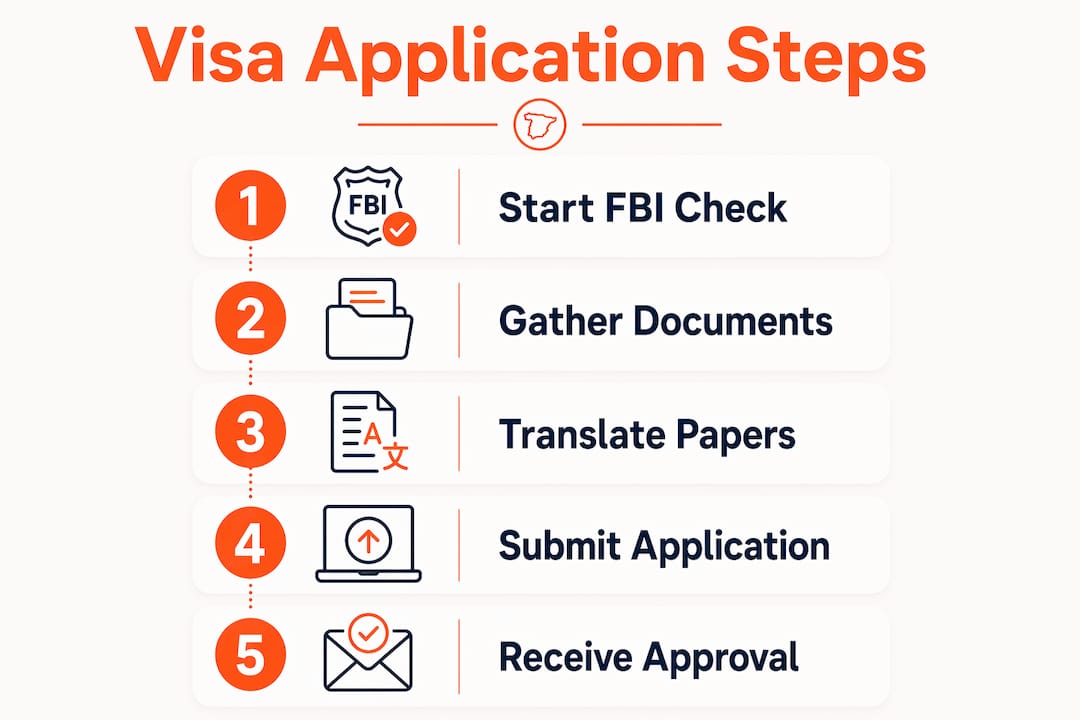
Two application routes exist, and choosing the right one depends on your timeline and risk tolerance.
Route 1: Apply from a U.S. consulate
- Gather all required documents: FBI check with apostille, employer letter, three months of income statements, degree or experience proof, health insurance policy, and accommodation proof.
- Book an appointment at the Spanish consulate with jurisdiction over your U.S. state of residence.
- Submit your full application package at the appointment.
- Wait for processing. The consulate issues a one-year visa if approved.
- Enter Spain on that visa, then apply for your TIE residence card within 30 days of arrival.
Route 2: Apply in Spain through the UGE
- Enter Spain as a tourist under the standard 90-day visa-free allowance for U.S. citizens.
- Arrange housing and gather your documents while in Spain.
- Submit your application to the Unidad de Grandes Empresas (UGE), Spain’s large business unit that handles these permits, before your 90-day tourist stay expires.
- The UGE typically processes applications within 20 business days. Approval grants a direct three-year residence permit, skipping the one-year visa stage entirely.
The UGE route is faster and gives you a longer initial permit. The trade-off is real: if your application is denied, you must leave Spain before your tourist allowance expires. The consulate route is slower but carries less personal disruption if something goes wrong.
Consular fees run approximately €73–190 depending on the route and consulate. Budget separately for document translation, apostille fees, and health insurance premiums.
Pro Tip: Get your NIE (Spanish tax identification number) as early as possible. You will need it for health insurance contracts, rental agreements, and social security registration. Some consulates allow you to request it alongside your visa application.
The total document preparation timeline typically runs three to four months when you factor in the FBI check, apostille, consulate appointment availability, and translation time. Build that buffer into your relocation plan.
What are the tax rules for U.S. citizens living in Spain on the Digital Nomad Visa?
Spanish tax residency kicks in automatically once you spend more than 183 days in Spain within a calendar year. At that point, Spain taxes your worldwide income unless a specific regime applies.
The most significant tax benefit available to Digital Nomad Visa holders is the Beckham Law. Under this regime, qualifying residents pay a flat 24% tax rate on Spanish income up to €600,000 for up to six years, instead of Spain’s progressive rates that reach 47%. Foreign income remains exempt from Spanish tax under this regime. To claim it, you must file Form 149 within six months of registering as a Spanish resident.
The Beckham Law is one of the most underused financial tools available to U.S. expats in Spain. Most applicants focus entirely on the visa paperwork and miss the six-month window to file Form 149. Missing that deadline means paying progressive Spanish tax rates for the entire residency period, which can cost tens of thousands of euros over six years.
U.S. citizens do not escape American tax obligations by moving abroad. The IRS taxes U.S. citizens on worldwide income regardless of where they live. Annual obligations include:
- Form 1040 filed every year, reporting all global income
- FBAR (FinCEN 114) if your foreign bank accounts exceed $10,000 at any point during the year
- FATCA (Form 8938) disclosures for foreign financial assets above specified thresholds
The good news is that the Foreign Earned Income Exclusion and Foreign Tax Credits, combined with the U.S.-Spain double taxation treaty, prevent most U.S. citizens from paying full tax twice. Getting this right requires a cross-border tax advisor who understands both systems. The interaction between the Beckham Law and FEIE is not straightforward, and a mistake in either direction is expensive.
Practical steps for living legally in Spain as a digital nomad
Getting the visa is step one. Staying legally compliant after arrival requires several additional registrations that many new arrivals overlook.
Health insurance must be private, from a Spanish-licensed insurer, with zero co-payments and full coverage for the entire visa period. Providers like Sanitas, Adeslas, and DKV meet these requirements. International plans that include co-payments or lack Spanish licensing are typically rejected by Spanish authorities.
Social security registration is mandatory. Whether you are an employee or self-employed, you must register with Spain’s social security system when working remotely from Spain. The procedure differs for employees versus freelancers, but skipping it puts your visa status at risk.
Town hall registration (called empadronamiento in Spanish) must happen within 30 days of arrival. This registration is your official proof of local residence and is required for many subsequent administrative steps.
TIE residence card application follows entry. Apply within 30 days of arriving in Spain. The TIE is your physical proof of legal residency and replaces the visa stamp for day-to-day identification purposes.
For renewals, keep organized records of your income throughout the visa period. You will need to prove that your income has remained above the threshold and that your work remains primarily for non-Spanish clients. The complete 2026 requirements guide from Digitalnomadinspain covers renewal documentation in detail.
Key Takeaways
The Spain Digital Nomad Visa gives U.S. citizens a clear legal path to long-term residency, but success depends on meeting income, documentation, and tax registration requirements precisely and on time.
| Point | Details |
|---|---|
| Income must be ongoing | Spain requires ~€2,849/month in active earnings, not savings, to qualify. |
| Two application routes exist | The UGE in-Spain route is faster (20 business days) and grants a 3-year permit directly. |
| FBI check takes time | Start the apostilled FBI Identity History Summary at least three months before applying. |
| Beckham Law has a deadline | File Form 149 within six months of residency or lose the 24% flat tax rate for good. |
| U.S. tax obligations continue | File Form 1040, FBAR, and FATCA annually regardless of Spanish residency status. |
What I’ve learned helping U.S. applicants get this visa right
The single most common mistake I see is treating the income requirement like a savings threshold. Applicants arrive with strong bank balances but no active contracts, and Spanish authorities reject them. The visa is built around the idea of a working professional, not a retiree living off capital. If your income is project-based or seasonal, document every contract carefully and show a consistent monthly average.
The choice between the consulate route and the UGE route deserves more thought than most people give it. The UGE route sounds appealing because it is faster and gives you a three-year permit. But entering Spain as a tourist, signing a lease, and then having your application denied is a genuinely stressful situation. I generally recommend the consulate route for first-time applicants who have never navigated Spanish bureaucracy. The extra time upfront is worth the certainty.
On taxes: the Beckham Law is real money. A U.S. remote worker earning $120,000 a year could save a significant amount annually compared to Spain’s standard progressive rates. But the interaction with U.S. FEIE rules is complicated. Hire a tax advisor who works specifically with U.S. expats in Spain before you file anything. The cost of that advice is trivial compared to the cost of getting it wrong.
Finally, translation quality matters more than people expect. Spanish immigration officers reject applications for poor translations, not just missing documents. Use a certified translator for every document that is not originally in Spanish.
— Joshua
Digitalnomadinspain can handle the hard parts for you
Getting the Spain Digital Nomad Visa right the first time saves months of delays and hundreds of euros in repeated fees. Digitalnomadinspain works specifically with U.S. applicants, managing document preparation, FBI apostille guidance, translation coordination, and consulate appointment support from start to finish.
The team at Digitalnomadinspain reports a 98% approval rate and processes applications roughly 30% faster than self-applicants, thanks to deep familiarity with Spanish immigration requirements. Whether you are applying from a U.S. consulate or planning the in-Spain UGE route, their visa application service covers every step. Not sure if you qualify? Use their eligibility checker to get a clear answer before you invest time in document collection.
FAQ
What income do I need for the Spain Digital Nomad Visa?
The 2026 minimum is approximately €2,849 per month, equal to 200% of Spain’s minimum wage. Each adult dependent adds 75% of the minimum wage to that threshold, and each minor adds 25%.
Can I bring my family on the Spain Digital Nomad Visa?
Yes. Dependent family members can be included in your application, but your required monthly income increases with each dependent you add.
How long does the Spain Digital Nomad Visa application take?
The FBI check and apostille alone take six to ten weeks. Total preparation and processing time typically runs three to four months for the consulate route. The UGE in-Spain route processes in approximately 20 business days once documents are submitted.
Do I still pay U.S. taxes if I live in Spain?
Yes. U.S. citizens must file Form 1040 annually on worldwide income regardless of where they live. FBAR and FATCA reporting apply if you hold foreign accounts or assets above the relevant thresholds.
What is the Beckham Law and does it apply to me?
The Beckham Law lets qualifying Digital Nomad Visa holders pay a flat 24% tax rate on Spanish income up to €600,000 for up to six years. You must file Form 149 within six months of becoming a Spanish tax resident to claim it.