
Navigate the Spain digital nomad visa process with ease! Learn the steps for U.S. applicants to live and work in Spain legally.
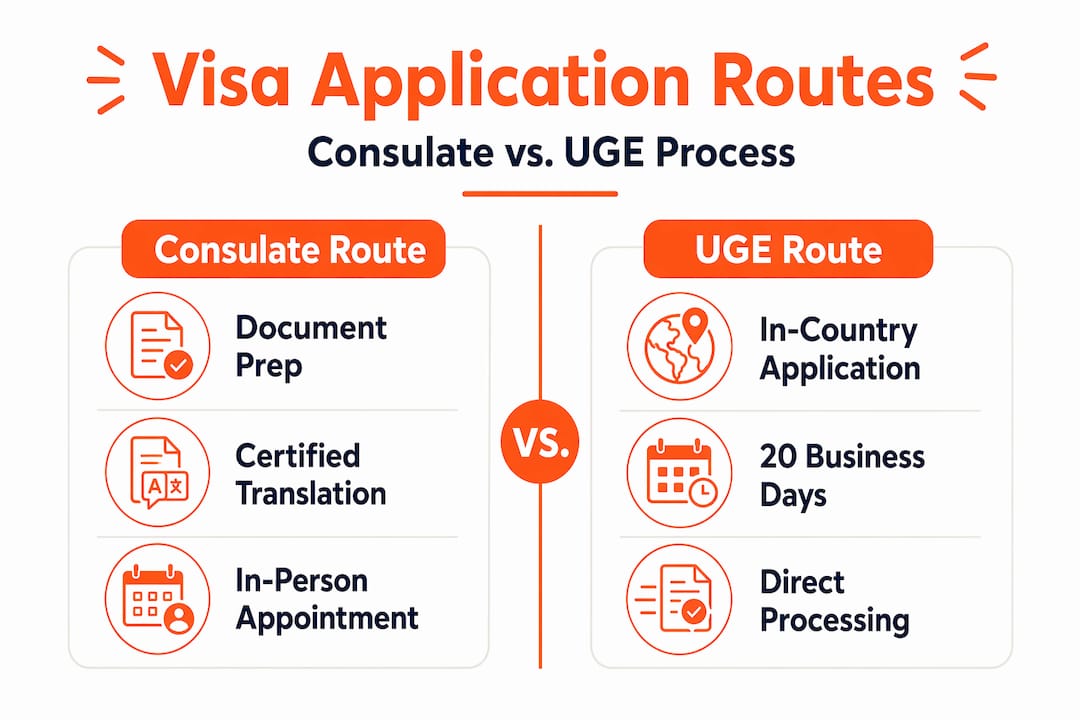
Spain’s digital nomad visa lets non-EU remote workers live and work legally in Spain while keeping their foreign income sources intact. For U.S.-based freelancers and employees, the Spain digital nomad visa process runs through one of two routes: apply at a Spanish consulate before you move (you get a one-year visa), or apply from inside Spain through the UGE (Unidad de Grandes Empresas y Colectivos Estratégicos) if you’re already there legally (you get a three-year residence permit directly). The consulate route is the standard path for most Americans starting from the U.S.
Here’s what the process looks like at a high level:
- Check eligibility: Confirm you meet the income threshold, remote work requirement, and professional qualification criteria.
- Gather and apostille documents: Collect criminal records, employment proof, degree certificates, and health insurance. Get U.S. documents apostilled through your state’s Secretary of State office.
- Get a sworn Spanish translation: All non-Spanish documents require a certified translator.
- Apply for your NIE: The Número de Identidad de Extranjero (foreign ID number) must be obtained before or alongside your visa application.
- Book a consulate appointment: Email your scanned documents to the relevant Spanish consulate, then attend in person.
- Collect your visa and travel to Spain: Once approved, collect the visa within one month and enter Spain.
- Apply for your TIE card: Within two months before your visa expires, apply for the Tarjeta de Identificación de Extranjero (foreigner identity card) through the UGE to extend your stay.
Table of Contents
- Who qualifies for Spain’s digital nomad visa?
- What documents do you need for the application?
- How does the Spain digital nomad visa process work, step by step?
- How long is the visa valid, and what happens after approval?
- What income proof do you actually need?
- What health insurance do you need for the visa?
- How long does the Spain digital nomad visa process actually take?
- How does expert immigration support speed up your application?
- Digitalnomadinspain makes the Spain visa process straightforward
- Key Takeaways
Who qualifies for Spain’s digital nomad visa?
Spain’s digital nomad visa requirements are specific, and checking them before you start gathering paperwork saves weeks of wasted effort. Here’s who qualifies:
- Nationality: Non-EU/EEA nationals only. U.S. citizens qualify.
- Remote work status: You must work for a company or clients based outside Spain, using digital or telecommunications tools exclusively.
- Income floor: You must earn at least €2,850 per month as of 2026, which is double Spain’s minimum monthly wage.
- Professional qualifications: A university or postgraduate degree from a recognized institution, or at least 3 years of professional experience in your field.
- Employment relationship duration: You must have worked with your employer or clients for a minimum of three months before applying.
- Employer history: Your employer or client company must have been operating for at least one year.
- Spanish income cap: If you freelance, Spanish-source work cannot exceed 20% of your total income.
- No recent Spanish residency: You must not have been a legal resident in Spain during the past five years.
- Clean criminal record: No convictions in Spain or in any country where you’ve lived during the past two years.
- Age: Must be 18 or older.
One detail many applicants miss: the 20% Spanish income cap applies to freelancers who take on Spanish clients. If you’re a salaried employee of a U.S. company, this restriction doesn’t apply to you in the same way, but your employer must explicitly authorize remote work from Spain in writing.
What documents do you need for the application?
Getting your document list right the first time is where most applications succeed or fail. Apostille and sworn translation of all foreign documents is mandatory. A missing apostille or an untranslated certificate is the single most common reason for delays or outright denials.
Core documents for all applicants
- National visa application form (EX-01): Completed and signed. Available on the Spanish Ministry of Foreign Affairs website.
- Valid passport: Original plus photocopy of the biometric data pages. Must be valid for at least one year and have two blank pages. Passports issued more than 10 years ago are not accepted.
- Recent passport-size photo: Color, light background.
- NIE certificate: Proof of assignment of your Número de Identidad de Extranjero.
- Criminal background check: Issued by the FBI (for U.S. applicants) and any other country where you’ve lived in the past two years. Must be apostilled and translated into Spanish. Cannot be older than six months.
- Proof of accommodation in Spain: A rental contract, property deed, or a letter from a host.
- Private health insurance: Certificate from a Spanish-authorized insurer. Coverage must match Spain’s public health system with no copays or deductibles.
- Proof of financial means: Bank statements, payslips, or contracts showing at least €2,850/month.
- University degree or proof of professional experience: Apostilled diploma or employment history demonstrating relevant qualifications or experience.
- Visa fee payment receipt.
Employment-specific documents
| Document | Employees | Freelancers |
|---|---|---|
| Employer letter authorizing remote work | Required | N/A |
| Employment contract (3+ months) | Required | Client contracts (3+ months) |
| Company registration certificate | Required (employer’s company) | Required (client’s company) |
| Invoices or proof of professional activity | Optional supporting doc | Required |
| Social Security registration or portability certificate | Required | RETA registration or equivalent |
For U.S. employees, the company registration certificate is typically a Certificate of Good Standing from your state’s Division of Corporations, apostilled and translated. Freelancers need client contracts or invoices that clearly show the professional relationship has been active for at least three months.
Pro Tip: Request your FBI Identity History Summary (the federal background check) at least eight weeks before your planned application date. Processing alone takes three to four weeks, and then you still need to apostille it through the U.S. Department of State.
How does the Spain digital nomad visa process work, step by step?
The Spain digital nomad visa process splits into two distinct paths depending on where you’re applying from. Here’s how each one works.
Consulate route (applying from the U.S.)
Step 1. Prepare and apostille your documents. Start with your FBI background check and degree certificate since these take the longest. U.S. documents need apostilles from the U.S. Department of State or your state’s Secretary of State, depending on the document type. Budget four to eight weeks for this phase.

Step 2. Get sworn Spanish translations. Every apostilled document must be translated by a certified Spanish translator. The Spanish consulate will not accept machine translations or bilingual documents without official certification.
Step 3. Apply for your NIE. The NIE application runs concurrently with your visa application at the consulate. You’ll complete a separate form, but it’s submitted at the same appointment.
Step 4. Email your scanned documents. For the Washington, D.C. consulate (covering D.C., Maryland, Virginia, West Virginia, and North Carolina), scan everything and email it to cog.washington.vis@maec.es with the subject line: “APPOINTMENT REQUEST. TELEWORK VISA. [Your Name]. Email Number.” The consulate reviews your documents and schedules your in-person appointment only after confirming your file is complete.
Step 5. Attend your in-person appointment. Bring originals and copies of everything. The consulate may ask for a personal interview or additional documents. The legal decision period is 10 days from submission, but this window pauses if they request more information.
Step 6. Collect your visa. Once approved, you have one month from the notification date to collect your passport with the visa. After that, the visa is canceled.

Step 7. Travel to Spain and apply for your TIE. Your one-year visa is sufficient proof of legal residency. Starting two months before it expires, apply to the UGE for an Initial Residence Authorization, then apply for your TIE card at the local police station.
UGE route (applying from inside Spain)
If you’re already in Spain legally (on a tourist visa, student visa, or another valid permit), you can apply directly through the UGE’s electronic portal for a three-year residence permit. The UGE processes applications electronically with a statutory 20-business-day resolution period. No appointment wait. You identify yourself with a digital certificate or Cl@ve PIN, attach your documents, and submit. The clock on those 20 business days only starts once your file is deemed complete, and it pauses if the UGE issues a request for additional documents (a “requerimiento”).
How long is the visa valid, and what happens after approval?
The validity structure depends on which route you took.
- Consulate route: One-year visa, then convert to a three-year residence permit through the UGE. Renewal pattern: 1 + 2 + 2 years.
- UGE in-country route: Three-year residence permit from the start. Renewal pattern: 3 + 2 years.
After approval, several administrative steps follow in sequence:
- Empadronamiento (municipal registration): Register at your local town hall (ayuntamiento) as a resident of your neighborhood. This takes one to fourteen days and is required before you can book a police appointment for your TIE card.
- TIE card application: Book a fingerprinting appointment at the local Policía Nacional. In cities like Madrid and Barcelona, appointment waits can exceed 30 days. Physical card delivery adds more time after that.
- Social Security registration: Employees register through their foreign employer’s Spanish Social Security affiliation. Freelancers register with RETA (Régimen Especial de Trabajadores Autónomas).
- Tax registration: Consider electing Spain’s special tax regime, known as the Beckham Law, within six months of arrival. Qualifying digital nomad visa holders who haven’t lived in Spain in the prior five years can pay a flat 24% tax rate on Spanish-source income for up to six years.
- Long-term residency path: After five continuous years of legal residence, you can apply for long-term residency. After ten years, citizenship becomes an option for most nationalities.
Renewals require proof that you still meet the income threshold, continue working remotely for foreign clients, and have filed Spanish taxes. Keep your records organized from day one.
What income proof do you actually need?
The income threshold is €2,850 per month in 2026, tied to 200% of Spain’s SMI. This is a hard floor, not a guideline. Here’s what counts as proof and how it differs by employment status.
- Salaried employees: Recent payslips (typically three months), an employment contract showing your salary, and a bank statement showing regular deposits. Your employer’s letter authorizing remote work from Spain must also confirm your salary.
- Freelancers: Invoices from clients for the past three to six months, client contracts, and bank statements showing consistent income deposits. The total must average at least €2,850/month.
- Mixed income: If you have both employment and freelance income, you can combine them, but Spanish-source freelance work cannot exceed 20% of the total.
One thing consulates look at closely: income stability. A single month of high earnings doesn’t satisfy the requirement. They want to see a consistent pattern. Three to six months of bank statements showing regular deposits at or above the threshold is the standard expectation.
For family members joining you, the income requirement increases. The first dependent adds €916/month (75% of the SMI in 2026), and each additional dependent adds €305/month (25% of the SMI in 2026).
What health insurance do you need for the visa?
Private health insurance valid in Spain is mandatory from the first day of your application or entry, not something you sort out after approval. The policy must meet three specific criteria:
- No copays or deductibles: The coverage must be comprehensive, not a high-deductible plan.
- Coverage equivalent to Spain’s public health system: This means inpatient, outpatient, emergency, and specialist care.
- Issued by an insurer authorized to operate in Spain: Foreign insurers must be licensed in Spain. Some U.S. international health plans qualify; others don’t. Verify authorization before purchasing.
A few practical notes for U.S. applicants. Many expat-focused international health insurance providers offer Spain-compliant policies. Check that the certificate they issue explicitly states coverage in Spain with no copays, because the consulate will read the certificate carefully. If your policy is issued in English, it needs a sworn Spanish translation like every other document.
The insurance must be active at the time of application, not just purchased. A policy start date after your application date will not be accepted.
How long does the Spain digital nomad visa process actually take?
Realistic timelines matter more than the statutory ones. The total timeline for obtaining Spain’s digital nomad visa realistically ranges from 3 to 6 months from document preparation through TIE card issuance.
Phase-by-phase breakdown
- Document preparation (apostilles, translations, background checks): 4–8 weeks. The FBI background check and apostille chain is the longest single step for U.S. applicants.
- Consulate appointment wait: 2–8 weeks after submitting your scanned documents.
- Consulate processing: The legal window is 10 days, but requests for additional documents pause that clock. Realistic processing runs 4–12 weeks.
- Post-approval TIE card process: Empadronamiento takes 1–14 days. Police fingerprinting appointments in major cities can take 30 days or more. Physical card delivery adds additional weeks.
Scenario planning
| Scenario | Total timeline |
|---|---|
| Best case | — |
| Average | 4–6 months |
| Worst case (delays, requerimientos) | Up to 10 months |
The UGE in-country route has a statutory 20-business-day processing period, but the legal clock only starts once the UGE confirms your file is complete. A requerimiento pauses it entirely. Realistically, in-country applicants should budget 3–6 months as well.
Pro Tip: If you’re on a U.S. passport and plan to enter Spain as a tourist first, you have 90 days within a 180-day period under the Schengen rules. Submit your UGE application as early as possible after arriving to avoid overstay risk while you wait for approval.
How does expert immigration support speed up your application?
Professional guidance cuts the most common failure points out of the process before they happen. The Spain digital nomad visa application has enough moving parts that a single missing apostille or an incorrectly formatted employer letter can trigger a requerimiento, pausing your timeline by weeks.
Immigration consultants who specialize in this visa know exactly how each Spanish consulate interprets the requirements, which documents need additional supporting evidence, and how to sequence the paperwork so nothing expires before your appointment. For freelancers especially, structuring income proof correctly is where self-applicants most often stumble. Consulates want to see a clear, consistent income narrative, and a consultant can review your bank statements and invoices before submission to flag gaps.
Requerimientos are the biggest timeline killer. When the consulate or UGE requests additional documents, the processing clock pauses and you typically have 10 days to respond. An experienced consultant handles these responses quickly and correctly, preventing the kind of back-and-forth that stretches a four-month process into eight. Digitalnomadinspain reports a 98% success rate across clients from over 50 countries, with processing times typically 30% faster than self-applicants.
Post-approval support matters too. Getting your empadronamiento right, booking TIE card appointments in cities where slots disappear within hours, and understanding your consulate interview expectations are all steps where having someone in your corner makes a concrete difference.
Pro Tip: Book a pre-application eligibility review before spending money on apostilles and translations. If your income structure or employment situation has a gray area, finding out early saves hundreds of dollars and weeks of effort.
Digitalnomadinspain makes the Spain visa process straightforward
Most U.S. applicants who struggle with Spain’s digital nomad visa don’t fail because of ineligibility. They fail because of paperwork errors, missing apostilles, or income documentation that doesn’t tell a clear enough story. That’s exactly the gap Digitalnomadinspain fills.
Digitalnomadinspain offers full-service support from your first eligibility check through post-approval steps like NIE registration, TIE card appointments, and tax registration. The team handles document preparation, sworn translations, employer letter review, and consulate follow-up, so you’re not piecing together requirements from five different government websites. For freelancers with variable income or employees at smaller U.S. companies unfamiliar with Spanish bureaucracy, that kind of hands-on preparation is what keeps an application on track.
The digital nomad visa service covers the full process, and you can start with a free eligibility check to confirm you qualify before committing to anything. If you’re ready to move forward, book a consultation and get a clear plan built around your specific employment situation, income structure, and timeline.
Key Takeaways
Spain’s digital nomad visa process requires meeting a €2,850/month income threshold, apostilling all U.S. documents, and choosing between a consulate route (one-year visa) or an in-country UGE route (three-year permit) based on where you currently are.
| Point | Details |
|---|---|
| Two application routes | Consulate from the U.S. gives a one-year visa; UGE from inside Spain gives a three-year permit directly. |
| Income threshold | You must prove at least €2,850/month (200% of Spain’s 2026 SMI) through payslips, bank statements, or invoices. |
| Realistic timeline | Total process from document prep to TIE card issuance typically takes 3–6 months; worst case up to 10 months. |
| Apostille everything | All U.S. documents (FBI background check, degree, company certificates) must be apostilled and sworn-translated into Spanish. |
| Digitalnomadinspain | Full-service consultancy with a 98% success rate, covering document prep through post-approval TIE and NIE registration. |