
Discover the Spain digital nomad visa tax benefits. Learn how to leverage the flat 24% tax rate and save thousands on your income.
Spain’s digital nomad visa tax framework gives non-EU remote workers access to a flat 24% tax rate on Spanish-source income up to €600,000 under the Beckham Law special regime, with most foreign-source income exempt from Spanish taxation entirely. Without that election, you fall into Spain’s standard progressive income tax system, where rates climb to 47% on high earnings. The difference between those two outcomes can run to tens of thousands of euros per year, and it hinges almost entirely on one form filed within a strict deadline.
Here is what every non-EU digital nomad needs to know before relocating:
- You become a Spanish tax resident after spending more than 183 days in Spain in a calendar year, or if Spain becomes your primary economic center.
- The Beckham Law (formally Article 93 of Spain’s Personal Income Tax Law, amended by Law 28/2022) lets you pay a flat tax rate on Spanish-sourced income up to a high earnings threshold for a limited period.
- Foreign-source income, meaning income from U.S. or other non-Spanish clients, is generally exempt from Spanish tax under the Beckham Law regime.
- Standard Spanish tax residency means your worldwide income is subject to progressive IRPF rates, up to 47%.
- Filing Form 149 within six months of your NIE or TIE issuance is mandatory to elect the Beckham Law. Missing that window forfeits the regime for the entire six-year period.
- The digital nomad visa requires that the majority of your income comes from non-Spanish sources, limiting the portion permitted from Spanish clients.
- Private health insurance valid in Spain is required from day one of your application.
- Social security contributions apply once you establish residency, though the U.S.–Spain totalization agreement can provide relief in some cases.
How Spain’s tax residency rules affect digital nomads
Tax residency and visa status are two separate legal categories in Spain, and confusing them is one of the most common and costly mistakes remote workers make. Your digital nomad visa grants you the legal right to live and work in Spain. Tax residency, governed by Spain’s IRPF law, is determined independently by two tests.
The first is the 183-day physical presence rule: spend more than 183 days in Spain during a calendar year and you are automatically a Spanish tax resident, regardless of your visa type. The second test looks at your economic center. If your primary business interests, investments, or financial activity are based in Spain, the Spanish Tax Agency (Agencia Tributaria) can classify you as a resident even if you spend fewer than 183 days in the country.
Family ties matter too. If your spouse or dependent children live in Spain, Spanish tax law presumes you are a resident unless you can prove otherwise. That presumption can be rebutted, but it requires documentation and, often, professional help. The practical takeaway: plan your arrival date carefully, track your days in Spain from the moment you land, and make the Beckham Law election before the window closes.
Spain digital nomad visa tax rates and the Beckham Law regime
Spain’s standard personal income tax, known as IRPF, is progressive. The national brackets run from 19% on the lowest income band up to 47% above €300,000, with some autonomous communities adding regional surcharges that push effective rates even higher. For a remote worker earning $120,000 a year, that standard regime is expensive.
The Beckham Law changes the math entirely. Under the special inpatriate regime, you pay a flat 24% on Spanish-source income up to €600,000. Income above that threshold is taxed at 48%. Critically, foreign-source income, the money you earn from your U.S. employer or international clients, is generally exempt from Spanish taxation during the regime’s six-year duration. For most American digital nomads whose clients are outside Spain, that exemption covers the vast majority of their earnings.

| Tax scenario | Rate | Applies to |
|---|---|---|
| Beckham Law (Spanish-source income up to €600,000) | 24% flat | Spanish-source income only |
| Beckham Law (Spanish-source income above €600,000) | 48% flat | Spanish-source income only |
| Beckham Law (foreign-source income) | — | Non-Spanish income |
| Standard IRPF (lowest band) | 19% | Worldwide income |
| Standard IRPF (highest band, above €300,000) | 47% | Worldwide income |
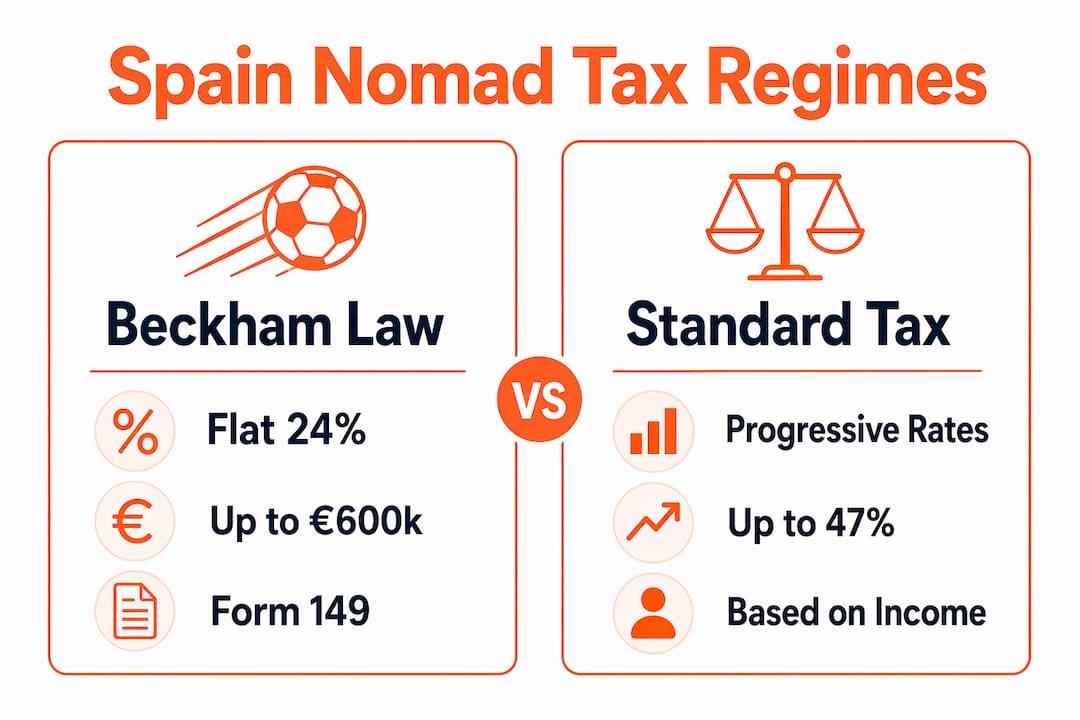
The Beckham Law is not automatic. You must file Form 149 with the Agencia Tributaria within six months of your NIE or TIE issuance date. Once elected, you file your annual Spanish tax return on Form 151 rather than the standard Form 100. The regime lasts for the tax year of your arrival plus five additional tax years, giving you up to six years of favorable treatment.
Social security contributions are a separate cost that many nomads underestimate. Self-employed digital nomads registered under Spain’s autónomo system pay monthly contributions that vary based on their declared income level. The U.S.–Spain totalization agreement can provide relief, but it requires advance planning before you establish Spanish residency.
Pro Tip: File Form 149 as soon as your NIE or TIE is issued, not when you feel settled in. The six-month clock starts on the issuance date, not your arrival date, and there is no extension.
Navigating double taxation between Spain and the U.S.

American digital nomads face a layer of complexity that most other nationalities do not. The U.S. taxes its citizens on worldwide income regardless of where they live, so moving to Spain under the digital nomad visa does not eliminate your U.S. tax obligations. It adds Spanish ones on top.
Under the Beckham Law, the picture is actually manageable for most Americans:
- Foreign-source income: Your U.S. client payments are generally exempt from Spanish tax under the Beckham Law, so you only owe U.S. tax on that income. No Spanish credit is needed because Spain does not tax it.
- Spanish-source income: If you earn income from Spanish clients (up to the 20% visa cap), Spain taxes it at 24%. You can claim a Foreign Tax Credit (FTC) on your U.S. return for Spanish taxes paid on that income, reducing your U.S. liability dollar for dollar.
- Foreign Earned Income Exclusion (FEIE): The FEIE lets qualifying Americans exclude a portion of foreign earned income from U.S. tax. Under the Beckham Law, however, you are technically treated as a non-resident for Spanish tax purposes, which creates complications for FEIE eligibility. Consult a U.S. tax professional before assuming the FEIE applies cleanly to your situation.
- Social security: The U.S.–Spain totalization agreement can exempt American remote workers from Spanish social security contributions for a limited period if they obtain a certificate of coverage from the Social Security Administration before establishing Spanish residency. Without that certificate, you may end up paying into both systems.
- Modelo 720: Even under the Beckham Law, Spain requires you to file Modelo 720 if your foreign assets exceed €50,000. This declaration covers foreign bank accounts, securities, and real estate. Non-compliance carries serious penalties.
Under the standard IRPF regime, the U.S.–Spain tax treaty provides a framework for avoiding double taxation through credits and exemptions, but the mechanics are more complex and the overall tax burden is higher. Most American nomads who qualify for the Beckham Law find it the cleaner and cheaper path.
What you need to qualify for the Spain digital nomad visa
The digital nomad visa is governed by Law 14/2013 on support for entrepreneurs and their internationalization, as updated for the 2026 application cycle. The core eligibility requirements for non-EU nationals are:
- Minimum income: You must earn at least twice Spain’s minimum interprofessional wage to qualify. This threshold is reviewed periodically by the government. Passive income, freelance revenue, and employment income all count, but you must document it consistently.
- Remote work requirement: Your work must be performed remotely for employers or clients based outside Spain. No more than 20% of your total income can come from Spanish sources.
- Employment or self-employment proof: Employed applicants need a contract with a non-Spanish company that has been in operation for at least one year. Freelancers need contracts or invoices from non-Spanish clients covering at least the past three months.
- Private health insurance: Valid health coverage in Spain is required from the date of application, not just from arrival. A policy from a recognized international insurer with no copayments is the standard requirement.
- Clean criminal record: A background check from your home country and any country where you have lived in the past five years is required.
- No prior Spanish residency in the last five years: This is also the Beckham Law eligibility threshold, so it applies to both the visa and the tax regime.
Application steps:
- Gather documents: passport, income proof, health insurance policy, criminal record certificate, and employment or client contracts.
- Apply at the Spanish consulate in your home country, or apply from within Spain if you are already there on a tourist visa.
- Receive your visa (typically valid for one year initially) and travel to Spain.
- Register your address with your local town hall (empadronamiento) within 30 days of arrival.
- Apply for your TIE (Tarjeta de Identidad de Extranjero) residence card at the nearest National Police station.
- Obtain your NIE (Número de Identificación de Extranjero) if you have not already done so.
- Register with the Agencia Tributaria and, if self-employed, register as autónomo with Spain’s social security system.
- File Form 149 within six months of NIE/TIE issuance to elect the Beckham Law.
For a detailed breakdown of the 2026 visa requirements and documents, the process differs slightly depending on whether you apply from a U.S. consulate or from within Spain.
How to decide between the Beckham Law and the standard tax regime
Choosing between the Beckham Law and Spain’s standard IRPF regime is the single most consequential financial decision you will make as a digital nomad in Spain. The difference can affect your overall tax liability by 10–25 percentage points, and the election is not automatic. Failing to file the required paperwork means you default into worldwide taxation at progressive rates.
Who qualifies for the Beckham Law?
- You have not been a Spanish tax resident in the five years prior to your move.
- You are relocating to Spain for work purposes, including remote work under the digital nomad visa.
- You file Form 149 within six months of your NIE or TIE issuance.
When the Beckham Law is clearly the better choice
For most American digital nomads earning primarily from U.S. clients, the Beckham Law wins on almost every metric. Your foreign-source income is exempt from Spanish tax, your Spanish-source income (capped at 20% of total) is taxed at a flat 24%, and you avoid the complexity of progressive IRPF brackets on worldwide income. A freelancer earning $150,000 annually from U.S. clients, with minimal Spanish-source income, could owe little to no Spanish income tax on the bulk of their earnings under the Beckham Law.
When the standard regime might make more sense
If your income is primarily from Spanish clients and exceeds the 20% visa cap, you are already in a gray area regarding visa compliance. In that scenario, the Beckham Law’s foreign income exemption provides less benefit, and a tax advisor may recommend restructuring your client base rather than choosing between regimes.
The deadline is the critical variable
Missing the six-month Form 149 filing window after NIE/TIE issuance irrevocably forfeits Beckham Law access for that entire six-year period. There is no appeal, no extension, and no workaround. Many nomads miss it simply because they did not know the clock started on the issuance date, not their arrival date.
Pro Tip: Book a tax consultation before you land in Spain, not after. A specialist who understands both U.S. and Spanish tax law can map out your specific income profile, confirm Beckham Law eligibility, and prepare Form 149 so it is ready to file the day your TIE arrives.
For long-term planning that extends beyond the six-year Beckham Law window, consider how your tax situation changes when you revert to standard IRPF. Some nomads use the six-year period to restructure their income, build savings, or explore other residency pathways. Consulting a firm that handles both immigration and residency planning alongside tax strategy gives you a more complete picture before you commit.
Key Takeaways
The Beckham Law is the single most powerful tax tool available to non-EU digital nomads in Spain, but it requires timely action and careful planning to access.
| Point | Details |
|---|---|
| Beckham Law flat rate | A 24% flat rate applies to Spanish-source income up to €600,000; foreign income is generally exempt. |
| Tax residency trigger | Spending more than 183 days in Spain subjects you to worldwide income taxation under standard IRPF. |
| Form 149 deadline | You must file Form 149 within six months of NIE/TIE issuance to elect the Beckham Law; missing it forfeits the regime. |
| Modelo 720 obligation | Foreign assets exceeding €50,000 must be declared via Modelo 720, even under the Beckham Law regime. |
| Digitalnomadinspain support | Digitalnomadinspain guides non-EU nomads through both the visa application and the Beckham Law election process. |
The tax mistake most digital nomads make before they even land
The conventional wisdom in most digital nomad communities is that the Beckham Law is a straightforward perk you pick up automatically when you get your visa. It is not. The Beckham Law is an opt-in regime with a hard deadline, specific eligibility criteria, and a filing process that requires navigating the Agencia Tributaria in Spanish. The number of remote workers who arrive in Spain, get their TIE, spend a few months settling in, and then discover they missed the six-month window is genuinely high.
What makes this worse is that the consequences are not just financial. Missing the Beckham Law election does not just mean paying more tax for one year. It means paying standard IRPF rates on your worldwide income for the entire duration of your stay, potentially for years. A freelancer earning $120,000 annually could face an effective Spanish tax rate well above 30% instead of the 24% flat rate, on top of their U.S. obligations.
The other underappreciated issue is the interaction between the Beckham Law and U.S. tax strategy. The Foreign Earned Income Exclusion and the Foreign Tax Credit work differently under the Beckham Law than under standard IRPF, and the wrong choice between them can create unexpected U.S. tax liability. This is not a situation where generic online advice is sufficient. The nomads who come out ahead are the ones who get country-specific, income-specific advice before they file anything.
The visa strategy and the tax strategy need to be planned together, not sequentially. Your income source mix, your client contracts, your arrival date, and your NIE timeline all feed into the Beckham Law election. Treating them as separate processes is how people end up with avoidable tax bills.
Digitalnomadinspain makes the visa and tax process straightforward
Getting the Spain digital nomad visa right the first time means more than just submitting the correct documents. It means arriving with a tax plan already in place, knowing exactly when to file Form 149, and understanding how your U.S. obligations interact with Spanish law from day one.

Digitalnomadinspain offers end-to-end support for non-EU remote workers navigating both the visa application and the Beckham Law election process. With a 98% visa success rate and processing times typically 30% faster than self-applicants, the team handles document preparation, consulate follow-up, TIE registration, and tax residency setup so you can focus on your work. Clients from over 50 countries have used the service to secure Spanish residency without the paperwork headaches. If you are ready to move forward, book a consultation to get a personalized assessment of your eligibility and tax position before you commit to a timeline.