
US applicants: expect a $140 to $190 consular fee plus separate euro charges. Learn how to confirm your consulate's exact fee, payment method, and proof...
US Applicants: Confirm Spain Visa Fees ($140 to $190) Before You Pay

U.S. applicants should budget roughly $140 to $190 for the consular visa fee on Spain’s Digital Nomad or Non-Lucrative visa, plus smaller euro-denominated charges from Spanish authorities once your file moves forward. The exact number depends entirely on which consulate covers your state, so the one action that matters right now is pulling up your consulate’s fee page and confirming the amount and payment method before you show up to your appointment.
TL;DR:
- U.S. visa applicants need to confirm the specific consulate fee, which ranges from $140 to $190, as there is no uniform national amount.
- After paying the USD consular fee, applicants must budget an additional approximately €73.26 in euros for the UGE authorization fee to avoid missed payments.
- Applicants should factor in possible extra costs for apostilles, translations, background checks, and appointment services, which can surpass government fees in total.
- Proper payment via the correct Form 790 subcode and accurate payee name is crucial, as errors here cause processing delays and often require resubmission.
- Visa fees are generally non-refundable, so applicants must verify current rates and payment procedures before payment to prevent costly mistakes.
Table of Contents
- How Much Are Spain Visa Fees for US Citizens?
- What Else Should You Budget Beyond Government Fees?
- How Do You Pay Spain Visa Fees Without Getting Rejected?
- How Do You Confirm Your Exact Consulate Fee?
- Why Professional Review Catches Fee Errors Self-Applicants Miss
- How Long Are Spain Visa Fees Valid, and When Do They Change?
- What Happens to Your Visa Fee If Your Application Is Denied or Withdrawn?
- What the Fee Numbers Actually Tell You
- Get Your Consulate’s Exact Fee Confirmed Before You Pay
- Sources
- FAQ
How Much Are Spain Visa Fees for US Citizens?
The consular fee is the biggest single line item, but it’s not the only one. Three separate government charges apply at different stages of the process, and they don’t all go to the same place or get paid in the same currency.
Consular visa fee. This is what you pay when you submit your application at the Spanish consulate covering your state. It runs $140 to $190 depending on reciprocity arrangements and the specific consulate. The Miami consulate lists $190 for Americans effective 2025, while other consular districts publish different figures in their own fee tables. There’s no single national number, which is the whole reason to check your specific consulate rather than trust a generic figure from a forum post.
UGE authorization fee. Once your application reaches the Unidad de Grandes Empresas (the office that processes digital nomad residence authorizations), you’ll pay a separate fee in euros. Recent procedures list this around €73.26 for the initial authorization, paid electronically as part of your submission. You need proof of this payment before the file can move forward.
TIE and NIE police fees. After you land in Spain, you’ll pay small, fixed amounts to get your physical residency card and foreigner identification number. These typically run around €16.08 for a first-issue TIE, €19.30 for a renewal, and €9.84 for NIE assignment. These are governed by nationally published fee headings under Spanish ministerial orders, including the fee schedule set out in Orden PJC/617/2025.
Here’s how the pieces stack up:
- Consular visa fee: $140 to $190, paid in USD at your U.S. consulate
- UGE authorization fee: approximately €73.26, paid electronically to Spanish authorities
- TIE first issue: approximately €16.08, paid in Spain
- TIE renewal: approximately €19.30, paid in Spain
- NIE assignment: approximately €9.84, paid in Spain
The number that trips people up most: the consular fee is charged in USD, but every fee after it is charged in euros. If you show up expecting one currency and one payment window, you’ll miss a step. Budget for both currencies and two separate payment moments, not one lump sum.
What Else Should You Budget Beyond Government Fees?
Government fees are the easy part to plan for because they’re published. The costs that catch people off guard are the third-party expenses that don’t show up on any consulate fee schedule but are required to build a complete application.
Private health insurance is usually among the larger recurring costs. Insurers eligible for Spanish visa purposes often price full coverage, no-copay policies at a moderate monthly rate, and the policy must come from an insurer authorized to operate in Spain. A U.S. travel medical plan won’t satisfy this requirement no matter how comprehensive it looks on paper.
Budget for these recurring extras:
- Apostilles: approximately $20 per document through the U.S. Department of State, plus any applicable state-level apostille fee
- FBI background check: the background check itself is inexpensive, but expediting services typically charge a modest fee
- Sworn translations: moderate per-document fees apply, required for anything not originally issued in Spanish; a certified translation service can confirm which of your documents actually need this step
- Appointment or booking service fees: some consulates route scheduling through third-party platforms that may charge a small convenience fee
Translation costs especially tend to run higher than initial quotes once a translator sees your actual document count.*
How Do You Pay Spain Visa Fees Without Getting Rejected?
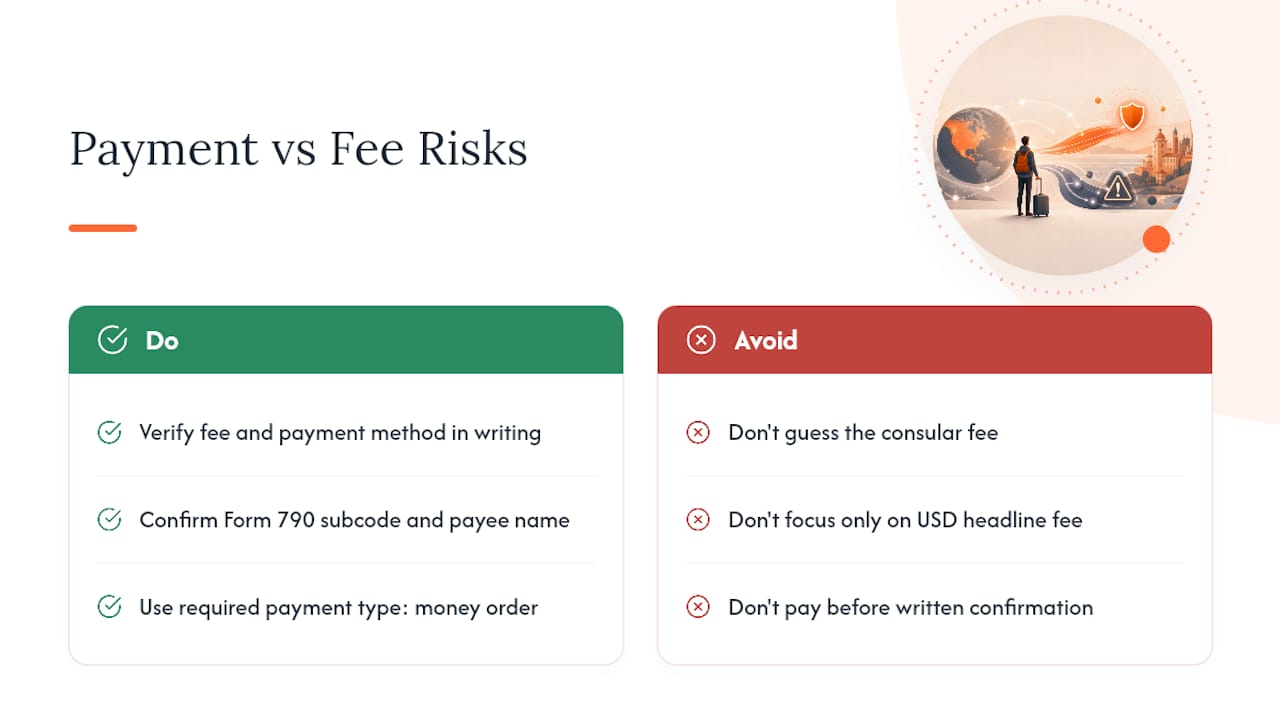
Most consulates route payment through Spain’s Form 790, but the subcode matters. Model 790-052 typically applies to the visa application fee itself, while 790-038 shows up at a different stage of the residence authorization process. Using the wrong code doesn’t just cause confusion. It can mean your payment gets recorded against the wrong authorization entirely, forcing you to start the payment process over.
Accepted payment methods vary by consulate. Miami requires a money order made out to the Consulate of Spain, while other consulates accept bank deposits or generate an online reference number (NRC) for electronic payment. Follow your consulate’s exact wording. A personal check when a money order is required, or a payment made to the wrong payee name, is one of the most common reasons applications stall.
Before your appointment, confirm you have:
- The correct fee amount in the correct currency
- Proof of payment (receipt, stamped money order copy, or NRC confirmation)
- The exact payee name as listed on your consulate’s instructions
- A backup copy of your payment reference number, saved separately from the physical receipt
How Do You Confirm Your Exact Consulate Fee?
Spain assigns each U.S. state to a specific consular district, and each consulate publishes its own “tasas” or fee page. Search your consulate’s name plus “tasas” or “visa fees” to find the current PDF, like the fee table Miami publishes for its district.
Look specifically for a line mentioning “United States” or “Americans” with a dollar figure or explicit payment instruction. If the page is vague, email or call and ask this exact question: “What is the current visa fee for U.S. citizens, and what payment method do you require?”
- Screenshot the fee page the day you check it
- Print the PDF and keep it with your application documents
- Save any payment reference or NRC number in a separate note, not just in your inbox
Pro Tip: Consulate fee pages get updated without much notice. If your appointment is more than a few weeks out, recheck the page the week before rather than trusting a screenshot from months earlier.
Why Professional Review Catches Fee Errors Self-Applicants Miss
Fee mistakes are rarely about the applicant not caring. They’re about not knowing which of three different payment systems applies to their specific consulate and visa stage. Visa consultants verify the exact consular fee line and payment method for applicants before submission, rather than relying on a generic figure that may not match the reader’s district.
Clients working with Digitalnomadinspain report a 98% success rate and processing roughly 30% faster than applicants who file solo, largely because payment errors and missing documentation get caught before they become rejections. That gap matters most for applicants with dependents, self-employment income across multiple sources, or a consulate whose instructions are genuinely ambiguous. A straightforward single-applicant case may not need it. A file with three moving pieces usually benefits.
How Long Are Spain Visa Fees Valid, and When Do They Change?
The fee you pay is tied to your specific application window, not a fixed calendar period. Once you pay the consular fee and submit your application, that payment covers your case through the decision. It doesn’t expire on a set schedule the way a passport does.
What does change is the published rate itself. Consular fees can shift when reciprocity arrangements between the U.S. and Spain are renegotiated, or when a consulate updates its fee table for a new fiscal year. The euro-denominated fees, like the UGE authorization charge and TIE/NIE fees, follow Spain’s own fee headings, which get revised through ministerial orders published in the Boletín Oficial del Estado (BOE). These updates don’t happen on a predictable annual cycle. They happen when the government decides to adjust the fee schedule, which can mean a gap of several years between changes or a revision with little advance warning.
The practical takeaway: don’t rely on a fee figure you saw six months ago, and don’t assume the amount you paid on a previous visa application still applies to a renewal. Check the current consulate page or the current BOE listing at the time you’re actually preparing to pay, not when you first started researching the process.
What Happens to Your Visa Fee If Your Application Is Denied or Withdrawn?
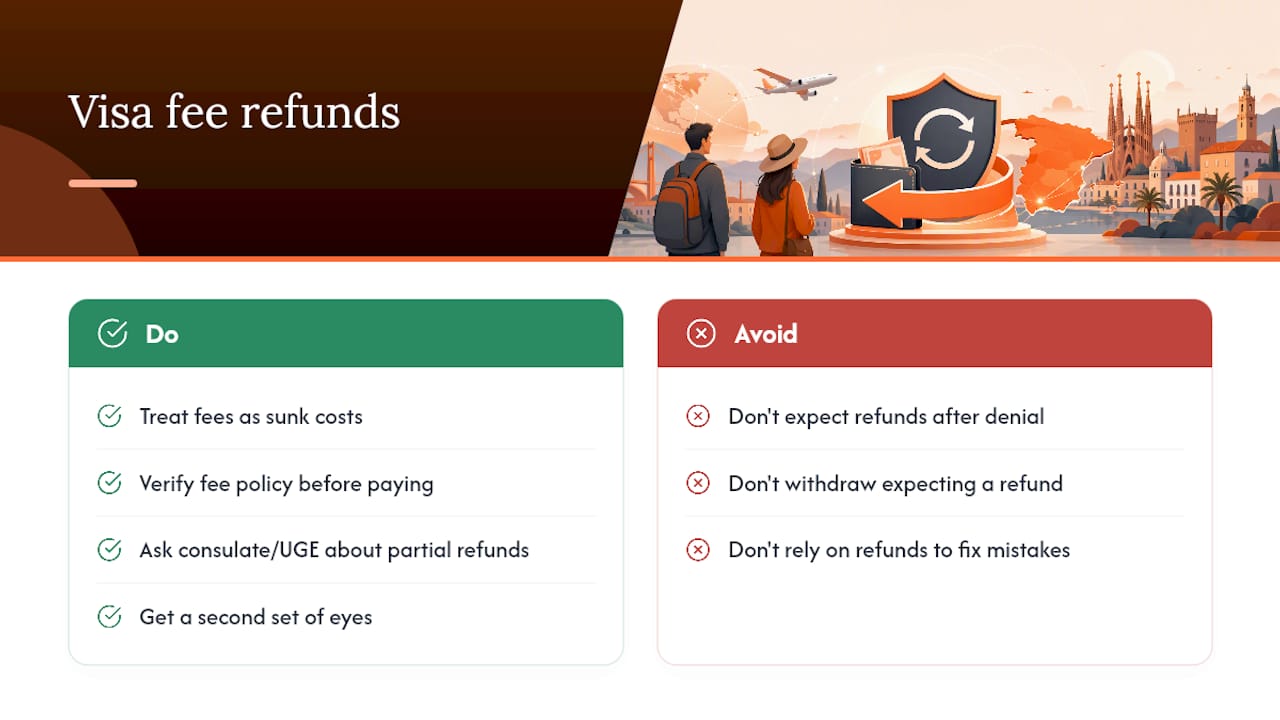
Consular visa fees are generally non-refundable once submitted, regardless of the outcome. This is standard across most consulates and mirrors how visa fees work in most countries: the fee covers the cost of processing and reviewing your case, not a guarantee of approval.
If your application is denied, the consular fee stays with the consulate. Some of the smaller Spain-side fees, like the UGE authorization charge, may follow a different path depending on the stage at which the denial occurs. If the fee was paid before a final decision was reached, ask your consulate or the UGE processing office directly whether any partial refund applies to your specific case, since policies can vary by fee type and by the point in the process where things stopped.
If you choose to withdraw your own application before a decision is made, don’t assume you’ll get anything back either. Withdrawal typically doesn’t trigger a refund of fees already paid, since the processing work has usually already started.
The safest approach is to treat every fee as a sunk cost the moment you pay it, and to make sure your application is complete and accurate before you submit, rather than planning to fix problems after the fact. This is also where a second set of eyes on your documents, whether from a consultant or a thorough personal review, pays for itself: catching an eligibility gap before you pay is far cheaper than discovering it after.
What the Fee Numbers Actually Tell You
The consular fee gets all the attention because it’s the number people search for, but it’s rarely the number that sinks an application. The real risk sits in the payment mechanics: the wrong Form 790 subcode, a personal check where a money order was required, a payment made to a payee name that doesn’t match the consulate’s exact wording. Those are the errors that cost people weeks, not the $50 difference between one consulate’s fee and another’s.
Conventional advice treats the fee question as a lookup problem: find the number, pay it, move on. That undersells how much the euro-denominated fees, especially the UGE charge and the TIE/NIE fees, get overlooked by applicants fixated on the USD figure they saw first. Insurance costs and translation fees usually add up to more than every government fee combined, a pattern borne out by cost breakdowns from relocation guides covering the full visa budget.
If you take one thing from this article, verify your consulate’s exact fee and payment method in writing before you pay anything. Everything else, the euro fees, the insurance shopping, the translation quotes, can be planned around a firm number. Guessing at the consular fee is the one mistake that’s entirely avoidable and still shows up constantly.
— Joshua
Get Your Consulate’s Exact Fee Confirmed Before You Pay
Chasing down the right fee page, the right Form 790 subcode, and the right payee name across dozens of U.S. consular districts is tedious work, and one wrong detail can cost you weeks of resubmission. Some visa document preparation and consultation services check your specific consulate’s fee line and payment instructions against your case before you send a single dollar, so you’re not guessing which subcode or currency applies to your district.

That verification step is exactly what closes the gap between a self-filed application and one reviewed by someone who checks the payment mechanics daily. If you’re applying for the Digital Nomad Visa or the Non-Lucrative Visa, book a consultation to get your fee schedule and document list confirmed before your appointment date, not after.
This article is general information, not a substitute for advice from a qualified lawyer. Consult a qualified legal professional about your own circumstances before acting on anything here.
Sources
- Exteriores
- BOE — Orden PJC/617/2025 (fees for immigration/residence procedures)
- Application: digital nomad visa — ONE (Large Companies and Strategic Groups Unit)
FAQ
How Much Is the Spain Visa Fee for Americans?
The consular fee for U.S. citizens generally runs $140 to $190, with the exact amount set by your specific consulate rather than a single national rate.
Are Spain Visa Fees Refundable if My Application Is Denied?
No. Consular visa fees are generally non-refundable whether your application is approved, denied, or withdrawn, since the fee covers processing rather than guaranteeing approval.
Do Fees Differ if I Apply From Spain Instead of the US?
Yes. Applying from within Spain follows a different residence authorization process with different fee lines than applying through a U.S. consulate, so the USD reciprocity fee discussed here applies specifically to applications filed from the United States.
What Proof of Payment Do I Need to Bring to My Appointment?
Bring your original receipt, money order stub, or NRC confirmation number, along with a backup copy saved separately, since a missing receipt is one of the most common reasons consulates ask applicants to reschedule.
Can a Visa Consultant Help Me Avoid Fee Payment Mistakes?
Yes.