
Discover what details your doctor needs for the Spain visa medical certificate. Ensure a smooth application process for your long-stay visa!
Spain Visa Medical Certificate: What to Give Your Doctor

The Spain visa medical certificate is a signed, stamped letter from a licensed physician confirming you have no diseases that could pose serious public-health risks under the International Health Regulations (2005). You need it for any long-stay national visa (stays over 90 days), and it must be issued within 3 months of your application date. Short Schengen stays generally require only travel health insurance, not a medical certificate.
Here is what you need at a glance:
- Certificate signed and stamped by an MD or DO, with “MD” or “DO” written next to the signature
- Wording that explicitly references the International Health Regulations (2005)
- Issued shortly before your visa application date
- Original plus one photocopy for the consulate
- Sworn translation into Spanish if the certificate is not issued in Spanish
Pro Tip: Print the official consulate template PDF and hand it directly to your doctor at the appointment. Physicians who have never issued one of these before will follow the template exactly, which eliminates the most common rejection reason: missing IHR 2005 language.
Table of Contents
- What the medical certificate must say and why the wording is legally required
- Where to find the official template and what to download
- Exact sample wording and the fields your doctor must fill in
- How to get the certificate in the United States: a step-by-step guide
- Translation and legalization: what U.S. applicants need to know
- What to bring to your visa appointment and how consulates handle your documents
- Common reasons medical certificates get rejected and how to fix them
- Practical tips from visa specialists for U.S. applicants
- Key Takeaways
- The part most applicants get wrong
- Digitalnomadinspain handles the paperwork so you can focus on the move
- FAQ
What the medical certificate must say and why the wording is legally required
The certificate’s language is not a formality. Spanish consulates are looking for one specific legal reference: the International Health Regulations of 2005, the WHO framework that defines which communicable diseases qualify as serious public-health threats. A certificate that says “the patient is in good health” without citing IHR 2005 will be rejected, even if the physician’s assessment is thorough and accurate.
The Non-Lucrative Visa and the Digital Nomad Visa both require this certificate for the initial national visa submission. Applicants rarely need to resubmit it during later residency steps inside Spain, so getting it right the first time matters.
Key legal requirements at a glance:
- The certificate must confirm absence of diseases with serious public-health repercussions as defined by the IHR 2005
- It applies to national visas; Schengen short-stay visas do not require it
- Validity window: certificate must be issued no more than three months before your visa application submission date
- Physician must be a licensed MD or DO; the consulate will not accept certificates from nurse practitioners or physician assistants acting alone
Where to find the official template and what to download
Every Spanish consulate in the United States publishes its own medical certificate template. The Los Angeles and San Francisco consulates both post downloadable PDFs directly on the exteriores.gob.es domain. These templates include the exact sample sentence, a reference list of relevant diseases, and fields the physician must complete.

Because requirements can vary slightly by jurisdiction, always pull the template from your specific consulate’s website rather than a third-party copy. A template from the Houston consulate may differ in small ways from the one used in Miami or New York.
| Consulate | Template location | Notes |
|---|---|---|
| Los Angeles | exteriores.gob.es (Los Angeles PDF) | Includes sample wording and disease list |
| San Francisco | exteriores.gob.es (San Francisco PDF) | Specifies wet-ink stamp or letterhead |
| Houston | exteriores.gob.es (Houston page) | Lists template for non-lucrative visa |
| Miami / New York | Check local consulate page | Confirm template before appointment |
Official consulate templates are designed for electronic transmission and printing on official letterhead. A physician’s own certificate is acceptable only if it contains every required field and the exact IHR 2005 language.
Pro Tip: Download the BLS Spain visa checklist for your consulate alongside the medical certificate template. The checklist confirms which documents must accompany the certificate at submission, so you are not caught off guard at the appointment.
Exact sample wording and the fields your doctor must fill in
The sentence consulates expect looks like this in English:
In Spanish (as used in official templates):
Both versions are acceptable depending on the consulate’s language preference. If the certificate is in English, a sworn translation will be required (covered in the next section).
Required fields checklist:
- Patient’s full name exactly as it appears in the passport
- Physician’s full name and license number
- Physician’s signature with “MD” or “DO” written next to it
- Date and place of examination
- Official clinic stamp (wet-ink) or clinic letterhead with printed address
- The IHR 2005 sentence above, verbatim or very close to it
- Statement excluding drug addiction and serious psychiatric disorders
- Clinic contact details if no stamp is used
Pro Tip: If your doctor refuses to use a wet-ink stamp (common in U.S. practices), ask for the certificate on official clinic letterhead with the physician’s license number and clinic phone number printed on it. The San Francisco consulate explicitly accepts this as an alternative.
How to get the certificate in the United States: a step-by-step guide
Getting this document in the U.S. is straightforward once you know what to ask for. The challenge is that most American physicians have never issued a Spanish consulate medical certificate, so you need to walk them through it.
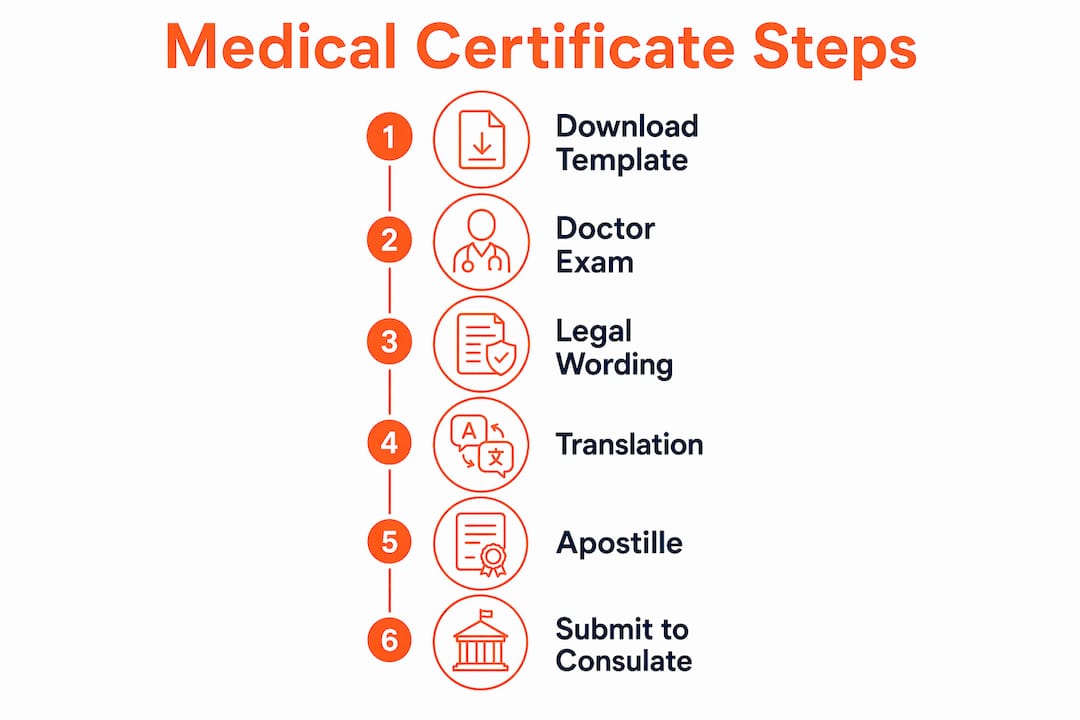
- Download your consulate’s template. Go to your specific consulate’s page on exteriores.gob.es and save the PDF. Print two copies.
- Book a general physical or wellness exam. Travel clinics, private urgent care centers, and international health clinics are the most reliable options. Your regular primary care physician works too, as long as they are an MD or DO.
- Bring to the appointment: your passport (or a clear copy), the printed consulate template, a list of any current medications, and your visa appointment confirmation if you have it.
- Hand the template to the doctor before the exam begins. Ask them to use the template’s exact wording and to sign with their MD/DO designation next to their name.
- Before you leave the clinic, check every field. Confirm the stamp is present (or letterhead is used), the IHR 2005 sentence is included, and your name matches your passport exactly.
- Request a second copy on the spot. You need the original plus one photocopy for the consulate. Having the clinic print a second copy while you are there saves a trip back.
Documents to bring to the appointment:
- Printed consulate template (two copies)
- Passport or clear photocopy
- List of current medications
- Visa appointment confirmation
On timing: schedule the exam to allow enough time to get a sworn translation and apostille (if needed) while staying inside the validity window. Cutting it to the last two weeks is the most common timing mistake applicants make.
Pro Tip: Give the doctor this exact phrase: “I need a medical certificate for a Spanish long-stay visa. It must reference the International Health Regulations of 2005 and confirm I have no diseases with serious public-health repercussions, no drug addiction, and no serious psychiatric disorders.” Most physicians will complete it correctly when the request is that specific.

Translation and legalization: what U.S. applicants need to know
A certificate issued in English must be accompanied by a sworn translation (traducción jurada) into Spanish before the consulate will accept it. A standard translation from a bilingual friend or a generic translation service is not sufficient. The translation must be certified by a sworn translator recognized by the Spanish authorities.
Because the certificate is issued in the United States, it may also require a Hague Apostille before the sworn translation is attached. Check your specific consulate’s checklist to confirm whether an apostille is required for your visa type.
Practical flow for U.S. applicants:
- Get the original certificate from your physician
- Check your consulate’s checklist for apostille requirements
- If required, obtain an apostille through your state’s Secretary of State office
- Hire a sworn translator (translator jurado) to translate the apostilled certificate into Spanish
- Assemble: original certificate + apostille (if required) + sworn Spanish translation + one photocopy
On costs and timing: apostilles from a U.S. Secretary of State office typically take 5–15 business days by mail, though many states offer expedited processing. Sworn translations from a certified translator generally take 2–5 business days. Budget at least three weeks for the full chain if you are starting from scratch.
Pro Tip: Hire the sworn translator before you get the apostille so you can confirm the translator’s format requirements. Some translators prefer to work from the apostilled original; others can work from a certified copy. Knowing this in advance prevents a second apostille request.
What to bring to your visa appointment and how consulates handle your documents
The San Francisco consulate and other U.S. consulates follow a standard practice: they accept the original medical certificate and a photocopy, keep the copy for processing, and typically seal and return the original to you. That sealed original may be needed when you register for residency inside Spain, so keep it safe.
Documents to submit at the appointment:
- Original medical certificate (with apostille and sworn translation if required)
- One photocopy of the complete certificate package
- Proof of health insurance (coverage of at least €30,000 for national visa applicants)
- Valid passport and copies
- Completed visa application form
- Payment receipt for the visa fee
- Any additional documents listed on your specific consulate’s checklist
| Document | Original required | Copy required |
|---|---|---|
| Medical certificate | Yes | Yes |
| Health insurance proof | Yes | Yes |
| Passport | Yes | Yes (photo page) |
| Visa application form | Yes | No |
| Payment receipt | Yes | No |
Organize documents in the order your consulate’s checklist specifies. Consulate staff process dozens of applications per day; a well-organized packet moves faster. For applicants pursuing the Digital Nomad Visa, the document bundle is nearly identical, with the medical certificate sitting alongside proof of remote income and health insurance.
Common reasons medical certificates get rejected and how to fix them
Most rejections come down to a handful of avoidable errors. Knowing them in advance means you can catch problems at the clinic before they become problems at the consulate.
Common mistakes:
- Missing IHR 2005 reference: the most frequent rejection reason, even when the physician’s assessment is otherwise complete
- No stamp and no letterhead: the certificate has no way to verify the issuing clinic
- Name mismatch: the patient name on the certificate does not match the passport exactly
- Expired certificate: issued more than three months before your visa application submission date
- Handwritten corrections: cross-outs or written-in changes made after the original was signed
If you discover an error after leaving the clinic, there is only one fix: return to the original physician. Only the examining physician is authorized to revise, add, or remove information. The consulate will not accept corrections made by anyone else, including a different doctor at the same practice.
Remediation steps if you find an error:
- Contact the original clinic immediately and explain you need a corrected certificate for a Spanish visa application.
- Bring the consulate template to the reissue appointment so the physician can verify the correct wording.
- If the corrected certificate pushes you past your original translation timeline, contact your sworn translator to expedite.
- If the error causes you to miss your visa appointment, call the consulate to rebook. Most U.S. consulates will accommodate a short delay when the reason is a document correction.
Practical tips from visa specialists for U.S. applicants
A few habits separate applicants whose certificates sail through from those who end up back at the clinic.
- Pre-check before you leave. Before walking out of the physician’s office, read the certificate against the consulate template line by line. Check the IHR 2005 sentence, the stamp or letterhead, and the name spelling.
- Keep the original sealed and accessible. Once the consulate returns your sealed original, store it with your passport. You may need it at the Spanish border or when applying for your TIE card.
- Hire a sworn translator early. Book the translator before your medical appointment so the translation is ready within days of getting the certificate. Waiting until after the exam adds unnecessary delay.
- Same-day certificates are available. Some travel clinics and private urgent care centers in major U.S. cities can issue the completed certificate the same day. Expect to pay a premium, but it is worth it if you are working against a tight visa appointment window.
- Check your health insurance coverage meets the consulate’s minimum before your appointment. The medical certificate and health insurance proof are reviewed together; a gap in either document can delay the whole application.
Pro Tip: Photograph every page of the completed certificate before submitting it. If the consulate loses a page or questions a detail, you have a clear reference copy that does not depend on the clinic’s records.
Key Takeaways
The Spain visa medical certificate must reference the International Health Regulations (2005), carry a physician’s stamp or clinic letterhead, and be issued no more than three months before your visa application submission date.
| Point | Details |
|---|---|
| IHR 2005 wording is mandatory | Omitting the exact IHR 2005 reference is the leading cause of certificate rejection. |
| 3-month validity window | The certificate must be issued no more than three months before your visa application submission date. |
| Sworn translation required | Certificates not in Spanish need a sworn translation (traducción jurada) before submission. |
| Original plus copy at appointment | Bring both; the consulate keeps the copy and typically seals and returns the original. |
| Digitalnomadinspain document support | Digitalnomadinspain reviews templates, coordinates sworn translations, and prepares the full document bundle for U.S. applicants. |
The part most applicants get wrong
The medical certificate feels like a minor checkbox in a long application list, and that is exactly why it trips people up. Applicants spend weeks gathering financial statements and insurance policies, then hand the doctor a blank sheet of paper and say “I need a health letter for a visa.” The doctor writes something reasonable and medically accurate. The consulate rejects it because it does not say “International Health Regulations of 2005.”
What actually works is treating the certificate like a legal form, not a clinical note. The physician’s job is to sign and stamp a document with specific prescribed language, not to write a free-form assessment. When you frame it that way at the appointment, the whole process takes about 15 minutes.
The other thing worth saying plainly: the certificate must be issued no more than three months before your visa application submission date. Factor in the apostille (up to two weeks), the sworn translation (up to a week), and any back-and-forth with the clinic, and you can easily burn six weeks before the certificate is ready to submit. Book the medical exam the same week you book your visa appointment slot, not after.
Digitalnomadinspain handles the paperwork so you can focus on the move
Getting the medical certificate right is one piece of a larger document puzzle that includes health insurance proof, financial statements, and consulate-specific checklists. For applicants who want every document reviewed before submission, Digitalnomadinspain offers end-to-end preparation for both the Digital Nomad Visa and the Non-Lucrative Visa, including template verification, sworn translation coordination, and consulate submission support.

The team works with applicants from over 50 countries and carries a 98% success rate, which comes directly from catching the small errors (missing stamps, wrong name formats, expired certificates) before they reach the consulate. If you are ready to confirm your eligibility and get your document checklist, check your visa eligibility and book a consultation with the team.
FAQ
Does every Spain visa require a medical certificate?
No. The medical certificate is required for national visas (stays over 90 days), such as the Non-Lucrative Visa and Digital Nomad Visa. Short-stay Schengen visas under 90 days generally require only travel health insurance.
How long is the Spain visa medical certificate valid?
The certificate must be issued no more than three months before your visa application submission date. A certificate issued earlier than that window will be rejected regardless of its content.
Can any doctor issue the certificate, or does it need to be a specialist?
Any licensed MD or DO can issue it. The physician must sign with their MD or DO designation next to their name and provide either a wet-ink stamp or clinic letterhead with their license number and contact details.
What happens if my doctor made an error on the certificate?
Return to the original examining physician for a corrected certificate. Only that physician is authorized to revise the document. The consulate will not accept corrections made by a different doctor or handwritten changes.
Do I need a sworn translation if my certificate is in English?
Yes. Certificates not issued in Spanish must be accompanied by a sworn translation (traducción jurada) into Spanish. Depending on your consulate’s requirements, you may also need a Hague Apostille before the translation is attached.