
Navigate Spanish administration with ease in 2026! Essential guide for US expats on visas, documents, and key steps for a smooth transition.
How Spanish public administration works for US remote workers and retirees
Spain’s public administration is a multi-layered system spanning central government, 17 autonomous communities, and thousands of municipalities. For US-based remote workers and retirees, the entry point is administracion.gob.es, the official Spanish General Access Point, which connects to the Electronic Office (SEDE) for document submission, fee payment, and application tracking.
Two visa categories dominate for Americans relocating to Spain: the Digital Nomad Visa, designed for remote workers earning income from outside Spain, and the Non-Lucrative Visa, built for retirees and passive income earners. Both require navigating the same administrative machinery, and both demand the same foundational documents.
Quick facts before you start:
- Your NIE (Número de Identidad de Extranjero) is your tax and identity number. You need it for almost everything.
- The Padrón is your municipal registration. Without it, you cannot access public healthcare or many local services.
- The TIE (Tarjeta de Identidad de Extranjero) is your physical residency card, issued after visa approval.
- The Cl@ve digital identity system unlocks most online government services, but the initial setup requires an in-person visit.
- Appointments (citas previas) for immigration offices are scarce and disappear fast. Book early, and book often.
- Digitalnomadinspain reports a 98% visa success rate and processes applications roughly 30% faster than self-applicants.
Table of Contents
- How Spain’s digital government tools actually work for you
- Step-by-step guide to residency procedures every new arrival must complete
- Why Spain’s bureaucracy is genuinely hard for foreign residents
- How Digitalnomadinspain cuts through the complexity for you
- Remote applications and what changed after COVID-19
- Key Takeaways
How Spain’s digital government tools actually work for you
Administracion.gob.es is the front door to Spain’s public administration. From there, the Electronic Office (SEDE) lets you submit documents, track applications, and pay fees without visiting an office, provided you have a valid digital certificate or Cl@ve credentials.
The system has three government tiers: the central state (Ministerios), autonomous communities (regions like Catalonia or Andalusia), and local municipalities. Each tier manages different services, and their rules do not always align. A procedure that works one way in Madrid may run differently in Valencia. That fragmentation is the single biggest source of confusion for newcomers.
Getting your Cl@ve credentials is the unlock. Once set up, many processes move entirely online. The catch: the initial registration requires an in-person visit to a participating office. After that, you can renew digital certificates through Spain’s National Currency and Stamp Factory (FNMT) online.
Recommended digital tools and resources:
- administracion.gob.es for office searches, appointment booking, and procedure lookup
- sede.administracionespublicas.gob.es for submitting documents and tracking status
- clave.gob.es for setting up and managing your digital identity
- FNMT online portal for renewing digital certificates after initial Cl@ve setup
- sede.sepe.es for social security and employment registration
| Service | Digital Access | In-Person Required |
|---|---|---|
| NIE application | Partial (form download) | Yes (appointment) |
| Padrón registration | Partial (some cities) | Usually yes |
| TIE fingerprinting | Appointment booking only | Yes |
| Fee payment (Tasa 790-012) | Yes (with Cl@ve) | No |
| Application status tracking | Yes | No |
| Social security registration | Yes | Rarely |
| Doctor’s appointment booking | Yes (regional portals) | No |
Step-by-step guide to residency procedures every new arrival must complete
The order matters here. Each document unlocks the next, so skipping ahead creates delays.
NIE first. The NIE is your foreign identification number, and you need it before you can open a bank account, sign a lease, or pay immigration fees. You can apply from the US at a Spanish consulate, or in Spain at a Foreigners’ Office (Oficina de Extranjeros). Either way, you need a completed EX-15 form, your passport and copies, proof of reason for the NIE (your visa approval letter works), and the Tasa 790-012 fee paid in advance. The full NIE process is detailed in Digitalnomadinspain’s step-by-step NIE guide.
Padrón registration second. Visit your local town hall (Ayuntamiento) with your passport and rental contract. Some cities, including Madrid and Barcelona, allow online submission. The Padrón certificate you receive is required for your health card application and, in many regions, for the TIE appointment.
TIE application third. After visa approval, you have 30 days to apply for your TIE. Book a fingerprinting appointment through the cita previa system at your local Foreigners’ Office. Bring your passport, visa, two passport photos, Padrón certificate, and the completed EX-17 form with the Tasa 790-012 paid. The TIE card process typically takes four to eight weeks from appointment to card collection.
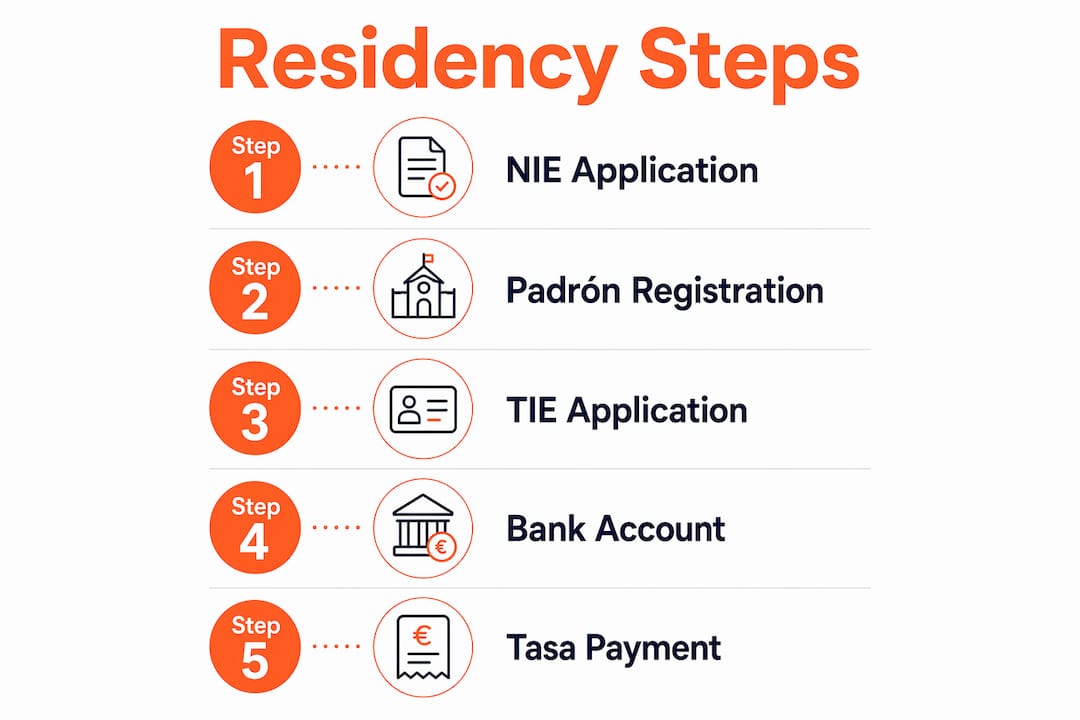
Healthcare and social security after approval. Once you have your NIE and Padrón, register for a Tarjeta Sanitaria (health card) at your local health center. Non-EU applicants on the Non-Lucrative Visa must show private health insurance until they qualify for the public system. Digital Nomad Visa holders who register as autónomos (self-employed) contribute to social security and gain access to the public system from that point.
Common pitfalls to watch:
- Regional offices interpret document requirements differently. Always verify locally, not just online.
- Appointment slots at immigration offices release unpredictably. Check the booking portal multiple times a day.
- Certified translations of US documents (birth certificates, financial statements) must come from a sworn translator recognized in Spain.
Pro Tip: The classic administrative paradox: you need a Spanish bank account to pay the Tasa 790-012 online, but banks want your NIE to open an account. Solve it by paying the fee in cash at a bank branch before your account is open, or by opening a temporary account using your passport number. Some banks, including Sabadell and BBVA, accept passport-only for initial account setup.
Why Spain’s bureaucracy is genuinely hard for foreign residents
Spain’s bureaucracy rates moderate to high in complexity, with frequent delays exceeding official processing times. That is not just expat frustration talking. The structural reasons are real.
The three-tier government system means rules fragment at every level. A document accepted at one Foreigners’ Office may be rejected at another in the same city. Regional autonomy produces variable administrative practices, and newcomers who rely on advice from other expats often find that advice is outdated or simply wrong for their municipality.
Appointment scarcity compounds everything. Immigration offices serving foreign residents operate at capacity, and cita previa slots for NIE and TIE appointments vanish within minutes of release. The digital portals are primarily in Spanish, with limited English support, which adds another layer for Americans who are not yet fluent.
A poll published by Euro Weekly News found that most foreign residents describe Spanish bureaucracy as genuinely complicated, citing heavy paperwork, inconsistency between offices, and frequent reliance on professional help. A smaller group frames it as “different rather than worse,” a fair distinction once you understand the system’s logic.
Common challenges and how to reduce their impact:
- Appointment scarcity: Use automated alert tools or check the booking portal at off-peak hours (early morning, late evening).
- Document inconsistency: Bring originals and at least three copies of everything. Offices rarely tell you in advance what they will ask for.
- Language barriers: Prepare a Spanish-language summary of your situation. Many officials will not switch to English even if they can.
- Regional variation: Verify requirements directly with your local office, not from general online guides.
- Processing delays: Submit everything digitally where possible and track status through SEDE to catch requests for additional documents early.
How Digitalnomadinspain cuts through the complexity for you
That gap between self-applicants and professionally supported ones is not surprising given the complexity above. What professional support actually changes is the error rate. A missing apostille, a translation from an unrecognized translator, or a form submitted to the wrong office can set a timeline back by months.
Digitalnomadinspain’s services cover the full arc: eligibility checks before you commit, document preparation and certified translation, appointment booking, consulate follow-up, and after-approval support including TIE card coordination and tax registration. For retirees pursuing the Non-Lucrative Visa and remote workers applying for the Digital Nomad Visa, that end-to-end coverage removes the guesswork at every stage.
The after-approval phase is where many self-applicants stumble. Knowing your visa was approved is one thing. Getting your TIE card, registering for taxes as an autónomo or under the Beckham Law, and setting up banking correctly are a separate set of procedures that require the same attention to detail as the application itself. If you want to check whether you qualify before committing to anything, the eligibility checker takes a few minutes and gives you a clear starting point.
What professional guidance specifically provides:
- Pre-application eligibility review to confirm you meet income, insurance, and documentation thresholds
- Document checklist tailored to your visa type and the specific consulate handling your application
- Certified translation coordination with sworn translators recognized in Spain
- Cita previa monitoring and booking for NIE, TIE, and consulate appointments
- Real-time application tracking and response to requests for additional documents
- Post-approval support for tax registration, healthcare enrollment, and banking setup
For citizenship by descent questions that sometimes arise alongside residency planning, Roots Recovered offers specialized support for navigating those parallel processes.
Remote applications and what changed after COVID-19
The pandemic pushed Spain’s administration to accelerate its digital infrastructure faster than it otherwise would have. Several procedures that previously required in-person visits shifted to allow digital submission, and those changes have largely held.
For US-based applicants, the most practical shift is that initial visa applications go through Spanish consulates in the US, with document submission increasingly accepted by email or secure upload rather than in-person drop-off. The consulates in Los Angeles, Miami, New York, and Chicago each handle their own regional caseloads, and processing times vary between them.
Inside Spain, the Electronic Office now handles fee payments, status tracking, and supplementary document submission entirely online. First-time applicants still need in-person appointments for biometrics and identity verification, but follow-up steps and renewals are largely digital. The Cl@ve system, which requires that one-time in-person setup, is the gateway to most of those remote capabilities.
Key Takeaways
Navigating Spanish public administration as a US remote worker or retiree requires the right documents in the right order, digital credentials set up early, and realistic expectations about appointment availability.
| Point | Details |
|---|---|
| Start with the NIE | Every subsequent step, from banking to TIE, depends on having your NIE first. |
| Get Cl@ve set up early | One in-person visit unlocks most online government services and saves repeated trips. |
| Verify locally, not online | Regional offices apply rules differently; always confirm requirements with your specific office. |
| Professional support cuts processing time | Digitalnomadinspain’s clients process applications approximately 30% faster and achieve a 98% success rate. |
| Post-approval steps matter | TIE card, tax registration, and healthcare enrollment require the same care as the visa application itself. |