Discover which Spanish consulate serves your area in the U.S. and learn how to access essential consular services efficiently.
Spanish Consulate Jurisdiction for U.S. Residents
Nine Consulates General cover the entire United States for Spanish consular services, and the rule is absolute: you must apply at the consulate whose territory includes your legal place of residence. No exceptions, no workarounds. Here are the nine offices and their general coverage:
- Boston — New England states (Massachusetts, New Hampshire, Vermont, Rhode Island, Maine)
- Chicago — Midwest states
- Houston — Texas and surrounding South-Central states
- Los Angeles — Southern California counties and nearby states
- Miami — Florida, Georgia, South Carolina
- New York — Connecticut, Delaware, New Jersey, New York, Pennsylvania
- San Francisco — Northern California, Alaska, Hawaii, and western/Pacific states
- Washington, D.C. — D.C., Maryland, Virginia, West Virginia, North Carolina
- San Juan — Puerto Rico and U.S. Caribbean territories
Key Takeaways
Your Spanish consulate jurisdiction is determined by your legal place of residence, and submitting to the wrong consulate means your application will not be accepted.
| Point | Details |
|---|---|
| Jurisdiction is mandatory | Apply only at the consulate covering your legal U.S. residence — no exceptions. |
| Nine Consulates General cover the U.S. | Boston, Chicago, Houston, Los Angeles, Miami, New York, San Francisco, Washington D.C., and San Juan each serve defined territories. |
| California splits by county | Los Angeles and San Francisco consulates divide California at the county level — check your specific county before applying. |
| BLS Spain mirrors consulate rules | If your consulate uses BLS Spain for intake, the same residency requirement applies at the BLS center. |
| Digitalnomadinspain confirms jurisdiction | The service includes a jurisdiction check, document prep, and appointment booking with a 98% application success rate. |
Table of Contents
- How does Spanish consulate jurisdiction work in the U.S.?
- Which consulate covers your U.S. state?
- How to verify your jurisdiction and submit your visa application
- What if you recently moved or are temporarily outside your jurisdiction?
- Common mistakes that cause rejections or delays
- Why this guide is reliable
- What the jurisdiction process actually looks like in practice
- Digitalnomadinspain handles jurisdiction checks so you don’t have to
- Sources
- FAQ
How does Spanish consulate jurisdiction work in the U.S.?
The determining factor is your legal place of residence, not where you work, own property, or happen to be staying. Spain’s Ministry of Foreign Affairs enforces this rule to keep application processing consistent across all nine offices. Submit outside your assigned territory and the application will not be accepted.
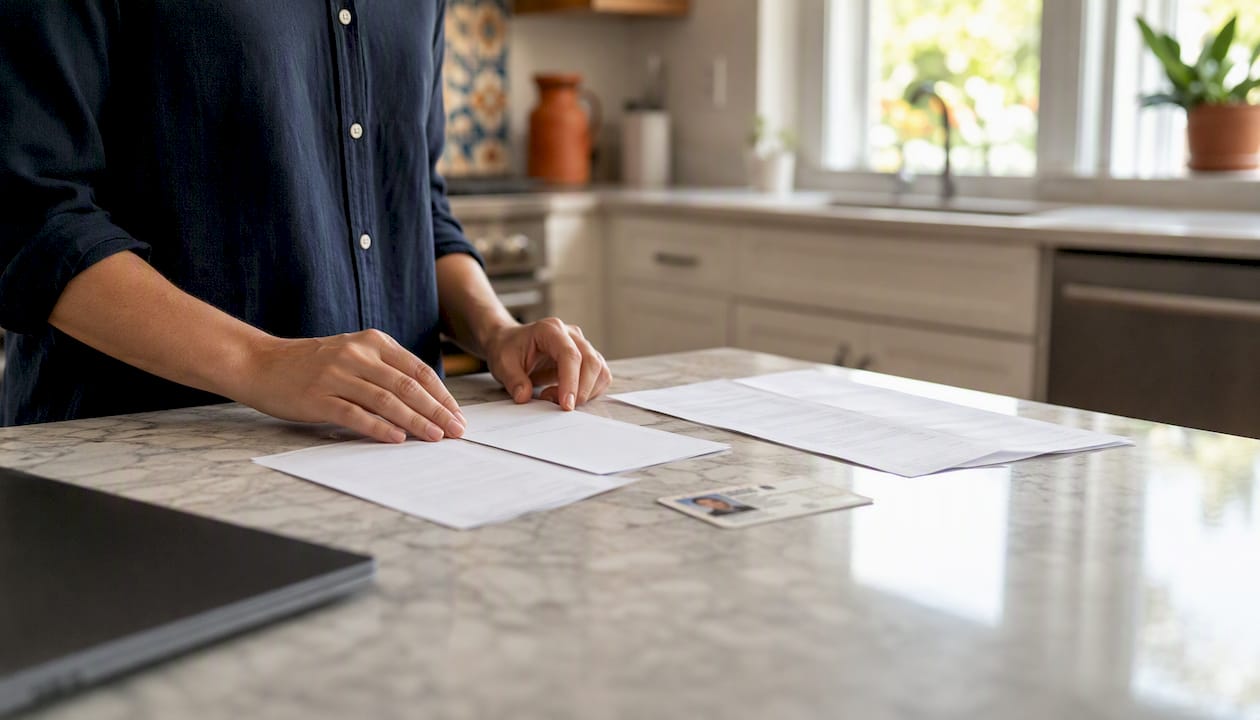
Acceptable proof of residence typically includes:
- State driver’s license or state-issued ID
- Recent utility bill (usually within 90 days)
- Signed lease or mortgage statement
- Voter registration card
One point that trips up a lot of applicants: Honorary Consulates are not the same as Consulates General. They appear on demarcation pages, but Honorary Consulates generally cannot process visas and provide only limited citizen services and local representation. For any visa application, you must go through a Consulate General or an authorized Visa Application Center such as BLS Spain.
California adds another layer of complexity. The state is split at the county level: Los Angeles handles Southern California counties (Los Angeles, Orange, San Diego, and others), while San Francisco covers Northern California. Assuming your state determines your consulate is the mistake that generates the most rejections in California.
Pro Tip: The documents you submit as residency proof must reflect your current address at the time of application, not a former one. A driver’s license with an old address paired with a current utility bill is a common mismatch that consulates flag immediately.
Which consulate covers your U.S. state?
If your county falls in a split state like California, do not rely on the state name alone. Pull up the consulate’s own demarcation page and find your specific county in the list before booking anything.
California split: Los Angeles County residents apply at the Consulate General in Los Angeles. Residents of San Francisco Bay Area counties apply at the Consulate General in San Francisco. Getting this wrong means your application is returned.
How to verify your jurisdiction and submit your visa application
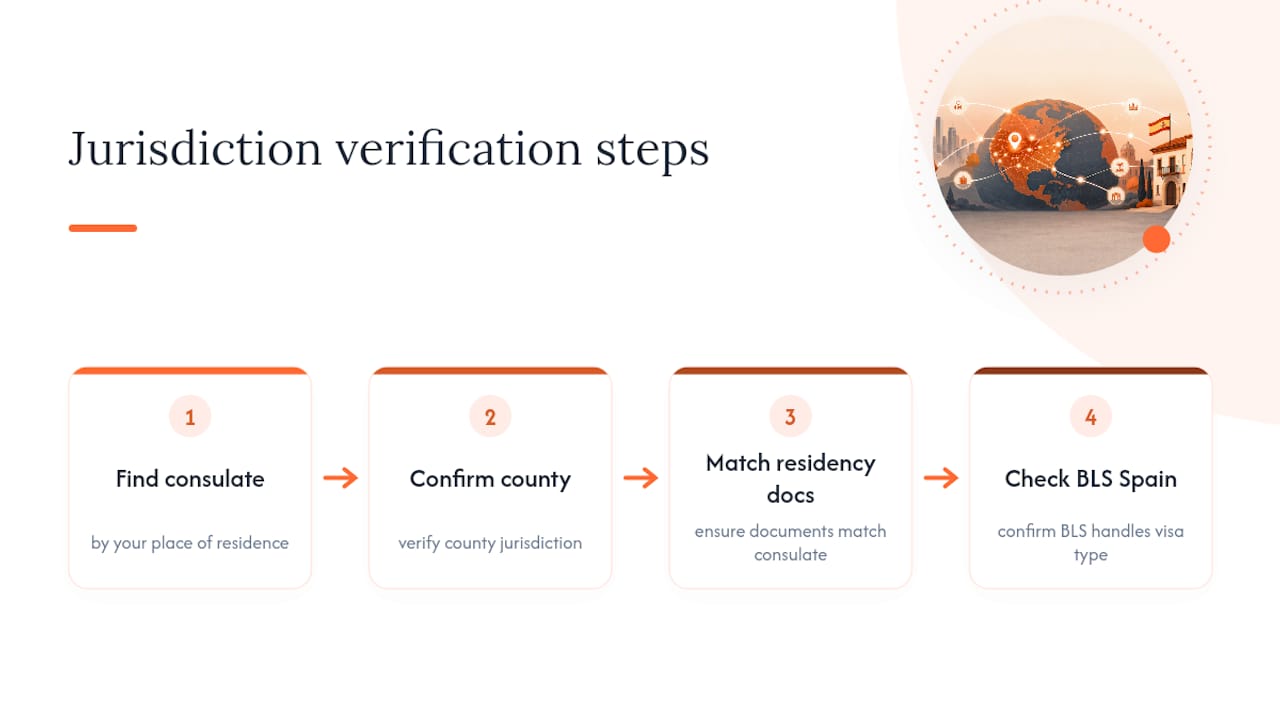
Getting this right before you book an appointment saves weeks. Work through these steps in order:
- Confirm your legal residence and county. Your legal address, not your mailing address or workplace, is what counts.
- Check the consulate’s demarcation page. Every Consulate General publishes a territory list. Find yours and confirm your state and county appear on it.
- Determine whether BLS Spain handles intake for your visa type. Some consulates delegate visa application intake to BLS Spain Visa Application Centers. BLS centers mirror consulate jurisdiction rules strictly — you still must be a legal resident of that consulate’s territory.
- Prepare your residency proof and full document checklist. Gather everything before the appointment date, not the morning of.
Documents visa centers consistently request alongside residency proof:
- Valid passport (plus copies of all pages)
- Completed national visa application form
- Passport-size photos meeting Spanish specifications
- Proof of financial means
- Health insurance documentation
- Any visa-type-specific documents (employment contract, income proof, etc.)
Fees are paid in the currency and method the consulate specifies — check the consulate page directly, as amounts and accepted payment methods vary by office and visa type.
Pro Tip: If the consulate’s website and BLS Spain instructions appear to conflict on a requirement, contact the consulate directly by email before your appointment. Do not assume the BLS page is wrong — but the consulate’s answer is the one that controls.
What if you recently moved or are temporarily outside your jurisdiction?
This is where applicants most often talk themselves into the wrong approach. The rules are straightforward:
- Recent move: Apply where you are legally resident at the time of application. If you moved last month and your driver’s license still shows your old address, update it or gather supporting documents (lease, utility bill) that confirm your new address before applying.
- Temporary absence: Living temporarily in another state for work or travel does not change your jurisdiction. Legal residence follows your permanent address.
- Students: Some consulates allow in-person students to apply at the consulate covering their educational institution’s location. This exception is not universal — confirm with the specific consulate before assuming it applies.
- Incomplete moving documentation: If your residency paperwork is still in transition, apply from your previous legal residence state until the new documentation is complete.
Before booking any appointment, contact the consulate by email or phone to explain your situation. A two-minute call can prevent a rejected application and a months-long delay.
Common mistakes that cause rejections or delays
Most rejections trace back to a short list of avoidable errors:
- Applying at the wrong consulate. Fix: confirm your state and county on the consulate’s demarcation page before touching the booking system.
- Mismatched residency documents. A license with one address and a utility bill with another raises an immediate flag. Fix: make sure every document shows the same current address.
- Submitting through an Honorary Consulate. They cannot process visas. Fix: use only a Consulate General or an authorized BLS Spain center.
- County-level errors in California. Assuming Los Angeles County and San Francisco County fall under the same office is wrong. Fix: check the county list on the Los Angeles demarcation page before applying.
Pro Tip: Update your driver’s license to your current address before starting any visa application. It is the single document consulates trust most as residency proof, and an outdated one creates problems that a utility bill alone cannot always fix.
Why this guide is reliable
This mapping was compiled directly from the official demarcation pages published by Spain’s Ministry of Foreign Affairs (MAEC) and each Consulate General. The sources include:
- The Embassy of Spain in Washington, D.C. consulate directory
- Individual demarcation pages for Boston, New York, Miami, Los Angeles, San Francisco, and Washington, D.C.
- The official Sede appointment and procedure portal
Digitalnomadinspain has guided clients through Spain’s Non-Lucrative Visa and Digital Nomad Visa processes with a 98% success rate, built on exactly this kind of jurisdictional precision. Consulate demarcation pages update periodically, so always re-check the relevant consulate page before booking your appointment.
The single most preventable reason an application gets returned is jurisdiction error — submitting to the wrong consulate or the wrong intake center. Catching it before you book costs nothing. Catching it after costs weeks.
What the jurisdiction process actually looks like in practice
The paperwork side of a Spain visa application is manageable. The jurisdictional side is where applicants consistently underestimate the detail required. Knowing your consulate is step one, but confirming your county, matching your residency documents, and verifying whether BLS Spain handles intake for your visa type are the steps that actually determine whether your application moves forward or gets sent back. The good news: every one of those steps is checkable in advance, and none of them require guesswork once you know where to look.
Digitalnomadinspain handles jurisdiction checks so you don’t have to
Getting the jurisdiction right is the foundation of a successful Spain visa application — and it is exactly where Digitalnomadinspain starts with every client. The service covers eligibility checks, jurisdiction confirmation for your specific U.S. address, document preparation, appointment booking at the correct consulate or BLS Spain center, and full follow-up through approval.
Clients from multiple countries have gone through this process with a high success rate. For U.S. residents applying for the Non-Lucrative Visa or the Digital Nomad Visa, an initial consultation includes a jurisdiction check, a document review, and a clear application roadmap. Book your consultation at Digitalnomadinspain to confirm your consulate and get your application moving.
Sources
Official pages used to compile this guide:
Always confirm on the consulate’s official page before booking or submitting. Demarcation lists update without notice, and a five-minute check is far cheaper than a returned application.
FAQ
Which Spanish consulate covers my state?
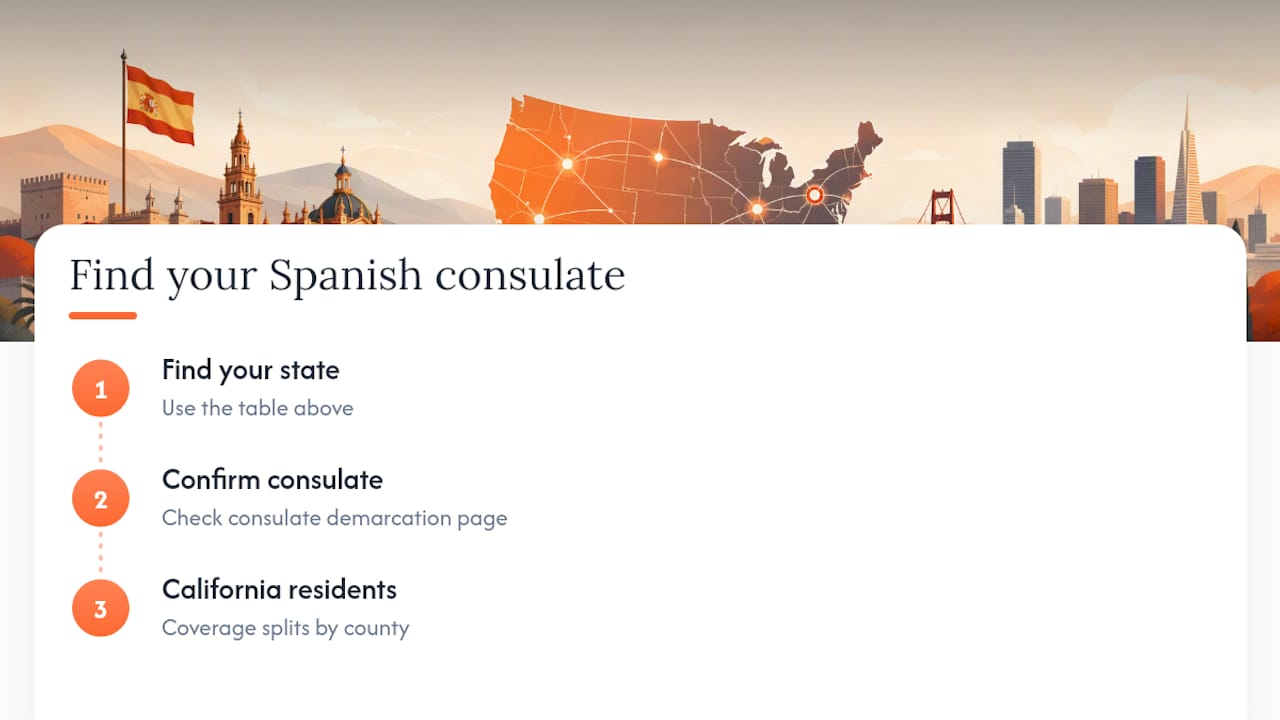
Your consulate is determined by your legal state of residence. Use the table above to find your state, then confirm on the consulate’s official demarcation page — especially if you live in California, where coverage splits by county.
Can I apply at an Honorary Consulate for a Spain visa?
No. Honorary Consulates do not process visas. You must submit your application at a Consulate General or an authorized BLS Spain Visa Application Center within your jurisdiction.
What counts as proof of residence for a Spanish consulate?
Consulates typically accept a state driver’s license or ID, a recent utility bill, a signed lease or mortgage statement, or a voter registration card. All documents must show your current address at the time of application.
What happens if I apply at the wrong consulate?
The application will not be accepted. Consular jurisdiction is mandatory under Spain’s Ministry of Foreign Affairs rules, and submissions from outside the assigned territory are returned without processing.
Can Digitalnomadinspain confirm my jurisdiction before I apply?
Yes. Digitalnomadinspain’s consultation includes a jurisdiction check for your specific U.S. address alongside full document preparation and appointment booking support.