
Step by step workflow for applicants abroad: apostille first, verify MAEC Traductor Jurado and e-signatures to avoid visa rejections.
Avoid Rejection: Apostille First Sworn Spanish Translations Abroad

For documents submitted to Spanish authorities, you will generally need a sworn Spanish translation, not a US-style “certified” one. The workflow is fixed: get any required apostille first, then send the full document to a translator registered with Spain’s Ministry of Foreign Affairs (MAEC). Skip either step and Extranjería or your consulate will likely bounce the file back.
TL;DR:
- Sworn translations must be produced by a MAEC-registered Traductor Jurado, not a US notarized or private certification, to be legally valid in Spain.
- Verify the translator’s MAEC registration number on the official Sede MAEC portal before commissioning the work.
- Get the apostille attached before translating to ensure the translation covers the final document, preventing rejection due to sequencing errors.
- Digital signatures verify many sworn translations, but confirm the receiving office accepts digital files before ordering.
- Coordinating multiple documents through a specialist service can reduce rejection risks caused by missequenced or invalidated paperwork.
Table of Contents
- What Makes a Spanish Sworn Translation Legally Valid
- How to Verify a MAEC-Registered Sworn Translator
- Which Documents Need a Sworn Translation for Spain
- Getting a Sworn Translation From Outside Spain, Step by Step
- Turnaround Times, Pricing, and Delivery Formats
- Rejections Happen for the Same Few Reasons
- Why Professional Coordination Cuts Rejection Risk
- Where the Conventional Advice Falls Short
- Let Digitalnomadinspain Handle the Document Chain for You
- Sources
- FAQ
What Makes a Spanish Sworn Translation Legally Valid
A traducción jurada carries legal weight a standard translation doesn’t. Only a Traductor Jurado, appointed directly by Spain’s Ministry of Foreign Affairs, can produce one. That appointment gives the translator something close to public faith: their signature and seal certify that the Spanish text matches the original, and government offices treat that certification as fact unless proven otherwise.
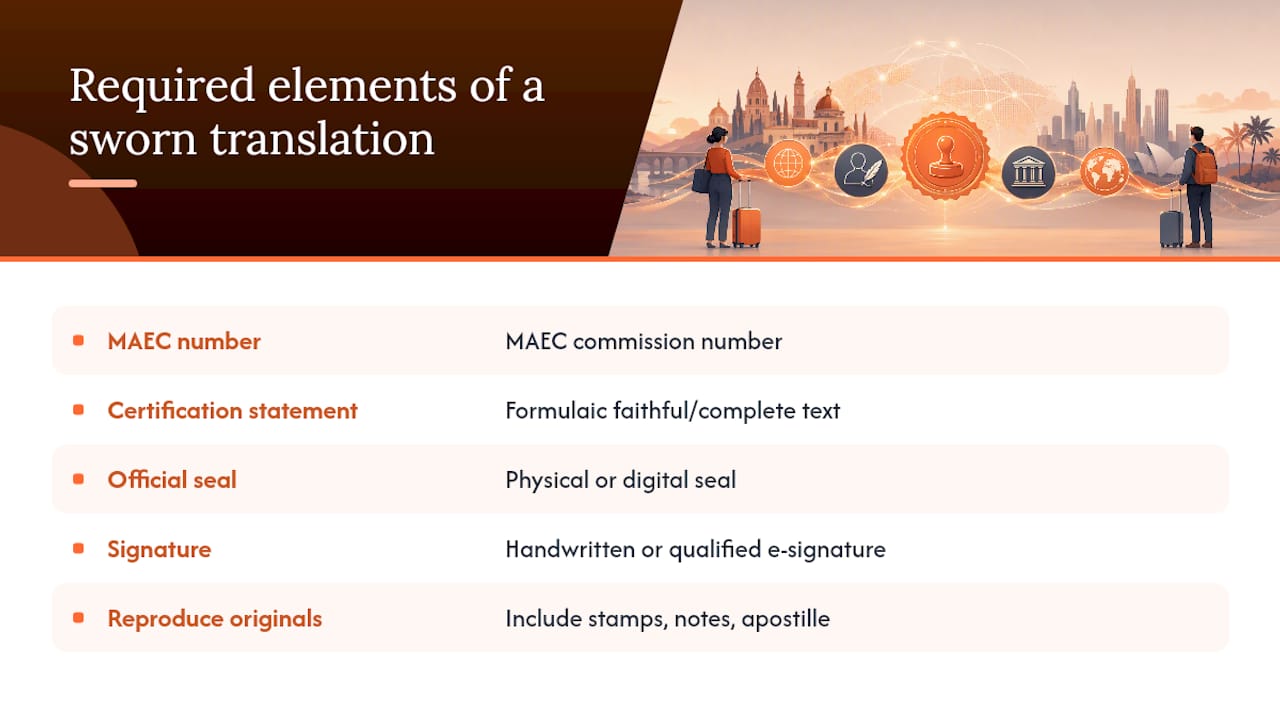
Four elements make a translation legally “sworn” in Spain. First, the translator’s official commission number, assigned by MAEC. Second, a formulaic certification statement, worded almost identically across every jurado in the country, attesting the translation is faithful and complete. Third, a physical or digital seal. Fourth, a handwritten or qualified electronic signature. Sworn translators must certify accuracy this way on every page or at the close of the document, and the translation has to reproduce the original in full, including stamps, marginal notes, and any apostille text.
This is where American applicants get tripped up. A notarized translation in the US only confirms the translator signed an affidavit in front of a notary. It says nothing about the translator’s qualifications and carries no standing with Spanish authorities. Neither does a translation stamped by a private US “certification” company. Spain doesn’t recognize either one for official use.
How to Verify a MAEC-Registered Sworn Translator
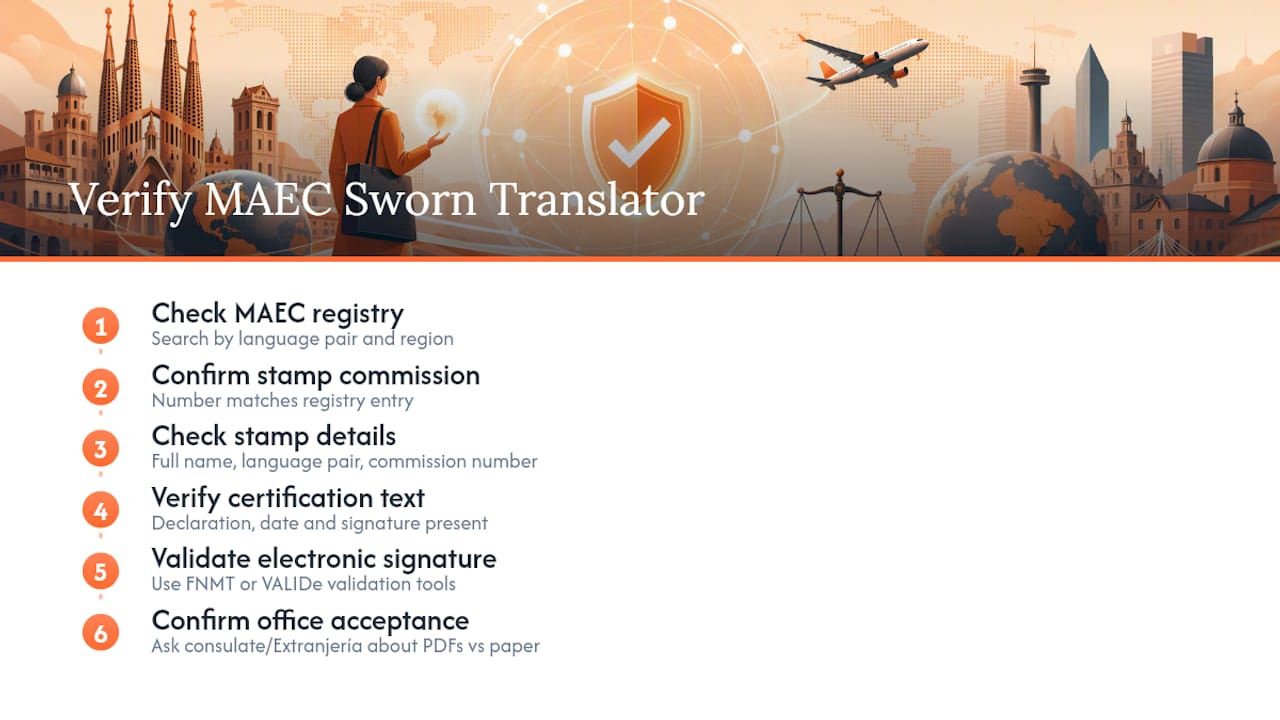
Before you pay anyone, confirm they actually hold a current MAEC appointment. The official Sede MAEC portal publishes the registry of active sworn translators and interpreters, searchable by language pair and region. If a name doesn’t appear there, or the commission number on their stamp doesn’t match what’s listed, walk away.
A legitimate stamp will show the translator’s full name, the language pair they’re certified for, and their commission number in a format MAEC assigns (not a made-up license number or a business registration ID). The certification wording follows a near-standard template: a declaration that the translation is a true and faithful rendering of the original document, dated and signed.
Digital delivery adds one more check. Translations now commonly arrive as PDFs bearing a qualified electronic signature issued through FNMT (Fábrica Nacional de Moneda y Timbre) or the VALIDe platform. You can verify these signatures directly through Spain’s official signature-validation tools, which confirm the certificate is current and untampered. Some consulates and Extranjería offices accept these digitally signed files outright; others still want a wet-ink signature on paper, so confirm with the receiving office before you assume a PDF alone will do.
Which Documents Need a Sworn Translation for Spain
Almost any foreign civil, academic, or legal document you submit to a Spanish authority needs to go through a jurado if it isn’t already in Spanish. The most common categories:
- Birth, marriage, and death certificates for civil registry filings and family-based applications
- Criminal background checks, required for nearly every visa category
- University diplomas and academic transcripts for recognized qualifications or student visas
- Employment contracts, freelance agreements, and business incorporation documents
- Medical certificates, often required for long-stay visas
- Powers of attorney and notarial deeds
- Court rulings, divorce decrees, and custody orders
Timing matters as much as content. Criminal record checks and some civil certificates carry validity windows as short as 90 to 180 days, so a document that was fine when you started gathering paperwork can expire before your appointment. Bank statements and insurance policies sometimes need translation too, but requirements vary by consulate and by visa type, so check the specific checklist your consulate or Extranjería office publishes rather than assume every category applies to you. Our guide on bank statement translation for Spain covers the financial-document side in more detail.
Getting a Sworn Translation From Outside Spain, Step by Step
The sequence matters more than most applicants realize, because a jurado certifies exactly what’s placed in front of them.
- Gather your originals. Confirm each document is the version your consulate or Extranjería office actually requires, not an outdated printout.
- Apostille first, translate second. If the document needs an apostille, get it from the competent authority in the issuing country before anyone touches the translation. Translating before the apostille is attached means the translator’s certification technically doesn’t cover the finished bundle, which frequently causes rejection later.
- Scan the complete package, apostille page included, at a resolution that keeps stamps and seals legible.
- Choose your translator route. You can go directly to a MAEC-listed jurado, or work through an agency that coordinates sworn translators on your behalf. Direct hiring is usually cheaper; an agency adds a layer of project management if you’re juggling multiple documents or languages at once.
- Decide on delivery format before you order. A digitally signed PDF is faster and often sufficient, but if your receiving office insists on paper, request a stamped physical copy mailed to you, not just a scan of one.
Pro Tip: Always ask the translator to confirm their MAEC commission number and reference visible stamps on your scans before they start. Fixing a missing signature line after the fact costs you the entire turnaround time twice over.
Turnaround Times, Pricing, and Delivery Formats
Standard orders for a handful of documents typically turn around within a few days. Build in extra time during peak visa season, when demand for jurados spikes alongside application deadlines. Rush service exists with most translators and agencies, usually for a premium.
Pricing works differently than you might expect from US certified-translation services:
- Per-page or per-word rates, with a minimum order charge regardless of length
- Rush requests add a surcharge above standard pricing
- Paper originals mailed internationally, plus complex notarized attachments with multiple exhibits, push costs higher
Some sworn translation providers publish sample pricing online, which gives you a rough benchmark before you request quotes. Delivery format changes the safety math too. A digitally signed PDF with a verifiable FNMT or VALIDe signature is nearly instant and works for most consulate submissions, but if you’re not certain your receiving office accepts digital files, order paper plus PDF together rather than risk a resubmission.
Rejections Happen for the Same Few Reasons
Four mistakes account for most rejected sworn translations. Translating before the apostille is attached tops the list, followed by hiring a US-based “certified” or notarized translator instead of a MAEC-registered jurado, a mix-up that causes real delays for American applicants specifically. Submitting a document past its validity window and receiving a translation with no visible stamp or commission number round out the list.
Run this checklist before you upload or mail anything:
- Confirm every original has its apostille attached, if one is required.
- Verify the translator’s MAEC commission number against the official registry.
- Check the stamp, signature, and certification wording appear on the finished document.
- Confirm your source documents are still inside their validity window.
- If delivery is digital, validate the electronic signature before submission.
Pro Tip: A rejected criminal record translation is almost always fixable in one pass: reorder the apostille and translation, resubmit with both attached, and note the original submission date in your cover letter so the office knows the delay wasn’t yours.
Why Professional Coordination Cuts Rejection Risk
Sequencing five or six documents across different validity windows, apostille offices, and translator schedules is where most self-filed applications stall. Digitalnomadinspain works with clients from more than 50 countries and reports a 98% success rate on visa filings, built on coordinating MAEC translators, tracking document expiry dates, and managing consulate follow-up so nothing lapses mid-process.
DIY works fine for a single document with a generous timeline. It gets riskier once you’re juggling multiple certificates, tight consulate deadlines, or post-approval steps like TIE card registration, where a small sequencing error can cost weeks.
Where the Conventional Advice Falls Short
Most guides treat sworn translation as a checkbox: hire a translator, get a stamp, done. That framing misses the part that actually causes rejections, which is sequencing. The apostille has to exist before the translation does, because a jurado certifies the exact document handed to them, not a promise that an apostille is coming later. Get that order backward and you’ve paid for a translation that technically doesn’t cover your final paperwork.
The other blind spot is assuming “certified” means the same thing everywhere. It doesn’t. A US notarized translation and a Spanish sworn translation solve different legal problems, and conflating them is probably the single most avoidable mistake in this whole process.
If you take one thing from this: verify the MAEC commission number before you pay anyone, and confirm your apostille is attached before the translator opens the file. Everything else, pricing, turnaround, format, is negotiable. Those two steps aren’t.
— Joshua
Let Digitalnomadinspain Handle the Document Chain for You
Digitalnomadinspain removes the sequencing risk entirely: instead of coordinating apostilles, MAEC translators, and consulate timelines yourself, one team manages the full document chain from start to finish.

That includes reviewing which documents actually need a sworn translation for your specific visa category, coordinating directly with MAEC-registered translators, and following up with the consulate or Extranjería office so nothing sits in limbo. Clients working toward the Digital Nomad Visa or the Non-Lucrative Visa get document prep and translation coordination handled as one package rather than juggled across separate vendors. If you’re not sure where your paperwork stands, run a free check through the eligibility checker, then book a consultation to map out exactly which documents need a sworn translation and in what order.
Sources
Cross-check any translator or requirement against primary sources, not a blog post. The MAEC consulate guidance explains the legal basis for sworn translations, while Sede MAEC hosts the searchable translator registry. For visa-service context beyond Spain, Fewa Consultancy’s visa page offers a general overview of consultancy-based application support.
This article is general information, not a substitute for advice from a qualified lawyer. Consult a qualified legal professional about your own circumstances before acting on anything here.
- Sworn Translators-Interpreters — Spanish Ministry of Foreign Affairs (Consulate guidance)
- Apostilles and sworn translations for Spanish visas — Spain Handbook
- Sworn translations — Clinter (explanation of legal certification and translator responsibilities)
FAQ
Is a “Spanish sworn translator” the same as any bilingual translator?
No. Only a Traductor Jurado formally appointed by Spain’s Ministry of Foreign Affairs can produce a legally sworn translation; a bilingual person or general translation agency cannot, regardless of fluency.
Where can I find a list of sworn translators in Spain?
The Sede MAEC portal publishes the official registry, searchable by language pair, and it’s the only reliable way to confirm a translator’s commission number is current.
What is a sworn statement in a Spanish translation?
It’s the formulaic certification a Traductor Jurado adds to the finished document, declaring under their MAEC appointment that the translation is complete and faithful to the original, backed by their signature and seal.
How do I get a certified Spanish translator for a US document?
Start by verifying a candidate against the MAEC registry, then confirm they can translate the apostille text alongside your original; agencies like Digitalnomadinspain can coordinate this for you if you’re managing multiple documents at once.