
Step-by-step plan for US students switching to Spain's Non Lucrative Visa. Apostille your FBI record, gather 6–12 months of bank proof, and meet the 400%...
US Students: 400% IPREM, Step by Step to Spain’s Non Lucrative Visa

Yes, students can switch from a Spanish student visa to a Non-Lucrative Visa (NLV) if they meet the same financial and eligibility rules as any other applicant. There’s no special “student pathway” or discount on the requirements. Start now on the two slowest steps: apostilling your documents and building six to twelve months of bank statements that show steady passive income. If you plan to keep working remotely for a US employer or clients, look at the Digital Nomad Visa instead, since the NLV bars any form of paid work.
TL;DR:
- Demonstrating consistent passive income of around €2,401 per month is essential, with proof covering six to twelve months and clear documentation of ongoing sources.
- Applicants must obtain an apostille on all US documents and ensure foreign-language papers are officially translated to avoid delays or rejection.
- The process requires applying through the correct consulate based on your legal residence, booking appointments early, and bringing complete, organized documentation.
- Extensions outside Spain or irregular income patterns can complicate renewal and future residency requirements, making careful record-keeping vital.
- A professional visa consultant can improve approval chances, especially for complex financial histories, tight timelines, or prior denial cases.
Table of Contents
- Who Qualifies for the Student to Non-Lucrative Spain Transition?
- What Documents Do You Need for the Non-Lucrative Visa?
- Where and When Do You Submit Your Non-Lucrative Visa Application?
- The Step-by-Step Path From Student Visa to NLV
- Digital Nomad Visa and Other Alternatives Worth Knowing
- When It Makes Sense to Get Professional Help
- Joshua’s Take: Three Things to Do This Week
- How Digitalnomadinspain Helps Students Make the Switch
- Where to Read the Official Guidance
- Sources
- FAQ
Who Qualifies for the Student to Non-Lucrative Spain Transition?
The NLV was built for retirees and people living off passive income, not students transitioning out of a study program. That’s the part a lot of applicants miss. You can move from a student visa to non lucrative Spain status, but you’re evaluated on the exact same criteria as someone who’s never set foot in a Spanish classroom.
Eligibility starts with the basics: you need to be a non-EU national, at least 18 years old, and you apply through the Spanish consulate that covers the US state or region where you legally reside, not the one nearest a relative or a convenient flight. Consulates don’t share jurisdiction, and filing in the wrong district is a common, avoidable rejection.
The financial threshold is where most applications succeed or fail. Spain requires proof of income equal to approximately 400% of the IPREM (Indicador Público de Renta de Efectos Múltiples) for the main applicant, plus 100% of IPREM for each dependent. Specialist guides put the practical 2026 figure at roughly €2,401 per month, which works out to somewhere around €28,800 annually. That’s the floor, not a target. Consulates generally want to see this income is recurring, not a one-time deposit dressed up to look like a salary.
Quick math: 400% of IPREM ≈ €2,401/month for the applicant. Add roughly the same base amount at 100% per dependent if you’re bringing a spouse or child.
Acceptable income sources include:
- Pensions or retirement disbursements
- Dividends from investments
- Rental income from property you own
- Annuities or structured passive payouts
Savings can round out your file, but consulates rarely accept a lump sum alone as proof you can support yourself indefinitely. A pile of cash in checking doesn’t demonstrate the “no gainful activity” condition the NLV is built around, which is the second pillar of eligibility. You’re signing on to live in Spain without working, for any employer, anywhere, including remote work for a US company. Many consulates require a signed affidavit confirming this, and some ask for a letter from a former or current employer confirming you’re not employed or won’t be working during your stay.
Pro Tip: If your income comes from a family trust or an irregular mix of sources, get a letter from your bank or financial advisor that explains the pattern in plain language. Consulate officers read hundreds of these files; the clearer your paper trail, the faster it moves.
What Documents Do You Need for the Non-Lucrative Visa?
Every consulate publishes a checklist, and while small details vary, the core document list stays consistent across US jurisdictions.
- Completed national visa application and the EX-01 form, along with the fee payment form (often referenced as code 79).
- Valid passport with at least one blank page and enough validity to outlast your intended stay, plus recent passport-style photos.
- Criminal record certificate. US applicants typically request an FBI Identity History Summary check, which then needs authentication before it’s valid abroad.
- Medical certificate stating you’re free of diseases that could have a serious public health impact, worded per the model most consulates require.
- Private health insurance with no copays and full coverage in Spain, matching what a Spanish public health provider would offer.
- Proof of financial means covering the 400% IPREM threshold, ideally with 6 to 12 months of consistent bank statements and a certificate showing your average and closing balances.
- Proof of accommodation in Spain, whether a lease, a deed, or a signed host letter.
Two things trip people up. First, your criminal record certificate and any US-issued civil documents need an apostille through the State Department’s Office of Authentications before a consulate will look at it. Second, every foreign-language document needs a certified Spanish translation, and consulates don’t always accept translations done by a friend who happens to speak Spanish well.
Pro Tip: Order your FBI check and apostille in parallel with your bank documentation, not after. The identity history process alone can eat several weeks, and a late apostille is the single most common reason applicants miss their consulate appointment window.
Where and When Do You Submit Your Non-Lucrative Visa Application?
You apply at the consulate covering your legal state of residence, never one you’d simply prefer. Many US jurisdictions route in-person intake through BLS Spain visa application centers rather than the consulate building itself, so check which system your consulate uses before assuming.
- Book your BLS or consulate appointment as early as your consulate’s calendar allows; slots fill up weeks in advance in busy jurisdictions.
- Bring originals and copies of every document, since most consulates won’t accept a file missing even one supporting paper.
- Fees are typically paid in USD at the time of submission, and amounts vary slightly by consulate.
Processing generally takes several weeks to a few months once your file is complete, and delays are common if a consulate requests additional bank history or a clearer explanation of income sources. Once approved, you’ll have a defined window (often 30 to 90 days depending on the consulate) to collect your visa and travel to Spain. Miss that pickup window and the approval can lapse, forcing you to restart the process. If your student visa is expiring soon, submit your NLV application with enough runway that processing delays don’t leave you in legal limbo.
The Step-by-Step Path From Student Visa to NLV
Step 1: Run the money test before anything else. Calculate your 400% IPREM threshold, confirm your income source qualifies, and start collecting 6 to 12 months of bank statements. If your numbers don’t clear the bar comfortably, fix that before spending time on paperwork.
Step 2: Order your slow documents in parallel. Request your FBI Identity History Summary, book a medical exam, and start the apostille process the same week. Simultaneously request bank certificates showing your average balance and current balance, and draft your non-work affidavit or employer letter. Doing these tasks together, rather than one after another, is what keeps a student-to-NLV switch from stalling out for months.
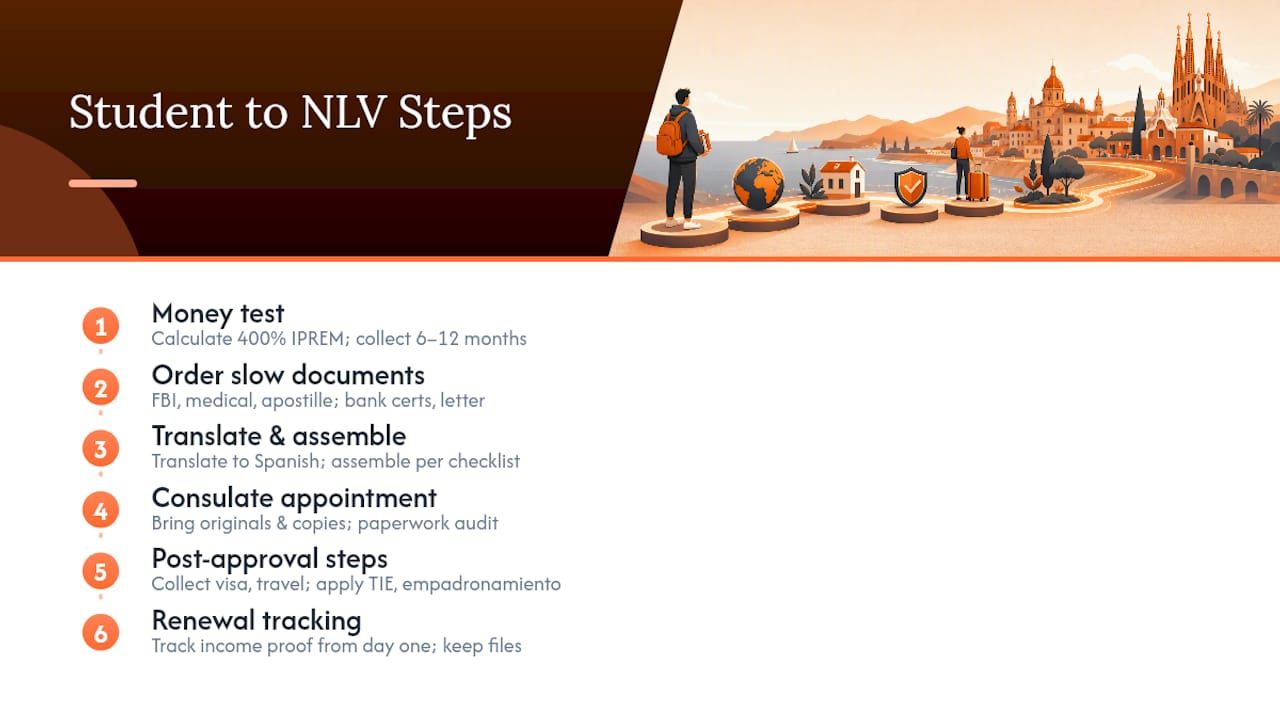
Step 3: Get certified Spanish translations for every foreign document, then assemble your file in the order your consulate’s checklist specifies. Sloppy ordering doesn’t cause rejection, but it does slow down an officer’s review.
Step 4: Book and attend your BLS or consulate appointment. Arrive early, bring originals and copies, and expect the intake staff to check that every document is present before accepting your file. This isn’t the interview stage. It’s a paperwork audit.
Step 5: After approval, collect your visa within the pickup window and travel to Spain. Once you land, you have a short period (typically 30 days) to apply for your TIE (Tarjeta de Identidad de Extranjero), register your address through empadronamiento at the local town hall, and confirm your NIE number is linked to your new residence status.
Step 6: Track your renewal evidence from day one. NLV renewals require the same income proof as your original application, so don’t let your bank records or insurance lapse between now and your first renewal date.
Pro Tip: Keep a single folder, digital and physical, with every document you submit. When renewal time comes, you’ll need to show the same categories of proof again, and having last year’s file as a template saves hours.
Digital Nomad Visa and Other Alternatives Worth Knowing
If you intend to keep earning from remote work, freelance clients, or a US employer while living in Spain, the NLV is the wrong tool. The Digital Nomad Visa was built specifically for that situation, and mixing remote income with an NLV is a compliance risk that can lead to revocation.
Recent graduates sometimes look at work permits or a job-seeker pathway instead, particularly if a Spanish employer is willing to sponsor them. These routes carry different timelines and eligibility rules than the NLV and are worth comparing before committing to one path.
The most common reasons NLV applications fail:
- Passive income that looks irregular or unverified across bank statements
- Missing apostilles on US-issued documents
- Weak or contradictory evidence of non-work intent
- Bank history with unexplained large deposits or gaps
One overlooked detail: extended time outside Spain can affect how your residency counts toward renewals and future permanent residency, so don’t treat the visa as a formality once it’s approved.
Pro Tip: If your NLV was denied, don’t assume it’s over. Many denials come down to a fixable documentation gap rather than a fundamental eligibility problem. If that’s your situation, this guide on fixing a denied NLV walks through the appeal and reapplication process.
When It Makes Sense to Get Professional Help
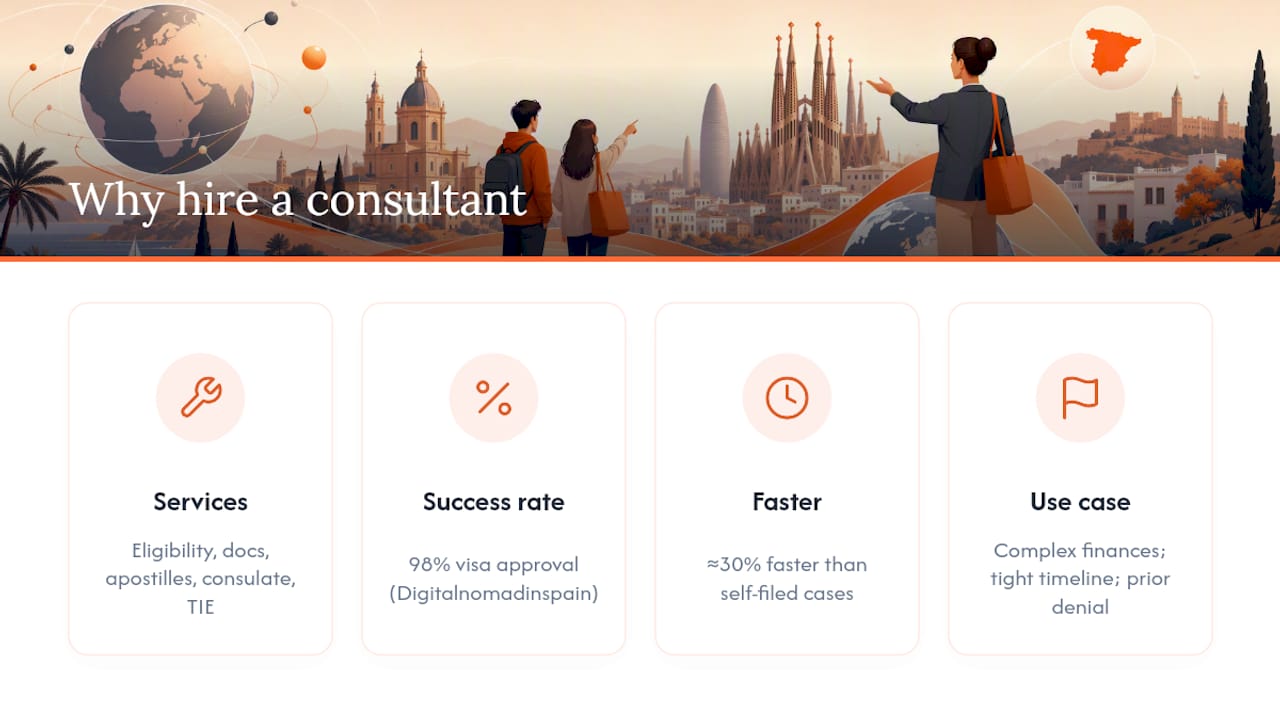
A consultant handles the parts that eat the most time: checking eligibility against your actual income sources, preparing and sequencing documents, coordinating apostilles and translations, following up with BLS and the consulate, and helping with TIE registration once you land.
Digitalnomadinspain reports a 98% success rate on visa applications and processing that runs roughly 30% faster than typical self-filed cases, drawing on deep familiarity with Spanish immigration procedure. Visa consultants typically handle applicants from many nations, each with different document standards and consulate quirks.
Complex financial histories, tight timelines before a student visa expires, or a prior denial are the three situations where paying for help usually pays for itself.
Hiring help makes the most sense if your income sources are hard to document cleanly, your timeline is tight, or you’ve already been denied once.
Joshua’s Take: Three Things to Do This Week
Order your FBI Identity History Summary today. That single step has the longest lead time in the entire process, and I’ve watched people miss consulate deadlines because they waited on it. Pull twelve months of bank statements next, and start your apostille and translation requests in parallel, not sequentially.
The pitfall I see most often isn’t a missing document. It’s weak proof that income is ongoing, not a snapshot. Ask your bank for a certificate showing your average balance over the past year, not just today’s number. That one document does more to reassure a consulate officer than a stack of monthly statements ever will.
— Joshua
How Digitalnomadinspain Helps Students Make the Switch
Switching from a student visa to an NLV means juggling apostilles, translations, bank certificates, and a consulate appointment, often while your student status is ticking toward expiration. Specialized visa consultancy services are designed to manage document-heavy transitions by providing eligibility checks, document preparation, apostille and translation coordination, consulate follow-up, and post-arrival TIE assistance as a connected process.
If you’re not sure where your file stands, start with a free eligibility check or review the Non-Lucrative Visa service details to see what a guided application actually includes.
Where to Read the Official Guidance
- Non-Lucrative Visa checklist (Los Angeles consulate)
- Long-term visa document requirements (Melbourne consulate PDF)
- BLS Spain visa center, Los Angeles
- Complete legal guide to NLV residency without working
Sources
- Non-working (Non-lucrative) residence visa
- LONG-TERM VISAS FOR NON-LUCRATIVE RESIDENCE IN SPAIN DOCUMENTS TO BE SUBMITTED
- Spain Non-Lucrative Visa for Language Students 2026 | Interlink Agency
- FBI — Identity History Summary Checks
- U.S. Department of State — Office of Authentications
FAQ
How Long Can You Be Outside Spain on an NLV?
Extended absences can jeopardize your residency count for renewals and future permanent residency, so most holders stay well within the limits their consulate specifies rather than testing the edges.
Can You Apply for a Non-Lucrative Visa From the US?
Yes. You apply at the Spanish consulate covering your state of legal residence in the US, often through a BLS application center for in-person document intake.
What Should You Do if Your NLV Application Is Denied?
Review the denial letter for the specific reason, since most rejections trace back to a fixable documentation gap rather than a fundamental eligibility issue; this guide on denied applications covers the reapplication process.
What Are the Tax Implications of Holding an NLV?
Spending a significant portion of the year in Spain generally triggers Spanish tax residency, which means worldwide income becomes reportable there regardless of where it originates, so review this with a tax advisor before you apply.
Does the NLV Allow Remote Work for a US Employer?
No. The NLV prohibits any gainful activity, including remote work for foreign employers; anyone planning to keep working should look at the Digital Nomad Visa instead.