
Learn how to successfully renew your TIE in Spain with our detailed step-by-step timeline, ensuring you stay compliant and stress-free.
Renewing Your TIE in Spain: A Step-by-Step Timeline

File your TIE renewal within the 60-day window before your card expires. Under RD 1155/2024, article 80.1, that filing keeps your prior authorization legally valid while officials process the new one, and the rule still lets you file up to 90 days after expiry if you miss the ordinary window. The process runs in two separate stages. First, renew the underlying authorization (the permiso) at the Oficina de Extranjería if your permit category requires it. Second, once that’s approved or a resguardo is issued, book an appointment with the National Police (Policía Nacional) to update the physical card itself using form EX-17.
Before you touch a computer to book anything, gather these items:
- EX-17 form, filled out for renovación (not duplicado)
- Valid passport plus a photocopy of the page with your photo and details
- Your current, even if expired, TIE card plus a copy
- A recent empadronamiento certificate (issued within the last three months)
- Two passport-style biometric photos
- Both Modelo 790 payment forms: código 052 for the permit renewal, código 012 for the police card fee
- The resguardo (receipt) proving your renewal application was filed
Miss the 60-day window and you’re not automatically out of options. Spain’s rules still let filings go through up to 90 days past expiry, though late filing can trigger a minor sanction of up to €500 depending on how long you wait.
Key Takeaways
Filing your TIE renewal inside the 60-day window before expiry, with both Modelo 790 fees paid correctly and your empadromiento current, is what actually prevents delays and sanctions.
| Point | Details |
|---|---|
| File early, not late | Start document prep 90 days before expiry; the 60-day ordinary window is the legal deadline that keeps your authorization active. |
| Two separate fees | Pay Modelo 790 código 052 for the permit renewal and código 012 for the police card, each with its own stamped bank receipt. |
| Book appointments fast | Cita previa slots in major provinces commonly take two to four weeks, so book the moment your window opens. |
| Watch the insurance and empadronamiento | Copago clauses and empadronamiento certificates older than three months are the most common rejection triggers. |
| Get help for complex cases | Digitalnomadinspain reviews document files and validates Modelo 790 forms before submission, reporting a high success rate. |
Table of Contents
- When Can You File Your Tie Renewal in Spain?
- What Documents Does Your Tie Registration Process Require?
- How Much Does Tie Renewal in Spain Cost?
- How Do You Book the Cita Previa for Your Tie?
- What’s the Full Process From Filing to Collecting Your New Card?
- Can You Travel While Waiting for Your New Tie Card?
- What Mistakes Cause the Most Tie Renewal Delays?
- When Does Professional Help Make Sense for Your Renewal?
- Where to Check Official Forms and Fees
- The Renewal Rules Are Getting Simpler, Not Harder
- Renewal Support That Fits Around Your Actual Deadline
- Sources
- FAQ
When Can You File Your Tie Renewal in Spain?
The legal window is narrower than most people assume, and getting the timing wrong is the single most common way people end up in administrative limbo. RD 1155/2024, article 80.1 sets two thresholds that every renewal case turns on.
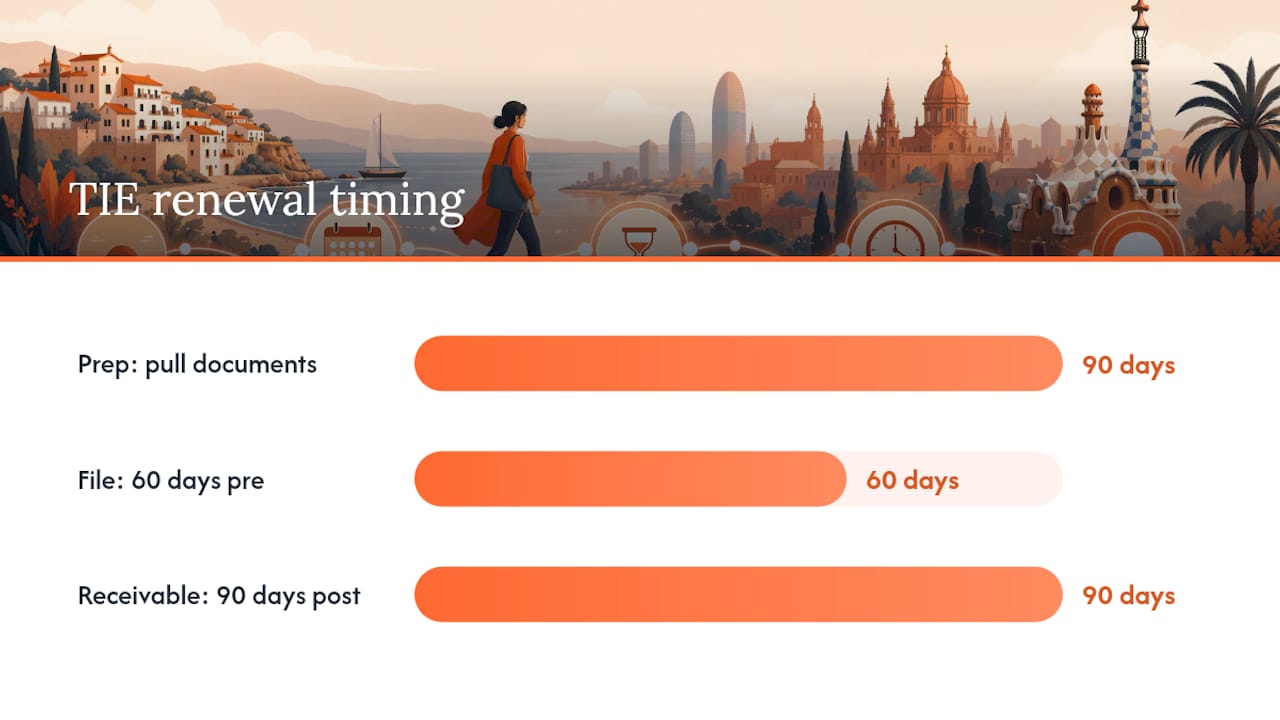
The ordinary window opens 60 days before your card’s expiration date. File anytime in that stretch and your case moves through the system on schedule, with your old authorization staying valid the entire time your application sits in review. Miss that window and you enter a second, less comfortable phase: applications remain receivable up to 90 days after expiry, but that grace period exists to catch people who slipped past the deadline, not to reward waiting. Filing in this late window can still open you up to a sanction process, even though the police won’t reject the paperwork outright.
Here’s a realistic calendar that avoids both extremes:
- 90 days before expiry: start pulling documents. Request a fresh empadronamiento, confirm your insurance policy has no copago gaps, check payslips or enrollment letters are current.
- 60 days before expiry: file the permit renewal (if your category requires one) and immediately try to book your police appointment for the card update.
- 30 to 45 days before expiry: if you haven’t secured a cita previa yet, widen your search to neighboring provinces or check daily for canceled slots.
Appointment slots in high-demand provinces like Madrid, Barcelona, and Málaga commonly take two to four weeks to secure, sometimes longer during peak relocation seasons. That lag is the real reason the 90-day head start matters more than the paperwork itself.
One more wrinkle worth knowing: many temporary permits now renew for four-year periods instead of two under the 2025 regulatory changes, so long-duration and permanent-type cards may follow a different, less frequent renewal rhythm than standard temporary permits. Check your specific card category before assuming the two-year cycle still applies to you.
Pro Tip: Set a calendar reminder for 90 days before expiry, not 60. The extra month buys you breathing room if your empadronamiento request takes longer than expected at your town hall.
What Documents Does Your Tie Registration Process Require?
Every renewal file gets built from the same core stack, with a few extras depending on why you’re in Spain in the first place.
- EX-17 application form, with the “renovación” box checked, not “duplicado” — checking the wrong box is one of the fastest ways to stall your own file.
- Passport, original plus a full photocopy of the identification page.
- Current TIE card, original plus a photocopy, front and back.
- Empadronamiento certificate issued within the last three months. Town halls will not accept a certificate older than that, and this is one of the most frequent rejection triggers.
- Two recent biometric photos, passport-style, white background.
- Proof of permit renewal or resguardo, showing your authorization case is filed or approved.
- Stamped Modelo 790 receipts for both código 052 and código 012, paid within their validity windows.
Beyond that shared list, your permit category adds its own layer:
- Workers need a current employment contract, recent payslips, and proof of active Social Security (Seguridad Social) registration.
- Students need an updated enrollment certificate from their academic institution covering the renewal period.
- Non-lucrative visa holders need private health insurance with no copago clauses and documented proof of sufficient funds, since this category has no access to public healthcare enrollment by default.
- Protected-status holders need whatever status documentation their specific protection category requires, carried over from their original grant.
Most rejected files fail for reasons that have nothing to do with eligibility. A name spelled differently across the passport and the empadronamiento will stop a clerk cold. An empadronamiento issued five months ago instead of three gets bounced. An insurance policy with a small copago clause that slipped through when the policy renewed can sink a non-lucrative case entirely, since insurance compliance is one of the most common causes of delay in the renewal process.
The fix for most of these is simple once you know to look for it. Request a new empadronamiento the same week you start the process rather than reusing one from months back. Call your insurer directly and ask them to confirm in writing that the policy carries zero copago. If your name appears differently across documents because of a transliteration issue, get a sworn translation of your passport that matches the spelling used on your original visa file.
How Much Does Tie Renewal in Spain Cost?
Two separate fees, two separate forms, and mixing them up is a documented way to get turned away at your appointment. The permit renewal itself uses Modelo 790 código 052, while the physical card and fingerprint stage uses código 012, generated directly through the Policía Nacional’s official portal.
Published amounts sit around the typical range for the 790-052 renewal fee and a standard amount for the 790-012 card fee, though exact figures depend on the fee order in force at the time you pay, currently governed by Orden PJC/617/2025. Amounts can shift by category, so treat these as reference points and confirm the exact figure on the official form before paying.
The payment sequence matters as much as the amount:
- Generate each Modelo 790 form online through the corresponding portal, filling in your NIE and personal details exactly as they appear on your passport.
- Print both forms. Digital-only receipts are not accepted at the counter.
- Pay at a participating bank counter, not through general bill-pay apps, since the bank needs to physically stamp the form.
- Keep the stamped copy. That stamp is your proof of payment, and without it, the appointment doesn’t happen.
- Watch the clock. The bank-stamped receipt is only valid for a limited window, commonly cited as 30 days, so pay too early and you risk the stamp expiring before your appointment date arrives.
Paying the wrong code, or letting a stamped receipt age past its window, ranks among the most preventable reasons applicants get sent home from an appointment they waited weeks to book.
How Do You Book the Cita Previa for Your Tie?
Getting the paperwork right means nothing if you file it at the wrong office. Spain splits the TIE renewal into two distinct administrative tracks, and each one has its own building, its own queue, and its own Modelo 790 code attached to it.
- Oficina de Extranjería handles the authorization renewal itself, the permiso stage, tied to Modelo 790 código 052.
- Policía Nacional stations handle fingerprinting and physical card issuance, tied to código 012, and this is where you’ll need an in-person cita previa through the official Sede Electrónica.
- When booking, select the correct procedure type (usually listed under “renovación de tarjeta de identidad de extranjero”) and save the confirmation page as a PDF the moment you get it, since some regional portals don’t resend confirmation emails reliably.
- If your city shows no available slots, check the booking calendar for nearby provinces. Nothing in the rule requires you to file in the exact city where you live, only within your jurisdiction, so a short drive to a less saturated office sometimes shaves weeks off the wait.
Appointments in major cities commonly require booking several weeks in advance, and refreshing the booking page at odd hours, early morning or just after midnight, tends to reveal canceled slots that don’t show up during the day.
If you genuinely can’t find a slot before your window closes, a gestoría (a licensed Spanish administrative agent) can sometimes access channels or knowledge of appointment patterns that individual applicants can’t. Calling the police station’s own extranjería phone line directly, rather than relying solely on the web portal, occasionally surfaces slots the online system doesn’t display.
Pro Tip: Book your police appointment for the card the moment your permit renewal is approved, not after. Slot availability rarely improves the longer you wait, and stacking the two stages back to back saves real time.
What’s the Full Process From Filing to Collecting Your New Card?
The renewal moves through a predictable sequence, though the exact wait at each stage varies by province and by how busy that particular office is that season.
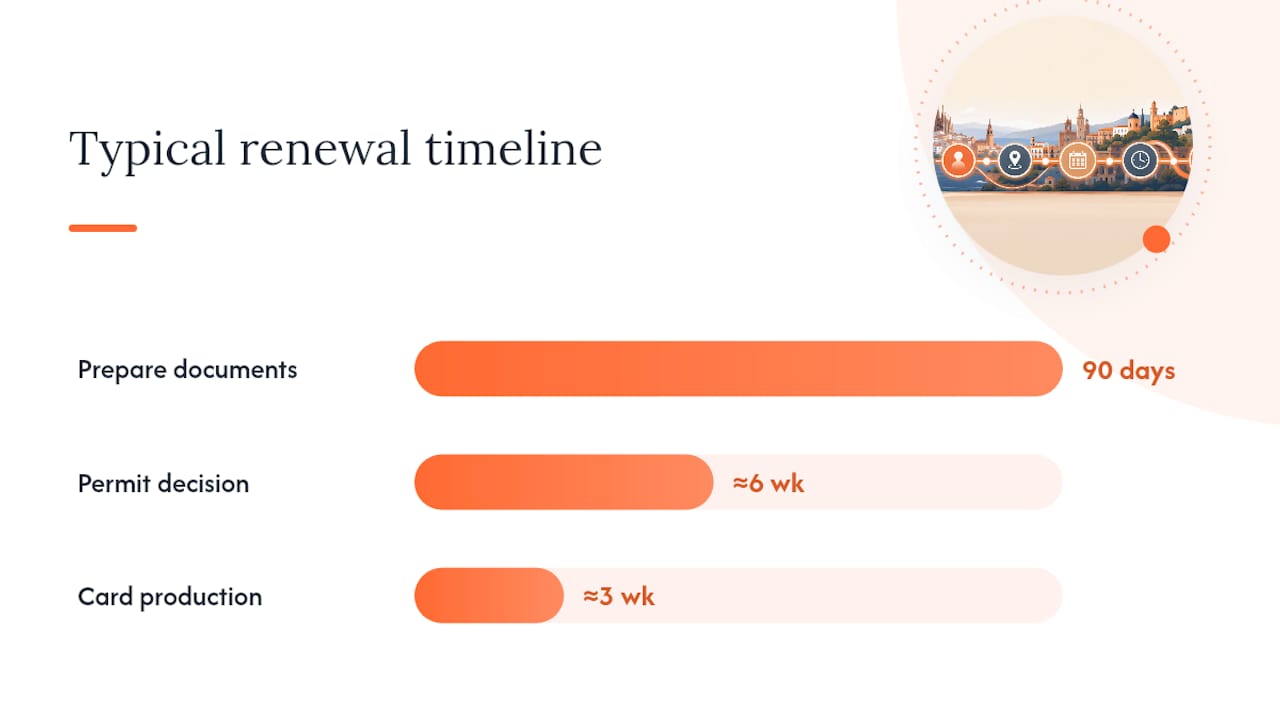
- Prepare documents: gather everything listed above starting around 90 days before expiry.
- File the permit renewal: submit at the Oficina de Extranjería if your category requires renewing the underlying authorization, not just the card.
- Receive your resguardo: this receipt confirms your application is in the system and extends your legal status while it’s reviewed.
- Pay Modelo 790 código 012: generate, print, and pay this once your permit renewal is approved or once you’re ready to schedule the card update.
- Book the police appointment: secure a cita previa for fingerprinting and photo capture.
- Attend the appointment: bring every original document plus copies, along with both stamped 790 receipts.
- Wait for card production: the physical TIE gets manufactured centrally after your appointment.
- Collect your new TIE: pick up the finished card at the same station, usually notified by SMS or through the tracking portal.
Administrative decisions on the permit renewal itself can take anywhere from a few weeks to a couple of months, depending on the province and permit category. Card production after a successful fingerprint appointment typically adds several more weeks on top of that.
It’s worth separating a true renewal from a duplicado. A renovación extends your authorization and card for a new period. A duplicado, used for lost or stolen cards, only reissues the card for whatever validity remained on the original — it doesn’t reset the clock. Confusing the two on your EX-17 form is a common, entirely avoidable filing error. Special categories, including family members of EU residents and Withdrawal Agreement beneficiaries, sometimes follow separate timetables, so check your specific card type before assuming a standard renewal path applies.
Can You Travel While Waiting for Your New Tie Card?
The resguardo does real legal work inside Spain: it documents that your renewal is filed and keeps your residence rights active while the file moves through the system. What it doesn’t reliably do is guarantee you can leave and come back.
Border agents at airports and land crossings don’t always treat a resguardo as sufficient proof of legal residence for re-entry, especially outside Spain’s own borders where the document carries no automatic recognition. That gap catches people off guard constantly, particularly students heading home for a semester break or workers with a trip already booked when their renewal window opens.
If travel genuinely can’t wait:
- Contact the police station handling your case and ask specifically about an Autorización de Regreso (return authorization), a document designed for exactly this situation.
- Apply for that authorization before you leave, not after you’ve already landed somewhere else, since it typically needs processing time.
- If you’re already abroad without one, check with the nearest Spanish consulate before attempting to board a return flight.
Pro Tip: If a trip is even a possibility during your renewal window, apply for the Autorización de Regreso before booking flights. It’s far easier to secure in advance than to sort out from a departure gate.
What Mistakes Cause the Most Tie Renewal Delays?
Most rejected files fail for reasons that have nothing to do with actual eligibility, and nearly all of them are avoidable with a five-minute check before you leave the house.
The recurring offenders: paying the wrong tasa code or letting a bank-stamped receipt expire past its validity window, health insurance that still carries a copago clause, checking “duplicado” instead of “renovación” on the EX-17, an empadromiento certificate older than three months, and showing up without a photocopy of the passport or old TIE.
A short pre-appointment checklist:
- 30 days out: confirm your permit category’s specific document list, request a fresh empadronamiento, verify your insurance has zero copago if that applies to you.
- 14 days out: generate both Modelo 790 forms, pay them at the bank, and confirm the stamp date leaves you inside the 30-day validity window on your appointment date.
- The day before: lay out every original and every copy side by side against the checklist, reconfirm your appointment time and location, and print your booking confirmation even if you also have it saved digitally.
If your situation involves a complicated travel history, a language barrier that makes navigating Spanish-only forms genuinely difficult, or a tight deadline with no room for a rejected appointment, a gestoría or a dedicated visa consultancy can catch errors before they cost you weeks. Digitalnomadinspain’s team handles exactly this kind of document review as part of its renewal support work.
When Does Professional Help Make Sense for Your Renewal?
DIY works fine for straightforward cases: a stable job, a clean document trail, and no unusual travel history. Where it gets harder is anywhere the file has moving parts, an insurance policy that needs replacing, a permit category with extra documentation, or a deadline that’s already tight.
Digitalnomadinspain built its renewal support around the failure points that show up most often in real files: mismatched empadronamiento dates, insurance policies that still carry a hidden copago, and Modelo 790 forms filled out with the wrong code.
A renewal file rarely fails because the applicant doesn’t qualify. It fails because one document, often the empadronamiento or the insurance certificate, doesn’t match what the office expects to see that week.
What the paid support actually covers: a document checklist built around your specific permit category, appointment scheduling assistance for the cita previa, Modelo 790 validation before you pay a euro, translation coordination where documents need it, and follow-up through to the day you collect the physical card.
If your timeline is comfortable and your paperwork is simple, handling it yourself is entirely reasonable. If any part of that isn’t true, getting a second set of eyes on the file before you submit it tends to save more time than it costs.
Where to Check Official Forms and Fees
Bookmark these before you start:
- Policía Nacional’s Modelo 790 código 012 portal, for generating and printing the card fee form.
- Policía Nacional’s extranjería procedures page, for EX-17 access and appointment booking guidance.
- Spanish consular guidance on the TIE, for baseline eligibility and timing expectations.
The Renewal Rules Are Getting Simpler, Not Harder
The regulatory shift under RD 1155/2024 actually works in the applicant’s favor more than most guides give it credit for. Extending many temporary permits to four-year cycles means fewer trips through this entire process over a person’s time in Spain, and the 90-day receivable window is a real safety net compared to the stricter systems some other countries run.
Where conventional advice falls short is treating this as a paperwork problem when it’s really a scheduling problem. Almost every serious renewal failure traces back to appointment scarcity or a document that aged out of validity while someone waited for a cita previa slot. The forms themselves are not complicated. The two Modelo 790 codes, the EX-17 box selection, the empadronamiento window: none of it requires legal training to get right.
What the reader should prioritize first is the calendar, not the checklist. Start 90 days out, book the police appointment the second your permit renewal clears, and treat the bank-stamped receipt’s validity window as a hard deadline, not a suggestion. Everything else follows from getting that sequence right.
Renewal Support That Fits Around Your Actual Deadline
Filing this yourself is entirely doable if your paperwork is clean and your timeline has room to breathe. Digitalnomadinspain exists for the cases where it doesn’t. That’s the real gap between the DIY route and paid support: not whether you can technically file the forms yourself, but whether you can afford a rejected appointment while your card sits expired.

Digitalnomadinspain’s renewal support checks your Modelo 790 forms before you pay, confirms your empadronamiento and insurance meet the current standard, and coordinates the appointment scheduling that eats up so much of the timeline. The service reports a high success rate and faster processing times based on client experience. If your renewal touches a non-lucrative visa’s insurance requirements specifically, the team’s non-lucrative visa service page walks through exactly what compliant coverage looks like.
If you’re not sure whether your situation needs professional help or just a document double-check, start with the eligibility checker to see where your file stands before your window closes.
Sources
- Renew the TIE/NIE in Spain step by step — OficinasAnitas
- Policía Nacional: Modelo 790 code 012 (TIE card payment form)
- How to renew your TIE card in Spain — Gestoraz
FAQ
How long can you stay in Spain after your TIE expires?
An expired TIE card doesn’t erase your residence rights if you filed your renewal on time. Filing within the 60-day window, or even the receivable window up to 90 days after expiry under RD 1155/2024, keeps your prior authorization in force while the case is reviewed, though late filing can trigger a sanction of up to €500.
What changed under Spain’s newer residency rules?
RD 1155/2024, in force since May 2025, extended many temporary permits from two-year to four-year renewal cycles and formalized the 60-day and 90-day filing windows under article 80.1, giving applicants more legal breathing room than the previous framework.
Can you leave Spain while waiting for your new TIE card?
Generally, no, not safely without extra paperwork. The resguardo protects your legal status inside Spain but doesn’t reliably guarantee re-entry, so anyone who needs to travel during the wait should request an Autorización de Regreso from the police first.
What documents do you need if your TIE was lost or stolen during renewal?
You’ll need a police report confirming the loss or theft, your passport, and the EX-17 form marked “duplicado” rather than “renovación,” since a duplicado only reissues the card for its remaining original validity rather than starting a new period.
Can Digitalnomadinspain help with a TIE renewal that’s already running late?
Yes. Digitalnomadinspain’s document review and Modelo 790 validation are built specifically to catch the errors, mismatched empadronamiento, expired insurance, wrong form codes, that cause the delays applicants are usually trying to recover from.