
Explore the essential types of visas for Spain in 2026. Discover options like the Digital Nomad Visa for remote workers and more!
Types of Visas for Spain: 2026 Guide for U.S. Nomads

TL;DR:
- The Digital Nomad Visa and Non-Lucrative Visa are Spain’s top options for U.S. remote workers and passive-income residents, respectively. The application process involves careful document preparation, consulate appointment booking, and post-arrival registration, with success rates around 98%. Accurate compliance with income, health insurance, and registration requirements is essential to maintain legal residency and avoid complications.
If you’re a U.S. remote worker or freelancer, the Digital Nomad Visa is your route. If you’re retiring or living on passive income, the Non-Lucrative Visa is the one to pursue. Both are long-stay national visas applied for at a Spanish consulate before you leave the U.S.
- Verify your income source first. Active remote income from non-Spanish clients points to the Digital Nomad Visa. Pensions, savings, or investment income points to the Non-Lucrative Visa.
- Start gathering core documents now. Both routes require comprehensive private health insurance, a clean criminal record, and several months of bank statements or income proof.
Run a quick eligibility check if you’re unsure which route fits your situation before booking a consulate appointment.
Table of Contents
- What types of visas for Spain do U.S. applicants actually need?
- How to apply for the Digital Nomad Visa as a U.S. applicant
- Non-Lucrative Visa requirements for retirees and passive-income applicants
- Digital Nomad Visa vs. Non-Lucrative Visa: which one fits you?
- After approval: TIE, padrón, tax registration, and social security
- What does the process cost, and how long does it take?
- Common pitfalls and how Digitalnomadinspain prevents them
- What qualifies you for Spain’s standard work visa?
- Special visas: trainee and au pair routes
- EU vs. non-EU: how nationality changes everything
- Key Takeaways
- The part most guides skip
- Digitalnomadinspain makes the process manageable
- Useful sources
- FAQ
What types of visas for Spain do U.S. applicants actually need?
Spain issues two broad visa categories: short-stay Schengen (Type C) and long-stay national (Type D). For most U.S. readers, the Schengen question is simple: Americans are visa-exempt for short stays up to 90 days in any 180-day period, no visa required. You cannot work or establish residency on that allowance.
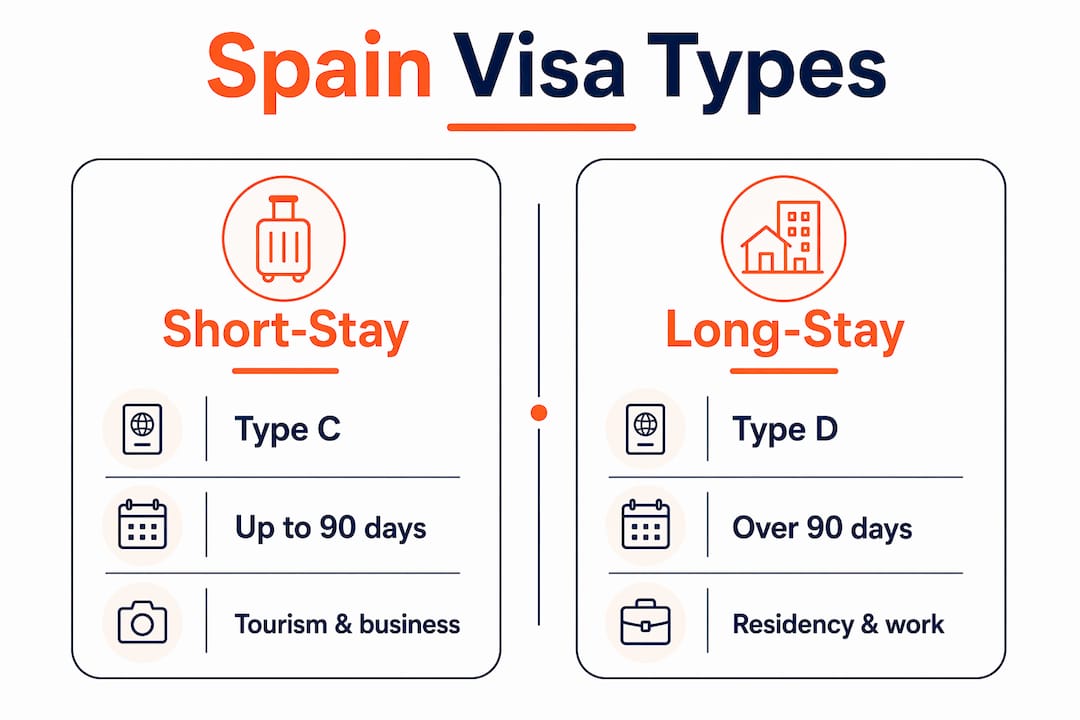
Everything beyond 90 days requires a Type D national visa, applied for at a Spanish consulate in the U.S. Type D is the entry permit; once you arrive in Spain, you convert it into a TIE residence card. That two-step process is where most applicants stumble.
Spain’s Golden Visa closed to new applicants on April 3, 2025, which pushed more demand toward the Digital Nomad Visa and Non-Lucrative Visa. The main long-stay routes available in 2026 are:
| Visa route | Best for | Work in Spain? |
|---|---|---|
| Digital Nomad Visa (DNV) | Remote workers, freelancers | Remote only, foreign clients |
| Non-Lucrative Visa (NLV) | Retirees, passive income | No |
| Work visa / HQP | Spanish job offer or senior role | Yes |
| Student visa | Enrollment 3+ months | Limited |
| Family reunification | Joining a resident family member | Depends on permit |
| Entrepreneur / startup | Founders, innovative projects | Yes |
For student visas, proof of enrollment and roughly 100% of IPREM per month in funds is the baseline. Family reunification typically requires the sponsor to show about 150% of IPREM plus 50% per additional family member.

How to apply for the Digital Nomad Visa as a U.S. applicant
The Digital Nomad Visa is for non-EU nationals who work remotely for companies or clients based outside Spain. You can also freelance for Spanish clients, but that work cannot exceed 20% of your total professional activity. Your employer or primary clients must generally have been operational for at least one year.
Step-by-step application sequence
- Confirm eligibility. Your income must come from remote work for non-Spanish clients. A Spanish-incorporated company will not qualify.
- Gather your documents. Valid passport, employment contract or client agreements, recent invoices and bank statements showing steady income, a criminal record check (FBI-level for U.S. applicants), comprehensive private health insurance, your CV, and proof of professional qualifications.
- Get translations and Apostilles. U.S. documents need certified English-to-Spanish translation and an Apostille stamp. Allow 2–4 weeks for this step.
- Book your consulate appointment. Apply at the Spanish consulate in your U.S. jurisdiction. Some consulates use third-party appointment systems, so check your specific consulate’s procedure early.
- Submit and wait. The consulate reviews your application and issues a Type D visa, typically valid for 90 days of entry.
- Enter Spain and apply for your TIE. Once in Spain, apply for your TIE residence card within the required window. The initial DNV permit issued by the consulate runs up to one year; in-Spain extensions can reach up to three years.
Pro Tip: Document your remote-work structure clearly. A letter from your employer confirming remote-only work, plus 6 months of invoices showing payments from a non-Spanish entity, is far stronger than a contract alone. Consular officers want to see the money trail, not just the agreement.
The 2026 DNV requirements guide covers the exact document formats consulates currently accept.
Watch the 20% cap. If Spain-sourced client work creeps above 20% of your total income, you no longer qualify for the DNV. Track this monthly, especially if you pick up local Spanish clients after arriving.
Non-Lucrative Visa requirements for retirees and passive-income applicants
The Non-Lucrative Visa is straightforward in concept: you live in Spain on money you already have, not money you earn there. No local employment, no freelancing, no remote work for anyone.
The income threshold is tied to IPREM (Spain’s public income reference index). For 2026, applicants must demonstrate approximately €2,400/month (400% of IPREM) in passive income or accessible savings, plus roughly €600/month per dependent. You also need comprehensive private health insurance with no copays and no waiting periods from an insurer authorized in Spain. Policies with exclusions or without a Spanish presence are commonly rejected.
Your document checklist: passport, 6–12 months of bank statements, pension award letters or investment income proof, the health insurance certificate, a police clearance certificate, a medical certificate, and certified translations with Apostilles for all U.S.-issued documents.
The initial permit runs one year. After that, you renew in two-year increments, provided you haven’t taken up local employment. For retirees weighing lifestyle and property questions alongside the visa, the NLV guide for retirees covers the broader relocation picture.
Digital Nomad Visa vs. Non-Lucrative Visa: which one fits you?
The single deciding factor is your income source. Everything else flows from that.
- Active remote work paid by non-Spanish clients? Digital Nomad Visa.
- Pension, savings, dividends, or rental income? Non-Lucrative Visa.
- Planning to take a local Spanish job after arrival? Neither. You need a work visa.
- More than 20% of your income from Spanish clients? You don’t qualify for the DNV; reassess your client mix first.
- Moving with a spouse or children? Both visas allow family members to apply concurrently, but each dependent adds to the income threshold.
- Complex income mix (some active, some passive)? This is where most denials happen. A specialist review before you apply is worth the cost.
Red flags that typically cause denials: using a Spanish-registered company to claim remote-work status, health insurance that doesn’t meet the “no copay, no waiting period” standard, and bank statements that show irregular or insufficient deposits. The NLV vs. DNV comparison walks through edge cases in more detail.
After approval: TIE, padrón, tax registration, and social security
Visa approval is step one. What happens in the first 90 days in Spain determines whether your residency actually holds.
The TIE is not optional. Your Type D visa grants entry but expires. The TIE (Tarjeta de Identidad de Extranjero) is your actual residence credential. Miss the application window after arrival and you’re out of legal status.
Municipal registration (padrón): Register at your local town hall (ayuntamiento) as soon as you have a fixed address. The padrón certificate is required for the TIE application, for opening a bank account, and for accessing local services.
Tax residency: Spend more than 183 days in Spain in a calendar year and you become a Spanish tax resident. That triggers an obligation to register with the Agencia Tributaria and file a Spanish tax return. DNV holders may also qualify for the Beckham Law regime, which taxes Spanish-source income at a flat rate for the first few years.
Social security: DNV holders working as autónomos (self-employed) typically register with Spain’s social security system. NLV holders are not working, so social security registration usually doesn’t apply, but confirm with a tax advisor for your specific situation.
What does the process cost, and how long does it take?
| Stage | Typical timeline | Estimated cost |
|---|---|---|
| Document prep (translations, Apostilles) | 2–4 weeks | €600 |
| Consulate decision (Type D visa) | 4–12 weeks | consular fee varies |
| Entry window (Type D visa validity) | 90 days to enter | — |
| TIE processing in Spain | 4 weeks | ~€20 card fee |
| Initial DNV permit duration | Up to 1 year (consulate) | — |
| DNV in-Spain extension | Up to 3 years | — |
| NLV initial permit | 1 year | — |
| NLV renewal | 2-year increments | — |
Consulate workloads vary significantly by U.S. city. The New York and Los Angeles consulates tend to have longer waits than Miami or Chicago. Booking your appointment the moment your documents are ready, not after, saves weeks.
Common pitfalls and how Digitalnomadinspain prevents them
The most frequent failure points are: choosing the wrong visa category, insufficient proof of remote-work structure, health insurance that doesn’t meet Spanish standards, incomplete translations or missing Apostilles, and missing the TIE or padrón window after arrival.
Digitalnomadinspain addresses each of these systematically. Document templates are matched to the specific consulate’s current expectations. Health insurance is reviewed against the no-copay, no-waiting-period standard before submission. TIE and padrón timelines are tracked after approval, not left to the client to manage alone.
The results: Digitalnomadinspain reports a 98% success rate across clients from over 50 countries, with processing times running roughly 30% faster than self-applicants. For borderline cases, such as mixed income structures or family reunification alongside a DNV, an eligibility consultation before filing prevents the most expensive mistakes.
What qualifies you for Spain’s standard work visa?
The Digital Nomad Visa covers remote work. Spain’s standard work visa covers something different: a formal employment relationship with a Spanish company that has already obtained a work authorization on your behalf.
To qualify, you need a signed job offer from a Spanish employer, and that employer must demonstrate they couldn’t fill the role with an EU/EEA candidate (the labor market test). The permit is tied to the specific employer and role. Highly Qualified Professional (HQP) visas and the EU Blue Card follow a similar employer-sponsored model but target senior or specialist roles with higher salary thresholds.
Self-employed individuals who want to work in Spain for Spanish clients, rather than remotely for foreign ones, apply for the autónomo (self-employment) route, which requires a viable business plan and proof of sufficient income to support yourself.
Special visas: trainee and au pair routes
Two lesser-known Spain visa categories are worth knowing if you’re in an early career stage or accompanying a family.
The Trainee/Internship Visa is for non-EU nationals completing a paid or unpaid internship with a Spanish company as part of a formal training program. It requires a training agreement, proof of enrollment in an educational institution, and health insurance. It’s not a path to open employment.
The Au Pair Visa covers non-EU nationals living with a Spanish host family in exchange for childcare and light household duties. The host family provides accommodation, meals, and a weekly allowance. Requirements include a formal au pair agreement, health insurance, and proof the arrangement is a cultural exchange rather than standard employment.
Neither route leads directly to long-term residency without transitioning to another visa category.
EU vs. non-EU: how nationality changes everything
EU, EEA, and Swiss citizens don’t need a visa to live or work in Spain. They register their residence with a green certificate (CUE) and are covered by EU free movement rights. Their non-EU family members can apply for an EU family member residence card rather than a standard national visa.
For U.S. citizens and other non-EU nationals, every long-stay route requires a national visa obtained before arrival. Americans are Schengen visa-exempt for short stays, which means no paperwork for a 90-day trip, but a full Type D application is required the moment you want to stay longer or work remotely.
The Digital Nomad Visa for U.S. citizens covers the consulate-specific steps and document formats that apply to American applicants specifically. Consulate procedures also vary by nationality for other non-EU applicants; the DNV guide for Indian nationals illustrates how requirements stay largely consistent but consular processes differ.
Key Takeaways
Spain’s two most practical long-stay routes for U.S. applicants in 2026 are the Digital Nomad Visa for active remote workers and the Non-Lucrative Visa for retirees or passive-income residents, each with distinct income, insurance, and compliance requirements.
| Point | Details |
|---|---|
| DNV vs. NLV split | Active remote income from non-Spanish clients = DNV; pensions, savings, or passive income = NLV. |
| NLV income threshold | Approximately €2,400/month (400% of IPREM) plus ~€600/month per dependent, plus private health insurance. |
| Two-step residency process | Type D visa grants entry; TIE residence card must be applied for in Spain within the required window. |
| After-approval compliance | Padrón registration, Agencia Tributaria enrollment, and social security registration are required steps, not optional. |
| Digitalnomadinspain support | End-to-end consultancy with a 98% success rate and processing times ~30% faster than self-applicants. |
The part most guides skip
There’s a gap in how Spain’s visa system gets explained online, and it costs applicants real time and money. Most articles stop at “here are the visa types.” What they don’t say clearly enough is that the visa is the easy part. The hard part is the 90 days after you land.
Missing your TIE window, skipping padrón registration, or failing to register with the Agencia Tributaria doesn’t just create paperwork headaches. It can unravel your residency entirely. The 183-day tax residency rule catches people off guard every year, especially DNV holders who didn’t realize that living in Spain means filing a Spanish tax return.
The other thing worth saying plainly: the Golden Visa’s closure in 2025 didn’t just remove one option. It pushed a wave of applicants toward DNV and NLV routes, which means consulates are busier and documentation standards are being applied more strictly. A file that might have sailed through two years ago now gets scrutinized more carefully. That’s not a reason to panic. It’s a reason to prepare properly.
Digitalnomadinspain makes the process manageable
Getting the right visa is one thing. Getting it approved, on time, without missing a step after arrival is another. Digitalnomadinspain handles the full process: eligibility assessment, document preparation, certified translations, consulate submission, and after-approval support including TIE applications, padrón registration, and tax setup.
The results speak clearly: a 98% approval rate across clients from more than 50 countries, with processing times running about 30% faster than self-managed applications. Whether you’re applying for the Digital Nomad Visa or the Non-Lucrative Visa, the consultancy matches your documents to your specific consulate’s current requirements, so nothing gets sent back.
Start with the free eligibility check to confirm which route fits your income profile, then book a consultation to map out your timeline.
Useful sources
Official pages to bookmark and check for fee updates, form changes, and IPREM adjustments:
- Visados nacionales — Spanish Ministry of Foreign Affairs: the primary source for Type D visa categories, document requirements, and consular procedures.
- Digital Nomad Visa application — Plataforma One: official government portal for DNV applications, eligibility rules, and the 20% local work cap.
- Schengen visa — Spanish Consulate New York: entry conditions and short-stay rules for U.S. applicants.
- Schengen visa — Spanish Consulate Washington: consulate-specific appointment and filing procedures.
- BOE — Organic Law 1/2025 (Golden Visa closure): the official legislative record of the Golden Visa repeal effective April 3, 2025.
- Digitalnomadinspain — DNV service page: current document checklists and consultancy support for DNV applicants.
- Digitalnomadinspain — NLV service page: NLV document prep, income verification, and renewals support.
- Living and working in Spain — expat guide: broader relocation context covering the entrepreneurship law and DNV.
Check the Ministry’s consular pages each year for IPREM updates, as the income thresholds for both NLV and student visas adjust when IPREM changes.
FAQ
What is the difference between a Type C and Type D visa for Spain?
A Type C (Schengen) visa covers short stays up to 90 days in any 180-day period and does not permit work or residency. A Type D national visa is required for stays beyond 90 days and leads to a TIE residence card.
How much income do you need for Spain’s Non-Lucrative Visa?
You must show a monthly income of approximately €2,400 (400% of IPREM) for the main applicant, plus roughly €600 per month for each dependent, and hold comprehensive private health insurance.
Can a U.S. remote worker use a tourist allowance instead of the Digital Nomad Visa?
No. Working remotely while in Spain on the 90-day Schengen visa-exempt allowance is not legally permitted. The Digital Nomad Visa is the correct route for remote workers planning to stay beyond 90 days.
What happens after you enter Spain on a Type D visa?
You must apply for your TIE residence card within the required window after arrival. Missing that deadline puts your legal residency at risk. You also need to complete padrón registration at your local town hall.
Can Digitalnomadinspain help with both the DNV and the NLV?
Yes. Digitalnomadinspain provides end-to-end support for both routes, including eligibility checks, document preparation, consulate submission, and after-approval steps like TIE applications and tax registration.