
Discover the US Spain tax treaty benefits for expats. Learn how it affects your income, withholding rates, and filing obligations today!
US–Spain Tax Treaty: A Practical Guide for Expats

TL;DR:
- The US–Spain tax treaty primarily allocates taxing rights and caps withholding rates on passive income, but the Saving Clause reserves US taxation rights over its citizens.
- US citizens in Spain must file US tax returns and use forms like 1116 or 2555 to claim relief from double taxation, regardless of treaty provisions.
The US–Spain tax treaty exists, it matters, and it does not do what most people assume. The formal name is the Convention between the United States of America and the Kingdom of Spain for the Avoidance of Double Taxation, signed in Madrid on February 22, 1990, and updated by a significant 2013 protocol. Its core job is to allocate taxing rights between the two countries and cap withholding rates on passive income — not to eliminate your US filing obligation.
Here is the short version before the detail:
- Who benefits: US citizens, US residents, and businesses with cross-border income between the US and Spain.
- What it actually does: Caps withholding on dividends (generally 15%, or 10% for qualifying corporate holdings), reduces interest and royalty withholding to 0% in most standard cases after the 2013 protocol, and coordinates residency rules to prevent the same income from being taxed twice.
- What it does NOT do: The Saving Clause (Article 1, paragraph 3) preserves the US right to tax its citizens as if the treaty did not exist, so US citizens living in Spain still file Form 1040 and typically rely on Form 1116 (Foreign Tax Credit) or Form 2555 (Foreign Earned Income Exclusion) for relief.
- Key forms to know: Form 1116, Form 2555, Form 8833 (treaty position disclosure), W-8BEN or W-8BEN-E (for non-US persons claiming treaty rates at source), and FBAR/Form 8938 for foreign account reporting.
- Where to find the official text: The IRS treaty documents page for Spain and the US Treasury protocol page are the primary sources.
Table of Contents
- What does the US–Spain tax treaty actually cover?
- Key treaty rates for dividends, interest, royalties, and capital gains
- How does the treaty’s tie-breaker resolve dual residency?
- The Saving Clause: why US citizens cannot opt out of US tax
- How to claim treaty benefits: the forms you need
- Foreign Tax Credit vs. Foreign Earned Income Exclusion: which one wins?
- Social Security totalization and how pensions are taxed
- Practical steps, timelines, and recordkeeping
- Common mistakes that lead to double taxation or denied benefits
- How your visa choice affects Spanish tax residency
- Key Takeaways
- The part most guides skip
- Visa and residency timing done right
- Authoritative sources and primary references
- FAQ
What does the US–Spain tax treaty actually cover?
The treaty applies to US federal income tax and Spain’s Impuesto sobre la Renta de las Personas Físicas (IRPF), the personal income tax. It also covers Spain’s corporate income tax and certain other income taxes. One important gap: US state income taxes are not covered. California, New York, and other states with aggressive residency rules can still tax you regardless of what the treaty says.
The treaty’s article structure maps to specific income types:
- Residence (Article 4): — Defines who is a resident of each country and provides the tie-breaker sequence for dual residents.
Key terms worth knowing: Beneficial owner means the person who actually receives and controls the income (not just a conduit). Permanent establishment is a fixed place of business that triggers taxing rights in the host country. The Limitation on Benefits (LOB) clause prevents third-country residents from using treaty rates they are not entitled to. And the Saving Clause is the provision that most directly affects US citizens — covered in detail below.
Key treaty rates for dividends, interest, royalties, and capital gains
The numbers that matter most for passive income are the withholding caps. The 2013 protocol modernized the original 1990 treaty significantly, cutting most interest and royalty withholding to zero in standard arm’s-length transactions.

| Income Type | Treaty Withholding Cap | Notes |
|---|---|---|
| Dividends (general) | 15% | Standard rate for portfolio investors |
| Dividends (corporate, 10%+ ownership) | 10% | Applies when a company owns at least 10% of the paying company |
| Dividends (pension funds, certain holdings) | 5% or 0% | Specific conditions apply under the protocol |
| Interest | 0% (standard) | After 2013 protocol; exceptions for contingent interest |
| Royalties | 0% (standard) | After 2013 protocol; applies to most arm’s-length transactions |
| Capital gains (general) | Residence country | Taxed where the seller resides, with exceptions | | Capital gains (real property) | Source country | Spain can tax gains on Spanish real estate | | Business profits | Residence country | Unless a permanent establishment exists in the other country |
Capital gains and real estate deserve a specific note. If you sell Spanish property, Spain has the right to tax that gain regardless of where you live. The US will also tax the gain (because of the Saving Clause for US citizens), but you can claim a foreign tax credit for Spanish tax paid.
The LOB clause is the anti-abuse provision. It denies treaty rates to entities that do not have a genuine economic connection to the US or Spain. A shell company set up purely to access treaty rates will not qualify. Beneficial-owner status must be confirmed before relying on reduced withholding rates.
How does the treaty’s tie-breaker resolve dual residency?
Spain defines tax residency three ways: spending more than 183 days in a calendar year in Spain, having your primary economic interests centered there, or having a spouse and dependent children habitually residing there. Once you meet any of these, Spain taxes your worldwide income.
The US takes a different approach. US citizens and green-card holders are taxed on worldwide income regardless of where they live. For non-citizens, the substantial presence test (roughly 183 days in the current year using a weighted three-year formula) determines US tax residency.
When someone qualifies as a resident of both countries simultaneously, the treaty’s tie-breaker sequence resolves it:
- Permanent home: — The country where you maintain a permanent home available to you takes priority.
Scenario 1 — Remote worker: A US citizen moves to Barcelona in March and works remotely for a US employer. She spends 200 days in Spain that year. Spain claims residency under the 183-day rule. The tie-breaker looks first at permanent home: she kept her New York apartment and rented in Barcelona. Both qualify as permanent homes, so the analysis moves to center of vital interests. Her employer, bank accounts, and family are all in the US. The tie-breaker assigns US residency for treaty purposes. Spain can still tax her Spanish-source income, but her worldwide income is not subject to Spanish IRPF as a resident.
Scenario 2 — Retiree: A retired US citizen sells his US home, moves to Valencia permanently, and has no ongoing US economic ties. He has a permanent home only in Spain. The tie-breaker assigns Spanish residency. Spain taxes his worldwide income, including US pension distributions. He files a US return because he is a US citizen (the Saving Clause applies), but claims a foreign tax credit for Spanish taxes paid on income Spain has primary taxing rights over.
The Saving Clause: why US citizens cannot opt out of US tax
The Saving Clause is the single most consequential provision for Americans living in Spain. Under Article 1, paragraph 3 of the treaty, the United States reserves the right to tax its citizens and residents as if the treaty had never been signed. This means:
- A US citizen living in Spain cannot use the treaty to reduce or eliminate US tax on income the treaty assigns to Spain.
- Treaty-reduced withholding rates on dividends and interest apply to Spanish residents who are not US citizens — a Spanish national receiving US dividends can claim the 15% treaty rate; a US citizen living in Spain generally cannot use the treaty to reduce their US tax on the same income.
- The treaty still allocates taxing rights and determines which country taxes first, which matters for calculating the foreign tax credit.
Carve-outs from the Saving Clause (where the US does relinquish some taxing rights):
- Certain Social Security benefits coordinated under the treaty and the Totalization Agreement.
- Specific pension provisions where the treaty explicitly assigns exclusive taxing rights to Spain.
- Relief from double taxation provisions (Article 24), which remain operative for US citizens.
- The mutual agreement procedure (Article 25) remains available.
Practical examples:
- Dividends: A US citizen in Madrid receives US-source dividends. The treaty’s 15% cap does not reduce her US tax. She pays full US rates and claims a credit for any Spanish withholding.
- Private pension: A US citizen receives distributions from a Spanish private pension. The treaty may assign primary taxing rights to Spain, but the Saving Clause means the US can still tax it. She reports it on Form 1040 and claims a foreign tax credit for Spanish tax paid.
- Wages: A US citizen employed in Spain pays Spanish income tax on her salary. The Saving Clause means the US also taxes that salary. Relief comes through Form 1116 (FTC) or Form 2555 (FEIE), not through the treaty itself.
How to claim treaty benefits: the forms you need
Claiming treaty benefits requires the right paperwork, filed at the right time. Here is what each form does and when you need it.
| Form | Purpose | When Required |
|---|---|---|
| Form 1116 | Claims a US foreign tax credit for taxes paid to Spain | Filed with Form 1040; used when Spanish tax exceeds FEIE or when FEIE is not elected |
| Form 2555 | Claims the Foreign Earned Income Exclusion (FEIE) | Filed with Form 1040; for earned income only; cannot be used for passive income |
| Form 8833 | Discloses a treaty-based return position | Required when you take a position that a treaty overrides or modifies US tax law |
| W-8BEN | Certifies foreign status and claims treaty rate at source | Used by non-US individuals receiving US-source income; submitted to the US payer |
| W-8BEN-E | Same as W-8BEN but for foreign entities | Used by foreign companies claiming treaty rates on US-source income |
| — | Certifies US person status | Used by US persons; confirms no treaty withholding reduction applies |
| FBAR (FinCEN 114) | Reports foreign bank accounts over $10,000 | Filed separately at fincen.gov; due April 15, auto-extended to October 15 |
| Form 8938 | FATCA reporting of specified foreign financial assets | Filed with Form 1040; thresholds vary by filing status and residency |
Stepwise checklist for claiming treaty rates and credits:
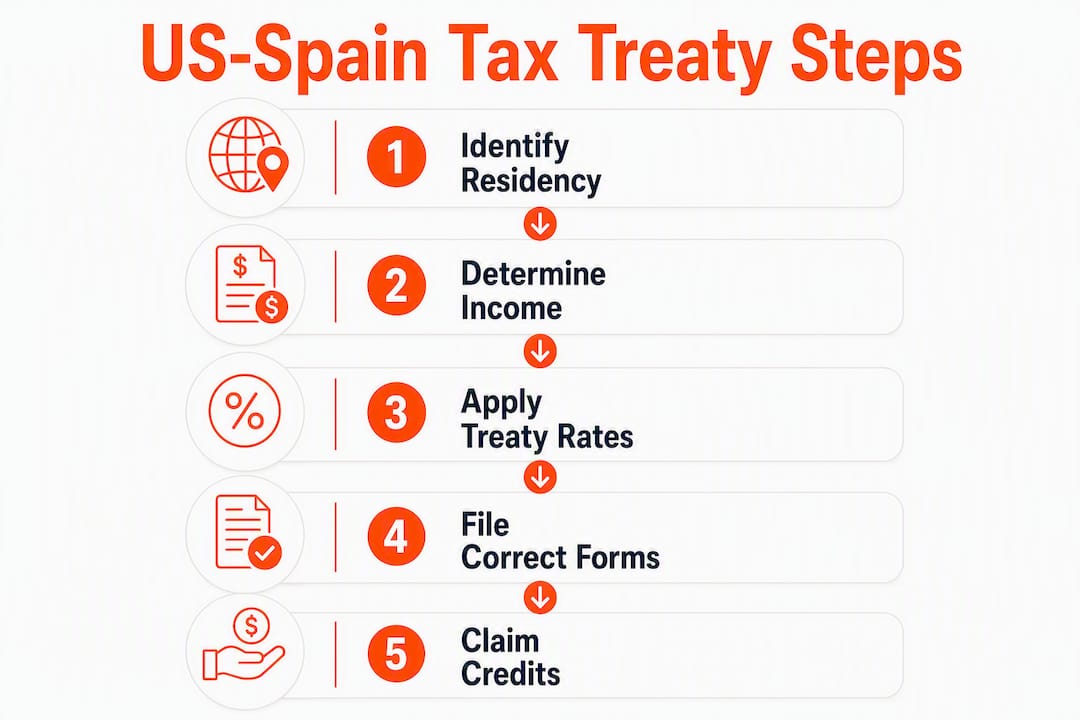
- Confirm your residency status under both US and Spanish rules, and determine whether the tie-breaker applies.
- Identify each income type and which country has primary taxing rights under the treaty.
- For income paid from a US source to a non-US person: submit W-8BEN or W-8BEN-E to the payer before payment, citing the treaty article and rate.
- For US citizens in Spain: file Form 1040 reporting worldwide income. Attach Form 1116 to claim credits for Spanish taxes paid, or Form 2555 to exclude qualifying earned income.
- If you are taking a treaty position that modifies your US tax (for example, claiming a treaty-based exclusion for a specific pension), attach Form 8833 with a description of the treaty article and the tax effect.
- Gather supporting documents: Spanish certificado de residencia fiscal, Spanish tax return (Modelo 100), withholding statements from Spanish payers, and proof of Spanish tax paid.
- File FBAR and Form 8938 if foreign account and asset thresholds are met.
Pro Tip: Request your Spanish certificado de residencia fiscal from the Agencia Tributaria before filing your US return. The IRS may request it as documentation for Form 1116, and obtaining it after the fact can delay amended returns.
Foreign Tax Credit vs. Foreign Earned Income Exclusion: which one wins?
This is the most consequential annual decision for most US expats in Spain, and the right answer depends on your income mix.
Form 1116 (FTC) credits you dollar-for-dollar for foreign taxes paid, up to the US tax on that same income category. It works for all income types, including passive income. The catch: if Spanish tax on a category exceeds your US tax on that same category, the excess credit is not refunded — it carries forward.
Form 2555 (FEIE) excludes a set amount of foreign earned income from US taxable income entirely. For 2025, the exclusion amount is adjusted annually by the IRS. It applies only to earned income (wages, self-employment), not dividends, interest, or rental income. Once elected, switching off FEIE requires IRS permission and a five-year waiting period before re-electing.
Worked example (simplified):
Assume a US citizen in Spain earns $90,000 in salary from a Spanish employer. Spain withholds income tax at an effective rate. She has no US-source income.
- FEIE route: She excludes qualifying earned income up to the annual FEIE limit. If her salary falls below that limit, her US taxable earned income drops to near zero. She pays no additional US income tax on that salary. She cannot claim a credit for Spanish taxes paid on the excluded amount.
- FTC route: She reports the full $90,000 on Form 1040. She claims a credit for Spanish income tax paid. If Spanish tax exceeds her US tax on that income, the excess credit carries forward — but she owes nothing additional to the IRS that year.
For salary-only earners below the FEIE limit, FEIE often produces a cleaner result. For earners with significant passive income (dividends, interest, rental), FTC is usually better because FEIE does not cover those categories. Spanish savings-income tax rates are relatively high, often exceeding typical US rates, which often exceeds the US rate on the same income — meaning the FTC credit may be capped at the US tax amount, and the excess Spanish tax becomes a real out-of-pocket cost.
Decision checklist:
- Is your income primarily earned (wages, freelance)? FEIE may be simpler.
- Do you have significant passive income (dividends, interest, capital gains)? FTC is likely better.
- Are Spanish taxes on your income higher than US rates? FTC still helps, but watch the per-category limitation.
- Are you considering Spain’s Beckham Law regime? That changes your Spanish taxable base significantly — see the Beckham Law guide before choosing.
- Do you have US-source passive income alongside Spanish earned income? A combination approach may apply.
- Have you previously elected FEIE? Switching to FTC requires IRS approval.
Pro Tip: You cannot claim a foreign tax credit for Spanish taxes on income you excluded under FEIE. If you exclude salary under Form 2555, those Spanish taxes are gone as a credit. Run both calculations before filing — the difference can be thousands of dollars.
Social Security totalization and how pensions are taxed
The US–Spain Totalization Agreement has been in force since 1988, predating the income tax treaty itself. Its purpose is straightforward: prevent workers from paying Social Security taxes to both countries simultaneously.
Key points:
- Detached-worker rule: A US employee sent to work in Spain for up to five years continues paying into US Social Security only, not Spanish Social Security. The employer obtains a Certificate of Coverage from the Social Security Administration.
- Spanish workers in the US: The mirror applies. Spanish nationals working temporarily in the US can remain in the Spanish system with a certificate from Spain’s social security authority.
- Combining credits: If you have worked in both countries but not long enough to qualify for benefits in either, the agreement allows you to combine credits from both systems to meet eligibility thresholds.
- Self-employed individuals: The agreement also covers self-employed workers, who pay into only one system based on where they reside and work.
Pension treatment under the treaty:
Private pensions are generally taxable in the country of residence. A US citizen living in Spain who receives distributions from a US 401(k) or IRA will typically owe Spanish IRPF on those distributions as a Spanish resident, plus US tax under the Saving Clause. The foreign tax credit on Form 1116 prevents true double taxation in most cases.
US Social Security benefits have specific treaty treatment. For non-US-citizen Spanish residents receiving US Social Security, the treaty may assign taxing rights primarily to the US. For US citizens, the Saving Clause means the US taxes Social Security regardless — though certain carve-outs allow Spain to be the sole taxing jurisdiction for specific pension types. Practitioners use those carve-outs strategically when advising retirees on residency timing and distribution planning.
Actions to take:
- Obtain a Certificate of Coverage from the SSA before starting work in Spain if you are a detached worker.
- Report US pension distributions on Form 1040 and on the Spanish Modelo 100 if you are a Spanish resident.
- File Form 8833 if you are taking a treaty-based position on pension taxation that modifies your US return.
- Check the SSA’s totalization agreement information for current certificate procedures.
Practical steps, timelines, and recordkeeping
Good records are the difference between a smooth filing season and a months-long dispute with either tax authority. The Agencia Tributaria and the IRS both require documentation of taxes paid in the other country before granting credits or confirming residency positions.
Documents to maintain:
- Spanish tax returns (Modelo 100) and proof of payment
- Certificados de residencia fiscal from the Agencia Tributaria
- Withholding statements from Spanish employers or financial institutions
- Brokerage and bank statements for all Spanish accounts
- Social Security statements from both the SSA and Spain’s Seguridad Social
- Calculations supporting FEIE or FTC claims, including the foreign tax credit limitation worksheet
Filing timeline:
| Deadline | Filing / Action |
|---|---|
| April 15 | US Form 1040 due (with payment if owed); FBAR auto-extended to October 15 |
| June 15 | Automatic two-month extension for US citizens abroad (no form required) |
| October 15 | Extended deadline for Form 1040 (extension form required by April 15); FBAR final deadline |
| June 30 (Spain) | Spanish Modelo 100 filing window typically closes |
| Ongoing | Retain Spanish tax payment receipts; update certificado de residencia fiscal annually |

The sequence matters: file your Spanish return first, obtain proof of Spanish taxes paid, then claim the foreign tax credit on your US return. Claiming the credit before you have documentation of Spanish taxes paid creates an audit risk.
Pro Tip: Store your certificados de residencia fiscal and Modelo 100 confirmations in a dedicated cloud folder with the tax year clearly labeled. If the IRS questions your Form 1116, you can respond within days rather than weeks.
Common mistakes that lead to double taxation or denied benefits
Most double-taxation problems are self-inflicted. The treaty provides the tools; errors in execution are what cause unnecessary exposure.
- Skipping Form 8833: — If you take a treaty-based position that modifies your US tax return (for example, claiming a treaty exemption for a specific pension type), Form 8833 is required. Omitting it can result in the IRS disallowing the position entirely.
How your visa choice affects Spanish tax residency
Visa type and the timing of your arrival in Spain directly affect when Spanish tax residency begins and which income Spain can tax. This is an area where immigration planning and tax planning must happen together.
Digital Nomad Visa: Spain’s Digital Nomad Visa grants residency to remote workers employed by non-Spanish companies. Holders can elect Spain’s Beckham Law regime (formally, the régimen especial para trabajadores desplazados), which taxes only Spanish-source income at a flat rate for up to six years rather than taxing worldwide income at progressive IRPF rates. For US citizens, this can dramatically change the FTC vs. FEIE calculation. Read the full breakdown in the Digital Nomad Visa tax guide before deciding.
Non-Lucrative Visa: Retirees and passive-income earners typically use this route. Holders become Spanish tax residents and are taxed on worldwide income at progressive IRPF rates. They cannot elect Beckham Law. The treaty’s pension and investment income provisions become the primary planning tools. See the Non-Lucrative Visa guide for US citizens for residency timing details.
Beckham Law: When available, it limits Spanish taxation to Spanish-source income for the first six years. This can make FEIE less attractive (since Spanish tax on foreign-source income may be zero or minimal under Beckham) and changes the FTC calculation entirely. The Beckham Law explainer covers eligibility and application timing.
Checklist for aligning visa and tax timing:
- Determine your target Spanish tax residency start date and work backward to your visa application timeline.
- Confirm whether you qualify for Beckham Law before arriving — the application must be filed within six months of starting work in Spain.
- Obtain a certificado de residencia fiscal from the Agencia Tributaria as soon as you qualify as a Spanish resident.
- Register with the Spanish tax authority (obtain your NIE and, if self-employed, register for autónomos).
- Notify your US brokerage and financial institutions of your Spanish residency status so they apply correct withholding.
- Coordinate the timing of large income events (pension distributions, asset sales, stock vesting) with your residency start date to minimize exposure in both countries.
Additional considerations:
- Arriving in Spain before July 2 of a calendar year generally means you will meet the 183-day test for that year.
- Arriving after July 2 typically means Spanish residency begins the following January 1 for IRPF purposes, though registration dates can complicate this.
- Some Spanish autonomous communities (regions) have additional wealth tax or income tax surcharges; treaty benefits do not cover these regional variations.
Key Takeaways
The US–Spain tax treaty coordinates taxing rights and reduces withholding on passive income, but the Saving Clause means US citizens must still file Form 1040 and rely on Form 1116 or Form 2555 for double-taxation relief.
| Point | Details |
|---|---|
| Saving Clause is paramount | US citizens cannot use the treaty to eliminate US tax; Form 1116 or Form 2555 provides the actual relief. |
| Withholding caps after 2013 protocol | Dividends are generally capped at 15%, with a 10% rate for qualifying corporate holdings; interest and royalties are typically not subject to withholding in standard cases after the 2013 protocol. |
| FTC vs. FEIE depends on income mix | High Spanish taxes on savings income often favor FTC; salary-only earners below the FEIE limit may prefer Form 2555. |
| Recordkeeping is non-negotiable | Certificados de residencia fiscal and Modelo 100 receipts are required documentation for Form 1116 claims. |
| Digitalnomadinspain helps align visa and tax timing | For Digital Nomad and Non-Lucrative Visa applicants, coordinating residency start dates with tax planning is a core part of the service. |
The part most guides skip
Most articles on the US–Spain tax treaty spend their energy on the withholding rate tables and stop there. The rates matter, but they are not where most Americans get hurt. The real problem is the gap between what the treaty promises and what the Saving Clause takes back.
US citizens moving to Spain often arrive expecting the treaty to simplify their tax life. What they find instead is that the treaty mostly determines who taxes first and at what rate at source. The actual relief from double taxation comes from domestic US mechanisms — Form 1116 and Form 2555 — not from the treaty itself. That distinction changes how you plan.
The other underappreciated issue is the FTC limitation by income category. When Spanish savings-income tax rates exceed US rates on the same income, the excess Spanish tax is not creditable. It is simply gone. For retirees with significant investment portfolios, this can be a meaningful annual cost that no amount of treaty planning eliminates. The fix is upstream: structuring income before you move, timing distributions, and in some cases choosing a different account type.
Visa timing compounds this. A retiree who moves to Spain in April and does not realize they have triggered Spanish tax residency for the full calendar year can face a Spanish tax bill on income earned before they even arrived. That is not a treaty problem. It is a planning problem that a conversation with a cross-border CPA and a visa consultant — before the move — would have caught.
Visa and residency timing done right
Tax planning for a Spain move is only half the picture. The other half is getting the right visa, filed correctly, at the right time. Digitalnomadinspain handles the immigration side with a 98% application success rate and processing times typically 30% faster than self-applicants — which matters when your Spanish tax residency start date depends on when your visa is approved.

For remote workers, the Digital Nomad Visa service covers eligibility checks, document preparation, consulate follow-up, and after-approval support including NIE registration and tax setup. For retirees and passive-income earners, the Non-Lucrative Visa service provides the same end-to-end support with attention to the residency timing details that affect your first Spanish tax year. Both services include a personalized consultation where residency timing and its tax implications are part of the conversation. Book a consultation at Digitalnomadinspain to get your visa and residency timeline right before the tax clock starts.
Authoritative sources and primary references
The sources below are organized by authority level. Treaty text and Treasury documents are primary law. IRS guidance and Agencia Tributaria materials are interpretive. Third-party guides are useful context but should not be relied on for specific filing positions.
Primary law and treaty documents:
- Convention between the US and Spain for the Avoidance of Double Taxation (1990 treaty text and IRS commentary) — IRS treaty documents page for Spain; includes the original treaty, technical explanation, and protocol.
- US Treasury Technical Explanation of the 1990 Convention — Article-by-article explanation from the Department of the Treasury; primary interpretive authority.
- 2013 Protocol amending the Convention — Amending protocol that reduced interest and royalty withholding and revised LOB rules.
IRS form pages:
- IRS United States income tax treaties A to Z — Index of all US tax treaties.
- FinCEN 114 (FBAR) — Foreign bank account reporting.
Spanish tax authority:
Social Security:
FAQ
Does the US–Spain tax treaty eliminate double taxation for US citizens?
Not automatically. The Saving Clause preserves US taxing rights over its citizens, so US citizens in Spain still file Form 1040 and use Form 1116 (Foreign Tax Credit) or Form 2555 (Foreign Earned Income Exclusion) to avoid paying tax twice on the same income.
Is there a double taxation agreement between the US and Spain?
Yes. The Convention between the United States and Spain for the Avoidance of Double Taxation was signed in 1990 and updated by a 2013 protocol that reduced withholding on interest and royalties to 0% in most standard cases and revised dividend caps.
Do US citizens living in Spain still pay US taxes?
Yes. US citizens are taxed on worldwide income regardless of where they live. The treaty coordinates which country taxes which income first, but the Saving Clause means the US can still tax its citizens on income the treaty assigns to Spain.
How does dual citizenship affect US and Spanish tax obligations?
Holding both US and Spanish citizenship does not eliminate either country’s tax claim. The US taxes its citizens on worldwide income under the Saving Clause; Spain taxes residents on worldwide income. The treaty’s tie-breaker and the foreign tax credit on Form 1116 are the primary tools for managing the overlap.
When is Form 8833 required for the US–Spain treaty?
Form 8833 is required when you take a return position that a treaty provision overrides or modifies US tax law — for example, claiming a treaty-based exclusion for a specific pension type or asserting that a treaty article reduces your US tax on a particular income item. Omitting it when required can result in the IRS disallowing the treaty position.